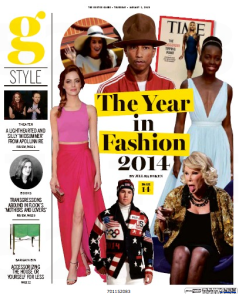
Globe to replace g section, Brian McGrory tells staff

Screen Shot 2015-01-01 at 11.59.30 AMThe Boston Globe is replacing its tabloid arts-and-feature section, g, with a standalone full-size Living section later this month, according to a year-end message to the staff from editor Brian McGrory.

Most of McGrory’s message, a copy of which was sent to Media Nation by a kind soul in the Globe newsroom, is a look back at what has been a year of accomplishment for the paper. (McGrory has also written a round-up of his picks for the Globe’s most important stories of 2014.)

McGrory’s superlatives aside, it’s hard to think of a news organization this side of Jeff Bezos’ Washington Post that is expanding its coverage the way the Globe has under the ownership of John Henry. The paper has also been consistently excellent journalistically under McGrory’s watch, and, as he notes, it seems to be paying off in terms of advertising, paid circulation and a growing digital audience.

The full memo is below. But before I get to that, some other Globe news: veteran New Hampshire political reporter James Pindell is returning to the Globe as “a digital-first political reporter and playing a key role in our effort to augment our coverage of the first-in-the-nation contest,” according to an email by Jennifer Peter, the Globe’s metro editor, which someone forwarded to me.

Pindell, whom I’ve known and respected for years, worked most recently for WMUR-TV in New Hampshire, a stint that ended in a minor controversy after he asked U.S. Senate candidate Scott Brown an impertinent question that turned out to be based on a mistaken premise. Pindell apologized and briefly disappeared from the air, which suggested an overreaction on management’s part. WMUR’s loss is the Globe’s gain.

Also this week, the departures at the Globe continued. Among those announcing their retirements were columnist Larry Harmon, business reporter Chris Reidy, health writer Deborah Kotz and former Spotlight and higher-education reporter Marcella Bombardieri. Harmon has been an important voice in holding city politicians accountable. I hope interim editorial-page editor Ellen Clegg finds a suitable replacement.

As for g, which was launched under New York Times Co. ownership, I doubt many will miss it. Mrs. Media Nation was a fan, but since we’re digital subscribers except on Sundays we rarely got to see what it looked like in print.

And now (drum roll, please) Brian McGrory’s year-end message to the staff.

Hey all,

Same-old, same-old in 2014, so I’ll be brief.

Wrong again.

We, meaning you, had an extraordinary year by every possible measure, certainly in terms of consistently superb journalism, but also with a driving sense of innovation in the work we produce and the way we present it. This was a landmark year for the Globe, one that I hope gives you a deep sense of pride.

Consider, for a moment, the new initiatives — Address, the absurdly readable Sunday real estate section; Capital, the Friday political section that is equal parts delightful and vital; the stand-alone Business section, which is off to a strong start and is set to improve even more; Crux, the company’s groundbreaking website dedicated to Catholicism around the world, done so well it will serve as a template for future initiatives; a restructured Spotlight Team that is set to produce signature investigative journalism with greater frequency; a stunning stand-alone Living broadsheet section to replace the current g tabloid, debuting the second week of January; the Cape Cod summer initiative; record-setting Business magazines, including the new “Game Changers;” the reintroduction of Score, as beautiful as it is insightful; artfully redesigned Sunday regional sections to the north, south, and west of Boston; and a revitalized Sunday Travel section that has become mandatory reading.

None of this came easy. All of it is vital. What made it possible is the high quality journalism upon which everything new and old is built.

Let’s be honest: 2013 was a tough year to follow in terms of accomplishment. And sitting at Columbia University in May, watching Chris Chinlund, Jen Peter, and Mike Bello accept the Pulitzer Prize on behalf of the entire staff, well, that’s a moment that I’ll forever cherish. I’m not sure Bello ever cradled any of his kids as lovingly as he did that plaque.

But you followed great work with still more great work, even amid the demands of so much new initiative. Mike Rezendes gave voice to those who wouldn’t otherwise have had one with his landmark stories on the inhumane and sometimes deadly treatment of inmates at Bridgewater State Hospital — work that led to immediate, meaningful reform. Likewise in the accountability category, Spotlight produced a searing, three-part series on dangerous student housing conditions in this, the college capital of America, a project that has launched vows for widespread change. Kay Lazar and Shelley Murphy kicked the marijuana dispensary licensing process on its side through their in-depth reporting, forcing the state to scrap its deeply flawed work and start from scratch.

I’d put our 2014 narrative work up against any news organization in the country, and in that regard, I’m specifically thinking of Jenna Russell’s breathtaking account of Michael Bourne and his mother, Peggy, as they battled not only his mental health issues, but a cruelly complicated system that seems to go out of its way not to help. Include there, too, Evan Allen’s heartbreaking story of a Newton father’s quest for justice after his son’s overdose death, Maria Sacchetti’s tense, poignant look at the deaths and recovery efforts along the Mexican border, and of course, Sarah Schweitzer’s extraordinary account of a Woods Hole biologist and his lifelong attempt to save the endangered right whale, a story that was accompanied by a groundbreaking online presentation. There are more, many more.

Day to day, Metro performed an extraordinary public service by driving the heroin epidemic into the public conscience. Business blanketed the single most readable storyline of the year — the Demoulas saga — with expert coverage that drove the plot for months. Photography continued to produce the kind of thoughtful, magnificent images that made readers linger on our pages in awe.

Sports did what our Sports staff always does: It offered the best coverage for the most sophisticated audience of any paper in the nation. Washington produced the deeply reported Power Lines series, along with its consistently probing coverage of two of the most interesting officials in the country — Elizabeth Warren and John Kerry. Living/Arts gave us a record number of colorful front page offerings and, as important, solidified Sunday Arts as one of the most popular and important sections of the Globe. Perhaps that last point is inevitable when you have the all-star roster of critics and writers that we have. The Sunday magazine remains among the most vital aspects of the paper, with consistently sophisticated stories that are devoured by readers.

Our design team was ever bolder in print and online, not only with new sections and sites, but with the front page as well. Our copy editing is ever more meticulous and consistently collaborative. Our graphics are often the envy of the industry, which explains why bigger organizations keep hiring away our directors.

And our digital team has quite literally been transformative, newcomers and veterans, all of whom have banded together to produce an evolving, ambitious namesake site that is a pitch perfect platform for our collective work.

Does any of this matter? Yeah, it does, very much so.

Advertising came in better than expected this year, by no means enough to declare success, but certainly a sign of improvement. In terms of readership, there were many, many weeks in the autumn that saw a net upside in print subscriptions. There are precious few papers that see anything like that. And Bostonglobe.com saw a 34 percent increase in visits and a 26 percent increase in pageviews. We also have more digital-only subscribers than any newspaper in the country outside of the NYT and WSJ, and we’ve begun adding to that number at a strong clip in the last quarter.

I’m way too late to say, “To make a long story short,” right? But please bear with me for one final point.

We can’t let up. To sit still is to beckon defeat, what with the breakneck pace of technology advances and the irrefutable fact that competition continues to lurk all across the web. We need all your creativity, all your ambition, all your brains – all across the enterprise. We also need to take full advantage of an enviable moment. We have committed owners, the Henrys, who value quality over short-term profits, and who believe to their core that the way to make the Globe a self-sustaining enterprise is by thoughtful investment combined with unfailing discipline. We have a CEO, Mike Sheehan, who believes deeply that great journalism is good business. We have a thriving region. We have a robust staff of stellar reporters, editors, and visual journalists, many of the best in the nation. We have all the ingredients in place for profound, durable success.

I’ll set up some times in January to share plans and trade ideas for 2015. Meantime, please take more than a few moments of pride on this New Year’s Eve, for where we’ve been, where we are, and where we are poised to go.

My deepest respect and appreciation to you all.

Brian

Correction: An earlier version of this post described the departures of Larry Harmon, Chris Reidy, Deborah Kotz and Marcella Bombardieri as “buyouts.” That was based on an incorrect assumption on my part. Harmon told me he was not offered a buyout, and I do not know about the other three.

GateHouse parent buys T&G — and its parent chain

Screen Shot 2014-11-20 at 5.26.17 PMA huge newspaper deal was announced late this afternoon. The parent company of GateHouse Media of Fairport, New York, which has been on the march since emerging from bankruptcy last year, is buying out Halifax Media Media Group of Daytona Beach, Florida. Locally, the acquisition greatly expands GateHouse’s footprint in the central part of the state: earlier this year Boston Globe owner John Henry sold the Telegram & Gazette of Worcester to Halifax.

Jim Romenesko has the memo from GateHouse chief executive Kirk Davis.

GateHouse now owns almost every significant newspaper property in Eastern Massachusetts (and beyond) other than the Globe and the Boston Herald. The Digital First papers, which include the Lowell Sun and the Fitchburg Enterprise & Sentinel, are for sale. Will GateHouse scoop them up? What about the CNHI papers, which include The Eagle-Tribune of North Andover and three other dailies in that region? How long can they hold out?

Even before its latest acquisition spree, GateHouse owned about 100 papers in Eastern Massachusetts — mostly weeklies, but also mid-size dailies such as the MetroWest Daily News of Framingham, The Enterprise of Brockton and The Patriot Ledger of Quincy. In the past year GateHouse has added the Cape Cod Times, The Standard-Times of New Bedford, The Providence Journal and — in a little-noticed move just last week — Foster’s Daily Democrat of Dover, New Hampshire, a small but legendary community daily.

GateHouse has a well-earned reputation for cutting staff and compensation, although that hardly makes it unique. The larger story is that its executives clearly believe it can be the last local-newspaper chain standing by centralizing every part of its operations that aren’t strictly tied to local news.

A considerable amount of copy editing is being moved to a facility in Austin, Texas. The ProJo has a nice new press, and no doubt it will soon be printing as many GateHouse papers as it can accommodate — possibly cutting into the Globe’s printing business. GateHouse also owns what Davis calls a “digital services agency” called Propel Marketing.

At a time when few business executives want to mess with the newspaper business, GateHouse has gone all in. How it will end is anyone’s guess. But GateHouse has been down this road before, and it ended in bankruptcy. If Kirk Davis and company have a better idea this time, we should soon find out.

More: “Copy editing” at daily newspapers traditionally refers to editing stories for grammar and style, writing headlines and laying out pages. I am told that the Austin facility’s mission is limited to page design, though some copy editors at the ProJo are losing their jobs.

Big moves as Globe prepares to expand its business section

Some big media moves were announced a little while ago as The Boston Globe plans to ramp up its business section next month. First the email sent to the staff by editor Brian McGrory and business editor Mark Pothier. Then a bit of analysis.

Hey all,

We’d like to fill you in on some terrific developments in our Business department, all of them designed to build on the exceptional work that went into our Market Basket coverage and so many other news and enterprise stories over the past year.

First, we’re reconfiguring the paper to give Business its own section front on Tuesdays through Fridays, starting the first week of December. In fact, Business will get a free-standing eight-page section, somewhere between Metro and Sports. We’ve worked with Mark Morrow and Dan Zedek, as well as an entire team of creative editors and reporters, to conceive a bold new approach to business coverage, both in form and function. There’ll be a more contemporary look, a plethora of new features, and a renewed commitment to the most insightful and energetic business coverage in New England. We’ve got everything but a new name, which is currently, to my chagrin, “Business.” Please offer better ideas.

For this new section, we need additional talent, and that’s the best part of this note. We’ve locked in three major moves and we’re working on still others. To wit:

— Cynthia Needham, the Globe’s invaluable political editor for the past four years, the person who has taken us deftly from Brown v Warren to Baker v Coakley, and through so much in between, is heading to Business to help oversee a talented team of reporters and key parts of the new section. There’s not a better person in the industry to help the cause. Cynthia was a vital part of the conception and launch of Capital, our wonderfully popular Friday political section. She knows inherently that journalistic sweetspot where insight meets accessibility. And she is among the smartest, hardest-working, and best-connected editors in the building, all of which is why we asked her to undertake this crucial assignment. Cynthia will start at her new post, as one of Mark’s deputies, next week.

— Jon Chesto, the managing editor of the Boston Business Journal, is coming to the Globe November 24, as a reporter covering what we’ll describe as a “power beat.” It’s a great get for us. Jon’s among the absolute best connected reporters in the city, with a deep knowledge of how commerce works and the major figures who shape it. He’s also an energetic workhorse, an irrepressible reporter who will help breathe fresh energy into the department with smart stories. Before his stint at the BBJ, Jon spent a big chunk of time as the business editor at the Patriot Ledger, where he won a string of national awards for his weekly column, “Mass. Market.”

— Sacha Pfeiffer will arrive back home to the Globe the first week of December. There’s no way to overstate the significance of this. Sacha is legend here, which has nothing to do with Rachel McAdams, but everything to do with her exceptional reporting over a decade-long stint at the Globe, during which she shared in the Pulitzer Prize for the Spotlight series on clergy child abuse and a litany of national honors for other stories. She’s been a star at WBUR since 2008, recognizable for her expert reporting and authoritative on-air presence. The exact particulars of Sacha’s beat are still being worked out, but it will focus on wealth management and power, along with a weekly column tailored to the huge and vital nonprofit world in greater Boston. Sacha, like Jon, will report to Cynthia.

We’re aiming to make our business coverage a signature part of the Globe, both in print and online, which shouldn’t be hard, given that we’re starting from a very strong position. Our reporters have attacked their beats with gusto. Shirley [Leung] has proven to be a must-read columnist every time she taps on her keyboard. Our editors have poured creativity into the job, and it shows.

The reimagined section will launch December 4, give or take a day. We have mock-ups we’ll share with the whole staff early next week. In the meantime, please take a moment to congratulate Cynthia and to welcome Jon and Sacha to the Globe.

All best,
Brian and Mark

Now, then. This is great news for Globe readers, although I would express the hope that expanded labor coverage will be part of this as well. But for those of us who watch the comings and goings of local media people, the most surprising development is Sacha Pfeiffer’s return to the Globe.

When Pfeiffer joined WBUR (90.9 FM) several years ago, I thought it solidified ’BUR as the city’s most interesting and creative news organization. Of course, ’BUR remains one of the crown jewels of the public radio system. But Pfeiffer’s return underscores the extent to which the Globe is expanding these days under owner John Henry and editor McGrory. (Disclosure: I’m a paid contributor to WGBH, whose news-and-talk radio station, at 89.7 FM, is a direct competitor of WBUR’s.)

Chesto’s move is less surprising because it’s a step up. But the Boston Business Journal has been set back on its heels given that executive editor George Donnelly left at the end of last month.

Whom will the Globe endorse for governor?

Screen Shot 2014-10-25 at 10.03.43 AMSometime this evening, I imagine, we’ll learn whom The Boston Globe has endorsed for governor. So today we can play a parlor game and try to figure out the choice.

I thought Martha Coakley’s chances improved when challenger Seth Moulton beat incumbent John Tierney in the Democratic primary for the Sixth Congressional District. Why? Because the Globe surely would have endorsed moderate Republican Richard Tisei over the ethically tarnished Tierney, as it did two years ago, thus making it easier to endorse a Democrat for governor. But the Globe seems certain to choose Moulton, a liberal war hero whom it has already endorsed once this year, over Tisei. (That may come tonight as well.)

Today, though, came the Globe’s endorsement of Patricia Saint Aubin, a Republican who’s challenging incumbent state auditor Suzanne Bump, a Democrat. The folks who run the Globe’s liberal editorial pages generally like to endorse one high-profile Republican. Is Saint Aubin high-profile enough that the gubernatorial nod will now go to Coakley?

Another wild card: longtime editorial-page editor Peter Canellos recently left, and is now the number-three editor at Politico. Taking his place on an interim basis is Ellen Clegg, a veteran Globe editor and until recently the paper’s spokeswoman. She doesn’t get to make the final call (that would be owner-publisher John Henry), but hers is an important voice.

One thing we can be fairly sure of is that the Globe’s most recent poll, showing Baker with an unexpected nine-point lead, will not be a factor.

So … whom do I think the Globe will endorse? I think it will be Baker. He’s liberal on social issues, reasonably moderate on most other issues and could be seen as a counterweight to the overwhelmingly Democratic legislature. (I’m trying to channel the Globe’s editorial board, not reveal my own choice.)

We’ll know tonight whether I’m right or wrong. And what do you think? Please post a comment here or on Facebook.

Ben Bradlee and the importance of private ownership

471661184_d792d22c04_oPreviously published at WGBHNews.org.

Several months ago I re-read what David Halberstam had to say about The Washington Post in “The Powers That Be,” his monumental 1979 book about the rise of the Post, the Los Angeles Times, Time magazine and CBS News.

As we celebrate the life and career of the Post’s legendary executive editor, Ben Bradlee, who died on Tuesday, it’s worth pondering the economic environment that made Bradlee’s charismatic brand of leadership possible: private ownership.

The Meyer and Graham families had been the sole owners of the Post since the 1930s. But in the early 1970s, publisher Katharine Graham decided to take her newspaper public. Here’s Halberstam:

So Katharine Graham went public. In the end she did it because she felt she had no choice. It was that or sell one of the television stations, which would provide instant cash but would narrow the base of the company. During the months that they prepared the stock issue [Post lawyer and Graham confidant] Fritz Beebe, whose office was in New York, talked frequently with the Post’s New York financial writer, Phil Greer, who was unusually knowledgeable about the workings of the market. Greer was pessimistic about the entire enterprise, and consisted it a drastic mistake. Wall Street, he believed, was a brutal partner, it was not interested in journalism or good writing, and it demanded not just profit but a relentless kind of profit; Wall Street wanted systems, and cost accounting, and a monitoring of expense accounts and higher productivity and lower expenditures. None of these things had anything to do with talent or covering the news. Greer did not believe that the Post could embrace Wall Street without changing. The Post would inevitably become, if not far more conservative on its editorial page, then far more conservative as an institution. When editors thought about covering stories or opening bureaus they would think of the accountants and the costs. What had made certain family-owned papers like The New York Times and the Postspecial in the past was a certain obliviousness to materialism, the power of the editors over the accountants, a willingness to settle for less than maximum profit. Now, however, simply being in the black would not be enough, the margin of profit would have to be larger, 15 percent or more a year to satisfy the stockholders. That was a powerful weapon for the Post’s accountants, for they could go into budget meetings and when editorial expenses were being discussed they could argue, not that the paper was losing money, but that the margin of profit was too low and that the stock might fall. The stock fall? What editor could argue back against that? Was a bureau in Johannesburg worth endangering the stock? The old paternalistic norms, some of them good and some of them bad, would be replaced by new modern computerized ones, some of them good and some of them bad, and all of them cold.

The decision had instant ramifications after the Post joined The New York Times in publishing the Pentagon Papers in 1971. As Halberstam writes, the Post could have been charged with a federal crime, which would have had serious negative consequences for the paper’s upcoming stock offering. Yes, the Post was on the verge of becoming a public company. But because Graham and Bradlee continued to run it as a highly personal institution, they held firm and went to press. Here’s Halberstam again:

Watergate, like Vietnam, had obscured one of the central new facts about the role of national journalism in America, a fact that helped explain the not entirely latent discontent at places like the Post and CBS and The New York Times, rich and powerful and successful as they were. Only very rich, very powerful corporate institutions like these had the impact, the reach, and above all the resources to challenge the President of the United States. Yet the price of that external influence was high to those institutions in an internal sense. The bigger and richer and more powerful the journalistic institution, the more bureaucratic its way of dealing with its own best people, the more distant and aloof its management. The Post was now part of a big rich corporation, 452nd in the Fortune list. Its standards and goals now resembled, not the standards and goals of small old-fashioned newspapers, but those of the other giant corporations on that list. For a highly individualistic profession like journalism there was an inherent contradiction in this. Even those Post reporters who were not entirely enamored of Bradlee, who thought his attention span too short, who objected to the fact that he sometimes preferred sexy stories to what they considered more serious ones, and who thought him too star-oriented, nonetheless welcomed his presence, highly personalized as it was, as a defense against the corporation. They believed that he was buying the newsroom time, that his connect to Mrs. Graham was so close that he could secure freedom of a sort that his successor could not.

In fact, the Post was often characterized as less engaging under Graham’s successor, her son Donald, and the executive editor who followed Bradlee, Len Downie. Whether that’s fair or not, there’s no disputing the reality that public ownership finally met its limits in 2013, when Don Graham sold the Post to Amazon.com founder Jeff Bezos.

Under executive editor Marty Baron, the Post is experiencing a revival, as Baron gets to expand coverage with the money that billionaire Bezos has proved willing to invest in the paper.

The New York Times Co.’s sale of The Boston Globe to financier John Henry in 2013 returned that paper to private ownership as well — and Henry and editor Brian McGrory have expanded the Globe’s coverage of politics and the Catholic Church, among other areas.

Neither Bezos nor Henry has been entirely benevolent. Bezos is trying to cut pension benefits for his employees. Henry has made reductions here and there, and some staff members continue to endure unpaid furloughs first instituted by the Times Co.

Yet there’s no question that both the Post and the Globe are better off in wealthy private hands than they were under the ownership of publicly traded corporations. News organizations are unique. The relentless focus on the bottom line that Wall Street demands inevitably hurts the journalism, which, in turn, harms the bottom line as the audience is driven away. Private owners can focus on the long term in a way that publicly owned corporations simply can’t.

They say it’s better to be lucky than good. Ben Bradlee was both. And we were the beneficiaries.

Photo (cc) by John C. Abell and published under a Creative Commons license. Some rights reserved.


CommonWealth criticizes Henry over Telegram sale

CommonWealth magazine editor Bruce Mohl has a very tough piece about Boston Globe owner John Henry in the new issue titled “The man who lied to Worcester.” Mohl, a former Globe staff member, criticizes Henry for going back on his promise either to sell the Telegram & Gazette of Worcester to local buyers or to keep the paper himself.

Mohl quotes the T&G’s coverage of a meeting that Henry held with the staff last fall at which Henry said, “This is not a forced sale. If we don’t find the right owner, you’re stuck with me.”

I’ve written about Henry’s broken promise on several occasions, including last April for WGBHNews.org. But Henry has never explained what happened, and he did not respond to Mohl’s request for comment. Now the T&G is owned by Halifax Media Group, a Florida-based chain.

In newspaper innovation, Bezos lags behind Henry

I’ve been saying for some time that John Henry has been more aggressively innovative at The Boston Globe than Jeff Bezos has at The Washington Post. Now Dylan Byers of Politico weighs in with this article, writing that “the Post, far from embarking on the radical reinvention that many thought Bezos would bring, remains more old school than cutting edge.”

Bezos has moved cautiously. His choice as publisher — former Reagan confidant Fred Ryan — seems anything but innovative. Henry, meanwhile, installed himself in the publisher’s office and has presided over high-profile new projects like Capital, a weekly political section, and Crux, a standalone website “covering all things Catholic.”

Byers also writes that Post executive editor Marty Baron is “the epitome of the 20th-century newspaperman,” which strikes me as both tonally and factually wrong. If anything, Baron was one of the more digitally savvy big-paper editors when he ran the Globe newsroom — a period that took place entirely in the 21st century, by the way.

But I think Byers’ overall point is correct. The Post is a fine newspaper, and it’s gotten bigger and better under Bezos’ stewardship. If there is to be a more drastic reinvention, though, we’re going to have to wait.

Ellen Clegg replaces Peter Canellos at The Boston Globe

Screen Shot 2014-09-15 at 2.25.38 PM
Peter Canellos

Boston Globe editorial-page editor Peter Canellos, a former metro editor and Washington bureau chief for the paper, is leaving. According to a press release issued earlier today, Canellos will depart after 26 years at the Globe. He is also an alumnus of The Boston Phoenix.

Canellos will be replaced on an interim basis by Ellen Clegg, a former newsroom editor who is currently executive director of communication and president of the Boston Globe Foundation.

Here is Globe reporter Beth Healy’s story on Canellos’ departure.

The timing is especially interesting given that we are in the midst of endorsement season. Though the Globe is a staunchly liberal paper, the opinion pages have shown a penchant over the years for endorsing the occasional moderate Republican. Already I’ve heard speculation that the Globe might endorse Republican gubernatorial candidate Charlie Baker over Democrat Martha Coakley. Presumably the paper’s owner/publisher, John Henry, will have the final word.

Canellos has long had a reputation for being one of the more cerebral journalists at 135 Morrissey Blvd. He oversaw the Sunday Ideas section as well as the opinion pages. In my dealings with him over the years I have always found him to be decent and thoughtful.

According to Craig Douglas of the Boston Business Journal, Canellos took an employee-buyout offer made earlier this summer. Also leaving, Douglas reports, is Kyle Alspach, a tech reporter for the Globe’s innovation site, BetaBoston. Alspach is going to work in a national position for Streetwise Media, which publishes the local site BostInno and which shares a common owner with the BBJ.

Here is an email from Canellos to the staff, a copy of which I obtained earlier today:

It’s been more than 26 years since I walked into the Globe newsroom to meet the then-Metro editor, our own David Scharfenberg’s brilliant father, Kirk. At the time, I could barely envision the breathtaking array of adventures to come. Now, more than half my life later, I will finish my Globe career as editorial page editor. It’s a perfect time, personally and professionally, to pursue exciting new opportunities. But it’s a tribute to all of you that it took me so long to prepare for another chapter.

At a time like this, it’s natural to think of all the editors, starting with the never-forgotten Kirk, who nurtured and encouraged me. There are too many to name, but all are in my thoughts. For a long time, though, I’ve had the honor of being an editor myself. And my own strength and inspiration, day in and day out, has come from the writers and fellow editors with whom I’ve worked over the past 15 years. During that time, I’ve had the unique privilege of holding three entirely different portfolios, from Metro to the Washington bureau to the opinion pages. And I owe all my satisfaction to the stimulating interactions with colleagues in all three departments.

Over the years, I’ve urged many Globe writers to consider doing stints as editors, on these grounds: It gives you a chance to look at the journalistic endeavor with fresh eyes; and it turns what can feel like a solitary and sometimes nerve-wracking process of creating great journalism into a truly collaborative experience.

Now, looking back over the years, it’s all those collaborations that I remember. I can see the people more clearly than the stories. All those days and nights talking through ideas, matching wits behind the keyboard, and then nervously watching the product take shape were meaningful because of the sense of shared creation.

Those stories live on, but so too do the relationships. Having shifted seats a few times, I’ve learned that the great reward at the end of any editing tenure is that colleagues can finally become friends. The breaking of the professional bond is only the start of an even more rewarding personal one. So it was when I left my previous two posts. So it will be again. I can only say how grateful I have been for these opportunities, and how happy I am in knowing — without any doubt — that while the work may end, the friendships will continue to grow. Thank you,

Peter

And here is the Globe’s press release announcing Canellos’ departure and Clegg’s new responsibilities:

Boston (September 15, 2014) – Boston Globe Media Partners today announced a change in leadership of its editorial and opinion pages. Peter Canellos is leaving his job as editorial page editor after five years in the role and 26 years at the Globe.

“It’s been more than 26 years since I walked into the Globe newsroom to meet the then-Metro editor, our own David Scharfenberg’s brilliant father, Kirk. At the time, I could barely envision the breathtaking array of adventures to come,” Canellos said. “Now, more than half my life later, I will finish my Globe career as editorial page editor. It’s a perfect time, personally and professionally, to pursue exciting new opportunities.”

Canellos was responsible for the paper’s editorial and op-ed pages, and Sunday Ideas section. As the head of the editorial board, he has played the leading role in crafting the paper’s positions on local, national, and foreign issues. During his tenure as editorial page editor, two writers were named finalists for the Pulitzer Prize: in 2013, columnist Juliette Kayyem was nominated as finalist for commentary, and this year deputy managing editor Dante Ramos was named a finalist for editorial writing.

“Peter is a singular talent, and we are extraordinarily thankful for the years he devoted to the Globe,” said John Henry, Globe owner and publisher. “He is a master storyteller, deep thinker and adept communicator.”

Ellen Clegg, who spent 30 years in the Globe’s newsroom and is now executive director of communication and president of the Boston Globe Foundation, will serve as interim editorial page editor. In the newsroom, she served as deputy managing editor for news operations; deputy managing editor for the Boston Sunday Globe; assistant managing editor for regional news; city editor, and specialist editor, where she oversaw reporting on health and science, religion, education, and ideas. In between stints at the Globe, she was a science writer at the Broad Institute of MIT and Harvard. She is the author of “ChemoBrain,” which was named consumer health book of the year by the American Journal of Nursing, and co-author of “The Alzheimer’s Solution.”

Henry has pledged that the Globe will continue to challenge convention and rethink the presentation of its opinion and editorial pages for the digital age.

“Our content, whether news, sports, entertainment or editorial, must be presented in formats that engage the broadest range of readers, wherever they are in the world and however they are reading the Globe,” said Henry.

Prior to becoming editorial page editor, Canellos was chief of the Globe’s Washington bureau, where he led the Globe’s bureau in its coverage of the 2004 and 2008 presidential campaigns and the insurgency in Iraq, among many other major issues. During his tenure the Globe’s bureau won numerous awards, including the Pulitzer Prize for national reporting.

In 2011, Canellos won a distinguished writing award from the American Society of News Editors.

Canellos also oversaw the development of the Globe’s best-selling biography “Last Lion: The Fall and Rise of Ted Kennedy,” which reached number seven on the New York Times best-seller list.

He began working for the Globe in 1988, covering housing and urban affairs.

From 1999 to 2003, he was assistant managing editor for local news, overseeing all news coverage of the city and the region.

The church, the Globe and cognitive dissonance

Crux cardPreviously published at WGBHNews.org.

Some two decades ago Cardinal Bernard Law invoked the wrath of God in denouncing The Boston Globe for its coverage of the pedophile-priest scandal. “We call down God’s power on the media, particularly the Globe,” Law told a crowd. Ten years later the Globe had Law himself on the run with a series of reports revealing the cardinal’s role in covering up the scandal.

And now? Cardinal Seán O’Malley was the star panelist Thursday night at an event sponsored by the Globe to mark the debut of Crux, its website devoted to covering the Catholic Church. O’Malley thanked Globe owner John Henry and his wife, Linda Pizzuti Henry, for launching the site. He praised John Allen, recruited from the National Catholic Reporter to write for both Crux and the Globe. And he expressed the hope that Crux would help foster “a better understanding of Catholicism.”

Among the crowd of several hundred: Globe reporter Walter Robinson, who led the Spotlight Team in its Pulitzer Prize-winning coverage of O’Malley’s predecessor. Michael Keaton will play Robinson in the movie.

Needless to say, much has changed over the past dozen years. A lot of it has to do with the man who was the subject of the panel discussion: Pope Francis, whose openness, humility and charisma have given the church an infusion of energy, even as he struggles to deal with the sexual-abuse crisis — an effort in which Cardinal O’Malley is his principal lieutenant.

Indeed, it is hard to imagine a project like Crux without a catalyst such as Francis, the subject of endless fascination since his selection in 2013. “We saw a need for more reporting, more journalism about the church,” said Globe editor Brian McGrory in his introductory remarks.

Crux, as I wrote last week, is a free standalone website aimed at the English-speaking world, and intersects with the Globe only tangentially. How tangentially? Well, this morning Michael O’Loughlin has a story on the BC event in Crux, and Derek Anderson covers it separately for the Globe.

If you were looking for some critical analysis of Francis’ pontificate thus far, you didn’t find much on Thursday. O’Malley called Francis “one of the most extraordinary leaders of our day,” and there was no disagreement from panelists Allen; Mary Ann Glendon, a professor at Harvard Law School and a former ambassador to the Vatican; BC theology professor Hosffman Ospino; and Robert Christian, the editor of Millennial, a website aimed at younger Catholics.

On a range of hot-button social issues such as LGBT rights, divorce and the role of women in the church, panelists talked about Francis’ compassion and outreach but played down the possibility of significant shifts in doctrine. As O’Malley said of the pope, “He hasn’t changed the lyrics, but he’s changed the melody.”

One of the more interesting lines of discussion began when Margery Eagan, who writes a column on spirituality for Crux (and who co-hosts Boston Public Radio on WGBH 89.7 FM), asked if Francis might bridge the gap between someone who is “a liberal Catholic” or “a cafeteria Catholic” such as herself and “a conservative Catholic” such as Glendon.

“I’m going to resist being called a conservative Catholic,” Glendon replied. “I think Francis helps us to explode those categories, which I don’t believe are relevant to Catholics.”

That led to a question from the audience, read by Crux editor Teresa Hanafin (audience members were instructed to write their questions on cards), as to whether Crux could help Catholics get beyond the liberal-conservative divide that Glendon believes is irrelevant.

“The purpose of Crux is to get the story right,” Allen replied, adding it was his goal to offer “an intelligent, thoughtful, serious presentation of the Catholic Church.” He described the divide as having a lot to do with a lack of contact with people outside their own groups: “I think we’re less polarized than tribalized. We live in affinity communities.”

He offered as an example his wife, whom he described as liberal, Jewish and suspicious of conservatives. Several years ago, when he was researching a book about the conservative Catholic organization Opus Dei, he said, his wife became friendly with some of the members.

“Friendship is the magic bullet when it comes to tribalism,” Allen said. “I want to create a space where all these tribes can become friends.”

Billionaires’ bash: Big moves by Henry’s Globe, Bezos’ Post

Screen Shot 2014-09-03 at 10.40.06 AM

Previously published at WGBHNews.org.

Tuesday may have been the biggest day yet for billionaire newspaper owners John Henry and Jeff Bezos. Henry’s Boston Globe launched the long-anticipated Crux, a free standalone website that covers the Catholic Church. And Bezos replaced Katharine Weymouth as publisher of The Washington Post, bringing an end to the 81-year reign of the Meyer-Graham family.

At a time when the newspaper business remains besieged by cuts (including 22 Newspaper Guild positions at The Providence Journal this week, according to a report by Ian Donnis of Rhode Island Public Radio), Henry and Bezos are taking the opposite approach.

“You can’t shrink your way to success,” new Washington Post publisher Frederick Ryan told Michael Calderone of The Huffington Post. “Growth is the way to continue to build a strong news organization.” Ryan’s words were nearly identical to those of the Globe’s chief executive officer, Michael Sheehan, at the unveiling of the paper’s weekly political section, Capital, in June: “You can’t cut your way to success. You can only grow you way to success.”

First Crux. To my non-Catholic eyes, the site appears to offer an interesting mix of the serious and the not-so-serious. The centerpiece is John Allen’s deeply knowledgeable reporting and analysis, some of which will continue to appear in the Globe. (In late August, Publishers Marketplace reported that Allen is writing a biography of Pope Francis with the working title of “The Francis Miracle.” No publisher was named, but according to this, Time Home Entertainment will release it in March 2015.)

Crux national reporter Michael O’Loughlin has weighed in with features on Native American Catholics who blend tribal and Roman traditions and on the Vatican Secret Archives, whose contents turn out to be not as interesting as the phrase makes them sound. Vatican correspondent Inés San Martín covers stories such as Pope Francis’ call for peace in Gaza. WGBH’s Margery Eagan, a former Boston Herald columnist, is writing a column called “On Spirituality.” The events calendar makes it clear that Crux is a very Catholic venture.

There’s a lighter side to Crux, too, such as a trivia quiz on the saints and updates on football teams from Catholic colleges. Crux’s own reporters are supplemented with wire services, including the Associated Press, Catholic News Service and Religion News Service, as well as personal essays such as the Rev. Jonathan Duncan’s rumination on life as a married Catholic priest with children (he used to be an Episcopalian). Crux is also asking readers to write brief essays; the debut topic is illegal immigration.

Two quibbles. An article on the suffering of Iraqi Christians was published as a straight news story, even though the tagline identifies it as coming from “the pontifical organization Aid to the Church in Need.” When you click to “learn more,” you find out that Church in Need is an advocacy organization that is actively seeking donations. The disclosure is sufficient, but the placement strikes me as problematic. If Crux were a print newspaper, the article could have appeared on the op-ed page. Crux needs a clearly marked place for such material as well.

My other quibble is that content is undated, leaving the impression that everything is now. That can cause confusion, as with a John Allen Globe piece on immigration that refers to “Friday night” — and links to an Associated Press story published on Aug. 2. (Dates do appear on author bios.)

The site is beautifully designed, and it’s responsive, so it looks good on tablets and smartphones. There are a decent number of ads, though given the state of digital advertising, I think it would make sense — as I wrote earlier this summer — to take the best stuff and publish it in a paid, ad-supported print product.

Globe editor Brian McGrory, Crux editor Teresa Hanafin, digital adviser David Skok and company are off to a fine start. For more on Crux, see this article by David Uberti in the Columbia Journalism Review and this, by Justin Ellis, at the Nieman Journalism Lab.

***

A torrent of punditry has already accompanied the news that Frederick Ryan, a former chief executive of Politico, will become publisher of The Washington Post on Oct. 1.

The irony is thick. When Post political reporters John Harris and Jim VanDeHei proposed launching Politico under the newspaper’s auspices in 2006, they were turned down. Today, Politico often dominates the political conversation in a way that the Post used to (and, of course, sometimes still does). I’m not always a fan of Politico’s emphasis on politics as insider gamesmanship, but there’s no doubt the site has been successful.

As the Post’s own account makes clear, Ryan is a longtime Republican activist, and was close to both Ronald and Nancy Reagan. That shouldn’t affect the Post’s news operations, though it could affect the editorial page — hardly a bastion of liberalism even now. In another Post story, Ryan “endorsed” executive editor Marty Baron and editorial-page editor Fred Hiatt. Baron, a former Globe editor, may be the best newspaper editor working on this side of the Atlantic.

What concerns me is the strong scent of insiderism that is attached to Ryan. In an address to the staff, Ryan said one of his goals is “winning the morning,” according to a series of tweets by Post media blogger Erik Wemple (reported by Jim Romenesko). That might seem unremarkable, except that it sounds like something right out of the Politico playbook — um, make that “Playbook.”

A New York Times account by Ravi Somaiya dwells on Ryan’s obsession with the annual White House Correspondents Dinner, and quotes Ryan as calling it “an important event.” Those of us who find the dinner to be an unseemly display of Beltway clubbiness might agree that it’s important, but for different reasons.

Then again, if Ryan can fix the Post’s business model and show the way for other news organizations, all will be forgiven. The Post, like the Globe, has been expanding under new ownership. On Tuesday, the Post unveiled its most recent venture, The Most, an aggregation site.

Bezos’ track record at Amazon shows that he’s willing to take the long view. I suspect that he’s still just getting started with the Washington Post.