An ebook about school reform in New Haven

CoverschoolreformcitySMALL1_363_580autoIf you care about public education, I have some good summer reading for you.

Melissa Bailey, who covers New Haven’s nationally recognized school-reform effort for the New Haven Independent, has published some of her best stories — along with supplemental material — in an ebook titled “School Reform City: Voices from an American Experiment.”

I got to know Melissa while I was researching my book “The Wired City.” She is a resourceful, dedicated reporter, and “School Reform City” should be a real contribution to the growing literature on school reform. She’ll split the proceeds with the Independent, so it’s a fundraiser (and a visibility-raiser) for the nonprofit news site as well.

Melissa will be taking a leave from the Independent this fall, as she’ll be a Nieman Fellow at Harvard during the 2014-’15 academic year.

CEO Mike Sheehan says Boston Globe is profitable

Mike Sheehan
Mike Sheehan

CommonWealth magazine editor Bruce Mohl interviews Boston Globe chief executive officer Mike Sheehan in the just-posted summer issue. The most interesting takeaway is that the Globe, according to Sheehan, is currently profitable:

The Boston Globe is a profitable enterprise. I think it can be more profitable, but it’s a profitable enterprise. Look, we’re not going to run this like a hedge fund trying to raise crazy EBITDA. You could do that. You could cut. John’s [a reference to Globe owner John Henry] objective is to make the Globe sustainable, to come up with a model that makes it sustainable forever. The better we do on the revenue side, the more we’re going to pump into the content side.

I’ve heard it before, but it’s significant that the CEO would say it on the record. No specifics, though — under John Henry’s ownership, the Globe is a private company that doesn’t have to disclose its numbers.

The headline of the interview is “Mr. Sunshine,” and it fits the tone of the interview. If Sheehan was determined not to make news, then he succeeded. But it’s an interesting read, and there are some details I didn’t know about Sheehan’s longtime family relationship with editor Brian McGrory — who, Sheehan says, “was put on the face of the earth to be the editor-in-chief of The Boston Globe.”

Photo via Saint Anselm College.

The economics of crowdfunded potato salad

866533999_975dac0291_z

I’m going to write a get-rich-quick book called “Finding Your Inner Potato Salad — And Making Your Financial Dreams Come True.” And, of course, I’ll fund it with a Kickstarter campaign. I’ll make that other Dan Kennedy look like an amateur.

Photo (cc) by Terry and published under a Creative Commons license. Some rights reserved.

Flashback: The state of digital culture in 1993

In the spring of 1993 I attended a conference on journalism and technology at Columbia University. It was a time when the digital culture that was to emerge was right on the brink: the Internet was not nearly as much of a force in the lives of ordinary people as were commercial services like Prodigy, and Mosaic, the first graphical Web browser, had just been released. With The Boston Globe just having run an image of the story I wrote for The Boston Phoenix after that conference, I thought I’d reproduce it here in full.

Future Watch: Lost in space

Why the electronic village may be a very lonely place

Copyright © 1993 by the Phoenix Media/Communications Group. All rights reserved.

May 7, 1993: From 500-channel interactive TV to portable electronic newspapers, an unprecedented explosion of information technology awaits us in the next several years. These services, media analysts say, will allow you to tailor news programming to your own interests, do your banking and shopping at home, and make restaurant reservations with a hand-held computer while you’re sitting at a bus stop.

Certainly the speakers were bullish at this past week’s conference on “Newsroom Technology: The Next Generation,” sponsored by the Freedom Forum Media Studies Center, at Columbia University, in New York. Expert after expert talked in rapturous tones about the “information highway,” fiber optics, coaxial cable, digital compression, and the like.

But there’s a dark side to the emerging electronic village, acknowledged almost as an afterthought amid the glowing financial projections and the futuristic technobabble. And that dark side is this: as information becomes increasingly decentralized, there’s a danger that consumers of that information — all of us, in other words — will become more and more isolated from society and from each other.

What’s being lost is the sense of shared cultural experience — the nationwide community that gathered to watch, say, the Vietnam War, in the 1960s, or the Watergate hearings, in the 1970s. Media analyst Les Brown, a former television reporter for the New York Times, believes that for all their “insufferable arrogance” during that era, the Big Three networks “served the needs of democracy very well.” With 500 channels, he fears, users will choose news programming that suits their political biases — if they choose any news programming at all.

“Whatever happened to everybody talking to each other?” he asked during the Freedom Forum gathering. “What happened to this big tent we used to have? As the media become more democratized, they may serve the needs of democracy less well.” Continue reading “Flashback: The state of digital culture in 1993”

The World Wide Wayback Machine

SKMBT_C36014070109090[1]

This is pretty cool. A story I wrote for The Boston Phoenix in 1993 was used to illustrate an article in The Boston Globe on the early days of the Web.

Among the interviewees: Michelle Johnson, the first editorial manager of Boston.com, now a Boston University journalism professor; and Barry Shein, the founder of The World, the first company to provide Internet access to members of the public (me among them).

“When I started to put the public on the Internet for the first time, I got flak,” Shein tells the Globe’s Leon Neyfakh. “People thought it was illegal, because for a long time you had to be part of an approved research institution to have access to the Web. So people involved in Internet governance, such as it was … they sent me hate mail saying, ‘You can’t do this. This is not a public resource. You have no right to put people on the Internet.'”

Common sense from Dan Shaughnessy

Not a headline you see every day. In this case, though, his curmudgeonliness meets the perfect topic: the please-kill-me-now idea to bring the Olympics to Boston. No, no, no. One quibble, though, as Shaughnessy writes:

Just for kicks, I ran the Olympic idea past a Boston business tycoon — a local lifer who has dealt with all the big shots on the business and political scenes.

“The Olympics in Boston would probably finish the city off for good,” he said, calmly.

Even if the lack of attribution doesn’t bother you, I would have loved to see an explanation as to why said tycoon wouldn’t let his name be used. Is he afraid of crossing the pro-Olympics crowd? Why? That could prove more interesting than his quote.


Presenting the 17th Annual New England Muzzle Awards

Muzzles logo
Click on image to read the Muzzle Awards.

U.S. Sen. Ed Markey, Rhode Island Gov. Lincoln Chafee, Massachusetts Gov. Deval Patrick and U.S. Attorney Carmen Ortiz (again) might consider running the other way when we try to present them with our coveted statuettes for dishonoring the First Amendment.

The 17th Annual New England Muzzle Awards are now online at WGBHNews.org and The Providence Phoenix. They should be up soon at The Portland Phoenix as well. This is the second year that WGBH has served as home base following 15 years at the late, great Boston Phoenix.

As always, the Muzzles are accompanied by an article on Campus Muzzles by my friend and sometime collaborator Harvey Silverglate. There are a couple of new touches this year as well: the WGBH design is responsive, which means it looks just as great on your tablet or phone as it does on your laptop; and WGBH reporter Adam Reilly, WGBHNews.org editor Peter Kadzis and I talk about the Muzzles on “The Scrum” podcast, which of course you should subscribe to immediately.

Peter, by the way, is a former editor of the Phoenix newspapers, and has now edited all 17 editions of the Muzzles.

Finally, great work by WGBH Web producers Abbie Ruzicka and Brendan Lynch, who hung in through technical glitches and my whining to make this year’s edition look fantastic.

Talking about Facebook and emotional manipulation

Click on image to watch video

Jon Keller of WBZ-TV (Channel 4) and I talked Monday about Facebook’s experiment in surreptitiously changing the emotional content in the newsfeed of some of its users to see if it made them happy or sad.

Author and Microsoft Jaron Larnier weighs in on The New York Times’ opinion pages today, writing:

The manipulation of emotion is no small thing. An estimated 60 percent of suicides are preceded by a mood disorder. Even mild depression has been shown to increase the risk of heart failure by 5 percent; moderate to severe depression increases it by 40 percent.

And if you want to get up to speed quickly, Mathew Ingram of GigaOm has written a terrific all-known-facts round-up.

This is an important issue, and it should not sink beneath a morass of outrage about other issues — although, sadly, it probably will.

Tales of two newspapers, one rising, one falling

Screen Shot 2014-06-30 at 8.32.23 AMOn the East Coast, The Washington Post is in the midst of a revival that could return the storied newspaper to its former status as a serious competitor to The New York Times for national and international news. On the West Coast, the Orange County Register is rapidly sinking into the pit from which it had only recently crawled.

The two contrasting stories are told by the Columbia Journalism Review’s Michael Meyer, who writes about the Post in the early months of the Jeff Bezos era, and Gustavo Arellano of OC Weekly, who’s been all over Aaron Kushner since his arrival as the Register’s principal owner in 2012.

First the Post, which has been the subject of considerable fascination since Amazon founder Bezos announced last August (just a few days after John Henry said he would buy The Boston Globe) that he would purchase the paper from the Graham family for $250 million.

Bezos’ vision, as best as Meyer could discern (Bezos, as is his wont, did not give him an interview), is to leave the journalists alone and work on ways to expand the Post’s digital audience across a variety of platforms. Meyer describes a meeting that Bezos held in Seattle with executive editor Marty Baron and other top managers:

Baron says he came away from the weekend in Seattle with a clear sense of what the Post’s mission would be in the coming year: It had to have “a more expansive national vision” in order to achieve the ultimate goal of substantially growing its digital audience. Baron brought this directive back to the newsroom, and the editors set about building a plan for 2014, a year managing editor Kevin Merida dubbed “the year of ambition.” At one point in the budgeting process, Bezos even admonished the leadership for not thinking big enough. “I think that we had been in the mode of sort of watching our pennies,” Baron told me. “We were just being more cautious at the beginning so he came back with an indication that we should be more ambitious.”

Among the more perplexing moves (to me at least) that the Post has made under Bezos has been to cut deals with more than 100 daily papers across the country so that paid subscribers to those papers would receive free digital access to the Post as well. Locally, the papers include the Portland Press Herald as well as Digital First Media’s papers, such as The Sun of Lowell, The Berkshire Eagle and the New Haven Register.

Journalistically, it’s a good deal for subscribers, since they get free access to a high-quality national news source. But no money changes hands. So how is it any better for the Post than simply offering a free advertiser-supported website, as it did until instituting a metered paywall last year? Meyer tells me by email that “the reason they are doing this is for customer data. A logged in, regular user is a lot more data rich than someone who just happens across your site from time to time.” He adds:

Data is the key difference between this program and just having a free website. And another key difference to my mind is psychological. The readers of partner newspapers feel like they’re being given something that would otherwise not be free. This adds value in terms of how they view their subscriptions to their home newspapers. And also adds value in terms of how they view the Post’s content. My guess is they will use the service more as a result.

And as Meyer writes in his story, “Anyone interested in seeing how consumer data might be used in the hands of Jeff Bezos can go to Amazon.com and watch the company’s algorithms try to predict their desires.”
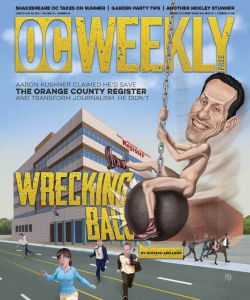
aaron-kushner-orange-county-register-financial-crisis.9842609.87The story Gustavo Arellano tells about Aaron Kushner and the Orange County Register has become well-known in recent weeks, in large measure because of Arellano’s own coverage in the OC Weekly. Kushner has spent 2014 rapidly dismantling what he spent 2012 and 2013 building up.

As I wrote recently in The Huffington Post, it makes no sense to invest in growth unless you have enough money to wait and see how it plays out, which is clearly the case with Bezos at the Post and Henry at the Globe — and which now is clearly not the case with Kushner and the Register.

The Orange County meltdown was also the subject of an unusually nasty blog post earlier this month by Clay Shirky, who criticized Ryan Chittum of the CJR and Ken Doctor of Newsonomics and the Nieman Journalism Lab for overlooking the weaknesses in Kushner’s expansion. (Chittum and Doctor wrote detailed, thoughtful responses, and I’ve linked to both of them in the comments of a piece I wrote about the kerfuffle for WGBHNews.org.)

Arellano has gotten hold of some internal documents that make it clear that Kushner’s expansionary dreams were doomed from the start. He also paints a picture of a poisoned newsroom and offers lots of anonymous quotes to back it up.

“I wouldn’t say I got hoodwinked,” he quotes one former staff member as saying, “but it’s just another lesson of life: If it’s too good to be true, it is.”

I recently criticized Arellano for his overreliance on anonymous quotes, although I freely concede that I used them regularly when I was covering the media for The Boston Phoenix in the 1990s and the early ’00s. This time, he includes a clear explanation of why almost none of his sources would go on the record: fear of “reprisal or the endangerment of their buyout, which included a nondisclosure clause.” Given that, I think the story is stronger with the quotes than without.

Arellano writes:

In retrospect, it seems obvious Kushner set himself up for failure, like a Jenga tower depending on every precariously placed block. He installed himself as publisher despite having no previous newspaper experience. A hard paywall — his most controversial move — was erected to force readers to buy the print edition in an era when online content is king. To justify that, Kushner plunged into a hiring binge that saw the Register sign up hundreds of employees even though it didn’t have the revenue to pay them. To fund his vision, the sales department was tasked with selling all those points despite an industry-wide decline in print advertising during the past decade.

It’s a sad, ugly moment for a tale that began so optimistically. As for whether this will prove to be the end of the story — well, it sure looks that way, although Kushner insists he’s merely slowed down. After two years of hiring binges and layoffs, the launch and virtual folding of the Long Beach Register, and the inexplicably odd decision to start a Los Angeles Register to compete with the mighty Times, Kushner is clearly down to his last chance — if that.