Gannett is seeking charitable donations to cover the salary of the local government reporter at the Reno Gazette Journal, one of its dailies. According to executive editor Brian Duggan, the paper is trying to raise $100,000 over the next two years so that it can keep paying Mark Robison. Duggan writes:
Mark’s salary is entirely dependent on the RGJ Fund, which is a field of interest fund held by the Community Foundation of Northern Nevada. It was established by the RGJ in 2020 as a way to help our newsroom grow.
My first reaction was blind outrage. My second reaction was tempered outrage. Short term, there’s no question that this will help the community. More coverage is better than less coverage, and Robison’s stories are offered for free, outside the Gazette Journal’s paywall.
But in the medium and long term, helping Gannett — the largest newspaper chain in the country, notorious for cutting its newsrooms to the bone — makes it more difficult for anyone else to start or maintain an independent news project. In fact, there are two such projects in Reno — This Is Reno and the Reno News & Review. Why not help them beef up their coverage of local government?
It’s not unprecedented for nonprofit grant money to be given to for-profit news organizations. To be fair, it sounds like none of the foundation’s money are actually being given to the paper; the foundation is simply administering the fund. (I emailed the foundation seeking comment but did not receive a response.) But there are two aspects of the Reno situation that stand out:
1. Robison is covering a core beat, local government. Grant money is usually used for special reporting projects, such as The Boston Globe’s series on educational inequality, “The Great Divide,” paid for partly by the Barr Foundation. Because of the grant money, the Globe is providing more and different education coverage than it otherwise might. By contrast, would the Reno paper actually not cover local government without charitable contributions? (OK, maybe it wouldn’t.)
2. Gannett keeps slashing its coverage to pay down debt and to squeeze out as much revenue as possible. I’m sure Duggan and Robison are fine journalists. But the people who own their paper demonstrate little interest in providing deep reporting in the communities they serve. Thus the donors are, in effect, subsidizing Gannett’s cost-cutting.
There has to be a better way of helping local news in Reno.
I’m not going to keep doing this, but it’s only Week 2 of The Transcript & Journal. My capacity for outrage hasn’t faded away yet. So here it is.
The T&J, owned by the Gannett chain, is sent to people in Medford and Somerville who previously subscribed to the Medford Transcript or the Somerville Journal. There’s not a single Medford-specific story on the front, and the story about rats only glancingly mentions Somerville. The inside consists of press releases, a story about a dog park in Billerica, a report from State House News Service and an obit from Cambridge. Nothing on the mayor’s office, the city council, the school committee or the police department — not even a civil-rights complaint filed against the police several weeks ago, which even Patch managed to write up.
It would be amazing if Patch saw this as an opportunity to go back to its old formula, at least in some communities — one full-time journalist and a modest freelance budget. I doubt that’s going to happen, though. They seem happy with their current, profitable model in which one person produces content for multiple cities and towns. But who knows? I thought this was pretty encouraging:
I think Medford more than most communities deserves/could sustain multiple reporters. It’s not lost on me or us. I see the hole Gannett has left. We recently lost our Medford reporter who I thought did admirable work given the position. Making this work is THE priority for us.
I’d also love it if someone wanted to start a TAPinto site in Medford. TAPinto is a franchise model that allows entrepreneurs to get up and running very quickly with a local news site. Ellen Clegg and I recently interviewed TAPinto founder and CEO Michael Shapiro on the “What Works” podcast. If anyone wanted to start such a project here, I’d be happy to make introductions.
In this Encore Edition of “What Works,” freelance investigative journalist Julie Reynolds talks about her singular pursuit of the truth about Alden Global Capital, the secretive New York hedge fund that has gobbled up newspapers across the country, stripping assets and firing reporters. Reynolds connects the dots from Alden to Cerberus Capital Management, the “shadow bank” that backed Alden’s 2021 takeover of Tribune Publishing.
In Quick Takes, I explore pink slime news sites, and Ellen Clegg reports on some good news for newspaper readers in the town that inspired Frostbite Falls, home to Rocky and Bullwinkle.
Ellen and I interviewed Julie in October 2021, but her research is still valid today — an unfortunate circumstance for the future of independent local journalism. We’ll be back with fresh content next week.
Like COVID or an overdue tax bill, the debut issue of The Transcript & Journal made its unwelcome appearance in our home earlier today. The weekly paper is a mash-up of Gannett’s Medford Transcript and Somerville Journal, a move that was announced earlier this year as part of the chain’s decision to eliminate 19 Massachusetts weeklies and merge nine others into four.
Last week’s final issue of the Medford Transcript had local news on the front page — a story about a debate among city council members on whether they should continue to meet weekly or switch to every other week and a report on efforts to build a replacement for (or substantially renovate) Medford High School.
But the front of The Transcript & Journal, as promised, replaces all that with regional news such as the Fair Share proposal to implement a statewide tax on millionaires and the opening of new restaurants in far-flung locales such as Brighton and Kingston. Meanwhile, there’s nothing on a story reported by The Boston Globe earlier this week on a civil-rights complaint filed against the Medford Police Department in which two Black residents say they were unlawfully stopped.
There is one Medford article on the front — a feature on a 10-year-old walking loop that recognizes the city’s historic landmarks. It’s a good story about something I wasn’t familiar with. It was also written by a journalism student at Endicott College. Now, journalism students are some of my favorite people. But we see what’s going on here, right?
And that’s it for the A section other than press releases, obituaries and a story about restaurants at the Burlington Mall. The B section, devoted to local sports, seems pretty much unchanged, but it was thin to begin with.
At a webinar earlier this week organized by the Shorenstein Center at the Harvard Kennedy School, Mizell Stewart III, vice president of news performance, talent and partnerships for Gannett and the USA Today Network, described the move as an attempt to drive digital subscriptions and to focus on local news that has a greater impact on people’s lives.
“Covering local news continues to be very labor intensive and very expensive,” Stewart said. The idea is to take “a more regional approach” and focus on “commonalities and trends.” But isn’t that why we have regional media like The Boston Globe, public radio and local TV newscasts?
Whenever I write about Gannett, our largest newspaper chain, it’s usually because they’re cuttings staff and closing papers. At the same time, though, the company has been a leader in rethinking how we cover law enforcement, which has emerged as a vitally important issue in the Black Lives Matter era. We know what the problems are:
Until recently, it was routine practice at many news outlets, especially smaller ones, simply to run stuff from the police log and from press releases issued by law enforcement without doing any actual reporting. The idea was that it’s a public record, so let’s get it out there.
A lack of follow-up: If charges were dropped or a suspect was acquitted, that often didn’t get reported.
Now that everything is digital, it’s very easy to Google someone applying for a job or whatever and find that they’d been arrested for something. Given that Black men, in particular, are disproportionately charged with crimes, it had the racist effect of denying opportunities to people of color.
So what is Gannett doing? As part of the Knight-Lenfest Newsroom Initiative, the chain has come up with a Public Safety Mission Statement that tries to get at some of these issues. Four Gannett journalists recently wrote up what they’ve been doing in an essay for the American Press Association’s Better News website. Here are some of the ideas they offered:
Gannett newspapers have stopped running mug shots, including mug-shot galleries, “recognizing instead that law enforcement pick and choose the crimes they announce and the mug shots they release, capturing people on their worst days in their worst moments, often in situations that may not reflect the full story.”
At the Rochester Democrat and Chronicle in upstate New York, reporters stopped rewriting routine police press releases and are trying to include community voices in public safety stories.
At The News Journal in Wilmington, Delaware, the staff is producing deeper stories on crime and policing that have led to more readers and new subscriptions. Examples of such stories include reporting on how a community was affected by a police standoff and how secrecy on the part of law enforcement prevents news outlets from reporting on allegations of excessive force.
These are all positive steps, and they follow earlier Gannett initiatives, such as making it possible for people to request that negative stories about them be removed from Google search. A number of other news outlets, including The Boston Globe, followed with similar programs.
This being Gannett, though, we should regard these initiatives with at least some degree of skepticism. Given the ongoing shrinkage of staff, it’s become increasingly difficult for the chain’s newspapers and websites to keep up with goings-on in muncipal government, public schools and public safety. Moving away from day-to-day police coverage and weighing in with an occasional piece that takes a look at broader issues may be good journalism — but it might be a money-saver as well. I say that not just theoretically but as the reader of a Gannett weekly (soon to be merged with another weekly) whose only full-time reporter is being moved to a regional beat.
So kudos to Gannett. But let’s keep an eye on what this looks like moving forward.
The print edition of the Boston Herald has been redesigned. It seems pretty subtle. The only difference I can detect on the front is that the headline type is blockier.
Executive editor Joe Dwinell calls it a “sharper look” that offers “a much richer reading experience.”
Some of the headlines now appear in italics.
The news section looks cleaner. Staff reporters have their email addresses listed.
The Herald’s last full redesign, as I recall, came in 1998. The paper was remade to look like a tabloid version of USA Today, and it was beautifully done. Over the next few years, as circulation began to slide, the paper was tarted up. I don’t know if I’d call this a complete redesign, but it appears to be an improvement.
Kristen Hare is a journalist, media watcher and faculty member at the Poynter Institute in Florida. Hare not only documents trends in our beleaguered industry, but she also teaches local journalists the critical skills they need to cover their communities effectively. Before joining Poynter’s faculty, she spent eight years covering local news for Poynter’s website. In addition to all of this, she also spent two years with the Peace Corps in Guyana, in South America.
At Poynter, she writes a weekly newsletter about local news called Local Edition. She’s also got experience in a number of local newsrooms. She has reported for the St. Louis Beacon and the St. Joseph News-Press in Missouri, and she still keeps her hand in by writing feature obituaries for the Tampa Bay Times, which is owned by Poynter in a for-profit/nonprofit partnership.
I’ve got a Quick Take on a tax credit for news subscribers in Canada, which apparently isn’t working all that well. Maybe it’s something in the permafrost. My co-host, Ellen Clegg, looks at a fight for control at the Chicago Reader, a 50-year-old alternative paper.
Mike Shapiro is the founder and CEO of TAPinto, a network of more than 90 online local news sites, most of them in New Jersey and with a few in New York and Florida. Shapiro launched TAPInto in 2008. Back then it was called TheAlternativePress.com, and the goal was to build a network of hyperlocal news sites covering New Jersey towns.
His core idea is relatively simple. Would-be editors and publishers are actually franchisees. They pay a fee to buy into a turnkey operation that gives them access to technology and marketing resources. Shapiro’s team provides training and maintains the infrastructure, but these publishers are responsible for maintaining and growing their readership. Some have journalism backgrounds, but some join because they love their communities and want to become small business owners. The name was changed as the network grew: Shapiro no longer sees it as an alternative to just one newspaper, but as a way to “TAPinto” any community.
I’ve got a Quick Take on a new survey by the Medill School of Journalism at Northwestern University that finds that news consumers in Chicago aren’t willing to pay for local content, and my co-host, Ellen Clegg, nerds out on a recent NiemanLab report on the importance of local coverage of science.
Provincetown Independent co-founders Ed Miller, the editor, and Teresa Parker, the publisher. Photo by Sophie Ruehr; used with permission.
Ed Miller is co-founder and editor of The Provincetown Independent. Founded in October 2019, the weekly competes with Gannett’s Provincetown Banner. The Independent covers Provincetown, Truro, Wellfleet and Eastham, and Miller explains why he believes that a print-centric strategy is essential on the tip of the Cape.
The Independent is a hybrid organization — a for-profit public benefit corporation that works in tandem with a nonprofit that Ed and co-founder and publisher Teresa Parker have also created. Up until now, the nonprofit, the Local Journalism Project, has operated under the fiscal sponsorship of the Center for the Study of Public Policy. But they have now created their own independent nonprofit and applied for 501(c)(3) tax-exempt status. (Disclosure: Dan is an unpaid adviser to the Independent.)
As we learned from Ed in planning this podcast, the first meeting of the new LJP board was happening the very day the episode was taped.
Ellen has a Quick Take on the abysmal results for the News Leaders Association newsroom diversity survey.
Dan reports on a startup newspaper in Queen Creek, Arizona, that will be called the Queen Creek Tribune and will make its debut on Sunday, April 24. It will be a total-market penetration print paper with a 20,000 press run.
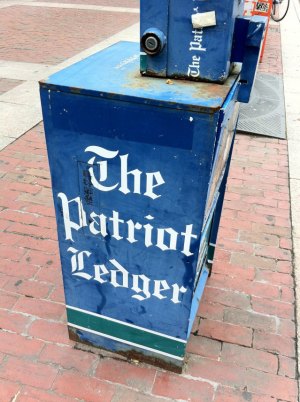
I’ve been trying to find out how widespread this is, but to no avail. Recently I learned that The Patriot Ledger of Quincy, a Gannett daily and, back in the misty past, one of the best medium-size papers in the country, is going to end home delivery and switch to the postal service instead.
What this means for print customers is unclear. You’d think there’s no way they will receive that day’s paper until the next day, or possibly the day after, although, as you’ll see in the message below, the Ledger is promising same-day mail delivery. Of course, this comes on top of the pending closure of 19 Gannett weeklies in Massachusetts, the end of Saturday print editions at many of the dailies, and numerous other cuts — including at the Ledger itself, which will switch from a print paper to an e-edition on Mondays.
As best as I can tell, the move to the USPS is being rolled out slowly at a few Gannett dailies here and there. It doesn’t seem like an all-at-once sort of thing. For instance, when I plugged some of the language from the Ledger announcement into Google, I discovered that Gannett switched to mail delivery at The Ithaca Journal of New York and The Banner-Press of Brenham, Texas, in December. I’m not coming up with others, but that doesn’t mean they’re not out there.
The message to Patriot Ledger subscribers, from a post office box in August, Georgia, was provided to me by a customer who lives in Quincy. It’s hard to see much good in here given that Gannett continues to cut its newsrooms and its coverage. It’s also very bad news for the paper’s loyal newspaper carriers; I reproduce a message from one of them below.
I have to say, though, that there are a few things in here that sound interesting. Ledger subscribers will be able to access any Gannett e-edition in the country, including the flagship USA Today. I might just get a digital subscription to USA Today if it means I can access other Gannett papers. Here’s most of the message:
Dear Subscriber:
The Patriot Ledger has been a vital part of the fabric of our community since its inception, bringing readers the reliable, local and passionate journalism you know and expect. While our commitment remains steadfast, we want to inform you of changes to your subscription.
Labor shortages have impacted newspaper deliveries across the country including the area and we want to make sure that your paper delivery is consistent. Beginning May 3, 2022, we will no longer provide home delivery of The Patriot Ledger. Delivery of your newspaper will continue and be provided via the U.S. Postal Service. The last day of home delivery will be May 2, 2022. You can expect delivery of your newspaper at the same time as your daily mail service. There will be no change to your current subscription rate.
Additionally, with more of our readers engaging with our content online, we are announcing a bold step towards our digital future. Beginning May 9, 2022, The Patriot Ledger will transition from delivering the Monday print edition to providing you a full Monday electronic edition (e-Edition), a digital version of our newspaper, available to you early morning. With the exception of Monday, you will continue to receive the print edition via USPS according to your delivery schedule.
As a loyal subscriber, we understand this change will impact you, which is why we are taking every step to ensure you have easy access to the news, sports, events and information you value most.
While a printed newspaper once was the sole means of accessing news and information, we offer many ways to connect with The Patriot Ledger. Your subscription includes unlimited digital access to patriotledger.com, where our team of journalists post updates and breaking news throughout the day, as well as our mobile apps, video, newsletters and the e-Edition….
Your local e-Edition also includes bonus magzines on various topics of interest and the full edition of USA TODAY. For quick tips on how to navigate the e-Edition visit patriotledger.com/eeditiontips.
As we make this transition, we are adding additional benefits to your subscription!
• Ad-free, 24/7 access to our USA TODAY Crossword puzzle! You can enjoy daily games by visiting puzzles.usatoday.com or through the USA TODAY Crossword app available on your iPhone or Android device.
• Universal access to all e-Editions throughout the USA TODAY Network in cities across the country, accessible via your own e-Edition. To access other newspapers, once inside the e-Edition, simply click on the icon titled Universal on the right-side navigation bar….
Thank you for your continued loyalty and support of our community-focused journalism.
Greg Mathis
Editor
So, is Gannett really making this move because of problems with its home-delivery network? Perhaps. But another Ledger customer sent me a message he received recently from a carrier who’s now out of work. Here it is:
Hello; I am writing to inform you that as of May 2, 2022, I will no longer be delivering your Patriot Ledger. The Parent company of the Patriot Ledger is the Gannett Company, they decided in their ultimate wisdom to get rid of all the Patriot Ledger Paper Carriers.
The Gannett Company has decided that they would rather pay more to have their paper delivered by the United States Postal Service. The average pay for a Patriot Ledger carrier is around $1.20 for 6 days papers (that is for all 6 days deliver $1.20). The USPS will be charging far more than this rate.
At the beginning of the pandemic, I was told that I was essential worker, and I delivered the Patriot Ledger throughout Covid every day. And now that things are getting a little better, for some reason that is beyond me, my job has been eliminated. I have enjoyed all your friendships all along the way. I feel fortunate for having the opportunity to meet you all. And hope that I also helped you by delivering your paper on time and where you wanted it.
The Patriot Ledger is also going to a 5-day newspaper, Tuesday Thru Saturday. They are stopping Monday deliveries. Gannett has continued to cut services and they are now saying to their customers you will no longer have your weekday Patriot Ledger at the time you have been receiving it and you will NEVER have your Saturday paper by 8:00am.
Many of the Patriot Ledger Carriers have been with the Patriot Ledger for many years, some for well over 20 years. We had our legally signed contracts with the Gannett Company voided because the contract has always been written in favor of the Company.
I have met the nicest guys that are also doing routes husbands, fathers, grandfathers, and ladies that have delivered the Patriot Ledger longer than most of the men. I have met the nicest customers because of this route too. Have enjoyed your friendships and your many kindnesses and gifts.
I want to say it has been a pleasure delivering your Patriot Ledger, and I will miss the friends I have made over these many years. For a while both our kids were in the Military and they also were deployed to the Middle East at the same time. This very route helped me to keep my mind off everythig too. They are both thankfully home.
Sincerely,
Your Patriot Ledger Carrier.
(name redacted)
Do you know of other daily newspapers that are dropping home delivery in favor of mailing it out? Please let me know in the comments.