From ‘Spotlight’ to a spotlight on local news: A conversation with Walter Robinson

Walter Robinson speaking at a New England First Amendment Coalition event

In the latest “What Works” podcast, Ellen Clegg and I talk with Walter Robinson, a longtime investigative journalist and editor of The Boston Globe’s Spotlight Team. Robby, as he is known, was instrumental in uncovering the clergy sex abuse scandal that rocked the Catholic Church in Boston and beyond. The series won the Pulitzer Prize for Public Service in 2003. The team’s work was captured onscreen in the movie “Spotlight,” where Robby was played by the actor Michael Keaton.

Robby is a former colleague — he was a Distinguished Professor of Journalism here at Northeastern. He was also a 1974 graduate of Northeastern’s journalism program and participated in co-op.

Robinson covered and edited local news at the Globe. But he ranged wide. He reported from 48 states and 33 countries. He covered the White House during the Reagan and George H.W. Bush administrations. He was also the Globe’s Middle East bureau chief and covered the first Persian Gulf War.

In recent years, Robby has been focused on the local news crisis in a big way. He has been deeply involved in the New Bedford Light, an impressive nonprofit digital news outlet. He lives in Plymouth, so it’s perhaps no surprise that he is a key adviser to the board of directors at the new Plymouth Independent.

I’ve got a Quick Take on developments in the junkyard known as Twitter. Ellen reports on a new podcast out of Memphis called “Civil Wrongs.” It’s produced by a Report for America corps member that examines a racist massacre in the aftermath of the Civil War.

You can listen to our conversation here and subscribe through your favorite podcast app.

There he goes again: Patrick Soon-Shiong delivers another paper to Alden Global Capital

Patrick Soon-Shiong. Photo (cc) 2014 by NHS Confederation.

Patrick Soon-Shiong, the wealthy surgeon who owns the Los Angeles Times, has delivered yet another daily newspaper into the greedy hands of the hedge fund Alden Global Capital. Soon-Shiong announced Monday that he’d sell The San Diego Union-Tribune to Alden’s MediaNews Group. By my count, the Union-Tribune becomes the 10th paper that Soon-Shiong has helped turn over to Alden. As Sara Fischer and Andrew Keatts report for Axios, the new owners immediately announced cuts to the newsroom.

When Soon-Shiong bought the LA Times in 2018, the Union-Tribune was thrown in as part of the deal. Soon-Shiong was hailed by optimistic media observers as someone who, like Jeff Bezos at The Washington Post and John Henry at The Boston Globe, would provide his papers with the runway they needed to become self-sustaining enterprises.

Please consider supporting this free source of news and commentary for just $5 a month. You can sign up here.

It’s been a mixed bag. Soon-Shiong’s main interest has been the LA Times, but he’s gone back and forth between investing and cutting. By no means has the Times been hollowed out as if it had been owned by, oh, let’s just say Alden Global Capital. But he’s run a lean ship, with the Times announcing just a few days ago that the recent sale of its press meant that game stories, box scores and standings would be eliminated from its print edition, according to Andrew Bucholtz of Awful Announcing.

Selling off the San Diego paper to one of the worst possible buyers is reminiscent of John Henry’s decision to sell the Telegram & Gazette of Worcester to a Florida chain back in 2014. As I recount in my book “The Return of the Moguls,” folks at the T&G thought Henry had promised not to sell unless a local buyer could be found; Henry told me his only promise had been not to sell to GateHouse Media. In any case, GateHouse managed to acquire the T&G within months and immediately began hollowing it out. GateHouse later morphed into Gannett, the country’s largest newspaper chain with about 200 dailies, which is notorious for its cost-cutting.

Alden Global Capital’s two newspaper chains, MediaNews Group and Tribune Publishing, make it the second largest owner with about 100 dailies. Alden is often described as the worst newspaper owner in the country, denounced as “vulture capitalists” who slash news coverage and sell off real estate in an attempt to squeeze out as much revenue as possible. Locally, Alden owns the Boston Herald, The Sun of Lowell and the Sentinel & Enterprise of Fitchburg.

Soon-Shiong was perhaps the central player in Alden’s acquisition of Tribune Publishing. Whereas MediaNews Group comprises mainly smaller papers, plus a few large dailies such as The Denver Post, Tribune owns eight of the largest, most iconic papers in the country, including the Chicago Tribune, The Baltimore Sun, the Orlando Sentinel and, closer to home, the Hartford Courant.

In the spring of 2021, Tribune, then comprising nine papers, was up for grabs, as it had been many times before. Stewart Bainum, a Baltimore hotel magnate, was attempting to buy the chain and sell off some of its properties to what he hoped would be public-spirited local owners. His main interest was in saving the Sun. Also bidding for the papers Alden. The hedge fund actually offered less money than Bainum, but its offer was reportedly less complicated as well.

The Tribune board ended up voting to sell the papers to Alden — a move that could have been halted by just one board member. Soon-Shiong, who was on the board, abstained, and he did so in a way that mean his vote essentially counted as a yes. As The Washington Post reported at the time, Soon-Shiong submitted his ballot without having checked the “abstain” box; if he had, his vote would have been counted as a “no.”

Bainum went on to found the nonprofit Baltimore Banner. Tribune, meanwhile, spun off one of its most prominent papers, the Daily News of New York, which remains part of the Alden empire as a separately owned entity.

So what’s next for The San Diego Union-Tribune? Nothing good, you can be sure. Voice of San Diego, a nonprofit news site, headlined its story “LA’s Richest Man Sells Union-Tribune to Feared ‘Chop Shop.’” Will Huntsberry and Scott Lewis interviewed the news-business analyst Ken Doctor, who predicted that San Diego will not be rid of Alden anytime soon.

“People get confused because these people are cut-throat capitalists,” Doctor told them. “But their papers are making money and they’re holding onto them for the time being.”

The Portland Press Herald and its 21 other papers are sold to a national nonprofit

Portland Press Herald mailbox
Photo (cc) 2022 by Jules Verne Times Two

The news about the news doesn’t get much better than this: The National Trust for Local News will acquire Maine’s Portland Press Herald and its affiliated four daily newspapers and 17 weeklies. The deal was announced earlier today. Although not all details of the sale are known, early indications are that the papers will remain for-profit entities under nonprofit ownership. The papers, known collectively as Masthead Maine, will continue to be managed by chief executive officer Lisa DeSisto.

According to Rachel Ohm of the Press Herald, the National Trust emerged as the buyer after the recently formed Maine Journalism Foundation, or MaineJF, fell short in its efforts to raise enough money to buy the papers on its own. MaineJF, also a nonprofit, then started working with the National Trust. Elizabeth Hansen Shapiro, the co-founder and CEO of the National Trust, told the Press Herald that the two organizations are continuing to work together, although it was unclear what ongoing role the foundation might have. The foundation, by the way, would have reorganized the papers as nonprofits; based on Ohm’s story, it sounds like that’s no longer on the table.

The papers were purchased in 2018 by Reade Brower, a printer who acquired them from billionaire owner Donald Sussman. Brower built a reputation as a solid steward who nevertheless was not averse to making cuts in order to stave off losses. Hansen Shapiro would not disclose what the National Trust paid, but it’s likely that Brower could have gotten more from a corporate chain looking to swoop in, gut newsrooms and squeeze out revenues. If that’s the case, then Brower deserves credit for putting his legacy above making every possible dollar.

The independently owned Bangor Daily News remains the only daily in the state that isn’t part of Masthead Maine.

The governance structure of the new ownership has yet to be announced, and maybe even the principals don’t quite know what it will look like yet. The National Trust is best known for rescuing a group of weekly and monthly papers in suburban Denver back in 2021, and now owns them in conjunction with The Colorado Sun, a well-regarded for-profit digital startup.

Earlier:

A new wrinkle in the quest to convert the Portland Press Herald into a nonprofit

Portland Harbor after dark. Photo (cc) 2021 by Paul VanDerWerf.

Brian MacQuarrie of The Boston Globe has an overview of efforts to sell the Portland Press Herald of Maine and its affiliated daily and weekly papers.

Back in April, I wrote about the establishment of a nonprofit organization, the Maine Journalism Foundation, known as MaineJF, which was hoping to purchase the papers from owner Reade Brower. MacQuarrie reports that yet another nonprofit group, the National Trust for Local News, “is believed to be in the running.” I assume that the trust is looking to work with the MaineJF rather than compete, so that is potentially a promising development.

Last August, Elizabeth Hansen Shapiro, the CEO and founder of the National Trust, was a guest on our podcast about the future of local news, “What Works.” Ellen Clegg and I spoke with her about her organization’s work in saving legacy newspapers from the depredations of corporate chain ownership.

The trust is perhaps best known for facilitating the sale of Colorado Community Media, a chain of weekly and monthly papers in the Denver suburbs. Hansen Shapiro is also an advisory board member of The Lexington Observer, a hyperlocal nonprofit startup.

Sue Cross of INN tells us why this is a golden age of news innovation

Sue Cross at the recent INN Days gathering in Washington. Photo by Will Allen-DuPraw and used with permission.

On the latest “What Works” podcast, Ellen Clegg and I talk with Sue Cross, the veteran journalist who will step down as executive director and CEO of the Institute for Nonprofit News (INN) by the end of 2023. Sue has led INN since 2015, and has overseen a period of tremendous growth. There were 117 nonprofit newsroom members listed in the INN’s 2015 annual report. This year, INN has 425 member newsrooms.

She has also been a driving force in the NewsMatch program, a collaborative fundraising project that has helped raise more than $270 million for emerging newsrooms since its launch in 2016. Before joining INN, Cross was a journalist and executive at The Associated Press. Cross says we are in a golden age of news innovation, and she hopes to continue to lend her support. She also says she hopes to spend time on personal projects.

Ellen has a Quick Take on the launch of the Houston Landing, a nonprofit digital site serving Greater Houston. I provide an update on efforts to extract money out of Google and Facebook in order to pay for news.

You can listen to our conversation here and subscribe through your favorite podcast app.

In a separate lawsuit, Gannett joins antitrust effort aimed at Google (and Facebook)

Photo (cc) 2010 by John Marino

Since early 2021, Google has faced legal challenges over its control of digital advertising. Essentially, the tech giant stands accused of violating antitrust law by controlling all aspects of the ad market. As Paul Farrell, the lawyer for a group of seven newspapers in West Virginia, told Gretchen A. Peck of the trade publication Editor & Publisher:

They [Google] have completely monetized and commercialized their search engine, and what they’ve also done is create an advertising marketplace in which they represent and profit from the buyers and the sellers, while also owning the exchange. Google is the broker for the buyer and gets a commission. Google is the broker for the seller and gets a commission. Google owns, operates and sets the rules for the ad exchange. And they are also in the market themselves.

The suit filed by Farrell on behalf of the West Virginia papers was later joined by about 200 papers and included Facebook, which was accused of colluding with Google in order to receive preferential treatment. Attorneys general in Texas and several other states filed a separate suit, with BuzzFeed News reporting that the CEOs of Google and Facebook “personally signed off on a secret advertising deal.” The Justice Department got involved, and the European Union is suing Google on similar grounds.

On Tuesday, Google’s legal woes grew that much more complicated as Gannett, the country’s largest newspaper chain, filed its own lawsuit against Google in federal district court. Writing in USA Today, Gannett’s flagship publication, chair and CEO Mike Reed accused Google of “monopolization of advertising technology markets and deceptive commercial practices.” He added:

The core of the case and our position is that Google abuses its control over the ad server monopoly to make it increasingly difficult for rival exchanges to run competitive auctions. Further, Google’s exchange rigs its own auctions so Google’s advertisers can buy ad space at bargain prices. That means less investment in online content and fewer ad slots for publishers to sell and advertisers to buy. Google always wins because it takes a growing share of that shrinking pie.

In addition to USA Today, Gannett owns about 200 daily papers and other publications across the country, including local papers such as the Telegram & Gazette of Worcester, The Patriot Ledger of Quincy, the MetroWest Daily News of Framingham and The Providence Journal.

So why did Reed decide to file his own lawsuit rather than joining antitrust efforts that are already under way? It’s a good question, and it’s one that Editor & Publisher’s Mike and Robin Blinder asked him about in their vodcast, “E&P Reports.” Reed’s answer: “You know, as far as us going by ourselves, we just felt like we had the right size, we had the right legal counsel, and we felt like we didn’t want to wait.”

Jeff Jarvis, a well-known digital media observer and director of the Tow-Knight Center for Entrepreneurial Journalism at the City University of New York Graduate School of Journalism, was critical of the Gannett suit, telling E&P:

It is tragic that once-great Gannett is resorting to protectionism and retribution against its competitors rather than have a strategy for innovation and growth in a changed marketplace. There are legitimate questions to be addressed regarding Google’s power in both sides of the advertising market and authorities in both Europe and the U.S. are investigating them. But for Gannett to blame Google’s alleged monopoly for its present troubles is just sad.

But you can disparage Gannett for decimating its newspapers while still supporting legal efforts to hold Google to account. Few media observers have been more critical of Gannett than my What Works partner Ellen Clegg and I. Greed and crushing debt have led the chain to cut its journalistic capacity far more deeply than would have otherwise been necessary. Yet it’s simply a fact that very little digital advertising money has flowed to the news business, and that lack of innovation on the part of the news business is only partly to blame. If news publishers and government investigators are able to show that situation is either partly or wholly the result of illegal practices on the part of Google (and Facebook), then there’s no reason why Gannett shouldn’t be one of the beneficiaries, regardless of the company’s otherwise loathsome behavior.

Moreover, the antitrust route strikes me as far more promising than congressional efforts to force Google and Facebook to pay for the news they repurpose. Last week, the Senate Judiciary Committee passed the Journalism Competition and Preservation Act on a bipartisan 14-7 vote, according to Ted Johnson of Deadline. The JCPA would allow the news business to bargain collectively with Google and Facebook for a share of their revenues. Even if the JCPA passes the full Senate, though, it seems unlikely to prevail in the Republican-controlled House. A similar law in Australia has served mainly to enrich press baron Rupert Murdoch, and there’s no guarantee that the JCPA would bolster journalism at the local level.

Regulating a monopoly often leads to unintended negative consequences. Breaking one up, as Gannett and its numerous co-plaintiffs would like to do, can spark innovation. Local news today is getting by through a combination of paywalls, low-value programmatic ads and — in the nonprofit sector — foundation grants, membership fees and events. Nothing would be more welcome than to see that bolstered by a reinvigorated ad market.

Andy Thibault tells us about The Winsted Citizen and his relationship with Ralph Nader

Andy Thibault and Billie Holiday delivering The Winsted Citizen

On this week’s podcast, Ellen Clegg and I talk with Andy Thibault, editor and publisher of The Winsted Citizen in Connecticut. The Citizen is a monthly print newspaper serving Litchfield County and the surrounding area. The paper’s digital presence is minimal, although it does publish The Winsted Citizen Blog. But that’s about to change, Thibault says. He’s going digital.

Starting a news organization is never easy, but the Citizen hit a brief speed bump. A speed bump named Ralph Nader, a native of Winsted who was initially the prime mover behind the paper but who got caught up in a dispute over how much financial support he was going to provide. According to Andy, he and Nader are now working together cooperatively and everything is moving ahead just fine.

Jack Walsh, a graduate student in Northeastern University’s School of Journalism, joins us to talk about his recent profile of the Chelsea Record,  a 150-year-old weekly paper in the small city of Chelsea, Massachusetts. You can find Jack’s story on the What Works website and read his newsletter, Local News Matters, on Substack.

I’ve got a Quick Take on Gannett. Recently, many union journalists at Gannett staged a one-day strike over layoffs and cutbacks in benefits. Yet there are some interesting moves being made at the top of the company as well, with two news leaders being added to the senior executive team. Is the chain actually looking to bulk up its journalism?

Ellen discusses a recent poll about local news and accountability journalism. Surprisingly few Americans believe that local news media hold public officials accountable, according to a national poll commissioned by the Medill School of Journalism at Northwestern University. This shows the devastating impact of the hollowing out of community news. And it calls into question whether local journalism is fulfilling one of its primary missions.

You can listen to our conversation here and subscribe through your favorite podcast app.

Gannett is (wait for it) bulking up on local even as union staffers stage a one-day strike

Michael Anastasi. Photo via LinkedIn.

As you may have heard, union journalists at many Gannett newspapers staged a one-day strike Monday to protest chair Michael Reed’s brutal leadership style, which has resulted in devastating cuts and a sliding stock price even as he’s pulled down more than $11 million in compensation over the past two years.

I’ll get back to that. But first I want to discuss a less publicized development. Over the past several weeks, Gannett has made a couple of personnel moves aimed at — wait for it — reinvigorating local coverage at the country’s largest newspaper chain.

On May 19 came word that Michael Anastasi, vice president of The Tennessean of Nashville and editor of USA Today’s South Region, was being promoted to the newly created position of vice president of local, part of what the company is calling “a new nationwide Gannett effort to transform the growth trajectory for hundreds of local newspapers.”

In an article announcing the move, Anastasi was quoted as saying, “I can’t wait to help accelerate our transformation as I work with the thousands of local Gannett journalists across the country.” He’ll report to Kristin Roberts, Gannett’s chief content officer, who stated, “We are going to save local journalism, and we’re going to do it by working together with absolutely clear eyes about the challenge and tremendous speed toward the solution.”

Anastasi’s promotion is part of what Gannett is calling Project Breakthrough, which “focuses on key growth areas to increase nationwide audience, including opinion columns, newsletters, service journalism, breaking news and audience engagement.”

Imtiaz Patel. Photo via LinkedIn.

Less than two weeks later came word that Imtiaz Patel, chief executive officer of The Baltimore Banner, will leave July 7 in order to become a top executive at Gannett. According to the Banner’s story on that departure, Gannett has not yet announced what Patel’s new position will be. But it’s remarkable that the head of one of the most respected nonprofit digital news organizations in the country would jump onto what is widely regarded as a sinking ship.

Now, there were family considerations involved in Patel’s move. He told the staff that a change in his wife’s job made it impossible for her to move from New York City to Baltimore, as she had planned. Still, Patel has won nothing but plaudits for his management of the Banner, and presumably he could have written his own ticket. (Interesting wrinkle: former Boston Globe editor Brian McGrory, now chair of Boston University’s journalism department, will help lead the transition as the outlet searches for a new CEO.)

“I’m tremendously proud of what we have achieved to bring locally owned, not-for-profit news to Baltimore,” said Patel, who’ll remain on the Banner’s board of directors. Under his leadership, the news organization signed up about 70,000 paid subscribers.

For all of Gannett’s cuts, which have had a devastating effect on newsrooms as well as the communities they serve, the company has always had a story to tell about how brighter days are just around the corner. Back before the merger with GateHouse Media, GateHouse folks used to talk about developing revenues from ancillary businesses such as services and events in order to support their journalism. Not much ever came of that. More recently, Gannett has embraced sports betting and even NFTs — again, without an discernable positive impact on the bottom line. (Are NFTs even still a thing?)

All of this came to a head Monday, when hundreds of journalists went on strike at Gannett’s dailies, which employ about 1,000 union members in 50 newsrooms. The job action coincided with Gannett’s annual shareholder meeting, Angela Fu reports for Poynter Online.

Most of the strikes are one-day work stoppages and involve journalists at some of Gannett’s largest newsrooms: the Rochester Democrat and Chronicle, the Austin American-Statesman and The Palm Beach Post. Workers at The Arizona Republic and The Desert Sun will stage multi-day strikes, and journalists at The Indianapolis Star are withholding their bylines in lieu of a work stoppage.

The NewsGuild-CWA had hoped to persuade shareholders to vote against Reed’s continued tenure as chair. Not surprisingly, according to Katie Robertson of The New York Times, that effort fell short.

So now we’ll get to see how the latest story Gannett is telling itself plays out. Anastasi and Patel are serious news leaders, and it seems unlikely they would have agreed to accept their new roles without promises of money, resources and time. And yet — really? Gannett is not going to bring back all the weekly newspapers that it closed in Massachusetts, or restore the local journalism it eliminated in favor of regional coverage. It’s almost certainly not going to repopulate daily papers like The Californian of Salinas, now operating with zero staff reporters.

It would be easier to read the tea leaves if Reed and his associates simply continued pillaging the company. The Anastasi and Patel moves suggest that they’ve got something else in mind. It will bear watching to find out exactly what that looks like.

Correction: Updated to fix Kristin Roberts’ name. That’s two this week. I’ll try to slow down and read more carefully.

Brant Houston talks about his new book, which chronicles two decades of disruption

Brant Houston

On the latest “What Works” podcast, Ellen Clegg and I talk with Brant Houston, who is hard to describe in one sentence: he’s an author, an educator, an investigative journalist, an expert in data-based reporting, and a co-founder of the Global Investigative Journalism Network and the Institute for Nonprofit News.

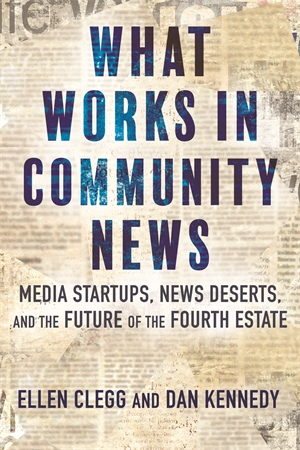
His new book, “Changing Models for Journalism,” chronicles the history of change, disruption and reinvention in our industry over the past two decades. These are themes we explore on this podcast, and in our own forthcoming book, “What Works in Community News.” Brant takes us back to the early days of digital and recounts the early optimism, and the early misconceptions, about the promise and the peril of the internet.

I’ve got a Quick Take on Pink Slime Journalism 3.0. We’ve seen an explosion of websites that might be called Pink Slime 2.0 as political operatives have sought to take advantage of the decline in real local news. That followed Pink Slime 1.0 — an outbreak about a decade ago of local news being produced by low-paid workers in distant locales, including the Philippines. Now, NewsGuard reports that dubious online content powered by artificial intelligence is spreading.

Ellen looks at the numbers in the 2023 impact report on local news by the INN. And there’s some good news: As the nonprofit journalism field expands, the resources to sustain these newsrooms are expanding, too.

You can listen to our conversation here and subscribe through your favorite podcast app.

Something for the kitchen table: Why print makes sense for some local news startups

Local news board members Greg Bestick of the Harpswell Anchor, Fred Perry of Brookline.News and Virginia McIntyre of The Concord Bridge. Photo (cc) 2023 by Dan Kennedy.

Residents looking to start news organizations in their communities usually look to digital first. Even at the local level, advertising revenues are not what they used to be, and the cost of offering a print newspaper — both in terms of money and complexity — often isn’t worth it.

Yet the traditional notion of publishing a weekly newspaper remains attractive on several levels. Readers like it. Advertisers prefer it. And in many states, public notices placed by governmental agencies, a lucrative source of revenue, are restricted to print papers.

So I was interested to learn that print is part of the discussion at three nonprofit local news startups that were featured at a panel discussion, “The Re-Emergence of the Community Newspaper,” held during the recent conference of the NorthEast Association of Communications Executives, held in Meredith, New Hampshire.

The Harpswell Anchor in Maine and The Concord Bridge in Massachusetts have offered print right from the beginning. Brookline.News in Massachusetts is digital-only but may offer a print edition in the future. (Disclosure: Ellen Clegg, my research, podcast and writing partner, is also a founder and co-chair of Brookline.News.)

Greg Bestick, president of the nonprofit board that publishes the Anchor, said print was not something he and his fellow founders especially wanted to offer. What changed their mind, he explained, was that a survey of the community revealed that 95% wanted something they could hold in their hands.

“We weren’t thrilled about that,” Bestick said, “but we did say we’d be much more robust online than the previous owner.”

Unlike The Concord Bridge and Brookline.News, which were both launched in response to massive budget cuts by the newspaper chain Gannett, The Harpswell Anchor had been a locally owned for-profit newspaper until several years ago. The paper ceased publication during the COVID-19 pandemic, Bestick said. The new iteration of the Anchor has had an operating surplus from the start, he added, and won 11 awards from the Maine Press Association during its first year.

Virginia McIntyre, a member of The Concord Bridge’s board, said the founders of that site were enthusiastic about print right from the start. “We wanted something people could have on the kitchen table,” she said, adding: “It’s nice to have something that the family can see as a whole. Our advertisers also like having an ad that hits every household.” The print edition of the Bridge, she explained, is mailed for free to each of Concord’s 8,700 households.

Discussions about starting a community news outlet began after Gannett decided in early 2022 to eliminate nearly all local journalism from its Massachusetts weeklies. The Concord Journal is still published, but it’s filled with regional stories from throughout Gannett’s network. Because of that, McIntyre said, many residents had no idea about important developments such as the hiring of a town manager and a $110 million middle school project. Although the Bridge includes feature stories and coverage of school sports, she said that the goal is to inform the public about day-to-day goings-on.

“It’s not entertainment,” she said. “I always thought Concord was a boring place, and now I know it is.”

In contrast to Concord, Gannett shut down the Brookline Tab altogether, leaving a community of nearly 60,000 people just minutes from Boston without any local source of news. “The Tab was not good. But it was something,” said Fred Perry, a member of the Brookline.News board.

Brookline.News’ website didn’t go live until last week; a newsletter began covering the town just before the annual town meeting in April. Perry said he’s hoping that the project can start offering a print edition sometime this fall, praising “the wonderful examples on both sides of me,” a reference to Bestick and McIntyre. Several other board members, he added, are skeptical of print because of the cost, but he said he’s optimistic that print “can generate a significant surplus.”

The panel discussion was moderated by John Harrison, an executive with Wallit, a company that helps publishers manage digital subscriptions.

In many cases, digital-only makes sense. LION (Local Independent Online News) Publishers, an organization for digital news entrepreneurs, has more than 300 members. Many of the projects that Ellen and I are profiling in our forthcoming book, “What Works in Community News,” are digital-only, and they have no plans to add a print edition.

Yet print has persisted long past its anticipated expiration date. Perhaps the best way to think about it is that print is still worth doing — but only if it makes sense in terms of revenue, reader preferences and advertiser reach.

Correction: Updated with the proper spelling of Greg Bestick’s name.