
Merry Christmas to all, and to all a great 2013!
By Dan Kennedy • The press, politics, technology, culture and other passions
Merry Christmas to all, and to all a great 2013!
Michael Graham has left WTKK Radio (96.9 FM), according to AllAccess.com. I certainly won’t miss him, but his departure, unfortunately, would appear to presage Greater Media’s rumored decision to relaunch WTKK as an automated music station. Here’s more from Radio Insight.
Talk radio, as we all know, is not what it used to be. But if WTKK is taken out of play, I wonder if Entercom might decide to reinvigorate WRKO (AM 680), which has all but disappeared except for Howie Carr’s afternoon-drive show. If Jim Braude and Margery Eagan are out at ‘TKK, then they deserve a slot somewhere.
Meanwhile, Dan Rea continues to do well evenings at WBZ (AM 1030) with a talk show that is as conservative as any on the air — but that is also intelligent and respectful of its listeners. Is there a lesson in that?
The New York tabloids weigh in.

Brian McGrory has been named editor of the Boston Globe, succeeding Marty Baron, who left recently to become executive editor of the Washington Post. McGrory was widely seen as a popular candidate inside the Globe newsroom, so no doubt they’re celebrating at 135 Morrissey Blvd. this afternoon.
McGrory drew praise inside and outside the Globe for his performance as metro editor several years ago. Although he returned to his slot as a metro columnist following three years on the job, that may have been the last ticket he needed punched given his previous experience as a local reporter, White House correspondent and roving national reporter.
He is also the author of several books, including, most recently, “Buddy: How a Rooster Made Me a Family Man.”
McGrory is just the sixth Globe editor of the modern era, dating back to the 1960s. He follows, in chronological order, Tom Winship, Michael Janeway, Jack Driscoll, Matt Storin and Baron.
McGrory takes over the newsroom at a time when the future of the Globe is unclear. Although the Baron era was a journalistic success highlighted by six Pulitzer Prizes, the Globe, like all newspapers, is unsteady financially. The Globe’s owner, the New York Times Co., is thought to be almost certain to sell the paper at some point, though it is not believed to be actively shopping it at the moment.
Here is the press release the Globe sent out a little while ago:
Brian McGrory, a 23-year veteran of The Boston Globe who led groundbreaking coverage of corruption as an editor, and writes with depth and texture about the region as a columnist, has been named the next editor of The Boston Globe, effective immediately.
Mr. McGrory, 51, will report to Christopher M. Mayer, Globe Publisher. A Boston native, he will be charged with running the newsroom for The Boston Globe and BostonGlobe.com and the newsroom’s contribution to Boston.com.
“Brian has distinguished himself throughout his career at the Globe as a reporter, editor and columnist and as a native of Boston, he is the ideal candidate to lead the Globe’s newsroom,” said Mr. Mayer. “Brian will continue to emphasize the accountability reporting that has been the Globe’s trademark, combined with narrative storytelling that gives readers a strong sense of our unique community.”
“This is a great honor to guide the Boston Globe news operations, since I grew up delivering the Globe, then reading the Globe, and later writing for the Globe,” said Mr. McGrory. “It is also a great honor to work with my colleagues and build on what I believe is the best metro newspaper in America.”
Mr. McGrory joined the Globe in 1989 as one of the first reporters hired into the South Weekly section. Since then, he has covered the city of Boston as a general assignment reporter, served as White House correspondent, and as a roving national correspondent. In 1998, he became a metro columnist, and quickly made his mark as a must read. He was named associate editor in 2004.
In 2007, he was named deputy managing editor for local news. He led the metro staff in a comprehensive investigation of corruption and cronyism on Beacon Hill that eventually led to resignations and indictments.
Governor Deval Patrick and the State Legislature passed a pension reform bill after an investigation by the Globe revealed public pension abuses, coverage that brought Sean Murphy recognition as a finalist for the Goldsmith Investigative Reporting Prize by the Shorenstein Center on the Press, Politics, and Public Policy at Harvard University. Under McGrory, the newsroom also reported extensively on a city system that bestowed benefits on favored developers.
He directed wide-ranging, sensitive coverage of Senator Edward M. Kennedy’s struggle with brain cancer, his death, and his funeral.
McGrory steered the metro staff to new levels of narrative journalism, stressing the value of vivid and detailed storytelling in an era when consumers have many media choices. An 8,000-word narrative about a pair of sisters who died in an arson fire in South Boston after years of neglect won the Casey Medal for Meritorious Journalism and led to widespread reforms in government services for children.
After nearly three years as metro editor, he resumed his twice-a-week metro front column, where he has regularly enlightened readers about the quirks and character of the community and held public officials and business leaders accountable. He is the author of a memoir and four novels.
“During his tenure as metro editor, Brian built a strong team of reporters and editors and imbued the newsroom with a competitive spirit. Day after day, Brian and his team delivered award-winning journalism, in print and online,” Mayer added.
McGrory was raised in Roslindale and Weymouth. He received a B.A. from Bates College in Maine, and worked early in his career at the New Haven Register and The Patriot Ledger in Quincy.
The timing was serendipitous. As the media swarmed around Newtown, Conn., following last Friday’s horrifying massacre, some observers were beginning to ask why so little attention was being paid to the ongoing crisis of urban violence. (Here’s one example, from The Phoenix’s Chris Faraone.)
On Sunday, the Boston Globe provided an answer of sorts: the first installment of “68 Blocks: Life, Death, Hope,” a five-day, multi-part series on Dorchester’s Bowdoin-Geneva neighborhood — a predominantly African-American community that is a vibrant center of family life but that is also beset by gangs and guns. The Globe went all in. The paper even rented an apartment in the neighborhood, where two of its reporters, Meghan Irons and Akilah Johnson, lived during the five months that they and others were doing their reporting.
It was only a week ago that the paper published an ambitious three-part series on the problems of immigration. The long-term prospects for the newspaper business may be bleak, but the Globe continues to produce important, expensive, time-consuming work.
At a time when you sometimes hear that various forms of digital storytelling have made narrative obsolete, “68 Blocks” is an example of how digital and narrative can work together. The story itself — 29,000 or so words spread out over five days — is unusual for newspaper writing. There is no news hook and, in the end, no real conclusion.
Thus we are left to wonder if Nate Davis and his wife, Trina Fomby-Davis, will be able to move on with their lives after the murder of one son and the imprisonment of another; if “Tal” will ever make something of himself; if Father Doc Conway can truly make a difference; and if Jhana Senxian will succeed in her efforts to remake her small part of Bowdoin-Geneva.
But if you’re only reading “68 Blocks” in print, you’re missing a lot. Fortunately the Globe has dropped the paywall for this package, so you can take the time to explore. It stands as a lesson in how to do multimedia, how to use data and how to involve your readers — “the people formerly known as the audience,” as Jay Rosen calls them — to help tell their own stories. For instance:
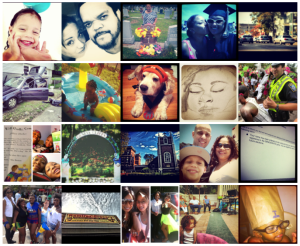
• Instagram and voices from the neighborhood. My students and I have taken several tours of the Globe Idea Lab, an innovation skunkworks inside the paper’s Dorchester headquarters. The lab is dominated by a giant vertical screen comprising nine smaller screens. On it is a map of Boston, with geotagged Instagram photos popping up as soon as people post them. The Globe tracked down some of the amateur photographers in Bowdoin-Geneva, got their permission to use their pictures (unlike, uh, Instagram) and recorded brief audio interviews to go with each one. Rachel McAthy has more at Journalism.co.uk.
• Kids using video to tell their own stories. This might be my favorite: the Globe distributed video cameras to young people in the neighborhood and posted the results. There are six short videos online, and every one is worth watching.
• Interactive data visualizations. Using maps and charts, “68 Blocks” lays out in graphic detail a number of quality-of-life measurements ranging from homicides to rodent activity. By letting the user call up the data she wants, the visualizations invite repeated visits.
• A photo tour of the neighborhood. With audio.
All of that is in addition to more typical offerings such as professionally produced videos, slideshows and diary entries written by Globe reporters.
This is a series that should have a long post-publication life — perhaps supplemented by an e-book. It’s a great example of what a large news organization is able to do if it’s got the resources and is willing to commit them to a long, complex project. Those of us who live in Greater Boston are lucky that the Globe is still taking on such important work.
One day in the summer of 2003 I found myself in a hotel lobby, engaged in an intense conversation with Andrew Solomon. His book on depression, “The Noonday Demon,” had won the National Book Award. Now he was working on a new project — about families with children who were so different from their parents that they called into question the very meaning of identity.
Solomon wanted to interview me because our daughter, Becky, has achondroplasia, the most common form of dwarfism. She had survived a rather harrowing infancy during which her too-small airways left her struggling for survival. She needed a tracheotomy, oxygen tanks and home nursing until she was nearly 3 years old …

As the Boston Globe seeks to replace departing editor Marty Baron, here’s someone to keep at least one eye on.
Former Globe managing editor Greg Moore has been named the Benjamin C. Bradlee Editor of the Year by the National Press Foundation for his leadership of the Denver Post. Moore was recently seen in the vicinity of the Globe, according to several people I’ve spoken with, although there’s also talk that he has no desire to return to Boston.
The smart money is on an internal candidate. The names that come up most frequently are metro columnist Brian McGrory, editorial-page editor Peter Canellos and managing editor Caleb Solomon. At The Phoenix, Peter Kadzis is predicting Solomon, and floats several other names as well. But, really, who knows what might happen?
Regardless of who ultimately moves into the glass house being vacated by Baron, congratulations to Greg Moore.
I’m trying a new WordPress theme. Thoughts? (Update: Yuck. Back to the old theme.)
 This interview was previously published at the Nieman Journalism Lab.
The first time I heard of Michael Morisy and MuckRock.com was in 2010, after the site was targeted by a bureaucrat working for Massachusetts Governor Deval Patrick.
It seems that MuckRock, using the state’s open records law, had obtained information about how food stamps were being used in grocery stores. The data, which did not name any individual food-stamp recipients, had been lawfully requested and lawfully obtained. But that didn’t stop said bureaucrat from threatening Morisy and his tech partner, Mitchell Kotler, with fines and even imprisonment if they refused to remove the documents from their site.
They refused. And the bureaucrat said it had all been a mistake.
Now Morisy is preparing to expand MuckRock’s mission of filing freedom-of-information requests with various government agencies and posting them online for all to see. The just-launched Freedom of the Press Foundation has identified MuckRock as one of four news organizations that will benefit from its system of crowdsourced donations. The best-known of the four is WikiLeaks.
The foundation’s board is a who’s who of media activists, including Pentagon Papers whistleblower Daniel Ellsberg, Electronic Frontier Foundation co-founder John Perry Barlow, Josh Stearns of Free Press and the journalist Glenn Greenwald, now with the Guardian.
“The Freedom of the Press Foundation can be a first step away from the edge of a cliff,” writes Dan Gillmor, author of “We the Media” and “Mediactive.” “But it needs to be recognized and used by as many people as possible, as fast as possible. And journalists, in particular, need to offer their support in every way. This is ultimately about their future, whether they recognize it or not. But it’s more fundamentally about all of us.”
What follows is a lightly edited email interview I conducted with Morisy about MuckRock, the Freedom of the Press Foundation, and what comes next.
Q: Tell me a little bit about MuckRock and its origins.
A: I’d been really frustrated that we hadn’t seen much innovation in newsgathering generated by journalistic organizations. You see lots of innovations in how stories are told, but they’ve been generated by companies like Twitter, Facebook, and Instagram — all wonderful organizations, but ones which generate news as a byproduct, and where the journalistic function is by far secondary to business considerations. My co-founder and I wanted to create a startup where creating news was a core part of the business, and where the news was both user-generated and -directed as well as verified.
Since requests on MuckRock come from — and are paid for by — our users, we are able to align our business and editorial goals almost perfectly. We don’t sell advertising, we don’t put up paywalls. We just help people investigate the issues they want to, and then share those results with the world.
We’ve know been growing as a business and as an editorial operation for three years, with a part-time news editor and two fantastic interns.
Q: What sorts of projects are you involved in today?
A: Our biggest project to date is a partnership with the Electronic Frontier Foundation (EFF) called the Drone Census, which has broken a lot of major stories around the country. We let anyone submit an agency’s information and then we follow up with a public records request. So far we’ve submitted 263 requests to state, local, and federal agencies, the vast majority of which were suggested by the public. And it’s helped shed more light on a program that police departments and drone manufacturers are very purposefully keeping quiet.
We’ve also gotten to cover some really interesting local stories, such as getting the late Boston mayor Kevin White’s FBI file and taking an inside look at the timing of a drug raid, as well as national stories.
Q: What is the nature of your relationship with the Boston Globe?
A: MuckRock was invited to be part of the Globe Lab‘s incubator program a little over a year ago. We’ve received free office space and, most important, a good mailbox to receive the dozens of responses we get back every day. It’s also given us a chance to bounce ideas back and forth with their technology and editorial teams, and we’re in the early stages of a collaborative project with them.
They also recently launched The Hive, a section focused on startups in the Boston area. Given my experience running one and my editorial background, when they were looking for someone to manage and report for that section, I was a natural fit and thrilled to be invited to cover startups in the area. It’s a dream job, and it means I now have two desks, and often wear two hats inside the same building.
Q: How did you get involved in the Freedom of the Press Foundation?
A: Trevor Timm has been our main point of contact with the EFF working on the drone project, and he’s been absolutely great to work with. He reached out to us about a week ago and said that he was working on a new venture to help crowdfund investigative journalism projects, and we were honored to be thought of. It turns out he is the executive director of the Freedom of the Press Foundation, so we got lucky to be working with the right people.
Q: Do you have a goal for how much money you’re hoping to raise through the foundation? What kinds of projects would you like to fund if you’re successful?
A: We’re kind of going into this with an open mind and a hopeful heart. Any amount raised is greatly appreciated, but this will help jumpstart several new projects similar in size and scope to the drone effort, which has had an amazing response, including nods from the New York Times and many other outlets. It may also give us the flexibility to fund important stories that maybe are not as sexy. We were really interested in funding an investigation into MBTA price jumps for the disabled, for example, but our crowdfunding efforts on Spot.us are essentially dead on arrival. Having a reserve will allow us to take gambles on stories like that without having to choose between making rent and breaking news.
I’ll have much more to say about the Boston Globe’s remarkable “68 Blocks” series on life and death in the city’s Bowdoin-Geneva neighborhood.
For now, I just want to lay down a marker. Not only is “68 Blocks” a tremendous exercise in narrative journalism, but it’s likely to stand as a landmark in its use of multiple technological storytelling tools: mapping, data visualization and crowdsourced video and photography.
If you’ve been reading it on paper, do yourself a favor. Put it down and turn on your computer. You’re only getting half the story.