This is the Wikimedia Commons 2021 Picture of the Year — a depiction of Saint John Church of Sohrol, a fifth- or sixth-century Armenian Catholic church in Sohrol, Shabestar, Iran.

By Dan Kennedy • The press, politics, technology, culture and other passions
This is the Wikimedia Commons 2021 Picture of the Year — a depiction of Saint John Church of Sohrol, a fifth- or sixth-century Armenian Catholic church in Sohrol, Shabestar, Iran.
🎄 For your Christmas Eve listening pleasure, I thought I’d share my top 10 Christmas song list. What are your favorites?
10. “Christmas in Prison,” John Prine. Kind of fun. Really good first verse, but it falls apart after that.
9. “Santa Claus Go Straight to the Ghetto,” James Brown. Have yourself a funky little Christmas.
8. “Must Be Santa,” Bob Dylan. The sole gem on Zimmy’s otherwise wretched Christmas album. Hilarious video, too.
7. “River,” Joni Mitchell. A sublime song from early in Mitchell’s career that’s only peripherally about Christmas.
6. “Christmas Morning,” Lyle Lovett. A really nasty edge here. They tell me that Jesus said to say hi. (Link now fixed.)
5. “Run Rudolph Run,” Keith Richards. With apologies to Chuck Berry, but there’s something special about Keef at Christmas.
4. “Merry Christmas Baby,” Otis Redding. So many great versions of this classic, including one by Bruce Springsteen. Otis wins.
3. “White Christmas,” Charlie Parker. This is a 1948 live recording. Not only do you get to hear the great Bird, but you don’t have to listen to the sappy lyrics.
2. “Ave Maria,” Luciano Pavarotti. A transcendent piece of heaven from a 1978 Christmas special.
1. “Comfort Ye My People” (3:20) and “Ev’ry Valley Shall Be Exalted” (6:45) — one piece, really, from Handel’s “Messiah.” This version is by the Academy of Ancient Music. We’ve been lucky enough to see the complete production twice, by Boston Baroque pre-COVID and then by the Handel and Haydn Society, masked, in 2021. We all love the “Hallelujah Chorus,” but these two pieces, which come right after the “Symphony” (the overture), are my favorites.

Josh Marshall, who’s been all over the George Santos story, has an update that casts media non-coverage of this fraud in an entirely new light. It turns out that there was a local news outlet reporting on several aspects of Santos’ fabricated history before Election Day.
You may recall that Santos is the newly elected Republican congressman from western Long Island who picked off a Democratic seat on the strength of his phony résumé. As best as anyone can tell, he’s been lying about his education, his career and maybe even whether he’s Jewish and gay. The New York Times exposed those fabrications on Monday, leaving a number of outraged observers to ask where the Times was last fall.
My own take was that the Times, as a national and international paper, couldn’t be expected to vet every candidate in New York State. At a certain point, you have to hold political candidates themselves responsible, and it appears that Santos’ Democratic opponent, Robert Zimmerman, didn’t do a very good job. As Marshall observes, the dossier Zimmerman’s campaign put together focused on the usual stuff — that Santos was a MAGA-loving Trump supporter — and missed the bigger picture.
But wait. A newspaper in Santos’ district called The North Shore Leader had it all along. Marshall posted the details on Thursday. As Leader reporter Niall Fitzgerald writes:
In a story first broken by the North Shore Leader over four months ago, the national media has suddenly discovered that US Congressman-elect George Santos (R-Queens / Nassau) — dubbed “George Scam-tos” by many local political observers — is a deepfake liar who has falsified his background, assets, and contacts. He is fact a wanted petty criminal in Brazil.
Fitzgerald doesn’t link to that earlier story, but the Leader endorsed Zimmerman nearly three weeks before Election Day and raised some serious questions about Santos’ background:
In 2020 Santos, then age 32, was the NY Director of a nearly $20 million venture fund called “Harbor City Capital” — until the SEC shut it down as a “Ponzi Scheme.” Over $6 million from investors was stolen — for personal luxuries like Mercedes cars, huge credit card bills, and a waterfront home — and millions from new investors were paid out to old investors. Classic Bernie Madoff “Ponzi scheme” fraud.
Santos’ campaign raises similar concerns. On paper Santos has raised over $2 million. But the money seems to have vanished — or never been there. Huge sums are listed with the FEC for personal expenses — like Brooks Brothers, Florida beach resorts, lavish restaurants and limo services — but many hundreds of thousands more disappear into a black hole of dubious “consulting fees.”
In other words, much of the Santos story was already out there before Election Day. It’s too bad that the Leader’s endorsement didn’t influence enough voters to drag Zimmerman across the finish line.
The Leader’s endorsement raises serious questions about the timing of the Times’ reporting. I was willing to give them a pass for not doing a scrub on Santos in the absence of specific information. Large news organizations rely on oppo research to signal them whether they need to do a deeper dive, and, as I said, Zimmerman’s oppo was lame. But the Times does cover metropolitan New York, and it should be a basic part of every metro newspaper’s duties to scan the local papers. The Leader’s endorsements ran in its Oct. 20 edition, more than enough time to gear up for an exposé.
Nor could the Times dismiss the Leader’s endorsement of Zimmerman as an act of partisan hackery. The Leader endorsed four candidates for the House, and three of them were Republicans. The Zimmerman endorsement laments that it couldn’t back a Republican in that district as well.
The Leader does not report its circulation to the Alliance for Audited Media, but according to the Leader’s About page, the paper was founded more than 60 years ago and reaches “thousands of Gold Coast readers.” Sounds like a fairly reliable source to me.
And let’s not let Newsday off the hook, either. Long Island’s daily paper, once regarded as among the best in the country, still has a substantial readership, according to the most recent figures filed with the AAM — 218,953 print and digital subscriptions on Sunday and an average of 191,413 on weekdays. I could find no evidence that Newsday examined Santos’ background in any substantial way in the run-up to the election. Don’t they read the weeklies?
At the very least, interns at the Times and at Newsday should be assigned to scan the local papers every day. If they had, it seems probable that someone would have seen the Leader’s reporting and amplified it before voters headed to the polls and elected a candidate who appears to be an utter fraud. Santos is even on the take from Russian interests, as The Daily Beast Reported — several weeks after the election.
It will be fascinating to see whether Santos can survive in office. At one time we’d be counting the days. But Kevin McCarthy needs him in his pathetic campaign for House speaker. Incredibly, Santos is likely to survive until the next election.

I’ve been talking about this on Mastodon and Facebook, and most people seem to be unexercised about it. But I don’t understand the rationale for releasing Donald Trump’s tax returns to the public.
When Trump refused to release them during his two presidential campaigns, he wasn’t violating any law or regulation. He was simply violating a norm. He has not been charged with a crime. There is no connection between the House Ways and Means Committee’s investigation into whether the IRS was auditing him while he was president, as it was supposed to do (but didn’t), and its decision to make his returns public.
All I can come up with is that the committee has the right to do so, and that Democratic members decided they’d better do it now before the Republicans take control in a few weeks.

The $1.7 trillion omnibus spending bill that’s making its way through Congress reportedly contains nothing to ease the local news crisis. An emailed news bulletin from the trade publication Editor & Publisher, citing unnamed sources, reported this morning that both the Journalism Competition and Preservation Act (JCPA) and the Local Journalism Sustainability Act (LJSA) have been excluded from the bill.
For those of you who don’t follow these issues obsessively, let me unpack this a bit.
The JCPA would allow an antitrust exemption for news organizations so that they could bargain collectively with Google and Facebook for a share of their advertising revenues. You often hear news executives complain that the giant platforms are republishing their content without paying for it. That is a serious distortion. On the other hand, there’s no doubt that Google and Facebook, which control about half the digital advertising market, benefit significantly from linking to and sharing news.
The LJSA would create three tax credits that would benefit local news organizations. The first would allow consumers to write off the cost of subscriptions. The second would provide a tax benefit to businesses for buying ads. The third would grant tax write-offs to publishers for hiring and retaining journalists. That last provision was included in President Biden’s Bill Back Better bill, which Senate Republicans, joined by Democratic Sen. Joe Manchin, killed last year.
The demise of the JCPA is not entirely bad news. I thought it might be worth giving it a try to see what the two sides might come up with. Still, there was a lot of merit to the argument made by critics like Chris Krewson, executive director of LION (Local Independent Online News) Publishers, that most of the revenues would be diverted to large legacy newspaper publishers — including those owned by corporate chain owners and hedge funds — rather than to community-based start-ups.
The LJSA, on the other hand, was more intriguing, even though it would also benefit legacy newspapers. For one thing, the tax credits could provide a real lifeline to small local news projects. For another, the third provision, for publishers, would reward the large chain owners only for good behavior — Gannett and Alden Global Capital could not tap into that credit if they keep laying off journalists.
I’m guessing that this is the end of the road for both proposals given that the Republicans will take over the House in the next few weeks. That’s not entirely a bad thing. As Ellen Clegg and I have found in our research at “What Works,” local news organizations across the country, from for-profit legacy newspapers to nonprofit digital start-ups, are finding innovative ways to continue serving their communities.
The economic challenges facing news organizations is real, but in many cases they can be managed with innovative thinking and committed local ownership.
Finally, here are a couple of “What Works” podcasts that will bring you up to speed.
One of my correspondents urged me to look at the print edition of today’s Boston Globe and count up the ads. I did — and I didn’t even have to use the fingers on two hands. There were two quarter-page ads and two smaller ads in the A section and a full page of auto dealers in the sports section on page C3. And that was it. Monday’s paper was actually a little meatier, and here we are just a few shopping days before Christmas. Tuesday is generally a down day for newspaper advertising, so I expect it will pick up the rest of the week. Still, the ongoing decline is real.
The perennial question is whether the Globe will cut back on print days, as a number of daily papers have across the country. Not necessarily. The Globe charges about $1,400 a year for home delivery of the print edition, and that’s a lot of money. Maybe it’s also enough to keep seven-day print alive. After all, it would be difficult to offer just four, five or six print editions a week without also cutting the price.
At some point, I think it’s likely that most daily papers will have one big weekend print edition with digital-only the rest of the week. But when that will happen is anyone’s guess. As recently as a year ago, about 55% of the Globe’s consumer revenue came from its print edition even though digital subscriptions have long since left print circulation in the dust. Print will last as long as it continues to make sense economically.
Correction: I somehow missed the death notices and legal ads in today’s Globe. And since state law requires that legal s be published in print newspapers, that’s another reason to keep the print edition alive.
The New York Times today published a remarkable exposé (free link) of a Republican congressman-elect from Long Island named George Santos. It seems that almost nothing he’s ever claimed about himself is true. For all I know, he may not even exist.
The details, though, are less important than the timing. If the article, by Grace Ashford and Michael Gold, had been published before the November election, it seems likely that Santos would have lost to his Democratic rival, Robert Zimmerman. Instead, the people of his district are almost surely stuck with him for the next two years. As I posted on Mastodon: “Not to play down the work involved, but it sure would have been nice for the NYT to publish this before the election — especially since this is the second time he’s run.”

Others soon piled on, including a few members of the conspiratorial left who asserted without evidence that the Times wanted Santos to win, so they waited until after the election. That, of course, makes zero sense.
What most likely happened is something I’ve seen during my own career: the media didn’t bother to vet Santos before the election because they believed he had no chance of winning, even though he’d run before. Now, before you get too outraged, let’s keep in mind that journalistic resources are limited, and not everything and everyone is going to receive the scrutiny that they perhaps they deserve. The political press is also dependent on opposition research as well. If Zimmerman didn’t think Santos warranted investigating then it’s difficult for the media to know that, of all the people running for office, Santos deserved a closer look. Josh Marshall put it this way:
So why didn’t Santos get more scrutiny? Basically because he was running in a fairly Democratic district and people didn’t think he had much of a shot. He ran against Rep. Tom Suozzi in 2020 and lost 56% to 44%. But Suozzi gave up his seat in what turned out to be a failed run for governor. This year Santos won 54% to 46% in what was now an open seat. These are generally Democratic districts. But they’re very different from districts in most of New York City where Republicans today have virtually no chance of winning. In New York state’s red wave, Santos won and by a significant margin.
It’s not pretty and, yes, it’s easy to say that the Times and other news outlets should have paid more attention to Santos and his apparently fake résumé before Election Day. But as the great poet Donald Rumsfeld once explained, there are known knowns, known unknowns and unknown unknowns. The possibility that Santos might win, and that his record wouldn’t hold up to the most cursory examination, was an unknown unknown. The press can’t expose this sort of thing if it doesn’t know where to look.
This episode also says something about the local news crisis. Was there no community journalism outlet for whom this race would have been a top priority? Apparently not.
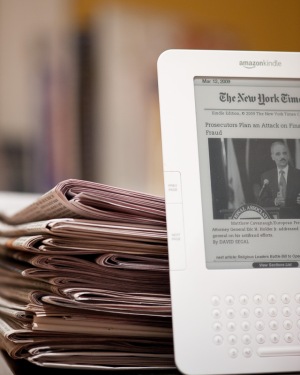
I was sorry to hear that Amazon plans to cut back on selling newspapers and magazines for the Kindle sometime next year, according to Jim Milliot of Publishers Weekly. The reason, I think, was the combination of a really bad deal for readers along with a recognition that the Kindle can’t compete with the whiz-bang color photos and multimedia that newspapers and magazines offer in their regular digital products.
Why are Kindle newspapers and magazines a loser for readers? Because you have to pay for the Kindle version over and above what you’re already paying for your digital subscription. A subscription to The New York Times on Kindle, for instance, costs $20 a month, and it makes no difference whether you’re already a Times subscriber.
On the rare occasions when I fly or take the Amtrak, I’ll buy that day’s Times for Kindle for $1. It downloads fully, so you don’t need wifi once it’s on your device. And I found it to be a pleasurable reading experience. Now, I like photography, and the small black-and-white photos you get on Kindle are no match for reading the Times on my iPad, or in print. But the Kindle provides a focused reading experience more akin to print than to digital, without the constant temptation to check your email or share an article on social media. Yet it is certainly not worth a separate subscription over and above what I’m already paying.
The Publishers Weekly article says that Kindle newspapers and magazines aren’t going away entirely. Reportedly “hundreds” of titles will be available for members of Kindle Unlimited, who pay $10 a month for access to a wide range of books and periodicals. But I think it’s still to be determined if you’ll be able to download a quality newspaper every day as part of that fee, especially since that’s only half what you’d pay for the Times alone right now.
Back in 2009, I suggested that The Boston Globe give away Kindles to subscribers. Instead, two years later the Globe started making its move toward paid digital subscriptions, which has been the paper’s salvation. I still like using my Kindle to read books, but most of us are far more likely to consume news on our phones.
I won’t call the semi-demise of Kindle newspapers a lost opportunity; it’s more a matter of changes in what we expect from our devices. The next time I take the Amtrak, though, I guess I’m going to have to find a Hudson News so that I can buy a print paper.
Paul Farhi of The Washington Post has an amazing story (free link) about The Hook, an alternative-weekly that used to publish in Charlottesville, Virginia. Its online archives disappeared after they were sold to a mystery buyer. Circumstantial evidence suggests that the buyer was a litigious deep-pockets guy who wanted to make invisible The Hook’s reporting about a sexual-assault case he was involved in years earlier.
Keeping online archives active and usable is a real challenge. Though what happened to The Hook was pretty unusual, it’s not unheard-of for valuable digital resources simply to disappear. Fortunately, the defunct alt-weekly I worked for, The Boston Phoenix, is available online through Northeastern University and the Internet Archive. You can find the Phoenix here.
It’s even more of a problem when the resource was digital-only and there was no print component that can be saved on microfilm. For instance, Blue Mass Group, a progressive political website that was a big deal in Massachusetts at one time, has been seeking a new digital home as the last of the co-founders, Charley Blandy, prepares to leave. Charley writes: “Plans are afoot for the site to be thoroughly crawled and archived. It won’t just disappear. The site will stay up, at least for a while, but for the purpose of archiving, commenting and posting will be disabled on 12/31/22.”
These resources need to be saved.
Given the fraught emotions that still surround the Fells Acres day-care case nearly 40 years after three members of the Amirault family were convicted of child sexual abuse, I thought The Boston Globe’s editorial was smart and nuanced.
The convictions of Gerald Amirault, his late mother, Violet Amirault, and his sister, Cheryl Amirault LeFave, have never been overturned despite multiple appeals, and several of the survivors continue to speak out about what they say they suffered at the day-care center the Amiraults ran. Gov. Charlie Baker’s last-minute bid to pardon them was inexplicable, and he was forced to withdraw his request in the face of a certain defeat at the hands of the Governor’s Council. The Globe covers that with a three-byline story here; and if you’re looking for a free link, WBUR.org has a pretty comprehensive report as well.
The Globe editorial cuts right to the heart of the matter: although a pardon is not an exoneration, the Amiraults’ supporters would surely take it as one, and that would be inappropriate:
Opponents of a pardon had feared, quite reasonably, that because the Amiraults have always proclaimed their innocence, any pardon would have been viewed as an official acceptance of their version of events, in which they were loving caregivers who were simply caught up in a hysterical moral panic. By implicitly calling the victims liars, a pardon on those grounds could have deterred victims in other cases from coming forward — “casting a pall over other children who will not be believed,” as Laurence Hardoon, the lead prosecutor in the case, said on Tuesday.
Over on the op-ed page, columnist Joan Vennochi adds:
Baker did not speak with the victims, or to Hardoon, who believed the children then, and still does. With that failure to reach out, the governor underestimated the power of their testimony and what victims like Jennifer Bennett — who was 3½ when she attended the day care center and is now 44 — believe to be true. The skeptics “can believe what they want. I know the truth. I was there, not them,” Bennett said during a break in the hearing.
Nearly every observer agrees that the case would not be investigated today as it was in the 1980s. Under repeated questioning, the children’s stories became more lurid over time, which is not surprising given that they were trying to process what had happened to them when they were as young as 3 or 4 years old. But that doesn’t mean they were brainwashed, as Dorothy Rabinowitz of The Wall Street Journal argued in a series of columns in the 1990s that served to reopen the case in the minds of the public. I wrote about Rabinowitz’s crusade in 1995 for The Boston Phoenix.
The Amiraults were in prison for a long time, and they’ve been free for a long time. We will never know with absolute certainty what happened at that day-care center, but they were not the victims of deranged prosecutors conducting a witch hunt. They received a fair trial in accordance with the best practices of that era. Enough.