House Speaker Kevin McCarthy. Photo (cc) 2020 by Gage Skidmore.
There were always two schools of thought as to what the Democrats ought to do about the civil war among the Republicans over who should be House speaker. One was to do exactly what they did: stay united and let the Republicans destroy themselves. Two years of hell awaits on the debt ceiling, aid to Ukraine and, of course, an idiotic investigation into Hunter Biden’s laptop.
One argument was that this was the best move politically — that after two years of chaos, the voters would gratefully turn back to the Democrats in 2024. And that may be the case.
The other school was that the Democrats should find a Republican they could work with, either inside or outside the House (the Constitution allows for outside candidates), stay united, and try to peel off a few reasonable Republicans to support a consensus candidate. My thought was that Liz Cheney might be a good choice. I heard former Maryland Gov. Larry Hogan’s name come up as well.
I understand this was always unlikely in the extreme. Keeping all 212 Democrats together and finding a half-dozen Republicans to form a majority was always going to be enormously difficult. And there really are no moderate Republicans. There’s a right wing, led by Kevin McCarthy (for the moment), and a far-right wing, led by no one. But if a consensus choice had emerged, we could have avoided the horrors I mentioned above. I also happen to think it would have been good politics for the Democrats.
Unfortunately, it did not come to pass. Two years after Jan. 6, 2021, the insurrectionists finally succeeded in taking over the House. God save the United States of America.
Downtown Marblehead, Mass. Photo (cc) 2011 by Daniel Mennerich.
People are starting to notice the local news renaissance in Eastern Massachusetts that’s been inspired by the Gannett newspaper chain’s never-ending cuts.
Dana Gerber reported in The Boston Globe on Tuesday about “The Great Marblehead Newspaper War,” where three independent start-ups have been launched in response to Gannett’s evisceration of the Marblehead Reporter last year. These days Marblehead is served by a for-profit digital project, the Marblehead Beacon; a well-funded digital and print nonprofit, the Marblehead Current; and the Marblehead Weekly News, a for-profit print newspaper started by The Daily Item of Lynn, which is itself independently owned.
Just a few days ago, Mariya Manzhos reported for Poynter Online about The Concord Bridge, another well-funded nonprofit start-up. And there are a number of others, including The Bedford Citizen, which at this point has to be considered venerable: the nonprofit digital site was started a decade ago by three volunteers in response to cuts by Gannett’s predecessor company, GateHouse Media, at the weekly Bedford Minuteman. Now the Citizen has a small paid staff and is the only news source in town, the Minuteman having been shut down last year. (The Citizen is one of the projects that Ellen Clegg and I are profiling in our book-in-progress, “What Works in Community News,” to be published in early 2024 by Beacon Press.)
But there is an ongoing problem, and it’s one I spoke with Gerber about when she interviewed me: these startups are highly concentrated in affluent, mostly white suburbs like, well, Marblehead, Concord and Bedford. Yes, there is The New Bedford Light, an extraordinarily well-funded nonprofit that’s gotten national attention, but that’s the exception. Most local outlets that serve more diverse communities, such as The Bay State Banner and the Dorchester Reporter, tend to be for-profit publications that have been around for a while; we’re seeing little in the way of new ventures to cover such places. And many have little or nothing. Cambridge Day does a good job, but it’s essentially a one-person shop. Why is Marblehead, with a population of under 20,000, getting more comprehensive coverage than a city of 117,000 people? (I should note that the Cambridge Chronicle is one of just three Gannett weeklies in Eastern Massachusetts that purportedly still covers some local news, although you wouldn’t know it from its website.)
As Manzhos notes, the Boston Institute for Nonprofit Journalism has provided some assistance to local news outlets. What we need, though, are news outlets that provide ongoing accountability journalism in each of the state’s 351 communities — city council, select board, school committee, police, development and the like. I hope that will happen.
We’re also closer than you might think. If you haven’t seen it before, here is a spreadsheet I maintain of every independent local news outlet in the state. Obviously some are better than others, but some of these are excellent.
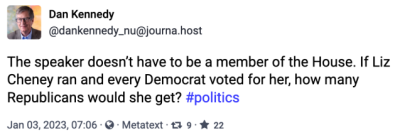
Earlier today I posted on Mastodon what I thought was a commonsense though impossible idea: the Democrats should nominate Liz Cheney for speaker. There didn’t seem like there would be any chance of that happening. There still doesn’t, although right-wing candidate Kevin McCarthy has just lost the third round of voting at the hands of the ultra-right.
But consider the possibilities. If you could get all of the Democratic House members to vote for Cheney, she would only need about a half-dozen Republican votes. I don’t know whether there are that many rational Republicans left to do such a thing, but maybe there are.
I’m not a fan of Liz Cheney on policy issues, but I admire her integrity and commitment to principle. The Republicans won the election and the Democrats lost, so I wouldn’t be expecting too much. But perhaps a Cheney speakership could lead to a few positive outcomes. She could agree ahead of time to stop Republican efforts to hold the debt ceiling hostage, which would risk default. She could draw sensible limits around Republican attempts to investigate the Jan. 6 commission of which she was part. And she could say no to Republican fantasies about turning the next two years into a witch hunt with Hunter Biden at the center.
Other than that, I would imagine she’d pursue the agenda of a typical conservative and work with Republicans more than Democrats. Progressive dreams are not going to come true in a House where Republicans outnumber Democrats. But is it too much to ask for decency and normality?
Update: Sorry, I forgot to note that there is no constitutional requirement that the speaker be a member of the House. That should clear up some confusion.
I doubt anyone is reading today, but here I am. I want to share an anecdote that I think sheds some further light on the media’s failure to expose serial liar George Santos before he was elected to Congress. My point is not to make excuses for the press — quite the opposite.
Way back in 1996, a somewhat obscure aide to Democratic congressman Joe Moakley named Jim McGovern stunned political observers by beating Republican congressman Peter Blute in the Central Massachusetts district that Blute had represented for two terms. Blute was scandal-free (at that time, anyway) and was not thought to be in any trouble. Polling in congressional districts, then as now, tends to range from poor to non-existent. Because of those factors, the race got virtually no coverage.
After McGovern won, I learned that political reporters were upset — not with themselves, but with Blute’s political consultant, Charley Manning, for not warning them that Blute might be in trouble. Yes, you read that correctly. Members of the press — some of them, anyway — thought it was Manning’s job to let them know that Blute wasn’t a shoo-in and that maybe they ought to pay some attention before Election Day.
Now, this isn’t entirely outrageous. Even 26 years ago, the media had limited resources, and there was a huge battle that year between Democratic Sen. John Kerry, who faced a strong challenge for re-election from Republican Gov. Bill Weld. It was a presidential year. And reporters (including me) were also busy covering the rematch between North Shore congressman Peter Torkildsen and attorney John Tierney; Torkildsen, a Republican, had nearly lost to Democrat Tierney two years earlier. (Kerry and Tierney both won in 1996, leaving Massachusetts with an all-Democratic congressional delegation, which has been unbroken to this day except for the brief Scott Brown interregnum.) Still, the idea of blaming Blute’s political consultant for their own inattention seemed then and now as fairly ridiculous.
So it strikes me that a large part of what went wrong in that Long Island House district was that the media made assumptions — always a bad idea, but nevertheless not at all unusual. Santos, a Republican, had lost in 2020 by a dozen points (albeit to an incumbent in a good year for Democrats). He seemed like a nonentity. The Democratic nominee in 2022, Robert Zimmerman, reportedly hadn’t turned up much beyond “Santos is a MAGA Trumper blah blah blah.” The New York media were obsessed with the possibility of a Red Wave and whether Democratic Gov. Kathy Hochul might be able to hang on. Inexcusably, everyone ignored pre-election reporting by the weekly North Shore Leader, which was able to publish some key details about Santos’ lies. And there matters stood until Dec. 19, when The New York Times published the first in a series of stories exposing Santos as an utter fraud.
So unless someone proves that Santos isn’t a U.S. citizen (a possibility), he’ll be sworn in on Jan. 3, casting a crucial vote to make Kevin McCarthy speaker. All because the media was depending on others to do their job for them.
Sarah Ellison of The Washington Post (free link) has a terrific story on The North Shore Leader, the Long Island weekly that broke parts of the George Santos story several weeks before the election only to be ignored by larger media outlets. I want to focus on this astonishing section:
Despite a well-heeled and well-connected readership — the Leader’s publisher says it counts among its subscribers Fox News hosts Sean Hannity and Jesse Watters and several senior people at Newsday, a once-mighty Long Island-based tabloid that has won 19 Pulitzers — no one followed its story before Election Day.
For obvious reasons, we can set Fox News aside. But one of the big questions all along has been why Newsday didn’t follow up. Now we know, at least according to the Leader, that “several senior people at Newsday” are among its readers. Assuming they saw the Leader’s coverage, which included a hard-hitting news story as well as a withering editorial endorsing Santos’ Democratic opponent, then there is no excuse for Newsday’s failure to dive in. Not to let The New York Times off the hook, either — though it is primarily a national and international newspaper, it does purport to cover the New York metro area. Yes, it’s the Times that finally exposed Santos as the fraud that he is, but it’s a little late.
I’ve seen a number of observers try to fit this square peg into the round hole of the ongoing local news crisis. Frankly, this strikes me as having more to do with journalistic sloth and arrogance, which have always been with us.
Finally, I talked with the USA Today podcast “Five Things” about the media and political breakdown that led to Santos’ winning a congressional seat without anyone other than the Leader holding him up to any scrutiny. You can listen here.
William Loeb in 1974. Photo via the Spencer Grant Collection / Boston Public Library.
I thought the final days of 2022 would be a good time to take stock of the state of Media Nation. I’ve put more of an effort into it since giving up my weekly column at GBH News last spring. Even though I stopped writing for GBH so that I could concentrate on writing the book that Ellen Clegg and I are co-authoring on local news, I’ve also tried to put more of an effort into the blog. It seems to have paid off.
According to the data, Media Nation received more page views in 2022 (243,489) than it had since 2014 (258,982). More visitors (160,548) dropped by than in any year for which I have data — the numbers only go back to 2013, and I’ve been blogging independently since 2005. I also published 329 posts in 2022, which is more than any year except 2021, when I published 530. I really don’t know what that was all about; it seems to me that I’ve been blogging more this year than last.
As you may know, this is the age of newsletters, and blogs are considered passé in many circles. So I’m pleased that 2,156 people have signed up for free email delivery of new posts to Media Nation, which makes this place a newsletter as much as it is a blog. I also have a small but hardy band of members who pay $5 a month to keep the blog going. If you’d like to join them, you can sign up here.
What follows are my top 10 posts for 2022. The most trafficked post was about revelations that the late William Loeb, the notorious right-wing publisher of the Manchester Union Leader, was a child molester. Five of the top 10 pertain to the Gannett newspaper chain, which went on a downsizing crusade in 2022 that made its previous efforts look almost benevolent. And away we go.
1. William Loeb’s stepdaughter says the toxic publisher was also a child molester,May 1 (8,820 views). Who would have thought that Loeb’s deservedly ugly reputation for racism, antisemitism and all-around hate-mongering could get any worse? Well, it did — so much so that his old paper, since rechristened the New Hampshire Union Leader, removed his name from the masthead.
2. Gannett goes on a massive spree of merging and closing papers weekly newspapers, March 17 (7,634 views). This will go down as the year when Gannett more or less got out of the weekly newspaper business in Massachusetts. The chain also made deep cuts at its 200 dailies, including its flagship, USA Today. But the weeklies, in particular, have been targeted for elimination.
3. While Gannett journalists brace for layoffs, those at the top rake in big bucks, Aug. 8. (6,273 views). Chair and CEO Michael Reed’s compensation has been an issue for years, but it seemed especially relevant at a time when his underpaid journalists were losing their jobs by the hundreds. According to company documents, Reed was paid more than $7.7 million in salary and other benefits in 2021. Compensation for other executives and for part-time board members was eye-popping as well. Who says the newspaper business doesn’t pay?
4. Gannett’s Mass. weeklies to replace much of their local news with regional coverage, Feb. 16. (5,120 views). To my mind, this was worse than shutting down and merging many of the weeklies. With the exception of just three papers (the Cambridge Chronicle, the Old Colony Memorial of Plymouth and the Provincetown Banner), Gannett eliminated virtually all local coverage, replacing it with regional beats such as climate change, the criminal justice system and food. Those are not unworthy topics, but who’s going to keep an eye on town hall? Fortunately, the year was also defined by the rise of new local news outlets in Marblehead, Concord, Newton and elsewhere — a trend I expect will continue in 2023.
6. “A Civil Action”: The real story, Dec. 18, 1998 (4,738 views). Now this one is a real mystery. I wrote the piece for The Boston Phoenix just before the movie version premiered, reporting on what actually happened to the Woburn families who sued three industrial polluters after their children became sick with leukemia; two of the children died. Since Northeastern University now owns the rights to the Phoenix archives, I posted it on Media Nation in 2015 in order to make it more accessible. But I have no idea why it got so many views in 2022. All I can think of is that someone assigned it for a course.
8. A Long Island weekly had the goods on Santos several weeks before Election Day, Dec. 23 (4,152 views). This one is still resonating and may move up in the rankings before the year draws to a close. Following up on reporting by Josh Marshall of Talking Points Memo, I found that The North Shore Leader had exposed some of the details about serial liar George Santos several weeks before Election Day — raising questions about why larger news organizations such as The New York Times and Newsday didn’t take notice.
10. Bob Garfield revisits his firing from ‘On the Media’ and brings his podcast to a close, June 21 (2,484 views). The public radio program “On the Media” has been one of my must-listens for many years, although I’m not happy that the program is less and less about the media. (There have been some recent signs of a return to form.) The chemistry between co-hosts Garfield and Brooke Gladstone was one of the things that made it special, even though we now know they hated each other’s guts. Garfield was fired in 2021 and accused of abusive behavior in the workplace, an accusation he more or less admitted to but defended anyway. And by the way, my post on Gladstone’s taking to the airwaves to say that Garfield got what he deserved was my most viewed (9,172 times) of 2021. The break-up of Gladstone and Garfield’s professional partnership obviously meant a lot to many people.
Londonderry (N.H.) Town Hall. Photo (cc) 2021 by Sdkb.
There’s been a sad development in the case of a New Hampshire newspaper publisher who was criminally charged with running political ads that did not include the required disclosure. Debra Paul announced last Friday that she and her husband, Chris Paul, are closing two of their three weekly newspapers, the Nutfield News and the Tri-Town Times. They will continue to publish the Londonderry Times. She wrote:
It’s been a good 18+ years, all things considered. Chris and I didn’t make millions, but we never expected to. I’ve never felt such delight as when people would come up and thank us, saying it seemed like “their” newspaper. Over the years we have come to know so many amazing people, some we call friends and hope to continue to keep even though we are not printing the paper.
The story of Paul’s arrest was reported last August by the investigative news organization InDepthNH. Paul published ads for political candidates that, in several instances, failed to include the words “Political Advertisement,” a violation of state law. No sentient being could possibly have thought the offending materials were anything other than political ads, but that didn’t stop the state attorney general’s office. At least in theory, Paul could be hit with a $2,000 fine or at least a year in prison.
It sounds like an outrageous breach of First Amendment protections, but the law isn’t necessarily unconstitutional because paid advertising does not enjoy the same protections as other forms of speech. In an odd twist, Debra Paul is also an elected member of Londonderry’s town council — an obvious conflict of interest for a newspaper, although that’s entirely unrelated to her arrest.
I could not find a follow-up, so I don’t know if this ridiculous case against Paul has been disposed of. But I’m going to try to find out.
Thanks for the traffic, Bob! Photo (cc) 2011 by Francisco Antunes.
I was looking at my WordPress statistics for 2022, and one number really leaped out at me. Twitter was the third-largest source of traffic to Media Nation in 2022. Search engines were responsible for 70,626 views, Facebook was second at 27,126, and Twitter was right behind at 25,371.
As you probably know, I’ve stopped using Twitter. But it shows you why walking away is pretty close to impossible for self-employed journalists and marginal operators who can’t afford to spurn any service that drives traffic to their site. Although I have a voluntary membership program for $5 a month (please consider!), my livelihood is not dependent on Media Nation.
Search, Facebook and Twitter were the big three, followed by LinkedIn at 4,047 and, in fifth place, an unexpected source: Editor & Publisher, the news industry trade publication, at 3,827. E&P has been kind enough to feature my posts in its daily newsletter on a fairly regular basis, so I guess that’s the explanation. Other notable entries in the top 10 were Universal Hub and Expecting Rain, a site for fans of Bob Dylan, who I’ve been known to write about from time to time. From there it quickly dribbles down to double and single digits.
I’ve taken most of my Twitter-like posts to Mastodon, so I was curious to see that there was nothing. The explanation, I found out, is that Mastodon contains code that makes referrals invisible, which is supposedly some sort of privacy protection. I don’t quite get it, and I’ve learned about a workaround that will supposedly make Mastodon referrals show up. I am getting some referrals from Post News, which, like Mastodon, is emerging as a leading Twitter replacement.
The State Capitol in Concord, N.H. Photo (cc) 2010 by Jimmy Emerson, DMV.
There was news in Mark Shanahan’s Boston Globe story on the decline of the once-great Providence Journal under Gannett ownership: the Globe is opening a New Hampshire bureau sometime in 2023, a move similar to what it’s done in Rhode Island.
At one time the Globe took New England coverage seriously, even publishing a Sunday section called New Hampshire Weekly. On a recent episode of our podcast about local news, “What Works,” Nancy West, executive director of the investigative news organization InDepthNH, said she would welcome a Globe comeback in the Granite State.
“I loved it when the Globe came up and was doing important reporting,” she said, citing in particular the paper’s coverage of a cardiac surgeon at Catholic Medical Center in Manchester whose horrendous malpractice record was obscured by his status as an operating-room star. “Was I a little jealous? My first instinct is jealousy, of course,” West told us. “But then I’m just really pleased that the word is getting out.” She added: “I would love to have the Globe come back. I would love to see it because we just need talented reporters on the street. And I think competition is healthy.”
Unlike Rhode Island, New Hampshire’s two major daily newspapers, the New Hampshire Union Leader and the Concord Monitor, are independently owned. Both, however, have endured significant cuts to their reporting capacity in recent years. As West says, another news organization focused on the state would be welcome.
As with Rhode Island, New Hampshire is an opportunity for the Globe to sell more digital subscriptions without the hassle of bygone days, when it was necessary to truck papers across New England.
So where might the Globe go next? Vermont strikes me as a stretch. Connecticut? Probably not. Much of the state roots for the Yankees, and Hearst CT has a growing digital operation. Maine? Possibly, although the Globe has collaborated on some stories with the Portland Press Herald. I’m not sure they’d want to compete. If they do, David Dahl, a former top editor at the Globe who’s now editor of the nonprofit Maine Monitor, told us on “What Works” that he’d love to work with his old paper. “We’re open to any partnership discussions that we would have,” he said, “and if they want to affiliate with us, they’re more than more than welcome.”
The most logical move for the Globe after New Hampshire would be an expanded presence in Central Massachusetts — ironic given that Globe owner John Henry acquired the Telegram & Gazette of Worcester when he bought the Globe in 2013 only to sell it to out-of-state interests. The T&G eventually landed in the hands of GateHouse Media, which merged with Gannett; like most of Gannett’s properties, the T&G has been gutted.
At a time when the decline of advertising and fears of recession are leading to cuts even at once high-flying newspapers like The Washington Post, it’s heartening to see that the Globe continues to focus on expansion.