The Scope, a social-justice website published by our School of Journalism, has unveiled a news-by-text pilot program so that Boston residents can receive information about testing sites, food pantries and other news related to the pandemic. The project is being led by Lex Weaver, one of our graduate students.
The initiative got a mention today from the American Press Institute.
At the beginning of 2021, I decided to shift my online activities — I was going to blog more and use Facebook and Twitter less. At the same time, I decided to start offering memberships to Media Nation for $5 a month, following the lead of Boston College historian Heather Cox Richardson, pundits such as Andrew Sullivan, reporters such as Patrice Peck and others.
Most of these other folks are using Substack, a newsletter platform. I figured I had sunk way too many years — 16 — into writing Media Nation as a blog, and I didn’t want to switch to a platform that’s reliant on venture capital and could eventually go the way of most such companies. So here I am, still blogging at WordPress.com, and asking readers to consider becoming members by supporting me on Patreon.
And yes, I have been blogging more as I try to stay on top of various media stories, especially involving local journalism, as well as politics, culture and the news of the day. Just this week I’ve written about Larry Flynt and the First Amendment, Duke Ellington’s legacy, a new partnership between The Boston Globe and the Portland Press Herald, and a Louisiana reporter who’s been sued for — believe it or not — filing a public-records request.
If you value this work, I hope you’ll consider supporting it for $5 a month. Members receive a newsletter every Friday morning with exclusive content.
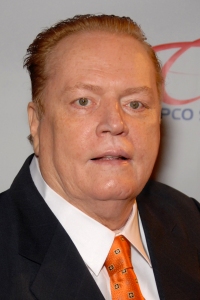
Larry Flynt, who took mainstream pornography to a new low, was an unlikely champion of the First Amendment. Then again, most First Amendment champions are unlikely. As Oliver Wendell Holmes Jr. put it, it’s “freedom for the thought that we hate” that needs protecting, not anodyne statements that offend no one.
Flynt, who died Wednesday at 78, many years after surviving an assassination attempt that left him partially paralyzed, achieved freedom-of-speech immortality because of a parody that he published in his magazine Hustler. It took up a full page and was meant to look like an ad, although the words “Ad Parody — Not to Be Taken Seriously” did appear at the bottom. The fake ad was a takeoff on a series of a real ads for Campari liqueur in which various celebrities talked about their “first time.” The idea was to make it appear they were discussing the first time they’d had sex, only to reveal at the end that they were talking about the first time they drank Campari.
The Hustler parody starred the Rev. Jerry Falwell, founder of the Moral Majority, a leader of the first wave of right-wing television evangelists and a figure of revulsion among liberals. Among other things, Flynt’s Falwell spoke about the “first time” he’d had sex with his mother in an outhouse.
Falwell sued for libel and the intentional infliction of emotional distress, arguing on the latter count that the parody met the legal standard for “outrage.” The case, Hustler Magazine v. Falwell, decided by the U.S. Supreme Court in 1988, established two important principles.
First, on the libel claim, Falwell contended that the parody was false and defamatory. Since he was a public figure, he also had to establish that Hustler published it knowing or strongly suspecting that it was false. A federal appeals court had thrown out the libel count on the grounds that there were no statements in the ad that could be subjected to a true-or-false test. In other words, no reasonable person could possibly believe that Falwell had sex with his mother in an outhouse and had then talked about it for a liqueur ad. The Supreme Court upheld the lower court’s ruling.
Second, the Supreme Court overturned the appeals court’s ruling on the emotional-distress allegation. In so doing, the high court imposed the Times v. Sullivan “actual malice” libel test to claims of emotional distress: in order for a public official or public figure to win such a suit, they would have to show that the offending material contained a false statement of fact — again, with the knowledge that it was false or strongly suspecting it was false. The ruling established a significant new protection for parody and satire.
The unanimous decision, written by Chief Justice William Rehnquist, compared the parody to previous work by Thomas Nast about the corrupt Tweed ring in New York, vicious cartoons about George Washington, and other political and public figures. Rehnquist wrote:
There is no doubt that the caricature of respondent [Falwell] and his mother published in Hustler is at best a distant cousin of the political cartoons described above, and a rather poor relation at that. If it were possible by laying down a principled standard to separate the one from the other, public discourse would probably suffer little or no harm. But we doubt that there is any such standard, and we are quite sure that the pejorative description “outrageous” does not supply one. “Outrageousness” in the area of political and social discourse has an inherent subjectiveness about it which would allow a jury to impose liability on the basis of the jurors’ tastes or views, or perhaps on the basis of their dislike of a particular expression.
Whenever I teach our First Amendment course, I assign my students to write about a major case of their choosing. Inevitably, half the papers are about Hustler v. Falwell, nearly always accompanied by a copy of the ad — just in case I’d forgotten what it looked like, I suppose.
And if you ever get a chance to see the 1996 movie “The People v. Larry Flynt,” you should. It’s a rollicking good portrayal of the whole affair.
Become a member! For $5 a month, you can support Media Nation and receive a weekly newsletter with exclusive content. Just click here.
You would think that reforming the opaque workings of the Massachusetts legislature would be something everyone could agree on. In fact, though, you can always find someone to defend the status quo.
Last summer, for example, New England School of Law Professor Lawrence Friedman wrote in The Boston Globe that the legislature should keep its exemption from the state’s public records law even though Massachusetts is only one of just four states with such a secrecy statute.
“It is not difficult to imagine state representatives and senators censoring themselves out of concern that their words might be taken out of context,” Friedman wrote. “Perspectives about proposed laws and their implications could go unshared and, therefore, unconsidered.”
Now Raymond La Raja, a political science professor at UMass Amherst, has written a commentary for CommonWealth magazine arguing that efforts to make committee votes public are misguided and would lead to more power for the legislative leadership. Such a move would also create incentives for grandstanding by members, La Raja argues, conjuring up the dysfunction in Washington as a warning:
Congress is an obvious example of where “messaging” has become more important to many than legislating. Using Twitter, members can score political points against opponents, shame colleagues, and try to torpedo discussions on policy. Calling out colleagues on committee votes or internal deliberations is especially valuable to extremists who value purity. The model here is the Freedom Caucus, whose members call other Republicans “RINOs” (Republicans in name only) and threaten to enlist primary opponents against them. This kind of behavior erodes goodwill and the ability to forge the kind of compromises that make democracy possible.
CommonWealth contributor Colman M. Herman disagrees, writing that the Massachusetts legislature “is one of the least transparent legislatures in the entire nation.” Herman is right. And the idea that good government will lead to bad government is absurd. If our elected officials need secrecy in order to do the right thing, then we are in mighty bad shape.
One afternoon in early 2016, I arrived at The Boston Globe’s former headquarters in Dorchester to talk with John Henry about the state of his newspaper. Before we could begin, though, he wanted to talk about something that was bugging him.
Google, it seemed, had started slapping the word “subscription” on Globe content when it came up in searches, even though few people were likely to run into what was then a relatively porous paywall. It took months to straighten out, he complained — costing the Globe readers and, therefore, advertising revenue.
Henry’s lament illustrates the complicated relationship publishers have long had with Google. On the one hand, they complain bitterly that the dominant search engine is repurposing their journalism without paying for it. On the other hand, they depend on the clicks that Google sends their way.
Now matters may be coming to a head.
Under pressure from the Australian government, Google and Facebook have agreed to start paying for the content they repackage, MediaPost reports.
In the U.S., the News Media Alliance, which represents newspaper publishers, has long sought an exemption from antitrust law so that they could attempt to negotiate a compensation package with the two companies. There are signs that Congress may finally pass legislation to let them try.
And now, a chain of newspapers in West Virginia has filed a lawsuit charging that Google and Facebook violated antitrust laws by forming an alliance aimed at perpetuating their monopoly on digital advertising.
In order to understand exactly what the two companies — especially Google — have done to harm the news business, you need to consider two different but related practices.
First there is the matter of grabbing content, which, as Henry’s complaint shows, is convoluted: Publishers can’t live with Google and can’t live without it. Years ago, before the Google-Facebook lockdown on ad revenue was even on the horizon, publishers would argue that Google should pay them. Google would counter that it was driving traffic to news sites, thus increasing the value of advertising on those sites. There was some logic to Google’s argument, though somehow it never worked out in favor of the publishers.
The problem in recent years is that Google acquired a number of advertising businesses and now controls not just search but also the advertising associated with search. Through the use of an automated auction system, the price of digital ads is being driven ever lower, making it all but worthless. As Nicco Mele, a former deputy publisher of the Los Angeles Times, explained several years ago, a full-page weekday ad in the paper that cost $50,000 had given way to Google ads on its website that brought in less than $20 to reach the same number of readers.
“To a large extent, Facebook and Google are sucking up revenue that publishers of content should be receiving,” Mele told an audience at Harvard.
It’s the ever-shrinking value of digital advertising that’s being targeted in the West Virginia lawsuit, brought by HD Media. The small chain owns seven newspapers, most notably the Charleston Gazette-Mail and The Herald-Dispatch of Huntington. Paul Farrell, the lawyer who represents the papers, told the trade magazine Editor & Publisher that Google is leveraging its control of two entirely different businesses in order to monopolize ad revenues and squeeze out anyone else.
“They have completely monetized and commercialized their search engine, and what they’ve also done is create an advertising marketplace in which they represent and profit from the buyers and the sellers, while also owning the exchange,” Farrell was quoted as saying. “Google is the broker for the buyer and gets a commission. Google is the broker for the seller and gets a commission. Google owns, operates and sets the rules for the ad exchange. And they are also in the market themselves.”
So where does Facebook fit in? According to a lawsuit filed by several state attorneys general that was reported by The Wall Street Journal, Google and Facebook are colluding through an agreement that Google has code-named Jedi Blue. The AGs contend that Google provides Facebook with special considerations so that Facebook won’t set up a competing ad network. (Google and Facebook have denied any wrongdoing, and, in the E&P story, Google reiterated that stance with regard to the HD Media suit.)
For Google, it’s a perfect closed environment: It holds a near-monopoly on search and the programmatic advertising system through which most ads show up on news websites. And it has an agreement with Facebook aimed at staving off competition.
As Washington Post media columnist Margaret Sullivan observed, the collapse of advertising is what has led to the closure of more than 2,000 newspapers over the past 16 years — as well as the shrinkage of surviving papers like the Gazette-Mail, which won a Pulitzer Prize for its coverage of the opioid crisis in 2017.
Back when newspapers were manufactured out of dead trees, advertising was responsible for about 80% of revenue. Once they started moving online, that revenue stream was decimated, first by Craigslist, a mostly free service that scooped up nearly all the classified ads, and then by Google and Facebook.
Ironically, Craigslist founder Craig Newmark today directs much of his considerable philanthropy to the news business, and Google and Facebook spend quite a bit on various journalism initiatives as well. But whereas Newmark’s only sin was to build a better mousetrap, Google and Facebook’s dominance has more in common with the robber barons of the Gilded Age. It’s time that someone brought them to heel.
At least some newspapers have come up with a formula for overcoming the digital-advertising debacle. The New York Times, The Washington Post, The Wall Street Journal and, yes, John Henry’s Boston Globe have all reinvented themselves as successful enterprises by reducing their reliance on ads in favor of digital subscriptions.
But it’s far from clear whether that will work for local and most regional papers, and even those that are doing well run the risk of becoming overreliant on one source. A reliable stream of ad revenue, freed from the depredations of Big Tech, would go a long way toward revitalizing journalism.
The Boston Globe will partner with the Portland Press Herald on an unspecified investigative reporting project, according to the trade publication Editor & Publisher. The partnership will produce “a multi-part investigative report that will be published by both organizations this fall.”
The project will be funded by the Spotlight Investigative Journalism Fellowship, established by the Globe and Participant Media, the producers of the movie “Spotlight.” Grants of up to $100,000 are awarded to reporters or teams of reporters. This is the first time the Globe has partnered with another news organization. The series will be published by both papers.
Scott Allen, the Globe’s assistant managing editor for projects, declined in an email to say what the topic of the reporting would be — but when I noted that the Press Herald reporter who’ll be working on the project, Penelope Overton, covers the lobster industry, Allen said that “we expect to take full advantage of her considerable expertise.”
There are some interesting intersections between the Globe and the Press Herald. The E&P story points out that Press Herald managing editor Steve Greenlee worked at the Globe for 12 years. But it goes beyond that. Lisa DeSisto, who is chief executive officer of the Press Herald and its sister papers, was previously a high-ranking business-side executive at the Globe (and, before that, a colleague of mine at The Boston Phoenix).
The two papers also have the distinction of having been pursued by Boston-area businessman Aaron Kushner, who tried to buy the Globe in 2010 and nearly succeeded in buying the Press Herald in 2012. Kushner and a team of investors ended up purchasing the Orange County Register in Southern California later in 2012. They spent considerable resources in building up the Register and acquiring and launching other papers — only to tear it all down in short order when the hoped-for revenues failed to materialize. Today the Register is owned by the notorious hedge fund Alden Global Capital. (I tell the story of Kushner’s newspaper adventures in my book “The Return of the Moguls.”)
Today the Press Herald is owned by Reade Brower, a printer, who’s built a small chain of Maine newspapers and gets generally high marks for his stewardship. The Globe, of course, is owned by billionaires John and Linda Henry.
Duke Ellington performs for patients Nov. 3, 1954, at the KFG Radio Studio for Fitzsimons Army Medical Center in Aurora, Colorado. (U.S. Army photo)
Louis Armstrong, Duke Ellington and Charlie Parker are often described as the three founding giants of jazz. Parker’s music comes across as modern and accessible to those of us listening today, though too modern and inaccessible when he arrived in the 1940s. Armstrong seems like an artifact from the distant past. That leaves Ellington, generally regarded as one of the great geniuses of 20th-century music but not often heard anymore unless you seek him out.
I had long wanted to know more about Ellington and his music, so I recently listened to the audio version of Terry Teachout’s 2013 biography, “Duke: A Life of Duke Ellington.” I learned a lot. But I wish, instead, that I could have listened to a series of lectures with examples from Ellington’s music. A nearly 18-hour biography of a musician with no music felt like a lost opportunity. I also would have liked a more generous telling of the Duke’s life.
One aspect that especially impressed me was that — unlike Armstrong (the subject of an earlier Teachout biography) — Ellington was largely able to elude the racist stereotypes of the day. From the earliest years of his career, Ellington was presented as an artist who came about as close to transcending race as was possible at the time. (And no, it’s still not possible today.)
Part of it was because of his manager, Irving Mills, who deserves a great deal of credit even if he and Ellington eventually had a falling-out. (Among other things, Ellington discovered Mills had lied to him about how much he’d spent on a coffin for Ellington’s mother.) Part of it was because Ellington came from a middle-class Washington family with bourgeois aspirations; Ellington was ever-conscious of acting as a Black role model. And part of it, Teachout acknowledges, is that Ellington was light-skinned.
Become a member! For $5 a month, you can support Media Nation and receive a weekly newsletter with exclusive content. Just click here.
My problems with Teachout are three-fold. First, he dwells at excessive length on Ellington’s voracious sexual appetites. Second, he dwells at even more excessive length on Ellington’s habit of lifting what he’d heard from other musicians without giving credit. Music, and jazz in particular, is a collaborative art, and it seems to me that the point could be made without driving it home over and over. It has to be said, though, that Ellington went too far at times, so much so that he broke the heart of his closest collaborator, Billy Strayhorn.
Third, Teachout’s analysis of Ellington’s music strikes me as oftentimes pedantic and obscure. Teachout believes that Ellington’s genius was in making three-minute records, and that his longer pieces fell short because he had never studied the European classical composers to learn how it’s done. But is that really a fair criticism? Ellington was a Black composer working in an African American idiom. Maybe his longer pieces came out just the way he wanted them to.
Even so, I learned a lot. Right now I’m listening to “Never No Lament: The Blanton-Webster Band,” recorded between 1940 and ’42 and regarded as the height of Ellington’s career. And Teachout includes a lot of fascinating details, including Ellington’s receiving the Medal of Freedom from Richard Nixon at a White House reception at which Nixon sat at the piano and played “Happy Birthday” for the Duke.
In a New York Times review, James Gavin called “Duke” a “cleareyed reassessment of a man regarded in godlike terms.” Despite its flaws, I found it to be a valuable guide to a the life and work of a genius who, today, is known mainly for being well-known. It’s time to listen to Ellington anew.
Walter Lippmann in 1905. Photo in the public domain.
Isaac Chotiner of The New Yorker has a terrific interview with Marty Baron, who’s retiring as executive editor of The Washington Post. I’m amused at the way Baron treats The New Yorker with the same brusqueness as he does other media outlets. For instance:
Chotiner: Why do you think [Jeff] Bezos decided to buy the Post?
Baron: You can look at what he’s said about that. I assume that you have. He’s talked about it many times.
Baron also expresses the view that local newspapers are going to have to save themselves the same way that national papers did: by persuading their readers to pay for it.
I was struck by how similar much of what Baron said was to my 2016 interview with him for “The Return of the Moguls.” Baron has his lodestar, and he follows it. But how journalists should and shouldn’t use social media is a bigger issue today than it was in 2016, so he and Chotiner talk about that quite a bit. And Baron also defines objectivity in exactly the way that I try to get it across to my students:
I do think that people have been routinely mischaracterizing what objectivity means. It really dates back a hundred years. Walter Lippmann essentially was the originator of the idea. What was the idea? It was a recognition that all of us as journalists, all of us as human beings, have preconceptions. Those preconceptions arrived from our own backgrounds, our life experiences, the people we associate with, you name it. And it’s important as we go about our reporting that we try to set those preconceptions aside — and almost approach our work in as scientific a way as possible — and to be open-minded, to be honest, to be fair, to listen generously to people, to hear what they have to say, to take it seriously into account, to do a thorough job of reporting, to do a rigorous job of reporting.
The idea of objectivity — I should make clear — it’s not neutrality, it’s not both-sides-ism, it’s not so-called balance. It’s never been that. That’s not the idea of objectivity. But once we do our reporting, once we do a rigorous job and we’re satisfied that we’ve done the job in an appropriate way, we’re supposed to tell people what we’ve actually found. Not pretend that we didn’t learn anything definitive. Not meet all sides equally if we know that they’re not equal. It’s none of that. It’s to tell people in an unflinching way what we have learned, what we have discovered.
Louisiana Attorney General Jeff Landry. Photo (cc) 2011 by Gage Skidmore.
Well, this is certainly a novel response to receiving a public-records request. The Republican attorney general of Louisiana, Jeff Landry, has sued a reporter for The Advocate and The Times-Picayune. The newspapers are seeking records about an official in the AG’s office who’s been accused of sexual misconduct. Landry has asked a judge to issue a declaratory judgment turning down the request and sealing the proceedings.
“In my 40 years as an editor, I’ve never seen a journalist get sued for requesting a public record,” Peter Kovacs, the newspaper’s editor, was quoted as saying. “We’re not intimidated. In fact, we’re more determined.” The reporter, Andrea Gallo, took to Twitter to warn: “I worry about reverse FOIA [Freedom of Information Act] suits against those who do not have my level of resources to fight back. Another reason to support local journalism!”
Just wanted to thank everyone who has reached out about this! I'm overwhelmed by the support. I worry about reverse FOIA suits against those who do not have my level of resources to fight back. Another reason to support local journalism!https://t.co/ClI1M96WxS
In fact, Gallo’s fears are already coming true. According to The Washington Post, such lawsuits are on the rise, with University of Georgia professor Jonathan Peters citing such examples as a lawsuit against a student newspaper filed by a university and an education agency that sued a nonprofit seeking enrollment information. Peters told the Post:
Government officials generally claim that these actions are initiated in good faith and that it is prudent for courts to step in immediately if an agency’s disclosure obligations are unclear. But suing record requesters is unwise, democratically dangerous, and usually unlawful.
Here in Massachusetts, reporters have long since grown accustomed to having their public-records requests ignored. Thanks to a weak state law, penalties for ignoring a valid public-records request are minimal, and government officials take full advantage of that. But suing journalists for seeking public records takes matters to a new and dangerous level.