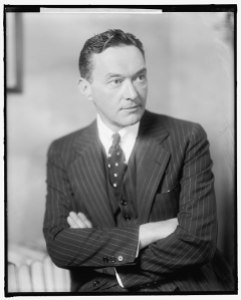
Walter Cronkite in 1976. Photo in the public domain.
If you haven’t seen it yet, I recommend M. Gessen’s essay in The New York Times opinion section about their grandmother’s work as a censor for the Stalin regime. Among other things, she had the task of bowdlerizing Harrison Salisbury’s Times dispatches, a source of endless frustration for Salisbury.
One detail that caught my eye was this slam of Walter Cronkite, the saint of broadcast news, who was the Moscow bureau chief for United Press in the late 1940s.
Joseph McCarthy’s anti-communist witch hunt discredited the just-the-facts model of journalistic objectivity. Photo via the Encyclopedia Britannica.
On Nov. 21, 1954, Palmer Hoyt strode to the podium at the University of Arizona to accept the John Peter Zenger Freedom of the Press Award. Hoyt, the editor and publisher of The Denver Post, was being honored for his courage in standing up to Joseph McCarthy and his anti-communist witch hunt — a notable exception to the timidity shown by much of the press in tangling with the Republican senator from Wisconsin.
Hoyt used the occasion to call out publishers who had enabled McCarthy’s campaign of lies and character assassination. As quoted in Bill Hosokawa’s 1976 book, “Thunder in the Rockies,” an authorized history of the Post, Hoyt told his audience, “It is true that the number of newspapers critical of McCarthy has grown during the last year or two. But there are still many of them who are his supporters, his apologists, even his devotees.” Moreover, he denounced McCarthy’s journalistic toadies for being “as short-sighted as they are self-destructive.”
The larger target of Hoyt’s disdain was the notion of journalistic objectivity, or at least a certain definition of that much-used and much-abused term.
In his 2010 book “The Shallows: What the Internet Is Doing to Our Brains,” Nicholas Carr argued that our immersion in digital media is rewiring the way we think, turning us into distracted skimmers who are losing the capacity for deep concentration.
Yet social media was in its infancy back then. His lament in those days was aimed at a panoply of online distractions such as email that needed to be written, blogs that cried out to be read, streaming videos, downloadable music — in other words, anything but the task at hand. He mentions Facebook, but only in passing. Over the years, I’ve sometimes wondered what he would make of the explosion not just of Facebook but of Instagram, TikTok and their ilk now that they’ve taken over so much of our lives.
Well, my question has been answered. Earlier this year Carr published what is essentially a follow-up to “The Shallows.” Titled “Superbloom: How Technologies of Connection Tear Us Apart,” the book surveys the mediascape of algorithmically driven tech platforms and finds that it is not just driving us to distraction but is creating a less happy, more polarized and more dangerous world.
Marty Baron, right, with then-Knight Foundation president Alberto Ibargüen. Photo (cc) 2017 by the Knight Foundation.
I downloaded Martin Baron’s book, “Collision of Power: Trump, Bezos, and The Washington Post,” on the first day that it became available. I expect it’s going to take me a while to read it, but I plan to review it once I’ve made my way through its 576 pages. The Post under Bezos and Baron comprise the longest section of my 2018 book, “The Return of the Moguls,” although — since it ends with Donald Trump’s Electoral College victory — I did not cover how the Post navigated the Trump presidency.
Based on what others are writing, and on interviews that Baron is giving during the early days of his book tour, it sounds like journalistic objectivity is a major theme of “Collision of Power.” Baron has written and talked about this before, as he did in an address this past spring at Brandeis University. And what his critics don’t give him enough credit for is that he subscribes to the proper view of objectivity defined by Walter Lippmann more than a century ago.
In Baron’s view, like Lippmann’s, objectivity is the fair-minded pursuit of the truth, not both-sides-ism, not quoting a variety of views and leaving it up to the poor reader or viewer or listener to figure it out. For instance, here’s Baron’s answer when he was asked by CNN media reporter Oliver Darcy about how good a job the press is doing in its coverage of the Republican Party’s meltdown into lunacy and authoritarianism:
I think the coverage of the latest chaos has been very good, based on what I’ve read. It portrays the Republican Party as Chaos Central, which it is. The party is proving to be ungovernable, and that is wreaking havoc on the country as a whole. The bigger issue is Trump. I’d like to see substantially more coverage of what a second Trump administration would do upon taking office. Who would be put in cabinet posts? Who would be put in charge of regulatory agencies?
No doubt Trump would embark on an immediate campaign of vengeance. Plans are already in the works. What would that mean for the FBI, DOJ, the courts, the press — really for all the institutional pillars of our democracy? Some stories have been produced, though not enough in my view. Those sorts of stories would serve the public better than yet-another interview with Trump himself. Look, the party that now levels evidence-free charges of “weaponization” of government openly boasts of how it would weaponize government against its perceived enemies.
I don’t want to copy and paste all of Darcy’s interview, so I’ll leave it at that. But do yourself a favor and read the whole thing. Baron touches on several other important topics, including Fox News, artificial intelligence and X/Twitter, and he’s got smart things to say about all of them.
Meanwhile, here’s a surprise: The Washington Post has published a long feature by former Post reporter Wesley Lowery on the oldest living survivor of the Tulsa Massacre, 109-year-old Viola Fletcher. Lowery, who’s now based at American University, left the Post in 2020 after he and Baron clashed over Lowery’s provocative tweets. It never should have come to that; Lowery, a gifted journalist, was essential for his coverage of the first Black Lives Matter movement and helped the Post win a Pulitzer Prize for its data journalism project tracking police shootings of civilians. My media ethics students are reading Lowery’s new book, “American Whitelash,” this spring.
As we wait to see how Yevgeny Prigozhin’s rebellion against the Russian government turns out, it’s worth remembering that Walter Lippmann conceived of objectivity as a response to the Western press’ — and especially The New York Times’ — being guided by wishful thinking in its coverage of the Russian Revolution. And here we are again.
As Lippmann disparagingly observed more than 100 years ago, the thrust of Western coverage was that the Bolshevik forces and, later, the nascent Soviet state were bound to fall. In “Liberty and the News” (1920), Lippmann and his co-author, Charles Merz, wrote:
In the large, the news about Russia is a case of seeing not what was, but what men wished to see…. From the point of view of professional journalism the reporting of the Russian Revolution is nothing short of a disaster. On the essential questions the net effect was almost always misleading, and misleading news is worse than none at all.
We don’t know what’s going to happen in the hours and days ahead. Prigozhin has come out against Vladimir Putin’s war in Ukraine, and so of course we hope Prigozhin might somehow prevail, even though his venality is at least the equal of Putin’s. If nothing else, it seems logical that chaos in Russia is good news for Ukraine.
As a number of observers have lamented, the days when you could curate a reliable news feed on Twitter are over — although Josh Marshall of Talking Points Memo has put together a good list of analysts tweeting about the Ukraine crisis. I’m also following live coverage at the Times (which is behind a paywall) and at BBC News (which is free). And hoping for the best.
The Jan. 6 select committee’s decision to ask Sean Hannity to testify carries with it a few nettlesome details.
The Fox News star’s lawyer, Jay Sekulow, has already invoked the First Amendment. But there is, in fact, no constitutional protection for journalists who are called to testify in court or, in this case, before a congressional committee. The problem, as the Supreme Court explained in its 1972 Branzburg v. Hayes decision, is that granting such a privilege requires defining who’s a journalist and who isn’t. And the First Amendment belongs to everyone.
That said, the government is generally loath to force journalists to testify because of the chilling effect it would have on the ability of news organizations to operate as independent monitors of power. It would be well within bounds for the committee to decide that Hannity is not a journalist. He was a close confidant of Donald Trump when Trump was president, was a featured speaker at a Trump rally and, in his communications with the White House, made it clear that he was a member of Team Trump.
But this brings us back to one of the central dilemmas of the Trump years. Hannity’s behavior was so over the top that it’s easy to say he’s not a journalist. Still, you can be sure that Trump’s defenders will point to far more ambiguous situations and say, “What about?” Ben Bradlee’s friendship with President John F. Kennedy comes to mind, as does Walter Lippmann, the ultimate insider.
The problem facing members of the select committee is that if they subpoena Hannity and other Fox News personalities, they would do so in the certain knowledge that Republicans will claim a precedent has been set and abuse it as soon as they’re in a position to do so. I have little doubt, for instance, that New York Times executive editor Dean Baquet and former Washington Post executive editor Marty Baron would be forced to testify about their papers’ coverage of the Russia scandal.
Which is why the select committee is hoping that Hannity will accept its invitation to testify voluntarily. If he refuses (as he almost certainly will), then it will have to decide whether to issue a subpoena — a move that could have far-reaching consequences.
The Denver Post’s former downtown headquarters looms over the Colorado Statehouse. The Post itself now operates out of its printing plant in the suburbs. Photo (cc) 2021 by Dan Kennedy.
The McCarthy era is often cited as a time when the limits of journalistic objectivity were exposed for all to see. For years, the press reported Sen. Joseph McCarthy’s false claims that he had a list of communists in a straight-up, deadpan manner, reasoning that it was their job to inform the country of what a United States senator was saying, not to offer any judgments.
But that’s not what Walter Lippmann had in mind when he first defined objective reporting a century ago. As he conceived it, objectivity was not acting as a conveyor belt for the lies of the powerful; nor was it mindless balance. Rather, it was an objective, fair-minded pursuit of the truth. Once you had determined the truth to the best of your ability, your job was to report it.
“We tell people in a forthright and unflinching way what we have learned because we’ve done the reporting,” retired Washington Post executive editor Marty Baron said at a virtual appearance at Northeastern earlier this year. Baron defined objectivity as “independence and open-mindedness and a posture of listening and learning.”
Recently I read a book as part of my research into local news that is about as obscure as you can imagine: “Thunder in the Rockies: The Incredible Denver Post,” written by Post staffer Bill Hosokawa and published in 1976. And I was struck by how courageously the Post stood up to McCarthy — especially since, in previous decades, the Post had been mired in corruption and racism.
This post was part of last week’s Media Nation member newsletter. To become a member for just $5 a month,please click here.
By the time McCarthy came along, the Post’s editor was a stand-up guy named Palmer Hoyt, who was unflinching in his insistence on holding the Wisconsin senator to account. In a memo to his staff, he defined true objectivity in such a compelling way that it ought to be taught to every reporter. I’m not going to quote the entire memo, but here’s a key excerpt:
It is obvious that many charges made by reckless impulsive officials cannot and should not be ignored, but it seems to me that news stories and headlines can be presented in such a manner that the reading public will be able to measure the real worth or value and the true meaning of the stories.
For example, when it is possible and practical, we should remind the public in case of a wild accusation by Senator McCarthy that this particular senator’s name is synonymous with poor documentation and irresponsible conduct and that he has made many charges that have been insupportable under due process.
In 1954, Hoyt received the John Peter Zenger Freedom of the Press Award. In his acceptance speech, Hoyt continued to speak boldly, turning media critic: “It is true that the number of newspapers critical of McCarthy has grown during the last year or two. But there are still many of them who are his supporters, his apologists, even his devotees.” And he singled out the Chicago Tribune and the Hearst papers as particularly egregious offenders.
It hardly needs to be said that we are facing a crisis of democracy today — perhaps the most serious since the Civil War, as Robert Kagan recently wrote in The Washington Post (free link). The brainless objectivity of the 1950s has morphed into something else. As Thomas Patterson of the Harvard Kennedy School has written, Donald Trump received an enormous assist from the press in 2016 by portraying his grotesque behavior and corruption as being equal to Hillary Clinton’s shortcomings — you know, her emails.
Today, Trump and his supporters, who seek to destroy the integrity of our elections in order to pave the way for an illegitimate second Trump term, are getting plenty of harsh coverage, as they should. But to absorb this through the media is to see it balanced against the Democrats’ struggles over its infrastructure bills and chaos at the border. It’s all both sides and false equivalence.
As New York University journalism professor Jay Rosen has said over and over again, the press is not equipped to cover a reality in which one of our two major political parties remains its normal self and the other has lurched into authoritarianism. You can see it in the headlines this week describing the debt-limit crisis as something the Democrats are struggling to solve — as if it’s a given that the Republicans have descended into madness and therefore can’t be blamed.
We are living through an incredibly ugly time. At the very least, we should remember what Palmer Hoyt said about the media’s obligation to tell the truth.
The meaning of objectivity is at the heart of a lawsuit brought by a Washington Post reporter against the paper, five of its top editors and former executive editor Marty Baron.
Felicia Sonmez argues that she was subjected to unlawful discrimination after she said she had been sexually assaulted by a Los Angeles Times reporter and was then banned from covering stories involving sexual misconduct, according to CNN media reporter Oliver Darcy.
I’m not going to get into whether Sonmez is right or wrong; that will be for the legal process to sort out. But what’s interesting about this is that her claim involves the appearance of objectivity — that is, she could have been accused of not being impartial, whether fairly or not. This is a largely bogus argument, in my view, as it places news organizations in the position of preemptively giving in to bad-faith critics.
What’s odd is that Baron understands the true meaning of objectivity, and pursued it during his years as the top editor at the Post and The Boston Globe. In particular, the Post’s fierce coverage of Donald Trump’s 2016 campaign and subsequent presidency was grounded in exposing the truth, not in “both sides” false equivalencies.
Several months ago Baron spoke to Northeastern journalism students and faculty via Zoom and defined objectivity in terms that would do Walter Lippmann proud. “I don’t think the answer for us is to be partisan,” he said. “I think the answer for us is to be independent.”
Citing Lippmann’s landmark 1920 book “Liberty and the News,” Baron said that objectivity is about “independence and open-mindedness and fairness,” not giving each side equal weight. After thoroughly reporting a story, he added, “then we tell people in a forthright and unflinching way what we have learned.”
What Sonmez is alleging is that the Post fell into some of the worst excesses and caricatures of objectivity, such as the bad old days when LGBTQ people were somehow thought to be disqualified from covering same-sex marriage, or when Black reporters were regarded as suspect if they covered issues involving racial justice. Surely some of that was at work in the Pittsburgh Post-Gazette’s prohibiting its then-reporter Alexis Johnson from covering Black Lives Matter protests after she posted an innocuous tweet.
There may have been other factors involved in the Sonmez case. You may recall that she was suspended for tweeting details of Kobe Bryant’s sexual-assault case not long after he died in a helicopter crash. I thought the suspension was unwarranted, as did Post media columnist Erik Wemple. But you could certainly argue that she should have waited a day or two.
In any case, her lawsuit raises some fascinating issues and is well worth paying attention to.
Correction: This post originally misstated the affiliation of the reporter whom Sonmez accused of assaulting her.
The Hussman School of Journalism and Media at UNC. Photo (cc) 2020 by Mihaly I. Lukacs.
There’s been an important new development in the Nikole Hannah-Jones story. According to the veteran journalist John Drescher, writing for a North Carolina website called The Assembly, a “mega-donor” to the University of North Carolina opposed hiring Hannah-Jones, the Pulitzer Prize-winning New York Times journalist who conceived of the 1619 Project and who’s been denied tenure by the UNC board of trustees.
The donor is Walter Hussman Jr., the publisher of the Arkansas Democrat-Gazette, whose $25 million gift to the UNC journalism program in 2019 resulted its being named the Hussman School of Journalism and Media. Drescher reported that Hussman is so enamored of old-fashioned both-sides objectivity that he “relayed his concerns to the university’s top leaders, including at least one member of the UNC-CH Board of Trustees.” Among other things, Hussman wrote:
My hope and vision was that the journalism school would be the champion of objective, impartial reporting and separating news and opinion, and that would add so much to its reputation and would benefit both the school and the University. Instead, I fear this possible and needless controversy will overshadow it.
Hussman is no fan of the 1619 Project either, although he appears to be aligned more with historians who’ve criticized it than he is with those on the right who’ve attacked it.
Now, there are several curious aspects to Hussman’s opposition. First of all, Hannah-Jones is an opinion journalist who works for the Times’ opinion section. Her journalism is rigorously fact-based, informed by a strong point of view. Does Hussman really oppose such journalism? After all, the Democrat-Gazette has an opinion section. (All four of the ADG’s opinion journalists who warrant a headshot are white men, by the way.)
The other curious aspect is that Hussman doesn’t actually understand what objectivity is. The Assembly quotes from an op-ed that Hussman wrote for The Wall Street Journal in 2019:
Two years ago I heard a prominent journalist say she doesn’t believe in the “false equivalency” of presenting both sides, and that she sees her job as determining the truth, then sharing it with her audience. I decided then that I needed to let our readers know that we didn’t agree with those statements.
The problem is that objective reporting, as conceived by Walter Lippmann more than 100 years ago, is an open-minded and dispassionate pursuit of the truth, not balance or both-sidesism. “Seek truth and report it” is the way the Society of Professional Journalists’ Code of Ethics puts it.
Hussman, unfortunately, has embraced the caricature of objectivity. And Hannah-Jones has gotten caught up in his misunderstanding.
Addendum: In 2019 I wrote about a genuinely innovative idea at the ADG: the paper was giving iPads to its subscribers so it could stop printing the paper and save money. If you let your subscription lapse, it would stop working.
Walter Lippmann in 1905. Photo in the public domain.
Isaac Chotiner of The New Yorker has a terrific interview with Marty Baron, who’s retiring as executive editor of The Washington Post. I’m amused at the way Baron treats The New Yorker with the same brusqueness as he does other media outlets. For instance:
Chotiner: Why do you think [Jeff] Bezos decided to buy the Post?
Baron: You can look at what he’s said about that. I assume that you have. He’s talked about it many times.
Baron also expresses the view that local newspapers are going to have to save themselves the same way that national papers did: by persuading their readers to pay for it.
I was struck by how similar much of what Baron said was to my 2016 interview with him for “The Return of the Moguls.” Baron has his lodestar, and he follows it. But how journalists should and shouldn’t use social media is a bigger issue today than it was in 2016, so he and Chotiner talk about that quite a bit. And Baron also defines objectivity in exactly the way that I try to get it across to my students:
I do think that people have been routinely mischaracterizing what objectivity means. It really dates back a hundred years. Walter Lippmann essentially was the originator of the idea. What was the idea? It was a recognition that all of us as journalists, all of us as human beings, have preconceptions. Those preconceptions arrived from our own backgrounds, our life experiences, the people we associate with, you name it. And it’s important as we go about our reporting that we try to set those preconceptions aside — and almost approach our work in as scientific a way as possible — and to be open-minded, to be honest, to be fair, to listen generously to people, to hear what they have to say, to take it seriously into account, to do a thorough job of reporting, to do a rigorous job of reporting.
The idea of objectivity — I should make clear — it’s not neutrality, it’s not both-sides-ism, it’s not so-called balance. It’s never been that. That’s not the idea of objectivity. But once we do our reporting, once we do a rigorous job and we’re satisfied that we’ve done the job in an appropriate way, we’re supposed to tell people what we’ve actually found. Not pretend that we didn’t learn anything definitive. Not meet all sides equally if we know that they’re not equal. It’s none of that. It’s to tell people in an unflinching way what we have learned, what we have discovered.


 In his 2010 book “




.jpg)
