Friends of Media Nation reflect on the tragedy

I’ve seen a lot of worthwhile, heartfelt commentary written by friends and colleagues in the last day and a half. I’ve retweeted some, “liked” others, but I thought I should try to pull some of them together here. The following is a highly idiosyncratic list; the only unifying principle is that I am friendly with the writers. I’m probably forgetting a few, but I can always post more later. Click on the names to read their essays in full.

Amy Derjue: “As I’m about to get on the train or back in the car after visiting my Mom, she says she puts me in a bubble when I leave. In the bubble, nothing bad can happen to me when I’m out of her sight. It’s how she can deal with me riding the subway to work, living in a city, driving a car. We all put ourselves and our loved ones in these bubbles every day. Boston’s bubble doesn’t feel very strong right now. But we’ll be OK. We’ll keep going about our business and doing what we love because a life lived in all-encompassing fear isn’t life.”

Taylor Dobbs: “The bombs sounded like fireworks. The screams sounded like the cheers that had poured through my open window for hours. It wasn’t until I saw ‘explosion at the finish line’ on Twitter that I took out my camera bag, snapped on my zoom lens and ran out the door, shoes untied and sockless.”

Azita Ghahramani: “Finally, safely at home, I made the mistake of turning on the news to hear updates on what had happened. When someone reported that the first casualty was an 8-year-old-boy, I heard my son gasp. A child, not much younger than him, hadn’t been spared the nightmare my son thought he had narrowly escaped. That gasp is the other moment I’ll never forget.”

William Bradford: “I have lived in Boston for almost four years now and this was the first time I had decided to be a spectator of the marathon, and to partake in the revelry of Patriots Day. In truth, I did not really want to go downtown. When you stand butt-high to the average citizen, crowds tend to be an annoyance. But there were two of my people running in the race and I wanted to greet them at the finish line. It was to be a monumental day: the first time in race history that two people with dwarfism would not only be qualified to run the race, but also finish it. Or so I hoped. I am the Senior Vice President of Little People of America, the nation’s largest support and advocacy group for people with dwarfism, and it was a proud moment for our organization. I felt a duty to be there in solidarity. As it turned out, it was the solidarity of strangers, Good Samaritans, that bore me through a time of crisis.”

Josh Stearns: “I have no doubt that my sons will have to confront violence in our media and our world, but I see no benefit to introducing it at such a young age. Children under the age of six witness media coverage of disasters as live events, happening before their eyes (ears) and so to children, the ongoing repeated coverage feels as though the disaster is in fact happening over and over again. At a time when the news stories can shift from budget debates and bombings, the news is full of emotional landmines.”

Charles P. Pierce: “Ultimately, many of the lost and the confused and the separated found themselves and their loved ones at the Boylston Street end of the Public Garden. There was a general milling about and, for a moment, it almost seemed as though the spirit of the day had been recaptured, until you realized that a lot of this joy was about finding out your wife or your son wasn’t maimed, and until you saw the people sitting alone, their backs against the trees, staring up through the branches as if they were hanging prayers on every one of them.”

Lloyd Schwartz (added Wednesday): “More people have lost their lives at stampedes at other sporting events in other parts of the world. But I’m heartbroken about the eight-year-old boy killed returning to the stands after running into the street to greet his father who was crossing the finish line. For the new amputees, some of them runners. For the dancer who sustained critical leg injuries. For Boston. It’s heartbreaking.”

Steve Krause (added Wednesday): “I’ve heard a lot in the past two days about how tough Bostonians are … and how resilient. I don’t know if we’re any tougher, or any more resilient, than anyone else whose city has been torn apart by a terror attack. The dichotomy of all this is that the most depraved acts we can think of often result, in their aftermath, in some of the most astounding examples of human kindness and nobility of spirit. I’d like to bottle it up if I could and let some of it out down the road when the shock wears off and people return to acting the way they normally do.”

Michael Jonas (added Wednesday): “Yesterday, as was true a dozen years ago, the security drill struck me as a fairly desperate effort to bring at least a thin veneer of order and security to a world with risks we simply are not able to eliminate. But once the office buildings are secured, what about the shopping malls? Downtown Crossing at midday? My Red Line ride home? Or anyplace, for that matter, where a dozen people might congregate close together, an inviting ‘soft target’ for someone bent on the mayhem that transformed the scene at the Boston Marathon finish line in an instant from a celebration of human perseverance to a sidewalk killing field.”

Our “greatest day” turns to horror

When Northeastern journalism student Taylor Dobbs heard the explosions, he writes, “I grabbed my camera and ran out the door.” For more of Dobbs’ photos, please click here. (Published with permission.)

I was going through my Twitter feed Monday morning when I came across this: “Happy greatest day of the year, #Boston!” And so it is. Or was, until about 2:50 p.m., when explosions near the finish line of the Boston Marathon transformed a celebration into a scene of carnage.

What matters now, needless to say, are the victims — the dead, the injured and their families and friends. But if you are looking for some insight into Boston at this horrible moment, it helps to understand why our marathon matters and where it fits into our civic psyche. Why it was, until Monday, our greatest day of the year.

Read the rest at CNN.com.

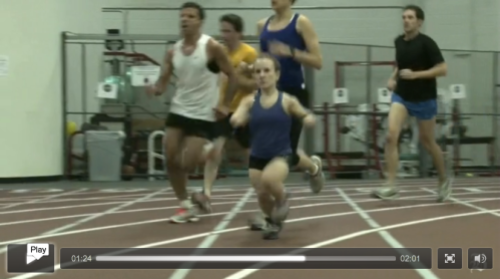
Two runners with dwarfism to compete in marathon

Click on image to watch video

Two people with dwarfism are running the Boston Marathon tomorrow, and today’s Boston Globe profiles them in a front-page feature. Globe reporter David Abel interviews Juli Windsor, who lives in the South End, and John Young, a teacher from Salem. His story is accompanied by a terrific video of Windsor produced by Thea Breite.

I don’t know Windsor, but I do know Young. He and his wife, Sue, and their son, Owen, are fixtures at Little People of America events, and we ran into them at a district conference in North Conway just a few weeks ago. Here is his blog. Young tells Abel:

The people who support and encourage me are the ones that get me to the starting line, while the ones who doubt or ridicule me are the ones that carry me to the finish line. Whenever I really start to hurt, I think of someone laughing, pointing, and saying, “You can’t do that!” and it seems to give me the strength to carry on.

Best of luck to Juli and John!

Carly Carioli is now tweeting for Boston.com

More good news from the land of the former Phoenicians: Carly Carioli, the last editor of the Boston Phoenix, has been hired by Boston.com, the Boston Globe’s free website. “I’m working on new projects aimed at attracting younger readers,” he tells me.

Carly is as smart as they come and did a great job of steering the Phoenix through its last couple of years — including its final incarnation as a glossy magazine. You can (and should) follow him on Twitter at @carlycarioli.

Michael Sullivan’s tired, uninspired debate performance

Dan Winslow and Gabriel Gomez at least seemed interesting in tonight’s Republican Senate debate, sponsored by WBZ and the Boston Globe. But Michael Sullivan, who’s way ahead in some polls, came across as old and cranky, a garden-variety right-winger who couldn’t even bring himself to support the gun-control compromise announced in Washington today.

It seems to me that either Winslow or Gomez could at least make the Democratic nominee — Steve Lynch or, more likely, Ed Markey — break a sweat. If either of them gets a chance, that is.

And, oh, the Massachusetts Republican Party has come to this: both Sullivan and Gomez attacked Winslow for being part of a governor’s team that raised taxes and passed Romneycare. If Willard Mitt Romney is now too liberal for Republican primary voters, then their candidate is headed off an electoral cliff.

A pair of heartfelt tributes to the Boston Phoenix

I want to share with you two extraordinary reflections on the Boston Phoenix and what its loss means to the city and the region. There have been a lot of such reminiscences, and many of them have been terrific. But I look at these as putting a cap on it, unless I decide to expand on my own recent effort, which came off as more sterile than I would have liked.

Harvey Silverglate
Harvey Silverglate

The first, by Harvey Silverglate, appeared late last month in the final, online-only edition of the Phoenix. Harvey is a friend and an occasional collaborator. (We are currently brainstorming ways to keep the Phoenix Muzzle Awards alive, and we hope to have an announcement within a month or so.)

Harvey began writing his civil-liberties column for The Real Paper in the early 1970s. When Stephen Mindich, the Phoenix owner, absorbed The Real Paper into the Phoenix later in the decade, Harvey’s column was renamed “Freedom Watch,” the name it carried up until the end. I had the privilege of editing Harvey in the early 1990s. He writes in his final column:

It’s no surprise to me that assaults on freedom — the mainstay of my long-running column — have outlasted the newspaper I could always count on to publish even my harshest critiques of the criminal justice system. Unlike, it seems, the institutions that work hard to subjugate others, newspapers, which are essential to free the subjugated, are not immortal.

Make sure you read the whole thing — and check out the photos, taken by his wife, Elsa Dorfman, a wonderful portrait photographer.

Al Giordano
Al Giordano

The second piece, which I’ve been anticipating since the end of the Phoenix was announced, finally popped into view on Tuesday — a 4,000-word-plus reflection by Al Giordano, who covered politics (among other things) for the paper in the mid-1990s. I was the news editor for the early part of Al’s time at the Phoenix. We struggled over Al’s radical, activist inclinations and the more mainstream direction the Phoenix was then taking, and he describes those struggles accurately and fairly.

I always respected Al, and my admiration for him only grew after he left the paper, moved to Mexico and launched NarcoNews.com, which covers the so-called war on drugs from a Latin American perspective. When Al writes about the Phoenix crusading in his defense after he got sued by “narco-bankers,” he is referring in part to this article I wrote in 2001.

Al’s essay on the demise of the Phoenix is impassioned and, in parts, poetic. It was not meant to be excerpted, but I’ll take a shot at it anyway:

My success at manipulating daily newspapers had stripped from me any sense of myth or magic that dailies had so carefully cultivated among the reading public. I liked reporters but felt badly for them: Their mothers thought they were powerful, but they were really slaves to the daily deadline, which more often than not denied them the time to ponder or think about a story before having to put their name on it. Spared from the popular illusion that anyone could be Woodward and Bernstein if he could just get to a big-enough daily, I pointed my ambition elsewhere: The Phoenix job, for me, was the pinnacle, top of the heap. It was all I had aspired to be.

Al is a force of nature, and had a hugely positive influence on the newsroom and what readers saw every week. By the time he left, I had moved into the media columnist’s slot. I was sorry to see him go. But, as he writes, he “never stopped being part of the Phoenix family.”

Peter Kadzis to work as a special contributor to WGBH

Peter Kadzis
Peter Kadzis

Great news about my friend and former editor Peter Kadzis. What follows is a press release from WGBH.

Peter Kadzis, former executive editor of the Boston Phoenix, joined the WGBH News team today as a Special Contributor. Kadzis will work on specific enterprise reporting assignments and contribute to all of WGBH’s news platforms, including radio, television and digital.

“For decades, the Boston Phoenix asked the right questions to get at what was really happening in Boston. While we all miss the Phoenix, I am pleased to welcome Peter Kadzis to the WGBH News team to continue the Phoenix’s strong tradition of hard-hitting, comprehensive local reporting,” said Phil Redo, managing director of WGBH Radio. “There is no shortage of compelling local stories in our region. WGBH continues to grow and invest in local reporting. Peter brings more than 25 years of experience to our newsroom and will be a strong addition to all of our platforms.”

Kadzis, who was born in Brighton, raised in Dorchester and lives in Jamaica Plain, served a number of editorial roles at the Boston Phoenix over 25 years. During his tenure at the standard-bearing weekly, alternative newspaper, Kadzis oversaw the Phoenix’s groundbreaking, local coverage of the Catholic Church sex scandal. Kadzis also directed the Phoenix’s political coverage in Boston, Providence and Portland.

“I am very excited to join the talented and driven WGBH News team,” Kadzis said. “WGBH has shown an unrivaled commitment to local stories and provides a platform to pursue the types of stories we covered at the Phoenix.”

Kadzis provides weekly political analysis on Fox 25, writes for a number of local publications and tweets regularly. Before joining the WGBH News team, he was a guest on a number of WGBH Radio programs, including “Under the Radar with Callie Crossley,” which airs Sundays at 6:30 p.m. on 89.7.

Lynch staggers under weight of chip on his shoulder

I thought Ed Markey and Steve Lynch both acquitted themselves fairly well in the Democratic Senate debate last night sponsored by the Boston Herald and UMass Lowell. (Herald story here; Boston Globe story here.)

What really struck me, though, was their closing statements, in which they both emphasized their working-class roots. Lynch came off as bitter and resentful. Markey told a lovely, uplifting story about the Dominican immigrants who now live in the Lawrence home where his father grew up.

The contrast turned an otherwise-OK performance for Lynch into a lost opportunity. I’m surprised Lynch can walk upright with that massive chip on his shoulder.

Masters of narrative journalism share their insights

Image (1) B_Kirtz.jpg for post 10773By Bill Kirtz

“Revel in hardship,” NPR’s Beirut-based correspondent Kelly McEvers told last weekend’s annual narrative journalism conference at Boston University. “Don’t despair if you have a scarcity of resources.”

Sneaking into danger zones where sources were too terrified to speak, the award-winning reporter has spent the past two years covering the Arab Spring uprisings, producing vivid stories with ambient sound, protective descriptions and a remote network of dissidents.

International photographer Alan Chin echoed her comments. He’s an editor at Newsmotion.org, a Kickstarter-funded collation of amateur and professional voices and video that focuses on undercovered human-rights stories. As traditional journalism faces financial crises, “we have to take chances…. We can’t just sit around” complaining about our problems, Chin said. “We have to absolutely be willing to fail.”

Newsmotion founder Julian Rubinstein, a prize-winning magazine and book author, hopes the site offers insight that deadline-driven traditional outlets often neglect.

And narrative journalism’s goal is insight, using fiction’s tools to create compelling scenes — with one huge distinction. Every detail must be as accurate and well documented as in the best investigative reporting. Mitch Zuckoff and Dick Lehr answer the perennial “How did the author know this?” question with 30 to 40 pages of endnotes verifying every detail.

The two, who won several reporting prizes at the Boston Globe and who now teach at Boston University with conference organizer and narrative journalism exemplar Mark Kramer, stressed that point with examples from their latest books.

For Zuckoff, the challenge is to tell an important story in the “richest possible way” — not “lecturing to people,” but drawing them into a complex history. In “Frozen in Time,” he weaves a World War II search-and-survival story into recent attempts to locate a long-missing rescue plane.

Lehr followed the traditional reporter’s dogged tactic of never abandoning the fight to get documents about mobster James “Whitey” Bulger. After years of trying, he found a “treasure trove” of prison files to use in his co-authored “Black Mass,” which chronicles the FBI’s corrupt ties to the fugitive killer.

Narrative journalism doesn’t take years’-long immersion in a story, noted Amy Ellis Nutt. Although she won a Pulitzer Prize ago for a 20-page Newark (N.J.) Star-Ledger feature series, she said she’s now a big fan of “miniatures.”

Why? “We don’t live life in long narrative span, [so] short is natural,” she said. “You [can] just jump in the middle.”

To make her point, Nutt cited Ernest Hemingway’s ability to tell a dramatic tale in six words: “For Sale. Baby Shoes. Never Worn.” One of her recent narratives, which starts by saying it was “too cold even for the seagulls,” delivers precise description in relatively few words.

Neil Shea, a BU lecturer and award-winning war reporter, has also turned to short-form narrative. He said that conventional coverage of such familiar topics as Afghanistan can become “background noise” for news consumers. So he’s doing regular 300- to 1,100-word vignettes of colorful dialogue and scenes without overwhelming readers with context.

Shea was one of several speakers who underscored the need to prune excess material ruthlessly.

“We have to be merciless self-editors,” he said. When considering using the first person, he said, ask yourself, “Do I really need to be in this story?”

Atlanta Journal-Constitution reporter Rosalind Bentley advises cutting anything, no matter how compelling, if it doesn’t support the story’s main thesis. She pored through the 500-page trial transcript after the poet Natasha Trethewey’s stepfather killed her mother to winnow out just this detail: “She died on the pavement.”

Any quote she uses “has to sparkle like the Hope diamond.” If it doesn’t, she’ll paraphrase.

“You can’t just wing it and start writing,” she said. “All your choices have to be deliberate.” So she wields multi-colored highlighters over pages of scrawled notes to boil down the essence of a story in one sentence, and then just one word.

In her definitive profile of Trethewey, the word was “self-definition.”

Why do narrative journalists keep plugging along in an age of economic uncertainty and audience fragmentation?

Author, magazine founder and University of California Berkeley journalism professor Adam Hochschild put it this way: “When you tell a story, it takes on a life of its own and sometimes it affects people.”

He said “Bury the Chains,” his 2005 account of how a few men started a movement to free the slaves in the British Empire, got good reviews, many awards and decent initial sales — then languished on remainder shelves for years.

But recently, Hochschild started getting speaking invitations from global-warming groups, who saw his 18th-century abolitionists as a model of how a few people could change how the world thinks about an issue.

His point: “A story can come bouncing back to you.”

Bill Kirtz is an associate professor of journalism at Northeastern University in Boston.