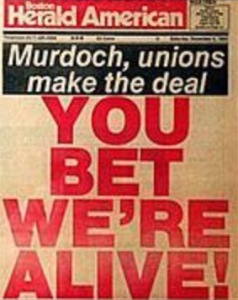
Chris Sweeney has written a sharp piece for Boston magazine on the state of the Boston Herald, the city’s number-two daily. As is generally the case with stories about the Herald, the overarching theme is: How much longer can the struggling tabloid cling to life?
And yet I wonder if that’s the right question. For a decade starting in the mid-1990s, I covered the Herald‘s ups and downs as the media columnist for the Boston Phoenix. If I had a dime for every person who told me the Herald had six months to live, I’d be a very rich man. Sadly, it was the Phoenix that didn’t survive.
As Sweeney notes, the Herald these days seems more like an extension of its online radio station than a standalone newspaper. Nearly two years ago editor Joe Sciacca gave me a tour of the paper’s new headquarters in South Boston, and I was impressed with what I saw—especially the amount of space devoted to multimedia and to the modern radio facilities.
My WGBH colleague Jim Braude tells Sweeney that not many people may be listening to Boston Herald Radio (OK, Braude’s actual quote is “I don’t think anyone listens”). But Braude also points out that it’s given the Herald a jolt of relevance in terms of high-profile guests like Mayor Marty Walsh, Governor Charlie Baker, and Donald Trump, whose appearances can then be written up and tweeted out.
Unfortunately, none of the top three executives at the Herald would speak with Sweeney, a group that comprises publisher Pat Purcell, Sciacca, and executive editor John Strahinich. It would have been useful to get some insights from them regarding the Herald‘s current business model. Not that I’m faulting Sweeney—I’ve been there. And his description of trying to get Strahinich to talk is pretty amusing.
But even though print circulation has shrunk precipitously and print advertising revenue is presumably scarce, the Herald does have some strengths. Sweeney does not report the size of the staff, but it’s small and therefore affordable. The sports section is very good. The website is slow and frustrating, but the third-party mobile app is excellent—and includes one-click access to Herald Radio. Purcell made a lot of money selling off the old headquarters in the South End; the Herald is now printed by the Boston Globe, which means that its larger competitor has every reason to keep its rival breathing.
So how long can the Herald survive? Keep those dimes rolling in.
I had never heard of Tom Nichols before he popped up in my Twitter feed with an epic tweetstorm explaining why he’s support Hillary Clinton over Donald Trump even though he’s a conservative Republican who detests Clinton. According to his Twitter bio, he’s a professor at the Naval War College and at Harvard Extension School.
Anyway, I’ve put together a Storify of Nichols’s rant, and it’s great stuff. So let’s get right to it.
Anderson Memorial Bridge. Photo (cc) by Antony-22.
In the Boston Globe, Lawrence Summers and Rachel Lipson offer a devastating look at our inability to build much-needed infrastructure projects in a timely, cost-efficient manner. Their example is the Anderson Memorial Bridge, connecting Boston and Harvard Square. Anyone who has to drive through that area know it’s best to avoid it. But they offer some truly horrifying facts, starting with this: the bridge was built in just 11 months 1912, but the repairs have been going on for four years—with “no end date in sight.”
Of course, the Anderson Bridge is hardly an anomaly. What about the Green Line Extension, plagued by cost overruns and years of delay? What about the Mother of All Infrastructure Projects, the Big Dig? On a smaller scale, the interchange of Routes 128 and 62 in Danvers has been a traffic-and-safety catastrophe since it opened a few years ago—and a similar interchange just to the south, at 128 and 35, is no better.
Summers and Lipson offer a list of what went wrong with the Anderson Bridge, and it’s instructive: historically accurate bricks that had to be specially ordered (really?); a redesign making it possible to build a pedestrian underpass (but not actually building it).
The following is a press release from the ACLU of Massachusetts.
BOSTON—In a pair of unanimous, bipartisan votes, the state House of Representatives and Senate today passed the first major reform of Massachusetts public records law in four decades, sending it to Governor Charlie Baker, who has 10 days to sign, veto, or let it become law without his signature. If signed into law by Governor Baker, the legislation would address widely criticized weaknesses in Massachusetts public records law, which make it hard for citizens to get information about how their government functions.
“This is a great day for open government,” said Carol Rose, executive director of the ACLU of Massachusetts. “We thank the House and the Senate for making public records reform a priority and for getting the job done. We also call on Governor Baker to do the right thing and sign the bill as soon as it reaches his desk.”
The bill would:
Set clear limits on how much money government agencies can charge for public records;
Set reasonable time frames for responses to public records requests;
Allow municipalities to request additional time for compliance and the ability to charge higher fees to cover reasonable costs;
Strengthen enforcement of the law by giving courts the ability to award attorney fees to those wrongly denied access to public records.
The Massachusetts Freedom of Information Alliance—a coalition of open-government groups—praised the House and its leadership for making transparency a significant legislative priority. The coalition urged Governor Charlie Baker to sign the legislation without delay and usher in a new era of openness in Massachusetts state government.
“A strong public records law is critical to democracy and our ability as citizens to hold government accountable,” said Pam Wilmot, executive director of Common Cause Massachusetts. “With today’s vote, the House and the Senate made a significant commitment to transparency and freedom of information, improving open government, and moving our state a huge step forward from near last in the nation. This reform is long overdue and we hope the Governor will sign it without delay.”
In November, the Center for Public Integrity released a report that gave the Commonwealth an “F” grade on public access to government information for the second time in a row. Dozens of organizations have advocated for comprehensive public records law reform, arguing that the law is among the weakest in the country and needs updating for the digital age. State lawmakers made their last substantive amendment to the law in 1973.
“This bill represents a significant step forward for transparency in Massachusetts,” said Bob Ambrogi, executive director of the Massachusetts Newspaper Publishers Association. “It will do a lot to improve access to public records. We hope and expect Governor Baker will prove himself to be a transparency-minded Governor by signing it into law.”
“Massachusetts residents deserve a stronger public records law, and this bill offers many improvements. We look forward to the governor signing it into law and providing more opportunity to hold government officials accountable,” said Justin Silverman, executive director of the New England First Amendment Coalition.
The pending legislation advanced earlier in the week when a conference committee of six legislators reconciled earlier versions passed by the House and Senate. The bill passed by the House and Senate today includes provisions designed to reduce the cost of obtaining public records and ensure timely responses to information requests. In addition, by allowing courts to award attorney fees to those wrongly denied access to public information, the bill would bring Massachusetts into line with 47 other states. The new law would not make such fee awards mandatory, but would establish a presumption in favor of covering requesters’ legal costs when courts find the law has been violated. The bill also includes safety-valve mechanisms to enable municipalities to get extensions on compliance deadlines and to receive reasonable compensation when dealing with particularly complex, time-consuming requests.
One of the last great newspaper rivalries got a boost on Monday with the debut of Margaret Sullivan’s media column in the Washington Post. Sullivan’s first piece was more a preview of coming attractions than an attempt to dig deep. But with Jim Rutenberg having replaced the late, great David Carr at the New York Times earlier this year, our two leading general-interest newspapers now have dueling media critics for the first time in ages.
Sullivan, a former editor of the Buffalo News, joins a team of experienced media observers at the Post, including reporter Paul Farhi and blogger Erik Wemple. She is the Post’s first media columnist since Howard Kurtz, who left in 2010 for the Daily Beast. (Kurtz was also the host of CNN’s Reliable Sources. He moved to Fox News in 2013 following some well-publicized problems at both the Beast and CNN.)
The Post’s hiring of Sullivan shows just how small the world of elite media can be, given that she was recruited while serving as the Times’s public editor, as the paper calls its ombudsman. Sullivan was the fifth and, to my eyes, the best. As Michael Calderone of the Huffington Post put it, Sullivan “radically updated the role for the digital age by quickly addressing Times-related controversies and debates in real time and actively engaging on social media.” Sullivan will be replaced by Elizabeth Spayd, currently the editor-in-chief and publisher of the Columbia Journalism Review and previously (yes, you guessed it) an editor at the Washington Post.
Needless to say, it will be interesting to see whether and how Sullivan chooses to write about the Times. In a recent interview with public radio’s On the Media, she praised her former employer—but also expressed frustration over an institutional attitude of “when the Times decides to cover it, then it becomes news” as well as bemusement over its oft-mocked trend stories. Indeed, Sullivan started something she called the “Monocle Meter” after the Times ran a story about the supposed resurgence of monocles in Brooklyn—a resurgence that apparently came and went without anyone actually ever having been spotted wearing a monocle.
Rutenberg, a veteran political reporter, got into a spat recently when he wrote that not only did journalists in general miss the rise of Donald Trump, but so did data journalists like Nate Silver of FiveThirtyEight, whose empirically based methodology should in theory produce more accurate results. In a two-fer of Times-Post incestuousness, Rutenberg invoked an observation by the Post’s Farhi that “nothing exceeds the value of shoe-leather reporting” in criticizing Silver, who moved his site from the Times to ESPN after the 2012 presidential election.
Silver, never one to suffer in silence, ripped into Rutenberg on a FiveThirtyEight podcast. As Bill Wyman wrote for the Columbia Journalism Review, Silver called Rutenberg’s column “dishonest” and “unethical,” and rehashed some old grievances over the way he was treated at the Times by Rutenberg and others, saying they were “incredibly hostile and incredibly unhelpful.” Silver later subtweeted Rutenberg with a lengthy article in which he argued that he got Trump wrong not because of an overreliance on data but because his predictions that Trump would fade weren’t based on any data at all. “In other words,” Silver wrote, “we were basically acting like pundits.”
The rivalry between the Times and the Post has a long, colorful history As recounted in Chalmers Roberts’s 1977 book The Washington Post: The First 100 Years, when the Times published a condescending item in 1900 about longing for “the rudeness of New York” after spending some time in “amiable and inefficient Washington,” the Post replied: “No doubt. The pig returns to his wallow.”
After years of striving, the Post emerged on an equal footing with the Times over the constitutional crisis sparked by the publication of the Pentagon Papers. The Post captured the public’s imagination in a way the Times never had during and after the Watergate scandal. How could the Gray Lady possibly compete with a newspaper whose journalists were portrayed by movie stars like Robert Redford, Dustin Hoffman, and Jason Robards?
But the technological and cultural forces that have brought the newspaper business to its knees did considerably more damage to the Post than to the Times—that is, until Amazon’s Jeff Bezos bought the Post in 2013 and added about 100 journalists to its newsroom in a bid to transform the Post into a national digital newspaper.
Now, once again, the Post and the Times are genuine rivals. The Post’s executive editor, Marty Baron, and the Times’s, Dean Baquet, are longtime friends and competitors. Bezos said in a television interview that his goal was for the Post to become “the new paper of record,” a clear reference to the Times—and the Post took it a step further than even Bezos had by putting together an ad proclaiming itself already to be “America’s New Publication of Record.” The Post also moved ahead of the Timesin online readership, despite having a newsroom staff about half the size.
It is into this ancient conflict—once heated, then dormant, and now heating up again—that Margaret Sullivan and Jim Rutenberg have now been enlisted. This is going to be fun.
The Boston Globe has published a terrific story by reporter Lisa Wangsness and photographer Dina Rudick about a Congregational church in our West Medford neighborhood.
It was right down the street from us when we lived here in the early ’80s. When we returned to a different part of West Medford in late 2015, we noticed it had become a Haitian church and that the Congregationalists had moved into a storefront in West Medford Square. The storefront is called the Sanctuary United Church of Christ.
Two newspapers have dramatically improved their digital offerings. The Boston Globe has unveiled four radically redesigned web pages for the Boston’s professional teams—the Red Sox, the Celtics, the Patriots, and the Bruins. The emphasis is on huge photos and on gathering together in one place everything you want to know about your favorite team. Sports editor Joe Sullivan offers a rundown.
The Washington Post, meanwhile, is testing a new mobile website that it is calling its Progressive Web App, which you can access by clicking here. The PWA uses new technology to load instantly—as fast as Facebook Instant Articles, Apple News, or news stories coded for Google’s new Accelerated Mobile Pages (AMP) standard.
These are both a couple of leaps forward. Even though the Globe‘s online presence is better than that of many newspapers, it needs to communicate to its readers that digital is a superior experience to print. The sports pages could be a prelude of things to come in other parts of the paper. The Post is well-known for its cutting-edge technology, but the speed of PWA is—as chief information officer Shailesh Prakash is quoted as saying in this press release—”a game-changing experience.”
A couple of quibbles. First of all, the Globe needs to focus on speed. Its responsive website is loads quickly enough on my Mac, but it’s slower on my phone and slower still on my aging iPad. That’s as true of the new sports pages as it is of the rest of the site. Second, it would be nice if the Post‘s PWA site loaded on a tablet and not just on a phone.
Finally, I found the type size a bit on the small side in both products with no way to make it bigger.
I still haven’t gotten around to writing anything more substantive about the controversy over Facebook’s “Trending Topics.” But this Storify lays out my main arguments.
Before the emergence of digital tools, recording and (especially) transcribing an interview was a tedious affair. The little micro-cassette tapes were of dubious reliability—and yes, I once had one fail on me during a crucial and contentious encounter. Transcribing was worse, as you’d sit there constantly hitting the “play” and “rewind” buttons, an imprecise process that risked damage to the tape.
I’ve been all-digital for maybe 10 years now. But I didn’t really begin upping my game until I tested my little Olympus recorder in a New Haven hotel room one morning in 2011 only to discover that it was pining for the fjords.
Since then, I have assembled a digital recording toolkit that I hope will be useful for journalists. By now, of course, nearly all of us are recording interviews on our smartphones. But I’ve been surprised by reporters who’ve told me their transcription technique consists of nothing more than playing back the audio on their phones. These tips, I hope, will make it easier for you to record and transcribe.