Today at What Works, we have a story by one of our Northeastern graduate students, Ian Dartley, about Inside Arlington, a local news project powered by artificial intelligence. It’s no substitute for the human touch, and in fact the town already has a very good nonprofit news organization, YourArlington. But it’s an interesting experiment, and Ian does a great job of explaining it.
We also decided to have a little fun. The headline and the bullet points used to summarize Ian’s story were written by ChatGPT. So was the social media post we used to promote the story. Here’s how it looks on Threads:
How about ChatGPT finding that dog emoji? Good boy! I thought it was interesting that ChatGPT wrote fairly dull headlines and bullet points but suddenly developed a sense of fun when it came time to write a social media post.
On the latest What Works podcast, Ellen and I talk with Meg Heckman, a colleague of ours at Northeastern University’s School of Journalism. Meg is an associate professor and author who’s had a long career as a journalist. She spent more than a decade as a reporter and, later, the digital editor at the Concord Monitor in New Hampshire, where she developed a fascination with presidential politics, a passion for local news and an appreciation for cars with four-wheel drive.
Her book, “Political Godmother: Nackey Scripps Loeb and the Newspaper That Shook the Republican Party,” documents the lasting impact of New Hampshire publisher and conservative activist Nackey Loeb. Loeb and her husband, the right-wing provocateur William Loeb, helped shape the first-in-the-nation New Hampshire presidential primary for many decades at their newspaper, the Manchester Union Leader. As you’ll hear, Heckman draws a straight line from Nackey Loeb’s support of Republican Patrick Buchanan in 1992 to the rise of Donald Trump a generation later.
In Quick Takes, Ellen calls attention to a piece in ProPublica by journalist Dan Golden about his history working for the local daily in Springfield, Massachusetts. Turns out the good-old-days in newspapering weren’t all good. Golden cautions against recreating them. ProPublica, a nonprofit, allows other outlets to republish its work, so you’ll find Golden’s essay on the What Works website.
I take a look back at an example of how diligent local news reporting can have an enormous impact nearly 45 years after the fact. Recently the EPA proposed a ban on trichloroethylene, an industrial solvent that’s been linked to leukemia, birth defects and other health problems. The road to that ban began in Woburn, Massachusetts, in 1979, with a super-smart young reporter I had the honor of working with. I wrote about it for The Boston Phoenix back in 1998.
With the January 2024 publication date of our book, “What Works in Community News,” drawing ever closer, we want to keep you up to date on new developments at the projects that we track.
The big news today is that Mukhtar Ibrahim, the founder of Sahan Journal, is stepping down as chief executive officer. Ibrahim launched the nonprofit (relaunched, actually; it’s complicated) five years ago to cover Minnesota’s immigrants and communities of color. He writes:
I am proud of the remarkable success story that our dedicated staff has built. We have grown from a four-person newsroom to an amazing and talented team of 20, covering a wide range of essential topics and producing innovative multimedia content. We have built an equitable, transparent, and responsive work culture that supports the professional development and well-being of every staff member.
Kate Maxwell, the publisher and co-founder of The Mendocino Voice in Northern California, has written a useful guide for the Reynolds Journalism Institute at the University of Missouri aimed at newsrooms looking to put together a kit to be used when covering emergencies. It’s a need that the Voice is experienced with, given that it covers an area frequently hit by wildfires. Maxwell begins:
For newsrooms preparing to cover emergencies, there are a range of material and operational considerations to examine such as necessary equipment, staff support and schedules, and how to stay safe in the middle of a disaster. Planning the practical ways you will communicate with each other and community members, and how to get crucial information out to the people who need it, is an essential part of preparing your newsroom and your community for an emergency.
Finally, Joe Amditis of the Center for Cooperative Media at Montclair State University in New Jersey, tells us about a collaborative effort to put together ahead of next week’s legislative elections. The guide, NJ Decides 2023, was put together by the center; NJ Spotlight News, one of the media organizations that we profile in our book; and the NJ Civic Information Consortium, a publicly funded effort to bolster local news in New Jersey.
A number of other news outlets assisted with reporting, and the guide is available not only in English but also in Chinese, Spanish, Turkish, Urdu and Korean. According to Amditis:
The collaborative then split the races up, with journalists from each news organization claiming the candidates they would commit to chase down.
Collaborative members sent hundreds of emails, social media messages, text messages and phone calls trying to convince candidates to fill out the form. Many did so immediately; others needed to be reminded multiple times.
LION Publishers has named 36 winners of its 2023 Local Journalism Awards — and four of them have either been featured in “What Works in Community News,” the forthcoming book by Ellen Clegg and me, have been guests on the “What Works” podcast, or both. Two other projects we’ve highlighted were finalists. For that matter, LION (Local Independent Online News) Publishers’ executive director, Chris Krewson, has been a guest on our podcast as well. Below I have omitted circulation categories, but you can find them if you click through to the full list.
• Santa Cruz Local, in California, was honored as LION Business of the Year, the organization’s “marquee award.” The Local was also the co-winner of the Operational Resilience Award and a finalist for a Community Engagement Award. We interviewed CEO and co-founder Kara Meyberg Guzman for both our book and our podcast.
• The Food Section’s editor and founder, Hanna Raskin, was the winner of the Community Member of the Year Award for her work in helping other members and for sharing her knowledge. The Food Section, which is devoted to Southern food and cooking, was also a finalist for a Business of the Year Award and an Outstanding Coverage Award. Raskin has been a guest on our podcast.
• VTDigger, a large nonprofit that covers both statewide and local news in Vermont, was a co-winner of the Public Service Award for its reporting on legislators’ ethics disclosures. Founding editor Anne Galloway has been a guest on our podcast.
• Burlington Buzz, a hyperlocal site that covers Burlington, Massachusetts, won a Community Engagement Award. Founder Nicci Kadilak has been a guest on our podcast.
In addition, The Colorado Sun and The Mendocino Voice, both of which are covered extensively in “What Works in Community News,” earned finalist nominations, the Sun for Collaboration of the Year and the Voice for an Accountability Award. We plan to have folks from both projects on our podcast sometime next year after the book is published.
Recently Max Tani of Semafor and Richard J. Tofel, who writes the newsletter Second Rough Draft, have raised questions about whether the folks involved in the purchase of the Portland Press Herald and its affiliated Maine papers from the retiring publisher, Reade Brower, have been sufficiently transparent in disclosing who the funders are.
The papers were bought during the summer by the National Trust for Local News, a nonprofit that has been involved in several acquisitions aimed at preventing legacy newspapers from falling into the hands of corporate chain ownership. In Maine, Tani and Tofel argue, the billionaire George Soros may have been more deeply involved than was previously known, while the involvement of another billionaire who was reportedly part of the purchase, Hansjörg Wyss, hasn’t been disclosed at all.
I’m going to go out on a limb and say that this is essentially a non-issue. Tofel himself notes that the previous management of the papers remains in place and that “invocations of Soros as a sort of bogeyman have long since become a principal way to dog whistle anti-Semitism; it ranks right up there with ‘globalist’ in this rhetoric.”
More to the point, the Press Herald itself followed up on Tani’s reporting, and it sounds like the full story behind the purchase will be revealed soon. (I was interviewed for the piece, written by reporter Rachel Ohm.) Longtime Press Herald publisher Lisa DeSisto, now the CEO and publisher of the Maine Trust for Local News, the nonprofit that has been set up to own the papers, is quoted as saying, “We want to make more of a splash and have a more comprehensive introduction to the Maine Trust rather than just [putting things out in] pieces. We’re really waiting to announce a broader vision.”
Added Will Nelligan, who’s the Maine project lead for the National Trust: “We will announce that coalition of Maine funders when we announce the Maine Trust.”
No, the announcement didn’t come in September, as had been originally promised. But is that really a big deal as long as disclosure is on its way? The papers themselves, by the way, remain for-profit entities, so it seems unlikely that either the National Trust or the Maine Trust will be looking for ongoing support to prop them up.
If you take a look at the National Trust’s funders, you’ll see that, in addition to Soros’ Open Society Foundations, they include a number of respected journalism funders, including the Knight Foundation, the MacArthur Foundation, the Democracy Fund and the Lenfest Institute, which owns The Philadelphia Inquirer. The Gates Family Foundation, by the way, is a Colorado-based philanthropy that has nothing to do with Bill or Melinda Gates.
When I asked University of Maine journalism professor Michael Socolow to weigh in, he emailed me comments he had previously posted on X/Twitter, noting that Tani and Tofel had emphasized Soros’ and Wyss’ liberal politics but adding they had been unable to back up whether that was relevant. (To be fair, Tofel seemed less impressed with that angle than Tani.) Socolow said:
I’m not sure there’s a story here. Neither Tani nor Tofel specify the ways the new ownership has altered editorial content. They’re seemingly insinuating that the new ownership purchased the newspapers to shape news content for partisan political reasons. But how much disclosure and transparency about Reade Brower and his business interests did these publications publish before the sale? It’s not clear to me why there needs to be a new, and apparently higher, standard simply because the ownership is now non-profit versus commercial. If evidence emerges that the sort of meddling Tani and Tofel insinuate begins occurring, then I agree we have an important story. But we’re not there yet.
Let me end with a couple of disclosures: Ellen Clegg and I interviewed National Trust co-founder and CEO Elizabeth Hansen Shapiro on our podcast, “What Works: The Future of Local News,” and we wrote about the National Trust’s successful effort to save two dozen community newspapers in the Denver suburbs in our forthcoming book, “What Works in Community News.” I worked with DeSisto at The Boston Phoenix and Ellen later got to know her at The Boston Globe, and we both consider her to be a first-rate, ethical news executive.
The purchase of the Press Herald papers by the National Trust was unalloyed good news, and it sounds like the questions that Tani and Tofel have raised will be answered soon.
Tumber is the author of “Small, Gritty, and Green: The Promise of America’s Smaller Industrial Cities in a Low-Carbon World.” She holds a Ph.D. and a master’s degree from the University of Rochester as well as a bachelor’s in social thought and political economy from UMass Amherst. Our conversation is about a recent report that she co-authored for the Lincoln Institute of Land Policy called “Greening America’s Smaller Cities.” She, along with Joseph Schilling and Gabi Velasco, offer a wealth of suggestions about how industrial legacy cities can be part of the climate solution. Our question to Cathy: How does the lack of reliable news and information in many of these cities contribute to the challenges of turning that vision into a reality?
In our Quick Takes, Ellen is back on the Midwestern beat with good news about a startup weekly paper called The Denison Free Press in Iowa. It’s scrappy as hell. Or heck, as they might say in Iowa. I’ve got a rave for a new effort to inject $500 million into local news over the next five years — with a caveat. The initiative, known as Press Forward, brings together 22 different foundations in an effort to provide a significant amount of funding for community journalism. But there may be less to that effort than meets the eye.
We also include a series of conversations drawn from our podcast with leaders, thinkers and entrepreneurs in local news.
Through a blend of on-the-ground reporting and interviews, we show how these operations found seed money and support, and how they hired staff, forged their missions, and navigated challenges from the pandemic to police intimidation to stand as the last bastion of collective truth — and keep local news in local hands.
“What Works in Community News” is already receiving praise from such important figures as Margaret Sullivan, Steven Waldman, Penelope Abernathy, Greg Moore, Victor Pickard and Anne Galloway.
It’s been quite a ride. We can’t wait to share what we learned with you.
Just two weeks after The Colorado Sun announced it was shifting from a for-profit to a nonprofit business model, Santa Cruz Local is taking the same step. The podcast-heavy Local, a much smaller project than the Sun, competes with Ken Doctor’s for-profit (the last time I checked!) Lookout Santa Cruz. Kara Meyberg Guzman, the CEO and co-founder of the Local, was a guest on our “What Works” podcast last year, as was Lookout founder Ken Doctor. Guzman is also featured in “What Works in Community News,” Ellen Clegg’s and my forthcoming book.
At Santa Cruz Local, we believe that Santa Cruz County is stronger when everyone has access to fair, accurate, high-quality local journalism. That’s why all our news is free.
Our business model depends on locals like you to donate, because many of our readers cannot. Santa Cruz Local recently changed our tax status to make it easier for you to donate. Now that Santa Cruz Local is a 501(c)3 nonprofit, your donations and membership contributions are tax-deductible.
My Northeastern colleague Meredith Clark and her co-researcher, Tracie Powell, spoke with Nieman Lab about funding inequities for local news start-ups serving BIPOC communities and how that might play out following the Press Forward announcement, in which 22 philanthropic organizations have pledged to provide $500 million over the next five years.
Really well-meaning people with access to social structures and access to capital are jumping in and wanting to get involved, but they’re not addressing some of the root causes that got us here in the first place. Instead, they’re building out infrastructures that allow the money to move from one place to another — but as it goes through that movement, it gets siphoned off.
Paul Bass checks the 2021 New Haven election returns. Photo by Maaisha Osman. Used with permission.
On the latest “What Works” podcast, Ellen Clegg and I talk with Paul Bass, the founder and former editor of the New Haven Independent. Bass is originally from White Plains, New York, but he arrived in New Haven in the late 1970s to attend Yale, and he has been reporting on all the quirks and glory of his adopted hometown ever since.
Bass was the main subject of my 2013 book, “The Wired City,” and is one of the news entrepreneurs featured in our forthcoming book, “What Works in Community News.” Bass launched the New Haven Independent in 2005 as an online-only nonprofit.
Last fall, Bass announced he was stepping aside as editor, handing the top job over to managing editor Tom Breen. But he’s continuing to play a role at the Independent and its multimedia arms, and he has just begun another venture: the Independent Review Crew, which features arts and culture reviews from all over, including right here in Boston via Universal Hub.
Ellen has a Quick Take on The Texas Tribune, the much-admired nonprofit news outlet started by Evan Smith and others in Austin. The Tribune has been a model for other startups, so it rocked the world of local news last month when CEO Sonal Shah announced that 11 staffers had been laid off.
I report on another acquisition by Alden Global Capital, the New York-based hedge fund that has earned scorn for the way it manages its newspapers. Alden acquired four family-owned newspapers in Pennsylvania. Worse, the family members who actually ran the papers wanted to keep them, but they were outvoted by the rest of the family.



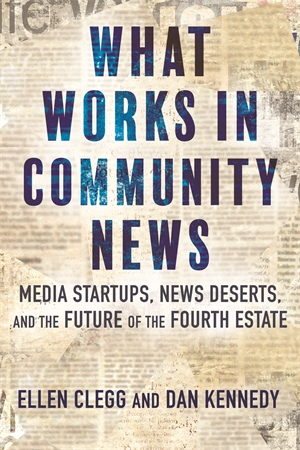 Ellen Clegg and I are thrilled to go public today with our book,

