 This commentary was published earlier at The Huffington Post and at WGBH News .
The speculation had been building since Wednesday, when The Boston Globe reported that Red Sox principal owner John Henry had restructured his bid to buy the paper.
It reached a peak on Friday afternoon, when legendary baseball reporter Peter Gammons — himself a Globe alumnus — posted a one-line item on his new website, Gammons Daily: “A source says the New York Times Corporation has chosen John Henry as the new owner of the Boston Globe.”
Confirmation came early today, as the Globe and The New York Times each reported that Henry had purchased the Globe and its associated properties — most prominently Boston.com and the Telegram & Gazette of Worcester — for $70 million. The Globe’s story led page one, whereas the Times’ version apparently didn’t even make it into today’s print edition.
The sale price represents a huge comedown from 1993, when the Times Co. purchased the Globe for $1.1 billion, half the company’s stock-market valuation at that time. As if by way of justification, the Times’ report on the Henry deal runs through several other pennies-on-the-dollar sales of major metropolitan newspapers in recent years, including those of Philadelphia’s daily papers, the Inquirer and the Daily News, as well as The Tampa Tribune.
Henry’s winning bid also thwarts an attempted comeback by members of the Taylor family, who owned the Globe almost from its founding in 1872 until the 1993 sale.
Among the would-be buyers was a group that included Stephen Taylor, a former executive vice president of the Globe, and Benjamin Taylor, a former publisher. A lot of people in Boston were rooting for the Taylors. But the money they got for selling the paper 20 years ago was split among dozens of family members, and their bid to repurchase the Globe was widely viewed as undercapitalized. You have to assume that if they had the money, the Times Co. would have sold it to them already — or in 2009, when the Globe was first put up for sale.
The ascension of a wealthy local owner may represent the best possible outcome for the Globe. Nevertheless there are questions Henry will have to answer soon — starting with the fate of publisher Christopher Mayer and editor Brian McGrory, well-liked Globe veterans who generally get high marks for the way they’re running the paper. Will they stay? Or will Henry bring in his own people?
Here are a few other questions for Henry.
1. Will he seek to improve the Globe’s bottom line by investing — or by cutting? Unlike newspaper owners who’ve financed their acquisition by taking on debt that they then have to pay off by slashing the newsroom, Henry has the luxury of being able to do anything he wants.
Although paid print circulation and advertising revenue have been dropping, the Globe is believed to be marginally profitable — a considerable improvement over 2009, when the Times Co. actually threatened to close the paper over mounting losses. The Globe today also has about 360 full-time editorial employees. That’s quite a drop from the 550 or so the Globe employed a dozen years ago, as my WGBH colleague Adam Reilly recently reported in Boston magazine, but it’s still enough to make the paper by far the largest news organization in Eastern Massachusetts. The Globe may no longer be the 800-pound gorilla, but a 600-pound gorilla can still accomplish a lot.
My guess (and hope) is that Henry will pursue a growth strategy, and that he has a healthy enough ego to believe he can succeed where others have failed. Perhaps he’ll emulate Aaron Kushner, the young greeting-card executive (and onetime Globe bidder) who’s attracted attention with his attempts to turn around the Orange County Register by hiring journalists and expanding coverage.
One aspect of Kushner’s stewardship I hope Henry doesn’t emulate is Kushner’s emphasis on print. The Globe has taken an innovative approach to the Internet with its two-website strategy (Boston.com, which is free, exists alongside the paid BostonGlobe.com site), a streaming music station, RadioBDC, and online coverage of Boston’s suburbs, neighborhoods and colleges through its Your Town and Your Campus sites. (Disclosure: Our students at Northeastern University contribute to Your Town and Your Campus as well as to other parts of the Globe.)
Henry could be a hero to the newspaper business if he can figure out new digital strategies. A print-first orientation would be a major step backwards.
2. What happens to the Globe’s Boston headquarters? The Globe occupies prime Dorchester real estate near the University of Massachusetts and the JFK Library, leading to considerable speculation that the next owner might want to sell the property and move the paper. Indeed, the Globe’s land and physical assets might be worth the $70 million purchase price all by themselves.
The challenge is that the Globe’s massive printing presses would have to be moved. And the paper has been able to build a nice business for itself by printing a number of other papers, including the city’s second daily, the Boston Herald, as well as some suburban papers.
Still, it would make all kinds of sense to move the presses to a low-cost exurban location and transfer the newsroom and business operations to a smaller space closer to the downtown.
3. How will the Globe cover the Red Sox? The jokes have already started (yes, I’ve done my best to help) about Globe sports columnist Dan Shaughnessy, a notoriously negative presence who wrote former Red Sox manager Terry Francona’s trash-and-burn memoir Francona: The Red Sox Years, which is highly critical of the Red Sox’ ownership.
In fact, the Globe and the Red Sox have been down this road before. Until a few years ago, the Times Co. was a part-owner of New England Sports Network (NESN), which broadcasts Red Sox and Bruins games and whose majority owner is the Red Sox. Henry’s sole ownership of the Globe, though, would represent full immersion in a way that the NESN deal did not.
The real issue is not how the Globe covers the Red Sox as a baseball team but rather how it manages the tricky task of reporting on a major business and civic organization that’s run by the paper’s new owner.
Earlier this year the Globe published a tough report on a sweetheart licensing deal the Red Sox have with the city to use the streets around Fenway Park before games — making “tens of millions of dollars” while “paying a tiny fraction in licensing fees.” (Further disclosure: Some of the Globe’s reporting was done in partnership with Northeastern’s Initiative for Investigative Reporting.)
I’d expect to see tough scrutiny of how the Globe covers the Red Sox in the months and years ahead. No doubt the Herald and other rival news organizations will pay close attention to the relationship. The problem isn’t so much that the Globe is likely to go into the tank for the Red Sox (it isn’t), but that it’s really in a no-win situation.
The answers to those and other questions will emerge in the weeks and months ahead. What matters today is that our largest and most important news organization has been purchased by a local businessman with deep pockets and a track record as a good corporate citizen. That’s good news not just for the Globe, but for all of us.
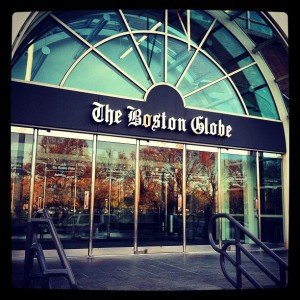
Photo (cc) by Dan Kennedy.


