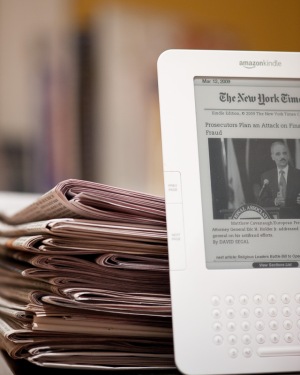
I was sorry to hear that Amazon plans to cut back on selling newspapers and magazines for the Kindle sometime next year, according to Jim Milliot of Publishers Weekly. The reason, I think, was the combination of a really bad deal for readers along with a recognition that the Kindle can’t compete with the whiz-bang color photos and multimedia that newspapers and magazines offer in their regular digital products.
Why are Kindle newspapers and magazines a loser for readers? Because you have to pay for the Kindle version over and above what you’re already paying for your digital subscription. A subscription to The New York Times on Kindle, for instance, costs $20 a month, and it makes no difference whether you’re already a Times subscriber.
On the rare occasions when I fly or take the Amtrak, I’ll buy that day’s Times for Kindle for $1. It downloads fully, so you don’t need wifi once it’s on your device. And I found it to be a pleasurable reading experience. Now, I like photography, and the small black-and-white photos you get on Kindle are no match for reading the Times on my iPad, or in print. But the Kindle provides a focused reading experience more akin to print than to digital, without the constant temptation to check your email or share an article on social media. Yet it is certainly not worth a separate subscription over and above what I’m already paying.
The Publishers Weekly article says that Kindle newspapers and magazines aren’t going away entirely. Reportedly “hundreds” of titles will be available for members of Kindle Unlimited, who pay $10 a month for access to a wide range of books and periodicals. But I think it’s still to be determined if you’ll be able to download a quality newspaper every day as part of that fee, especially since that’s only half what you’d pay for the Times alone right now.
Back in 2009, I suggested that The Boston Globe give away Kindles to subscribers. Instead, two years later the Globe started making its move toward paid digital subscriptions, which has been the paper’s salvation. I still like using my Kindle to read books, but most of us are far more likely to consume news on our phones.
I won’t call the semi-demise of Kindle newspapers a lost opportunity; it’s more a matter of changes in what we expect from our devices. The next time I take the Amtrak, though, I guess I’m going to have to find a Hudson News so that I can buy a print paper.
Paul Farhi of The Washington Post has an amazing story (free link) about The Hook, an alternative-weekly that used to publish in Charlottesville, Virginia. Its online archives disappeared after they were sold to a mystery buyer. Circumstantial evidence suggests that the buyer was a litigious deep-pockets guy who wanted to make invisible The Hook’s reporting about a sexual-assault case he was involved in years earlier.
Keeping online archives active and usable is a real challenge. Though what happened to The Hook was pretty unusual, it’s not unheard-of for valuable digital resources simply to disappear. Fortunately, the defunct alt-weekly I worked for, The Boston Phoenix, is available online through Northeastern University and the Internet Archive. You can find the Phoenix here.
It’s even more of a problem when the resource was digital-only and there was no print component that can be saved on microfilm. For instance, Blue Mass Group, a progressive political website that was a big deal in Massachusetts at one time, has been seeking a new digital home as the last of the co-founders, Charley Blandy, prepares to leave. Charley writes: “Plans are afoot for the site to be thoroughly crawled and archived. It won’t just disappear. The site will stay up, at least for a while, but for the purpose of archiving, commenting and posting will be disabled on 12/31/22.”
Given the fraught emotions that still surround the Fells Acres day-care case nearly 40 years after three members of the Amirault family were convicted of child sexual abuse, I thought The Boston Globe’s editorial was smart and nuanced.
The convictions of Gerald Amirault, his late mother, Violet Amirault, and his sister, Cheryl Amirault LeFave, have never been overturned despite multiple appeals, and several of the survivors continue to speak out about what they say they suffered at the day-care center the Amiraults ran. Gov. Charlie Baker’s last-minute bid to pardon them was inexplicable, and he was forced to withdraw his request in the face of a certain defeat at the hands of the Governor’s Council. The Globe covers that with a three-byline story here; and if you’re looking for a free link, WBUR.org has a pretty comprehensive report as well.
The Globe editorial cuts right to the heart of the matter: although a pardon is not an exoneration, the Amiraults’ supporters would surely take it as one, and that would be inappropriate:
Opponents of a pardon had feared, quite reasonably, that because the Amiraults have always proclaimed their innocence, any pardon would have been viewed as an official acceptance of their version of events, in which they were loving caregivers who were simply caught up in a hysterical moral panic. By implicitly calling the victims liars, a pardon on those grounds could have deterred victims in other cases from coming forward — “casting a pall over other children who will not be believed,” as Laurence Hardoon, the lead prosecutor in the case, said on Tuesday.
Baker did not speak with the victims, or to Hardoon, who believed the children then, and still does. With that failure to reach out, the governor underestimated the power of their testimony and what victims like Jennifer Bennett — who was 3½ when she attended the day care center and is now 44 — believe to be true. The skeptics “can believe what they want. I know the truth. I was there, not them,” Bennett said during a break in the hearing.
Nearly every observer agrees that the case would not be investigated today as it was in the 1980s. Under repeated questioning, the children’s stories became more lurid over time, which is not surprising given that they were trying to process what had happened to them when they were as young as 3 or 4 years old. But that doesn’t mean they were brainwashed, as Dorothy Rabinowitz of The Wall Street Journal argued in a series of columns in the 1990s that served to reopen the case in the minds of the public. I wrote about Rabinowitz’s crusade in 1995 for The Boston Phoenix.
The Amiraults were in prison for a long time, and they’ve been free for a long time. We will never know with absolute certainty what happened at that day-care center, but they were not the victims of deranged prosecutors conducting a witch hunt. They received a fair trial in accordance with the best practices of that era. Enough.
When making ethical decisions, we all have to decide where we’re going to draw the line. I’ve been watching Elon Musk’s behavior closely since he purchased Twitter in late October and thinking about where I ought to draw my own line.
It’s different for everyone, and I’m not going to criticize anyone else’s judgment. For Jelani Cobb, it came when Musk restored Donald Trump’s Twitter account, which had been locked because he incited violence during the Jan. 6 insurrection. I semi-shrugged my shoulders. No, I wasn’t thrilled that Musk had brought back Trump and his merry band of Q-adjacent loons, including the loathsome Marjorie Taylor Greene. But my goodness, have you seen the internet? Twitter’s a big place, and I didn’t see any particular reason why we couldn’t all co-exist in our own spaces.
Then there are the deeply stupid “Twitter Files,” promoted by house journalists Matt Taibbi and Bari Weiss, internal documents given to them by Musk that show evidence of some mistakes in moderation but that mainly demonstrate Twitter was attempting to enforce its publicly stated policies about hate speech, incitement and misinformation. There’s some big-time hyperventilating going on about one of those mistakes — the decision to suppress the New York Post’s story about Hunter Biden’s laptop. But that decision was reversed within 24 hours, and it’s worth noting that it was based on an actual policy not to share hacked information. This is a scandal? (Brian Fung of CNN has more.)
What has brought me to this moment, though, is Musk’s own behavior. In late November, Twitter announced that it would no longer take action against misinformation about COVID-19, in accordance with the Chief Twit’s wishes. And then, within the past few days, came the end of the line, at least for me. First Musk attacked Yoel Roth, his former head of trust and safety. Musk tweeted out a short section of Roth’s Ph.D. dissertation to make it appear, falsely, that Roth supports the sexualization of children. “Looks like Yoel is arguing in favor of children being able to access adult Internet services in his PhD thesis,” Musk tweeted. (If you’re interested in the particulars, see this piece at Business Insider by Sawdah Bhaimiya.)
Then, on Sunday, Musk tweeted, “My pronouns are Prosecute/Fauci,” and followed that up with a meme from some fantasy movie (“Lord of the Rings”?) of Fauci whispering in President Biden’s ear, “Just one more lockdown my king.” (Details from Jesse O’Neill in the New York Post.)
At what point does indifference morph into complicity? What we have now is the head of Twitter, with 121 million followers, tweeting out messages that are putting actual people and their families at risk. In what should have been a surprise to no one, Roth has had to flee his home and go into hiding, according to Donie Sullivan of CNN. Fauci, as you no doubt know, has been facing death threats throughout the pandemic, and Musk’s amplifying a bogus call to arrest and prosecute him could make matters worse. I realized that was my line, and Musk had crossed it.
I’ve downloaded my Twitter archive and will no longer be posting there except to help those who contact me and are looking for an alternative. I’ll set my account to private as soon as I’ve tweeted this out. I considered deleting my account altogether, but who knows what’s going to happen? Maybe next week Musk will enter a monastery and donate Twitter to the Wikimedia Foundation. Yes, that’s pretty unlikely — as unlikely as one of Musk’s SpaceX rocket ships safely taking you to Mars and back. For the moment, though, I don’t want to do anything that I can’t reverse if conditions change.
This was not an easy decision. I’ve been a heavy Twitter user since I joined in 2008. I’ve got more than 19,000 followers, and I know that not all of them are going to move to other platforms. But here are some alternatives below. You might also want to check out this roundup from Laurel Wamsley at NPR.
If you’re not doing so already, you can sign up to receive new posts to Media Nation by email. It’s free. Just scroll down the right-hand rail on the homepage, enter your email address and click on “Follow.”
The most promising Twitter alternative is Mastodon, which is a decentralized network of networks that — once you get past the clumsiness of figuring out how to sign up — works very much like Twitter. I joined in early November, and more than 1,300 people are following me there already. I’m at @dankennedy_nu@journa.host. There are various guides on how to get started. Here’s one from CUNY journalism professor Jeff Jarvis.
If Mastodon is the earthy-crunchy alternative to Twitter, then Post News is the corporate version. Like Mastodon, Post News is promoting itself as a civil environment free of abuse and trolling. I know that some Mastodon folks are criticizing Post News for being just another venture-capital play that may eventually come to as bad an end as Twitter. They’re not wrong. For now, though, I’m looking at Mastodon as a place where I can connect mainly with journalists, academics and the extremely online, and then mosey over to Post News to engage with normal people. The interface is simple and attractive; the site is still in beta and will continue to improve. You can follow me at dankennedy_nu.
Let’s not forget that Facebook isn’t going anywhere. If we don’t know each other, please don’t send me a friend request; follow my public feed instead. Here’s where you can find me.
I’m also on LinkedIn and Instagram, but I prefer not to use those to engage the way I do on the other platforms.
There are a million takes on what has happened to Twitter that I could point you to, and believe me, there are very few that are worth reading. But this one is worthwhile. It’s by Ezra Klein, and he questions whether any of these platforms, even the nice new ones, are doing us any good.
Finally, what we need more than anything on Mastodon and Post News is some diversity, which, at its pre-Musk best, is what was great about Twitter. Black Twitter needs a home, and I really miss my non-Trumpy conservative followers and the less politically engaged. I invite you all to take the plunge. Join one of the alternatives. Cut down or eliminate your Twitter activity. And discover the joys of de-Muskifying your life.
Moakley Federal Courthouse in Boston. Photo (cc) 2017 by Beyond My Ken.
A Boston Globe journalist was forced to testify Tuesday in U.S. District Court in a case involving the Harvard admissions scandal. According to the Globe’s Shelley Murphy, politics editor Joshua Miller briefly took the witness stand and attested to the accuracy of quotes in an April 2019 article for which he interviewed the defendant, Jie “Jack” Zhao. Zhao has been charged with purchasing a Needham home at an inflated price owned by then-Harvard fencing coach Peter Brand so that Zhao’s two sons would be admitted to Harvard.
Miller’s compelled participation raises troubling First Amendment issues. Miller testified after a federal judge ruled against his motion to quash a subpoena. That’s not especially surprising. When faced with the prospect of requiring a journalist to testify, judges usually are more likely to rule against the journalist in a criminal case rather than in a civil matter, and they are more likely to rule against the journalist if they are not being ordered to reveal a confidential source. In this case, prosecutors merely sought Miller’s testimony so that they could enter his article into the record.
Nevertheless, the Globe’s lawyer, Jonathan Albano, cited in his motion to quash “the widespread recognition that the First Amendment protects journalists from the needless disclosure of sources, investigative techniques, and both confidential and non-confidential work product.”
Miller’s case also was the subject of a “friend of the court” brief filed by the Reporters Committee for Freedom of the Press, joined by 40 other media and legal organizations including the Center for Investigative Reporting, the Committee to Protect Journalists, Dow Jones, the First Amendment Coalition, the Freedom of the Press Foundation, Gannett, the Massachusetts Newspaper Publishers Association, McClatchy, MediaNews Group, the New England First Amendment Coalition, the New England Newspaper and Press Association, the NewsGuild, The New York Times, the Society of Professional Journalists, Tribune Publishing and others.
The Reporters Committee brief was submitted by First Amendment lawyer Robert Bertsche of the Boston firm Klaris Law. Perhaps the most notable aspect of his brief is that he observes the subpoena was not limited to asking that Miller attest to the accuracy of his article but, rather, was “open-ended.” In other words, if Miller was on the witness stand and was unexpectedly asked about confidential sources or reporting methods, he would either have to answer or refuse and thereby risk being held in contempt of court. Bertsche wrote:
Compelling reporters to testify about their communications with sources — even on-the-record, nonconfidential conversations — harms the newsgathering and reporting process, to the ultimate detriment of the public. It embroils reporters in time-consuming litigation and diverts news organizations’ already scarce resources away from newsgathering and reporting — burdens that weigh especially heavily on journalists who regularly investigate and report on matters that could involve potential criminal activity, and thus whose interviews and other work product could regularly be the target of federal prosecutors. Moreover, enforcement of subpoenas like the one at issue here threatens to erode public trust in the independence of the news media by creating the misimpression that journalists are an investigative arm of prosecutors and courts. That risk is particularly acute in situations where, as here, a journalist’s testimony is sought in connection with a criminal investigation launched after publication of the relevant reporting. Simply put, enforcement of government subpoenas that seek to compel journalists like Mr. Miller to testify in criminal trials risks making reporters’ existing and potential sources—both confidential and non-confidential — more reluctant to speak candidly, or simply unwilling to speak at all.
As I noted recently, Miller was subpoenaed not long after U.S. Attorney General Merrick Garland was hailed for announcing that reporters would no longer be compelled to testify in leak cases involving national security. This may be a matter of apples and oranges, but it’s notable that the stakes involved in demanding Miller’s testimony are considerably lower than the standard that Garland articulated. Yet that didn’t stop a judge from dragging a journalist into court.
I didn’t have to come to Northeastern today, but I was excited to try the Green Line Extension, which made its grand debut on Monday. So here I am.
My ride began at the new Medford/Tufts station at Boston and College avenues. It’s a mile and a half from my house and it was c-o-l-d, so my wife dropped me off on her way to work. There are a couple of buses I could have taken, too, although they don’t run as often as they should.
I walked inside the shiny new station, downstairs to the platform and then onto a train. There was no place to pay either before or after boarding, so the handful of us who were riding from Medford got a free pass. I don’t know about the other five new stations, but obviously that’s not a viable business plan; I assume payment options will be coming soon. We sat there for a few minutes in the cold, with the doors open, and then pulled out at 7:27 a.m.
The ride was smooth and a lot zippier than I’m used to on the Green Line. We had a beautiful sunrise view of the Zakim Bridge as we crossed the channel before heading underground. Things began to bog down south of Science Park. The train finally got crowded at North Station, so I put on my mask. And then it was the usual slow roll the rest of the way.
We pulled in to Northeastern at 8:06. Thirty-nine minutes wasn’t bad at all, but it was closer to an hour when you add in getting to the station and then waiting for the train to start moving. I’ll probably stick with my usual commute — I’m a seven-minute walk from the West Medford commuter rail station, which gets me to North Station in 12 minutes. After that, I can take the Orange Line or the Green Line to campus depending on my mood and which comes first.
On the other hand, I’m teaching an evening class this fall, and the commuter rail rarely runs after rush hour. The Green Line may be an attractive alternative to paying for a Lyft.
Finally, a semi-unrelated observation: I couldn’t make out where the Somerville Community Path was, which struck me as odd. On rare occasions, I like to ride my bike to work, and this ought to be a better option than what’s available to me now. The path has been built out to Lechmere and runs along the tracks. I had hoped the path would be extended north to the Medford/Tufts station, but I don’t think that’s the case. From what I can tell, you’ll pick it up at Lowell Street in Somerville.
Photo (cc) 2020 by Administración del Principado de Asturias
This kind of fuzziness drives me crazy. David Wallace-Wells, writing in his New York Times newsletter, is rightly concerned that the death rate from COVID-19 remains high among the elderly, which he defines roughly as those 80 and older. And he notes that 94% of Americans 65 and older have been vaccinated.
He puts it this way: “If it was ever comfortable to say that the unconscionable levels of American deaths were a pandemic of the unvaccinated, it is surely now accurate to describe the ongoing toll as a pandemic of the old.” His message, not clearly stated (there is little that’s clear about this piece), is that vaccines are not protecting the elderly from dying from COVID, which is a pretty serious assertion.
But what does he mean by “vaccinated”? Farther down he writes of the high death rate among the elderly:
It is also partly a reflection of how many fewer Americans, including older ones, have gotten boosters than got the initial vaccines: 34 percent, compared with 69 percent. The number of those who have gotten updated bivalent boosters is lower still — just 12.7 percent of Americans over the age of 5.
So is getting fully boosted, including with the bivalent vaccine, decent protection against death and serious illness among the elderly or isn’t it? He doesn’t say, and he probably doesn’t know. I’m guessing that the 94% figure he cites means “fully vaccinated,” which is defined as two shots. As we know, that’s not very protective. At this point, I’ve had four shots plus a mild case of COVID for a total of five immunity-boosting events.
This NBC News story by Aria Bendix is more helpful. Analyzing data from the Centers for Disease Control and Prevention, Bendix reports that 85% of people who died of COVID in November were 65 and older, but only 31% of that age group had received a bivalent booster. Here, too, though, we have two different numbers passing in the night: We don’t know what the death rate was among elderly people who had gotten the bivalent shot. That’s the key fact, right?
This is important, because COVID is both serious business and the subject of ongoing fear-mongering among those who envision all of us wearing masks forever. (I’m not anti-mask; I wear one on public transportation.) What Wallace-Wells establishes is that the elderly, despite vaccines, are dying of COVID at a frighteningly high rate. What he doesn’t establish is whether that’s a consequence of them not getting the bivalent booster.
As Wallace-Wells notes, the elderly don’t get as much protection from vaccines in general because their immune systems are less active. Still, an 80-year-old who’s had the bivalent booster is surely less likely to become seriously ill or die from COVID if they’ve received the bivalent booster than if they’ve only had the first two shots. How much less likely? Who knows?
The New York Times union is asking people to stay off Times platforms on Thursday. Let’s fuel a huge drop in traffic in solidarity with the union.
We’re asking readers to not engage in any @nytimes platforms tomorrow and stand with us on the digital picket line! Read local news. Listen to public radio. Make something from a cookbook. Break your Wordle streak.
Well, that didn’t take long. Cristiano Lima of The Washington Post reports that the Journalism Competition and Preservation Act (JCPA) has been dropped from the defense-spending bill. I pointed out on Tuesday that there were some real shortcomings to the proposal but thought that, on balance, it was worth giving a try. Since the JCPA got new life earlier this week, though, it’s been subject to a withering attack by everyone from the ACLU a group of United Church of Christ ministers.
I’m going to guess that that’s the last we’re going to hear about the JCPA because House Republicans oppose it, and time is running out for the Democratic majority to push it through. Maybe this will carve out space for a better bill, the Local Journalism Sustainability Act, which would bolster local news by creating temporary tax credits for subscribers, advertisers and publishers. I’m dubious, though, that House Republicans are going to be willing to do anything for the next two years except investigate Hunter Biden and cower before Marjorie Taylor Greene.
A controversial measure that could force Google and Facebook to pay for the news they repurpose has suddenly been revived in the last days of the lame-duck Congress. The Journalism Competition and Preservation Act, or JCPA, would allow news organizations to skirt antitrust law and band together so they can negotiate with the two giant platforms over compensation. If negotiations fail, an outside arbitrator would be brought in to impose a settlement.
On the “What Works” podcast, Ellen Clegg and I recently interviewed U.S. Rep. David Cicilline, D-R.I., one of the co-sponsors of the JCPA. Cicilline spoke of the measure in terms of breaking up Google and Facebook’s monopoly on digital advertising, which is certainly real enough. According to Statista, the two tech titans control 52% of the market.
I last wrote about the JCPA in August. And though I described the bill as having lurched back to life, there hadn’t been many signs since then that it was going anywhere. That is, until this week, when the measure was added to a “must pass” defense-funding bill. House Republicans oppose the JCPA, and with Rep. Kevin McCarthy, R-Calif., on the verge of taking the speaker’s gavel, right now is the last chance. Sara Fischer and Ashley Gold have the details at Axios.
In August, I expressed some reservations about the JCPA but thought it was worth passing to see what would come out of it, especially since it was time-limited to four years (since doubled to eight). You often hear simplistic claims by proponents that Google and Facebook are republishing journalistic content without compensation. In fact, they’re not republishing anything. There’s no stealing and no copyright violation taking place. But there’s also no question that Google is far more valuable and useful because users are able to search for news content, and that some not-insignificant portion of Facebook’s traffic comes from users linking to and commenting on news stories. It does not strike me as unfair to insist that the platforms pay something for that value.
And yet the JCPA carries with it the possibility of some real downsides. Greedy corporate owners like Gannett and Alden Global Capital would benefit without any obligation to invest more in journalism. And though the legislation excludes larger news organizations like The New York Times and The Washington Post, a similar law in Australia has served mainly to line the pockets of the press baron Rupert Murdoch.
A better bill, in my view, is the Local Journalism Sustainability Act, or LJSA, which would provide for three tax credits: one for consumers who pay for a local news subscription; one for advertisers; and one for publishers that hire or retain journalists. As Steve Waldman of the Rebuild Local News Coalition told Ellen and me on “What Works,” that last provision, at least, would only benefit the corporate chains if they actually invest in journalism. But the LJSA has been seemingly stuck in congressional limbo for several years. If the JCPA passes, I can’t imagine that the LJSA will do anything other than disappear.
Facebook is threatening to eliminate all news content if the JCPA becomes law, a threat similar to one that it made and backed away from in Australia. The company, formally known as Meta, also ended its program of supporting local journalism recently, which will remove millions of dollars from what is an already shaky revenue stream.
I have to say that I was struck by a letter of opposition to the JCPA issued Monday by a coalition of 26 public-interest and trade organizations including the ACLU, the Internet Archive, LION (Local Independent Online News) Publishers, Common Cause, the Wikimedia Foundation and the United Church of Christ Ministry (!). Among other things, the letter claims that the money will mainly benefit media conglomerates and large broadcasters without setting aside anything for journalists. The coalition puts it this way: “The JCPA will cement and stimulate consolidation in the industry and create new barriers to entry for new and innovative models of truly independent, local journalism.”
We’ll see how it works out. There’s no question that many local news organizations are in difficult straits, and that a guaranteed source of income from Google and Facebook may be the difference between thriving and just barely getting by. If the JCPA is approved, I just hope it doesn’t become one of those government programs that become a permanent part of the landscape. If it works, fine. If there are problems, fix them. And if it’s a disaster, get rid of it.