The Carlisle Mosquito, a free nonprofit weekly newspaper that has long stood as an example of how a community can take care of its own news and information needs, is in trouble. “We need at least $125 — at least $10 a month — from every household in town,” says a front-page editorial. “And we need those who can afford to give more to do so.”
The Mosquito spends about $44,000 a year on print and distribution, which adds up to about a fifth of its annual budget. “Ad revenues,” the editorial says, “have been declining for years.” I’m not sure why they’ve stuck with print, but they know their community better than I do. The editorial says that the paper’s top editors earn just $15,000 to $25,000 for what I have to assume are part-time positions.
I hope the Mosquito, which serves a wealthy rural community of about 5,000, can find a way forward. If it can’t, maybe The Concord Bridge, a well-funded nonprofit digital and print hybrid that was recently launched in a neighboring community, can provide some coverage.
The New Bedford Light is hiring an editor-in-chief. Congratulations to founding editor Barbara Roessner for getting this important project off the ground and moving in a good direction.
By now it is widely understood that local news is in crisis. The United States has lost a fourth of its newspapers since 2005, and the loss has led to such ills as lower voter turnout in local elections, more political corruption, and the rise of ideologically driven “pink slime” websites that are designed to look like legitimate sources of community journalism.
Even in the face of this decline, though, hundreds of local news projects have been launched in recent years, from Denver, where The Colorado Sun was launched by 10 journalists who’d left The Denver Post in the face of devastating cuts, to MLK50, which focuses on social justice issues in Memphis. Some are nonprofit; some are for-profit. Most are new digital outlets; some are legacy newspapers. All of them are independent alternatives to the corporate chains that are stripping newsrooms and bleeding revenues in order to enrich their owners and pay down debt.
This trend is happening in the Boston suburbs, too, as Gannett, the country’s largest newspaper chain, has closed many of its weekly newspapers and shifted most of those that remain from local to regional news. Affluent communities such as Marblehead, Concord, Bedford, and Lexington are all home to startups, with more scheduled to come online this year. So, too, is New Bedford, a gritty, working-class city where the nonprofit The New Bedford Light is filling much of the gap created by the shrinkage of Gannett’s daily The Standard-Times. (I’m also hoping to help facilitate a news startup in the community where I live.)
But these projects all must deal with the headwinds of chain owners. Gannett, a publicly traded company that controls about 200 daily papers, and the hedge fund Alden Global Capital, with about 100, have a stranglehold on readership and advertising in many communities, even where they offer little in the way of news and information.
Which raises a question: What if corporate chain ownership could somehow be made to disappear? As it happens, there are several Massachusetts examples that offer lessons for what happens when the slash-and-burn out-of-town owner sells to local interests.
Take Nantucket. Marianne Stanton, editor and publisher of The Inquirer and Mirror, purchased the weekly from Gannett in 2020 with the help of David Worth, a local businessman. Since then, she said in an interview, she’s expanded the editorial staff from four to seven full-time positions, upgraded the computer system, and boosted marketing and circulation efforts.
“We are doing this off of the revenues we earn,” she said, adding that Gannett had been planning to cut the budget and replace much of the local coverage with regional news even though “we were profitable, we were doing well.”
In Pittsfield, the story is similar. In 2016, a group of four local business leaders bought from Alden three small papers in southern Vermont as well as The Berkshire Eagle, once one of the most respected small dailies in the country, which had to slash much of its coverage following repeated budget cuts by Alden. They added staff, increased the size and improved the quality of the newsprint, and expanded coverage in areas such as investigative reporting and culture.
The upward trajectory has been somewhat uneven. In 2020 the Eagle cut back the number of days it offers a print paper from seven to five, a move that Fredric Rutberg, president and publisher, said was accelerated because of the challenges posed by the COVID-19 pandemic. The following year, the owners sold the Vermont properties. Still, there is little question the Eagle is doing far better than it would have under continued Alden ownership.
Rutberg said he believes that many more newspapers may be acquired by local owners as the chains realize that the economies of scale they hoped for may not exist. But what if that process could be speeded up? What if chain owners could be given incentives to unload their papers?
It’s something that Steven Waldman has been thinking about. The founder of Rebuild Local News, a coalition of more than 3,000 news and civic organizations, Waldman has put together a plan called Replanting Newspapers into Communities aimed at making it easier for the chains to sell and for local interests to buy. One of its goals is proposed federal legislation that would provide tax credits, pension relief, and loan guarantees for buyers that have a public service mission, and a range of tax incentives for chain newspaper owners to sell to such buyers. The proposal would also impose limits on new acquisitions by chain owners.
“I think we are in a new era where people understand that public policy has to be an important part of the discussion about how to save local news,” Waldman said in a recent podcast interview.
At a time of intense polarization at the national level, local news can be a way to bring us together — but overcoming the pernicious effects of corporate chain journalism is essential to providing the news and information we need to for self-governance. Independent local ownership is proving it can be done, one community at a time.
Dan Kennedy is a professor of journalism at Northeastern University. His latest book, “What Works in Community News,” coauthored with former Globe editorial page editor Ellen Clegg, who is launching a nonprofit news startup in Brookline, is scheduled to be published in 2024.
There is no substitute for journalism. For-profit legacy newspapers may no longer muster enough reporting capacity to cover their communities — especially if they’re owned by a corporate chain or a hedge fund. But independent journalism with reporters, editors and ethical standards are fundamental to providing the public with the news and information it needs to govern itself in a democracy.
Today we are seeing an explosion of independent local news outlets, mostly digital, mostly nonprofit. It’s happening in the Boston area and across the country. Yet a different kind of vision, stretching back to the earliest days of the web, persists: that members of the public can take charge of at least some of their own information needs. We used to call these people citizen journalists, and it became fashionable to sneer when that vision fell short of its most idealistic expectations. Yet it persists in some quarters and — harnessed properly — could still prove useful to grassroots democracy and storytelling.
Last week a report called “The Roadmap for Local News: An Emergent Approach to Meeting Civic Information Needs” was released by three respected media thinkers — Elizabeth Green of Chalkbeat, Darryl Holliday of City Bureau and Mike Rispoli of Free Press. Based on interviews with 51 thought leaders in local news, the report calls for reorienting ourselves from journalism to civic information in solving the local news crisis.
Natural Bridges State Beach in Santa Cruz, Calif. Photo (cc) 2005 by Coralie Mercier
James Rainey of the Los Angeles Times has a pretty wild story about the trials and tribulations of Lookout Santa Cruz, a news outlet in California launched by the longtime media analyst Ken Doctor. In Rainey’s telling, Doctor is a demanding, dictatorial boss who’s had trouble holding onto talent, and he’s angered his competitors with claims that they regard as dismissive.
On the other hand, it sounds like Doctor has pretty quickly established Lookout as the news source of record in Santa Cruz, even though the Santa Cruz Sentinel, owned by the hedge fund Alden Global Capital, reaches more readers.
As it happens, we’ve had both Doctor and another of his competitors, Kara Meyberg Guzman, co-founder of Santa Cruz Local, on the “What Works” podcast, and we asked them both about each other. Please give them a listen.
Massachusetts Statehouse. Photo (cc) 1996 by Daderot.
Now that federal efforts to provide assistance to local news have fallen short, we may see more activity at the state level. One such effort is a bill filed in the Massachusetts Legislature that would provide tax credits to people who subscribe to a “local community newspaper,” whether in print or online. Boston Globe reporter Dana Gerber has the details (and quotes me).
The bill was filed last month by Rep. Jeffrey Rosario Turco, D-Revere. The legislation, H.D.1518, is similar to one of the three tax credits in the federal Local Journalism Sustainability Act — it provides a tax credit for subscribers of up to $250 a year. As I told Gerber, this may prove to be symbolic given that state income taxes are lower than federal taxes. Still, it would focus attention on the importance of local news, which is not a bad thing.
The devil, as always, is in the details. According to the bill, an eligible newspaper or website would have to provide “original content derived from primary sources and relating to news and current events,” serve “the needs of a regional or local community,” and employ “at least 1 local news journalist who resides in such regional or local community.”
That last requirement could prove to be a sticking point. Low-paid community journalists can’t be expected to live in an affluent community where the cost of housing is sky-high. That was as much of an issue decades ago as it is today. Maybe “regional or local” means that a reporter who covers, say, Concord could live in Lowell; I hope so.
Another challenge is that local news is increasingly being provided by nonprofit news organizations as the Gannett newspaper chain closes weekly newspapers and cuts back on community coverage. Most nonprofits offer their news for free, and donations to nonprofits are already tax-exempt.
It’s also hard not to notice that Turco is proposing his legislation in something of a vacuum, as the state commission approved two years ago to study the local news crisis in Massachusetts has yet to get off the ground. I had a hand in drafting the bill that created the commission would be a member. Maybe 2023 will be the year that there’s some movement on that front.
Everett Mayor Carlo DeMaria. Photo (cc) 2019 by Joshua Qualls / Governor’s Press Office
I can’t recommend this long, astonishing story highly enough. In the new issue of Boston magazine, Gretchen Voss reports on the Everett Leader Herald’s crusade against Mayor Carlo DeMaria. The paper’s editor, Josh Resnek, has accused DeMaria over and over of blatant corruption and sexual abuse. DeMaria is currently pursuing a libel suit against the paper.
Not to give away the ending, but Voss writes that Resnek has admitted to making up much of what he’s written about DeMaria, who barely won re-election last fall in the face of the Leader Herald’s relentless attacks. In a deposition, Resnek admitted that he’d faked key interviews and concocted evidence. Here’s a key paragraph that comes near the end of Voss’ story. You won’t understand all of it without reading the entire story, but you’ll get the gist:
During his deposition, Resnek sealed his legacy: not that of a fearless journalist but of a fabulist. He admitted that he’d found no evidence of DeMaria receiving a kickback for the Encore casino deal in Everett, even though he’d reported in the paper that he had. Resnek claimed he was merely expressing his “opinion.” Resnek also confessed that he had made up all the quotes attributed to [City Clerk Sergio] Cornelio in his explosive September articles about the Corey Street deal [in which Resnek claimed that DeMaria had extorted $96,000 from Cornelio]. Every single one of them. Resnek failed to conduct even the most basic journalistic efforts to determine whether there was a formal agreement between Cornelio and DeMaria. In fact, a judge had issued a written opinion that Cornelio and DeMaria did act together in the purchase, development, and sale of the property, and DeMaria had obtained an advisory opinion from the state ethics commission concerning his interest in acquiring a financial stake in commercially zoned land in Everett. DeMaria also filed a “Disclosure of Appearance of Conflict of Interest” with the City Clerk’s Office for his ownership interest in a property adjacent to Everett Square. Resnek owned up to the fact that he’d never checked for these documents.
Voss also reports that Resnek tried to enlist Boston Globe reporter Andrea Estes in his attempt to destroy DeMaria. Estes comes across as interested in what Resnek had to tell her, and in fact she’s written several stories about DeMaria, including this one, about excessive campaign contributions that a contractor made to the mayor, and this one, about DeMaria’s being the state’s highest-paid mayor. But Voss’ story makes it clear that Estes did her own reporting and that Resnek exaggerated his contacts with her.
Why has the Leader Herald engaged in a multi-year campaign against DeMaria? According to Voss, it may have been retribution by the politically wired Philbin family, who ran afoul of DeMaria going back to his time as a city councilor. The Philbins bought the Leader Herald in 2017 and hired Resnek, a veteran journalist with multiple career stops in the Boston area. Here is a characteristic line from an opinion piece that Resnek wrote in 2019, quoted by Voss: “Kickback Carlo DeMaria is in his tenth year of organized, obscene, uniquely disguised municipal theft and greed.” Yikes!
The Leader Herald, a free weekly, is nearly 140 years old. Incredibly, it is also one of three independently owned news outlets in Everett, a blue-collar community with about 49,000 residents. One of them, the Everett Advocate, is enjoying DeMaria’s libel suit against the Leader Herald, running a story under the headline “Sinking Fast: the Implosion of Matthew Philbin; Leader Herald Owner Admits to Actual Malice.” (Actual malice is the legal term for publishing a defamatory claim about a public official or public figure despite knowing or strongly suspecting that it was false.) The story also describes Resnek as a “corrupt reporter.”
Resnek is still writing for the Leader Herald. I scrolled down through its website and could find no sign that he’s written anything about DeMaria’s lawsuit (at least not recently) or the Boston magazine story.
The third Everett news outlet, the Everett Independent, which once employed Resnek, appears to be a lively weekly newspaper. The current edition features a front-page photo of DeMaria to accompany a story on the debut of sports betting at the Everett casino.
Needless to say, it will be fascinating to learn the outcome of DeMaria’s lawsuit.
On this week’s “What Works” podcast, Ellen and I talk with Anne Larner, a civic leader in Newton, Massachusetts, a city of nearly 90,000 people on the border of Boston. Anne is on the board of directors of The Newton Beacon, an independent nonprofit news outlet covering Newton.
Anne has a long track record of civic engagement in Newton and in Massachusetts. She moved to Newton in 1973 and has served on the School Committee, the Newton League of Women Voters, and has been a PTO president, among many roles. She also served 15 years at the MBTA Advisory Board, a public watchdog agency.
Newton is a microcosm of what’s happening in local news all over the country. Years ago, Newton had four local newspapers: The Newton Times, the Graphic, the Tribune and the Tab. But Gannett shut down a number of Massachusetts newspapers last year, including the print weekly, the Newton Tab. The Gannett digital site, Wicked Local, is still up and running. But content is regional.
Ellen has a Quick Take on MLK50, the award-winning Memphis newsroom that focuses on poverty, power and justice. They’ve received two major philanthropic grants that allow them to build for the future. And speaking of MLK50, executive editor Adrienne Johnson Martin was here at Northeastern ahead of Martin Luther King Day to give a talk on their work in Memphis. We’ll feature some interviews from that by our colleague Dakotah Kennedy.
I’ve got news about the Rebuild Local News Coalition, a new nonprofit organization that’s advocating for solutions to the local news crisis. But wait. It’s not new. And the solutions that it’s proposing aren’t new, either. We talked with the co-founder of the coalition, Steven Waldman, last summer, and our conversation is worth a listen if you missed it earler. Still, this is good news, which I explain.
Tuesday’s announcement about a new organization aimed at helping to ease the local news crisis was a bit of a head-scratcher. Here’s the lead of Sara Fischer’s story at Axios:
Local journalism groups representing more than 3,000 local newsrooms have come together to create a new nonprofit that aims to save local news through bipartisan public policy initiatives.
Well … OK. Except that the organization has been around for a few years. Way back in July 2021 I quoted Steven Waldman and noted that he was the co-founder of the coalition. Its main policy goals — tax credits aimed at boosting subscriptions and advertising as well as giving publishers incentives to hire and retain journalists — are also nothing new. That’s the Local Journalism Sustainability Act, or LJSA, a federal bill that kicked around for several years before dying at the end of the last Congress. With the House now controlled by press-hating right-wing Republicans, we are not likely to see it resurrected anytime soon.
But if the coalition wants to relaunch and call new attention to its work, so be it. According to this announcement, Waldman is taking a more prominent position — he’ll now be the full-time president, and he’s cutting back on his work at Report for America, which he also cofounded. The coalition has also reorganized as an independent nonprofit.
Ellen Clegg and I talked with Waldman about the Rebuild Local News Coalition and the LJSA on the “What Works” podcast in mid-2022. You can listen to it here, and subscribe wherever you get your podcasts.
From the Department of You’ve Got to Be Kidding: Gannett has announced that it will close its printing plant in Portsmouth, New Hampshire, and move the work to its presses in Auburn, Massachusetts, and Providence, Rhode Island. The daily papers that will be affected are the Portsmouth Herald, Foster’s Daily Democrat and — are you ready? — the Burlington Free Press, located not far from the Canadian border.
Word of the switch was published in the Portsmouth Herald on Wednesday. I have not been able to find it in the Free Press, either in print or online (my USA Today digital subscription gives me access to the replica editions of every Gannett daily in the country, which is why I was able to check). But assuming that Gannett’s own story is accurate, that is really a breathtaking move. According to Apple Maps, it’s a three-and-a-half-hour, 240-mile drive from Auburn to Burlington. Providence is even worse — about four hours and nearly 270 miles. And that’s right now, without any traffic to speak of.
The Herald offers this statement from Gannett:
As our business becomes increasingly digital and subscription-focused, newspaper printing partnerships have become standard. We are making strategic decisions to ensure the future of local journalism and continue our outstanding service to the community.
Ah, yes, digital subscriptions, Gannett’s standard answer to everything. Well, let’s look at the Burlington Free Press’ latest filings with the Alliance for Audited Media, shall we? For the six-month period ending last Sept. 30, the average weekday print circulation was 4,000, with another 6,012 on Sundays. Meanwhile, paid digital replica circulation was 1,051 on weekdays and 667 on Sundays. Nothing is listed for straight-up digital subscriptions, but in March 2021 the Free Press reported about 1,400 on weekdays and about 1,200 on Sundays for digital nonreplica. So, roughly, that’s a total of around 2,000 digital replica and nonreplica subscriptions. Not impressive, and clearly the Free Press’ print product is still what its readers are looking for.
Then again, Gannett has long since ceded the Burlington market to a terrific alt-weekly, Seven Days; a leading digital nonprofit, VTDigger; and Vermont Public Radio. I wrote about that in my 2018 book, “The Return of the Moguls.” We also recently interviewed VTDigger’s founder, Anne Galloway, on the “What Works” podcast.
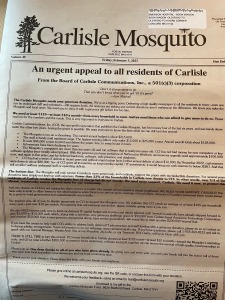 The Carlisle Mosquito, a free nonprofit weekly newspaper that has long stood as an example of how a community can take care of its own news and information needs, is in trouble. “We need at least $125 — at least $10 a month — from every household in town,” says a front-page editorial. “And we need those who can afford to give more to do so.”


