The altar boy-in-chief resigns. 1974 photo in the public domain.
Two weeks ago The Boston Globe published letters from readers of La Presse, a Montreal newspaper, in which they expressed their views about Donald Trump. The letters were published in both the Globe and La Presse.
Part two, letters from Globe readers to La Presse, appears today. If you’re not a Globe subscriber, you can access the feature at La Presse by clicking here. If you use Chrome, you should see a box at the top asking if you want to translate the page from French into English.
Because I’m always up for a good Nixon analogy, I especially liked a letter written by Sandra Regan of Winthrop, who says in part:
Richard Nixon was an altar boy compared with the entity who is currently impersonating the president of the United States. Donald Trump has trashed our Oval Office and soiled the history and dignity of our beautiful White House. Now he is trying to use you and other allies in yet another shameless attempt to get whatever he wants.
Donna R. Cooper of Provincetown adds:
I want to assure you that many Americans do not support his racist, sexist, and homophobic agenda. He understands only money, so I support you in not spending yours in the United States (although I’ll miss overhearing that lovely French as I sit on the beach this summer). Urge your elected officials not to compromise in the face of Trump’s tariffs. Take your products to other countries. Do not let the bully win.
And Marjorie Martin of Framingham concludes her letter with this: “Please pray for us.” Indeed.
Lyndon Johnson on the campaign trail in 1954. Photo via the LBJ Library.
The IRS has ruled that religious leaders can endorse political candidates from the pulpit, thus overturning a ban that had been in place since 1954. The New York Times broke the story, but in case you can’t get around the paywall, here is The Associated Press’ version.
The news is sure to be greeted with consternation among many observers, especially on the left. But the ban was, in fact, an unintended consequence of a move by Lyndon Johnson to silence a tax-exempt political group that opposed his re-election to the Senate. Johnson’s chief aide, George Reedy, told an interviewer years later that he believed LBJ had not intended to include religious organizations in the ban.
The IRS action comes just days after the presiding bishop of our denomination, Sean Rowe, wrote a powerful commentary in which he called on the Episcopal Church to be an engine of the resistance to Donald Trump’s authoritarian rule. (You may recall that Episcopal Bishop Mariann Budd got Trump’s second term off to a rousing start by admonishing him from the pulpit on Inauguration Day.) It sounds like it just became easier for our church to speak out and not have its tax status threatened, although who knows if the regime will try to punish religious liberals? Here is part of what Bishop Rowe wrote:
Churches like ours, protected by the First Amendment and practiced in galvanizing people of goodwill, may be some of the last institutions capable of resisting this administration’s overreach and recklessness. To do so faithfully, we must see beyond the limitations of our tradition and respond not in partisan terms, but as Christians who seek to practice our faith fully in a free and fair democracy.
We did not seek this predicament, but God calls us to place the most vulnerable and marginalized at the center of our common life, and we must follow that command regardless of the dictates of any political party or earthly power. We are now being faced with a series of choices between the demands of the federal government and the teachings of Jesus, and that is no choice at all.
In 2017 I wrote a commentary for GBH News in which I expressed agreement with Trump after he called for the Johnson Amendment to be overturned. Now that has happened. I’m posting the full piece after the jump.
One day you’re telling yourself that at least the billionaire owner of your local newspaper hasn’t thrown in with Donald Trump. The next day a group of players from the baseball team he owns are lined up in the Oval Office, shaking hands with the president on the very day that Congress passed the worst piece of legislation in our lifetime.
Apparently we’ve already moved on from the news that a group of Red Sox players were greeted by Trump on Thursday during what has been described as a family visit. News accounts have been sketchy on the details, and it seems that no one is inclined to follow up. They should. I mean, this is Boston, and it’s the Red Sox, not the Trump-supporting Patriots. Has our favorite fourth-place, below-.500 team gone MAGA?
Here’s what we know, according to Chris Cotillo of MassLive. Thursday was an off-day before the Red Sox’ Fourth of July game against the Washington Nationals. A number of players decided to visit the White House as part of their annual family outing. Margo Martin, part of Trump’s communications team, posted a 17-second video on Twitter (you can watch it above) of 10 players shaking hands with the president. Those players were Trevor Story, Justin Wilson, Abraham Toro, Romy Gonzalez, Connor Wong, Greg Weissert, Wilyer Abreu, Garrett Whitlock, Brennan Bernardino and Rob Refsnyder. If there were any others, they haven’t been identified.
Not everyone on the team attended. Garrett Crochet posted a photo of a panda that he took while visiting the zoo, which may or may not have been intended as a zing at his teammates. Also missing were manager Alex Cora, coaches and team officials. This appears to have been an unofficial visit — an extremely embarrassing unofficial visit.
“It was scheduled as an apolitical, behind-the-scenes tour with no expectations of publicity or meeting President Trump, a source familiar with the visit said,” the Globe’s Tim Healey reported. Whether that source is being straight with Healey or not, at least the Sox realize this is not something they want to associate themselves with. As they say, hypocrisy is the tribute that vice pays to virtue.
The Globe’s owner, John Henry, is a billionaire financier, and he’s also the principal owner of the Red Sox. That’s what makes this so dicey. Unlike Jeff Bezos’ Washington Post and Patrick Soon-Shiong’s Los Angeles Times, the Globe has remained a liberal paper, and its editorial pages enthusiastically endorsed Kamala Harris for president last year. Henry and his wife, Globe Media CEO Linda Pizzuti Henry, are regarded as politically liberal. Any signs of slippage would be alarming, which is why I hope that Thursday’s White House visit was just something that 10 players did on their own.
A protest in Chicago against the illegal detention of Kilmar Ábrego García in a Salvadoran prison. Photo (cc) 2025 by Paul Goyette.
This is likely to be my last post of the week, and it’s a depressingly fitting one this Fourth of July. Although we may have much to celebrate in our own lives, we all recognize that our country is in great danger. Donald Trump is trampling on the Constitution, and the Republican-led Congress and Supreme Court are doing nothing to slow him down.
So today I want to make sure you’ve seen this story about Kilmar Ábrego García, one of the better known victims of Trump’s persecution of undocumented immigrants. Earlier this year, Ábrego García, of Maryland, charged with no crime other than living in the U.S. without the proper papers, was illegally shipped off to a prison in El Salvador. He’s back, at least for now, and his lawyers filed chilling documents on Wednesday alleging that he was tortured while in Salvadoran custody. Maanvi Singh reports for The Guardian:
While being held at the so-called Terrorism Confinement Center (Cecot) in El Salvador, Ábrego García and 20 other men “were forced to kneel from approximately 9:00 PM to 6:00 AM”, according to the court papers filed by his lawyers in the federal district court in Maryland.
Guards struck anyone who fell from exhaustion while kneeling, and during that time, “Ábrego García was denied bathroom access and soiled himself”, according to the filing.
Detainees were held in an overcrowded cell with no windows, and bright lights on 24 hours a day. They were confined to metal bunk beds with no mattresses.
Ábrego García is back in the U.S., and now federal prosecutors are charging him with human smuggling and being a member of the MS-13 gang. We’ll see if there’s any actual evidence; the case has all the hallmarks of a story that the Trump regime concocted after the fact.
But why should we take seriously Trump’s alleged desire to crack down on MS-13? On Monday, a team of six New York Times reporters revealed (gift link) that Trump had returned a notorious MS-13 killer and other gang members to El Salvador who are allies of that country’s thuggish president, Nayib Bukele. The transfer appears to be a quid pro quo for Bukele’s willingness to accept U.S. deportees.
I hope there will come a time when Trump and everyone associated with his brutal reign is held to account, perhaps by the International Court of Justice. In the meantime, we have to live through this and do what we can to call out their shocking behavior and engage in acts of resistance. For what it’s worth, I write.
May you, your families and friends have a wonderful Independence Day. There will be better times ahead.
Shari Redstone speaking at a Committee to Protect Journalists event. Photo (cc) 2022 by CPJ photos.
Given how long negotiations were dragged out, there was some reason to hope that Paramount Global wouldn’t give in and settle Donald Trump’s bogus lawsuit claiming that “60 Minutes” had deceptively edited an interview with Kamala Harris last October.
In the end, Trump got what he wanted. Paramount, CBS’s parent company, will settle the suit for $16 million. If you’re looking for one tiny reason to be hopeful, the settlement did not come with an apology. In agreeing to pay off Trump, Paramount’s major owner, Shari Redstone, will now presumably find smooth sailing through the regulatory waters in selling her company to Skydance Media. Skydance, in turn, is headed by David Ellison, the son of Oracle co-founder Larry Ellison, a friend of Trump’s.
NPR media reporter David Folkenflik has all the details. What’s clear is that this may well be the end of CBS News as a serious news organization. Just the possibility of a settlement has brought about the resignations of top executives as well as criticism from “60 Minutes” correspondent Scott Pelley. As recently as Monday, media reporter Oliver Darcy revealed that all seven “60 Minutes” correspondents had sent a message to their corporate overlords demanding that it stand firm. Murrow weeps, etc.
What I want to note, briefly, is that there are still two complications that Paramount and Skyline must contend with before wedded bliss can ensue.
The first is a threat by U.S. Sens. Elizabeth Warren, D-Mass., Ron Wyden, D-Ore., and Bernie Sanders, I-Vt., to launch an investigation into whether the payoff amounts to an illegal bribe. Given that every legal and journalistic expert who’s looked at the case believes the editing of the Harris interview was ordinary and unremarkable (among other things, “60 Minutes” edited out a clip of Harris complaining about her hay fever), that investigation might yield some headlines at least.
“Paramount appears to be attempting to appease the Administration in order to secure merger approval,” the three said in a May press release issued by Warren’s office. They added: “If Paramount officials make these concessions in a quid pro quo arrangement to influence President Trump or other Administration officials, they may be breaking the law.”
The second is a threatened shareholder lawsuit by the Freedom of the Press Foundation. In a May statement, the organization’s director of advocacy, Seth Stern, cited the three senators’ possible investigation and said this:
Corporations that own news outlets should not be in the business of settling baseless lawsuits that clearly violate the First Amendment and put other media outlets at risk. A settlement of Trump’s meritless lawsuit may well be a thinly veiled effort to launder bribes through the court system.
In this morning’s newsletter from CNN media reporter Brian Stelter, the foundation is reported to be moving ahead with its plans: “The group’s lawyers are huddling today, I’m told. A spokesperson said ‘Paramount’s spineless decision to settle Trump’s patently unconstitutional lawsuit is an insult to the First Amendment and to the journalists and viewers of “60 Minutes.” It’s a dark day for Paramount and for press freedom.’”
The Paramount settlement follows Disney’s disastrous and unnecessary $15 million settlement of a suit brought by Trump over a minor wording error by ABC News anchor George Stephanopoulos in describing the verdict against Trump in the E. Jean Carroll civil case. Stephanopoulos said Trump had been found to have “raped” Carroll, whereas the technical legal term was “sexual abuse.”
Trump’s claim failed on two grounds: What Stephanopoulos said was substantially true, and there was no evidence that the anchor had deliberately or recklessly mischaracterized the outcome of the case. But no matter. Disney settled anyway.
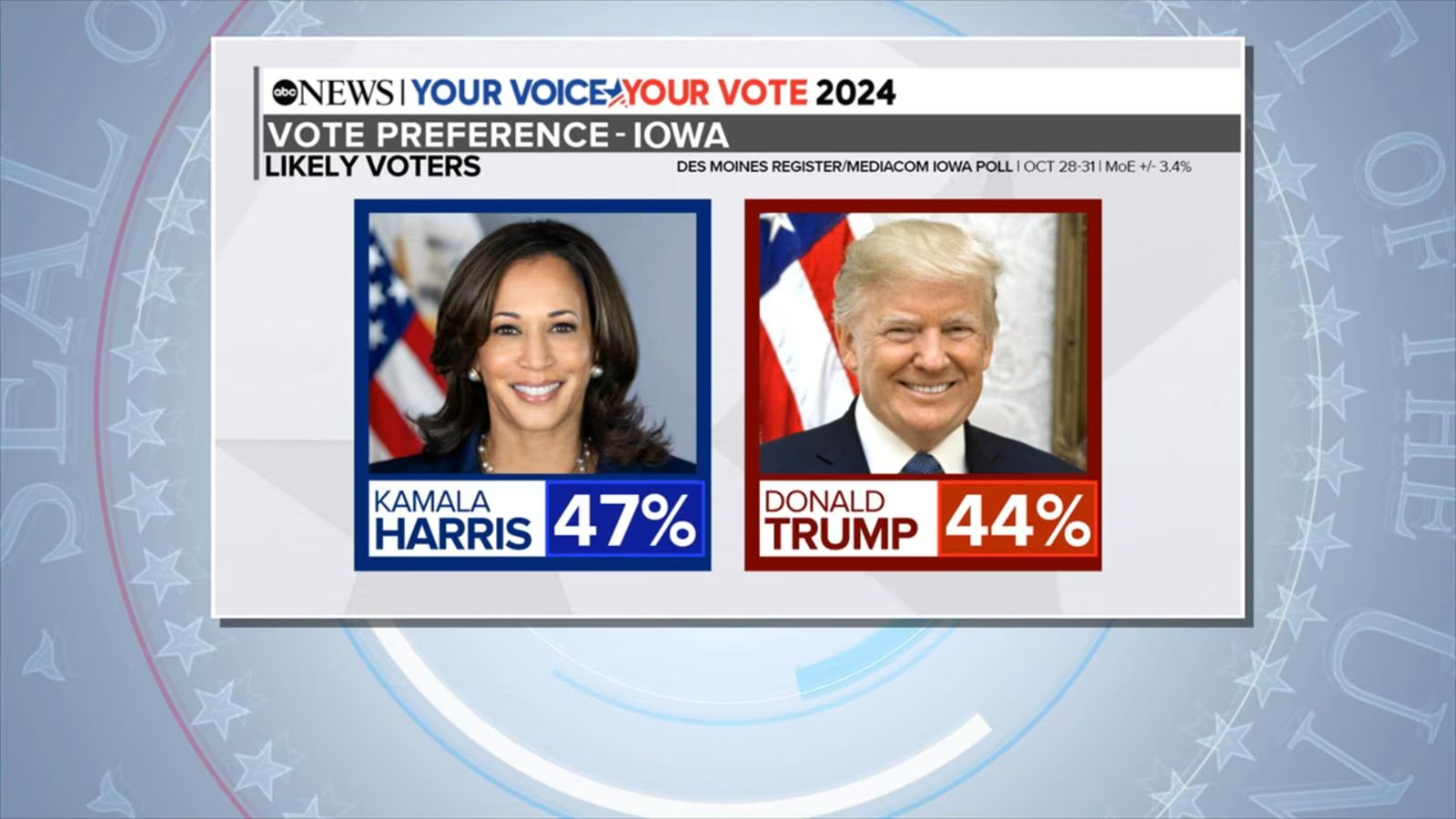
So far, at least, Gannett is holding firm in Trump’s suit against The Des Moines Register and pollster Ann Selzer over a survey that showed Trump trailing Harris in the Buckeye Hawkeye State (which he ended up winning easily) several days before the 2024 election.
Correction: Like the great Boston Brahmin writer Cleveland Amory, I regarded “the West” as anything west of Dedham. So, yes, Iowa is the Hawkeye State. I’m fixing that here and in Tuesday’s item as well.
For a brief moment Monday, it looked like Donald Trump had given up on his ridiculous lawsuit against The Des Moines Register and pollster Ann Selzer.
You may recall that Trump claimed they had committed consumer fraud because of a poll taken just before Election Day showing Kamala Harris with a 3-point lead in the Hawkeye State. Notwithstanding Selzer’s sterling reputation, Harris ended up losing Iowa by 13 points, which is about what you’d expect. She was wrong, and the error may have hastened her retirement, but the notion that she put out a false poll to help Harris is transparently ludicrous.
Well, Monday’s good news didn’t last. It turns out that Trump withdrew his suit from the federal courts and refiled it in state court one day before an Iowa anti-SLAPP law was scheduled to take effect, William Morris reports for the Register. SLAPP stands for “strategic lawsuits against political participation,” and it’s designed to give judges a reason to throw out garbage suits such as Trump’s. No such luck since Trump beat the deadline.
This isn’t the first time Trump has sought to have his Iowa case heard in state court. Apparently his lawyers believe the federal courts are unlikely to tolerate his foolishness. To its credit, the Register’s corporate owner, Gannett, has hung tough. A spokesperson for the paper, Lark-Marie Anton, said in a statement:
After losing his first attempt to send his case back to Iowa state court, and apparently recognizing that his appeal will be unsuccessful, President Trump is attempting to unilaterally dismiss his lawsuit from federal court and refile it in Iowa state court. Although such a procedural maneuver is improper, and may not be permitted by the court, it is clearly intended to avoid the inevitable outcome of the Des Moines Register’s motion to dismiss President Trump’s amended complaint currently pending in federal court.
The Foundation for Individual Rights and Expression, which is representing Selzer, said on social media that Trump’s attempt to move the case to state court was “a transparent attempt to avoid federal court review of the president’s transparently frivolous claims,” according to The Washington Post.
Meanwhile, there have been some developments in one of Trump’s other legal attempts to intimidate the press. According to media reporter Oliver Darcy, all seven correspondents at CBS News’ “60 Minutes” have sent a message to their corporate owner, Paramount, demanding that it stand firm in fighting Trump’s lawsuit over the way the program edited an interview with Harris last October. Darcy writes:
They pointedly expressed concern that Paramount is failing to put up a fierce and unrelenting fight in the face of Trump’s lawsuit over the program’s Kamala Harris interview, which has been widely denounced by the legal community as baseless, according to the people familiar with the matter. They said Trump’s allegations against the storied program are false and ripped his lawsuit as baseless. And they warned in no uncertain terms that if Paramount were to settle with Trump, it will stain the reputation of the company and undermine the First Amendment.
Trump is claiming consumer fraud in a Texas federal court under the state’s Deceptive Trade Practices Act, alleging that “60 Minutes” edited its interview with Harris to make her appear more coherent, thus helping her campaign. “60 Minutes” has defended the editing as normal and routine. The interview has been nominated for an Emmy in the editing category, no doubt to send a message to the White House.
Unfortunately, Darcy reports that Paramount continues to lurch toward a settlement with Trump in order to pave the way for federal approval of a merger with Skydance Media.
Now here’s an interesting idea. On Saturdays, letters to the editor take up about two-thirds of The Boston Globe’s op-ed page. And today, those letters are from readers of La Presse, a Montreal paper, about the state of U.S.-Canadian relations under Donald Trump.
The letters are running in La Presse as well, writes the Globe’s letters editor, Matthew Bernstein — and Globe readers are being invited to write letters to their Québécois neighbors as well. The letters were written in French and translated into English. Bernstein explains:
Simon Chabot, director of the Dialogue section for La Presse in Montreal, invited readers of the French-language news outlet to share messages to their American neighbors. Chabot reminded them that not all Americans share President Trump’s point of view, especially in New England, which has maintained close ties with Quebec for centuries. He asked his readers: “Are these ties important to you? Would you like to tell our neighbors?”
So what do La Presse readers have to say? “It pains me to be unable to visit you, and the thought of enduring this for the next four years saddens me,” writes Nathalie Perreault of Sherbrooke. “I cherished my time in your country, where I completed my postdoctoral studies and embraced your culture for five wonderful years.”
Adds Jocelyne Kucharski of Bromont: “May I say that I found you very naive to have elected a criminal to head your country? The fact that you ignored all the red lights warning you of his duplicity arouses total incomprehension on my part…. How could you not hear and understand that he doesn’t give a damn about the average American? That his real friends are the ultrarich?”
Unfortunately, the letters are behind the Globe’s unforgiving paywall. But La Presse allows a few free clicks per month, and you can find the same letters here. When I accessed the page using Chrome, a button popped up giving me the option of using Google Translate. It looks pretty good to me, but caveat emptor.
The late Ayatollah Ruhollah Khomeini, left, and Iran’s current supreme leader, Ayatollah Ali Khamenei. Photo of mural in the city of Qom (cc) 2013 by David Stanley.
I think the most rational response to President Trump’s bombing of Iran’s nuclear facilities is to hang back a bit — that is, to acknowledge that he’s the wrong leader to do this, that he was more likely acting on ego and personal pique than out of any strategic vision, but that it’s too soon to tell whether this will be a disaster or might actually accomplish some good.
One starting point is that Iran shouldn’t be allowed to possess nuclear weapons. Another starting point is to understand that what led to this really is all Trump’s fault. President Barack Obama painstakingly negotiated an agreement with Iran that significantly slowed Iran’s race to get a nuclear bomb, and Trump undid that in his first term for no discernible reason other than to disrespect Obama.
Terry Moran, right, interviews Donald Trump in April 2025. Public domain photo by Joyce N. Boghosian via the White House.
How to behave on social media has bedeviled journalists and confounded editors for years. Marty Baron clashed with reporters Wesley Lowery and Felicia Sonmez over their provocative Twitter comments back when he was executive editor of The Washington Post, and those are just two well-known examples.
The latest journalist to run afoul of his news organization’s social-media standards is Terry Moran, who was, until Tuesday, employed by ABC News. Moran was suspended on Sunday after he tweeted that White House official Stephen Miller and President Trump is each a “world-class hater.” The tweet is now gone, but I’ve included an image. On Tuesday, Moran’s employer announced that they were parting company with him, as NPR media reporter David Folkenflik writes.
I think ABC was right to suspend Moran but wrong to get rid of him, and that media critic Margaret Sullivan got the nuances perfectly when she wrote this for her newsletter, American Crisis:
I’m amazed that Moran posted what he did. It’s well outside the bounds of what straight-news reporters do. It’s more than just calling a lie a lie, or identifying a statement as racist — all of which I think is necessary. Moran is not a pundit or a columnist or any other kind of opinion journalist….
I would hate to see Moran — with his worthy career at ABC News, where he’s been for almost 30 years — lose his job over this. I hope that the honchos at ABC let a brief suspension serve its purpose, and put him back to work.
Unfortunately, this is ABC News, whose corporate owner, Disney, disgraced itself earlier this year by paying $15 million to settle a libel suit brought by Trump over a minor, non-substantive error: George Stephanopoulos said on the air that Trump had been found “liable for rape” in a civil case brought by E. Jean Carroll when, in fact, he’d been found liable for sexual abuse. The federal judge in the Carroll case even said in a ruling that the jury had found Trump “raped” Carroll in the ordinary meaning of the term. But Disney couldn’t wait to prostrate itself before our authoritarian ruler.
So when Moran violated ABC News’ social-media policy, as the organization claimed, he no doubt knew he could expect no mercy.
Trump meets the press. 2019 photo by the Trump White House.
A three-judge panel of the U.S. Court of Appeals in Washington has ruled that, at least for now, the White House can exclude The Associated Press from coverage of presidential events in most venues. The 2-1 ruling puts on hold a decision by a lower court in favor of the AP.
The decision is 55 pages long, and I’ve simply scanned it for a few highlights. But it appears that the court’s main argument is grounded in the number of media organizations that would like to gain access to President Trump’s events. It’s not so much that the White House is kicking out the AP as it is that they’re letting someone else in instead. Here’s how Judge Neomi Rao puts it in her majority decision:
The White House is likely to succeed on the merits because these restricted presidential spaces are not First Amendment fora opened for private speech and discussion. The White House therefore retains discretion to determine, including on the basis of viewpoint, which journalists will be admitted. Moreover, without a stay, the government will suffer irreparable harm because the injunction impinges on the President’s independence and control over his private workspaces.
In a strongly worded dissent, Judge Cornelia Pillard writes:
In granting a stay, my colleagues assert a novel and unsupported exception to the First Amendment’s prohibition of viewpoint-based restrictions of private speech — one that not even the government itself advanced….
Make no mistake as to why it matters that the panel majority accepts these theories. In the short term, the court allows the White House to rely on viewpoint to exclude the AP from the Press Pool pending a final decision on the merits, a process that typically takes months. And, looking further ahead, if any merits panel were to accept those theories, the result would be a Press Pool — and perhaps an entire press corps — limited during Republican administrations to the likes of Fox News and limited to outlets such as MSNBC when a Democrat is elected.
As you may recall, the Trump regime banned the AP from many of its events after the wire service refused to go along with President Trump’s absurd insistence that the Gulf of Mexico be referred to as the “Gulf of America.” Map services from Apple, Microsoft and Google quickly toed the line, as did several news organizations; the AP, though, held firm.
But as Zach Montague and Minho Kim report for The New York Times, Trump changed the facts on the ground, possibly making it easier for the the president to prevail in a lawsuit brought by the AP. Most notably, the regime ended the practice of allowing the White House Correspondents’ Association to determine which news outlets would be included in the press pool.
The White House now has the discretion to decide for itself. And though announcing that the AP was being banned might not withstand constitutional scrutiny, saying that the pool will include NewsMax, Breitbart and Catturd, and “oh, sorry, there are no more slots” is an assertion that might hold up. It’s a complicated decision, since the majority ruled that the AP must be allowed into press briefings where there is some give-and-take with the president but may be excluded from merely observational events, such as those that take place in the Oval Office.
Needless to say, this is fairly disastrous for democracy since it allows Trump to decide who will cover him. Excluding the AP is particularly outrageous since so many news outlets are dependent on the wire service for coverage of national and international affairs; indeed, the service provides news to about 15,000 media organizations around the world. It is for that reason that the AP had always been included in the press pool.
The AP’s own story on the stay, by media reporter David Bauder, calls Friday’s stay “an incremental loss.” But as Judge Pillard notes, it could take months for the full Court of Appeals to render a decision, and then there’s the prospect of the case winding up before the Supreme Court. If nothing else, the Court of Appeals’ endorsement of viewpoint discrimination should not be allowed to stand. It would be yet another lurch down the road to authoritarianism if the high court ultimately decides that Trump has found a way to censor the AP without violating the First Amendment.
More: As I’ve mentioned before, we now have access at Northeastern to Claude, a leading AI chatbot from Anthropic. Though I have deeply mixed feelings about AI, I also think it’s worth experimenting with. I asked Claude to produce a 1,200-word summary of the decision, and you can read it here. I can tell you that reading Claude’s handiwork did lead me to go back and add a tweak to this post.