I’ll be talking about the late, great Boston Phoenix tonight from 9 to 10 p.m. on “NightSide with Dan Rea,” on WBZ Radio (AM 1030). Also in studio will be longtime Phoenix contributor Harvey Silverglate, and perhaps former editor Peter Kadzis by phone. I hope you can join us.
Tag: Boston Phoenix
Carly Carioli is now tweeting for Boston.com
More good news from the land of the former Phoenicians: Carly Carioli, the last editor of the Boston Phoenix, has been hired by Boston.com, the Boston Globe’s free website. “I’m working on new projects aimed at attracting younger readers,” he tells me.
Carly is as smart as they come and did a great job of steering the Phoenix through its last couple of years — including its final incarnation as a glossy magazine. You can (and should) follow him on Twitter at @carlycarioli.
A pair of heartfelt tributes to the Boston Phoenix
I want to share with you two extraordinary reflections on the Boston Phoenix and what its loss means to the city and the region. There have been a lot of such reminiscences, and many of them have been terrific. But I look at these as putting a cap on it, unless I decide to expand on my own recent effort, which came off as more sterile than I would have liked.

The first, by Harvey Silverglate, appeared late last month in the final, online-only edition of the Phoenix. Harvey is a friend and an occasional collaborator. (We are currently brainstorming ways to keep the Phoenix Muzzle Awards alive, and we hope to have an announcement within a month or so.)
Harvey began writing his civil-liberties column for The Real Paper in the early 1970s. When Stephen Mindich, the Phoenix owner, absorbed The Real Paper into the Phoenix later in the decade, Harvey’s column was renamed “Freedom Watch,” the name it carried up until the end. I had the privilege of editing Harvey in the early 1990s. He writes in his final column:
It’s no surprise to me that assaults on freedom — the mainstay of my long-running column — have outlasted the newspaper I could always count on to publish even my harshest critiques of the criminal justice system. Unlike, it seems, the institutions that work hard to subjugate others, newspapers, which are essential to free the subjugated, are not immortal.
Make sure you read the whole thing — and check out the photos, taken by his wife, Elsa Dorfman, a wonderful portrait photographer.

The second piece, which I’ve been anticipating since the end of the Phoenix was announced, finally popped into view on Tuesday — a 4,000-word-plus reflection by Al Giordano, who covered politics (among other things) for the paper in the mid-1990s. I was the news editor for the early part of Al’s time at the Phoenix. We struggled over Al’s radical, activist inclinations and the more mainstream direction the Phoenix was then taking, and he describes those struggles accurately and fairly.
I always respected Al, and my admiration for him only grew after he left the paper, moved to Mexico and launched NarcoNews.com, which covers the so-called war on drugs from a Latin American perspective. When Al writes about the Phoenix crusading in his defense after he got sued by “narco-bankers,” he is referring in part to this article I wrote in 2001.
Al’s essay on the demise of the Phoenix is impassioned and, in parts, poetic. It was not meant to be excerpted, but I’ll take a shot at it anyway:
My success at manipulating daily newspapers had stripped from me any sense of myth or magic that dailies had so carefully cultivated among the reading public. I liked reporters but felt badly for them: Their mothers thought they were powerful, but they were really slaves to the daily deadline, which more often than not denied them the time to ponder or think about a story before having to put their name on it. Spared from the popular illusion that anyone could be Woodward and Bernstein if he could just get to a big-enough daily, I pointed my ambition elsewhere: The Phoenix job, for me, was the pinnacle, top of the heap. It was all I had aspired to be.
Al is a force of nature, and had a hugely positive influence on the newsroom and what readers saw every week. By the time he left, I had moved into the media columnist’s slot. I was sorry to see him go. But, as he writes, he “never stopped being part of the Phoenix family.”
Peter Kadzis to work as a special contributor to WGBH

Great news about my friend and former editor Peter Kadzis. What follows is a press release from WGBH.
Peter Kadzis, former executive editor of the Boston Phoenix, joined the WGBH News team today as a Special Contributor. Kadzis will work on specific enterprise reporting assignments and contribute to all of WGBH’s news platforms, including radio, television and digital.
“For decades, the Boston Phoenix asked the right questions to get at what was really happening in Boston. While we all miss the Phoenix, I am pleased to welcome Peter Kadzis to the WGBH News team to continue the Phoenix’s strong tradition of hard-hitting, comprehensive local reporting,” said Phil Redo, managing director of WGBH Radio. “There is no shortage of compelling local stories in our region. WGBH continues to grow and invest in local reporting. Peter brings more than 25 years of experience to our newsroom and will be a strong addition to all of our platforms.”
Kadzis, who was born in Brighton, raised in Dorchester and lives in Jamaica Plain, served a number of editorial roles at the Boston Phoenix over 25 years. During his tenure at the standard-bearing weekly, alternative newspaper, Kadzis oversaw the Phoenix’s groundbreaking, local coverage of the Catholic Church sex scandal. Kadzis also directed the Phoenix’s political coverage in Boston, Providence and Portland.
“I am very excited to join the talented and driven WGBH News team,” Kadzis said. “WGBH has shown an unrivaled commitment to local stories and provides a platform to pursue the types of stories we covered at the Phoenix.”
Kadzis provides weekly political analysis on Fox 25, writes for a number of local publications and tweets regularly. Before joining the WGBH News team, he was a guest on a number of WGBH Radio programs, including “Under the Radar with Callie Crossley,” which airs Sundays at 6:30 p.m. on 89.7.
Tom Menino’s days of future past

My one extended interview with Boston Mayor Tom Menino came in the summer of 1997 as part of a package I was doing for the Boston Phoenix on “The future of Boston.” (Check out Kristen Goodfriend’s enhancement of John Singleton Copley’s Paul Revere portrait.)
I remember showing up in Menino’s brightly lit City Hall office overlooking Faneuil Hall on a warm afternoon. Given his famed struggles with the English language, I found myself surprised and relieved at how articulate he was. Why, I asked myself, do people say this guy can’t talk?
Later, when I started to transcribe the tape, I realized I had a mess on my hands: without the mayor’s facial expressions and hand gestures, at least half the meaning was gone. Menino is a master of non-verbal communication, and here I was trying to cobble together a Q&A for print.
I did the best I could. As you’ll see, he said nothing particularly startling that day. He put forth some fairly bold ideas, and not all of them came to pass — expanding Copley Square to the edge of the Boston Public Library and remaking the Stalinesque City Hall Plaza, to name two.
“People get mad when I say this, but visionaries don’t accomplish anything,” Menino told me that day. “You have to have an idea of how you want to move the city forward.” Hmmm … isn’t that the definition of a visionary? Never mind.
Ex-Phoenician David Bernstein’s big Menino win
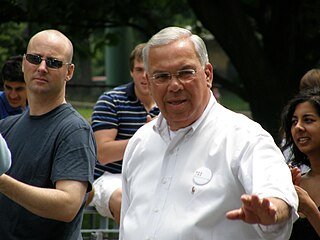
My former Boston Phoenix colleague David Bernstein, now looking for work, scored a big win on Wednesday, reporting before anyone that Mayor Tom Menino would not seek re-election. With the Phoenix now history, Bernstein posted the news on his blog — first as rumor, later as confirmed fact.
Given that Menino gave major interviews Wednesday to the Boston Globe and the Boston Herald, it strikes me as exceedingly likely that a media embargo was in place — and I received additional, direct confirmation of that this morning. Which just goes to show the futility of embargoes in the Internet age. Good for Bernstein for operating outside the system, even if it’s not by his own choice. News organizations might consider rethinking their participation in such attempts at media manipulation.
Both the Globe and the Herald offer excellent coverage of the Menino era today. And how about Globe editor Brian McGrory jumping back into the fray by interviewing Menino and writing a column? McGrory was the Globe’s signature voice for years. Returning to the trenches for one day was a smart move.
More: Andrew Beaujon of Poynter has a nice Storify on how Bernstein’s scoop played out on Twitter.
Photo (cc) by Dan4th Nicholas and published under a Creative Commons license. Some rights reserved.

Ex-Phoenician David Bernstein is still Talking Politics
Former Boston Phoenix political columnist David Bernstein hasn’t skipped a beat, moving his Talking Politics blog from thephoenix.com to his own domain. I’ve changed the link in the blogroll. And, of course, as I learn about new homes for Phoenix staffers, both virtual and terrestrial, I will post the information here.
How the decline of community helped kill the Phoenix
For the Boston Phoenix, the decline lasted years — but the end came swiftly.
Last Thursday afternoon a local journalist called to ask if I’d heard rumors that the 47-year-old alt-weekly was about to go under. I hadn’t. Within an hour, Boston.com was reporting that the Phoenix would cease publication immediately. One more issue — online only — will be posted this week. After that, the Phoenix, my professional home for 14 years and an important part of my life since the 1970s, will go dark.
Farewell from the @BostonPhoenix
Thank you Boston. Good night and good luck.
— Boston Phoenix (@BostonPhoenix) March 14, 2013
The Boston Phoenix comes to the end of the road
I’m not even going to try to write a real post about this today. I’m getting bombarded from all directions, and besides that, I’m devastated. But I did want to note quickly, in case you haven’t heard, that The Phoenix — the erstwhile Boston Phoenix, reinvented as a glossy magazine last fall — is closing down, as is its affiliated Internet radio station, WFNX.com.
The Providence and Portland Phoenixes will continue, as well as a few non-journalism businesses.
Here is Doug Most’s report for Boston.com. [5:07 p.m. update: That report now carries Joe Kahn’s byline.]
The Phoenix gave me 14 great years, and it’s hard to believe that the end has come. There are way too many people to mention, so I’ll leave it at this: Peter Kadzis and Stephen Mindich were great bosses, smart, tough and loyal. Carly Carioli has done tremendous work on the reinvention, and it’s a tragedy that he ran out of time. I rely on David Bernstein for his deep reporting on politics and Chris Faraone for an alternative look at the news. Here is Mindich in a statement to the staff:
What I can and will say is I am extremely proud, as all of you should be, of the highest standards of journalism we have set and maintained throughout the decades in all of our areas of coverage and the important role we have played in driving political and socially progressive and responsible agendas; in covering the worlds of arts and entertainment, food and fashion – always with a critical view, while at the same time promoting their enormous importance in maintaining a healthy society; and in advocating for the recognition and acceptance of a wide range of lifestyles that are so valuable for a vibrant society….
We have had an extraordinary run.
And this is an incredibly sad day.
More: Unlike many who got their start at the Phoenix in their early 20s, I was 34 years old and thought my journalism career was over. In the late 1980s I had tried my hand at launching a regional lifestyle magazine in the suburbs northwest of Boston following some years at the Daily Times Chronicle of Woburn. The magazine failed, and I was doing what I could to survive.
I was picked up on waivers in 1991 from the Pilot — yes, the Catholic paper — where I had been doing layout and production. The Phoenix hired me as a copy editor, but I kept an eye out in case something better came along. Yes, I had grown up reading the Phoenix, Boston After Dark and the Real Paper, but any romantic notions I’d had of the alternative press had pretty much dissipated.
Gradually, though, I got sucked in. And when I inherited the media beat in late 1994 from Mark Jurkowitz, I became a made member of the Phoenix family. It was the most formative experience of my career. Without the Phoenix, I can’t imagine what I’d be doing today — PR for some politician? Ugh.