Boston Globe reporter Beth Healy appeared on WGBH’s Boston Public Radio with Jim Braude and Margery Eagan a little while ago and said there is no way the Globe is going to accept a four- to six-month timeframe before home delivery returns to normal. She said we should expect news in a day or two.
Tag: Boston Globe
How the Globe’s home-delivery woes became a crisis
Previously published at WGBHNews.org.
Boston Globe owner John Henry now has a full-blown crisis on his hands. Before Sunday night, the Globe’s inability to deliver newspapers to its paying customers looked like an annoying but manageable problem—provided it was solved within the next few days. But the stunning revelation by the paper’s new distributor that it could take four to six months for home delivery to return to normal changes everything.
Following Sunday night’s devastating story by Globe reporters Mark Arsenault and Dan Adams (it’s also on the front of today’s print edition if you can find one), it’s clear that there is going to be an ugly—and very public—standoff between the Globe and the new distributor, ACI Media Group of Long Beach, California.
Earlier claims that only 5 percent of customers were being affected have given way to reality. The Globe’s chief executive, Mike Sheehan, now says the number is 10 percent, citing ACI’s own figures. Anecdotally, that still seems low. As of this morning, people living in 112 zip codes are still experiencing delays. Or, as many customers have been complaining, no delivery at all.
Other than the four- to six-month timeframe, I thought the most mind-boggling part of the Globe story was a quote from Jack Klunder, the president and chief executive of ACI, who claims he told Globe executives exactly what to expect:
“I said ‘I cannot describe to you how painful it is,’ ” Klunder said, recounting his warning to Globe officials. “I used the expression ‘massive disruption.’ … You’re going to get thousands of calls, emails—social media is going to be blistering you. The news media is going to be blistering you. You’re going to like where you are at the end of this cycle but you’re going to go through this.”
Sheehan essentially denies being told that, saying the problems of the past week go “far beyond any reasonable definition of disruption.”
Incredibly, Arsenault and Adams also report that ACI can’t be held liable for any performance problems during the first three months of the contract.
Despite all this, I suspect there’s more than a little posturing going on. Both sides have to know that a months-long delivery crisis is unacceptable and will set off an avalanche of canceled subscriptions (I’ve already heard from people who want to cancel but can’t because the phones are jammed), refunds to advertisers, and severe damage to the Globe’s brand and reputation. (Klunder seems to think this isn’t going to hurt ACI’s reputation at all. “We’ll be fine,” he’s quoted as saying. And why not? The Globe hired him despite similar problems in 2014 at the Orange County Register.)
But what can be done? We can safely assume that Globe executives don’t want to give ACI more money. Although Sheehan is quoted as saying the switch was mainly made to improve service (oops), he adds that he was aiming to save money as well. Perhaps the Globe could cancel the contract and re-up with the previous vendor, Publishers Circulation Fulfillment. But the network of hardworking, underpaid delivery people has already been so thoroughly upended that there’s probably no sure way of restoring the status quo.
Among the many threads to this ongoing story, one emerging theme may be tension between the Globe’s newsroom and the business side. The era of good feelings engendered by John Henry’s ownership suffered a setback this fall, as the paper eliminated about 45 positions through buyouts and layoffs at the same time that Henry was launching Stat, a well-staffed website covering health and life sciences.
On Saturday night and into the early-morning hours on Sunday, many dozens of Globe journalists volunteered to deliver the Sunday paper. It was a feel-good story, to be sure, and it would have been seen as a nice gesture if the delivery woes were just a few days away from being solved. But there was an edge to it as well. I spent some time at the paper’s Newton distribution center, and unhappiness was clearly evident among newsroom staffers toward their colleagues whose job it is to manage the paper’s business operations.
“We’re fighting for our survival here, and I like doing what I’m doing,” technology columnist Hiawatha Bray told me as he assembled papers alongside reporter Todd Wallack. “Not just because I get paid, but because I love journalism.” When I asked him why he thought the switch in vendors had been so painful, Bray replied, “I’m sorry, I have no idea. We have nothing to do with whatever it was that happened, and we’re just mystified.”
Added Wallack: “People deserve their paper. I agree with all our readers. They have a right to expect the paper to be there every morning.”
For that matter, Sunday night’s bombshell story was something of a declaration by Globe editor Brian McGrory that the paper can best serve its readers by holding powerful institutions accountable—including the Globe itself.
A final point. If you feel tempted to snark about the Globe’s dependence on print circulation some 20 years into the digital age, you need to understand a few things about the newspaper business. Digital is both the present and the future, of course. But print is still where the money is, not just for the Globe but for nearly all newspapers. Online, advertising is ubiquitous and therefore cheap. In print, advertising remains a lucrative if declining source of revenue.
Moreover, if we’ve learned anything from the past week, it’s that a lot of people still like to read the newspaper in print. On one end of the scale are the Globe readers who took to Twitter and Facebook to complain about the delivery problems. On the other are the total digital holdouts. I’ve heard stories that Globe employees took calls from customers who don’t even have an email address.
One person who hasn’t been heard from throughout the chaos of the past week is John Henry himself. This is his first real crisis since he purchased the Globe in 2013. But if there’s anything we’ve learned throughout his long tenure as principal owner of the Red Sox, it’s that he has a tendency to let bad situations play out—sometimes too long—before he acts.
It would be nice to hear from him. But it would be even better if he commits to doing whatever it takes to fix this mess. The Globe doesn’t have four to six months to get it right.
It may be 4-6 months before Globe delivery is back to normal
The Boston Globe weighs in with its first in-depth story on the home-delivery mess. Unfortunately, the news is not good. Executives for the Globe and the new distributor, ACI Media Group, are pointing fingers at each other, and ACI says service won’t be back to what it was previously for (are you ready?) four to six months. (For what it’s worth, I’m quoted.)
Here’s a paragraph to chew over:
“I said ‘I cannot describe to you how painful it is,’ ” [ACI chief executive Jack] Klunder said, recounting his warning to Globe officials. “I used the expression ‘massive disruption.’ … You’re going to get thousands of calls, e-mails—social media is going to be blistering you. The news media is going to be blistering you. You’re going to like where you are at the end of this cycle but you’re going to go through this.”
To which I and all other Globe subscribers (and managers and employees) can only say: You’ve got to be kidding.
Tweets, an interview, and a statement from the Globe
I spent some time Saturday night and early Sunday morning at The Boston Globe‘s distribution center in Newton, where employees—including many journalists—were assembling papers and getting ready to go out on routes. The Globe covers the story here. What follows is my live-tweeting.
In addition, I’ve posted audio of an interview I conducted with tech columnist Hiawatha Bray and reporter Todd Wallack as they were juggling inserts. (Bray is the first speaker.) After the tweets you’ll find a statement from Peter Doucette, the paper’s vice president for consumer sales and marketing.
By the way: We got our Globe here in West Medford this morning as well as the Sunday New York Times. But they used to be delivered by one carrier, who told us recently she was sticking with the Globe. Now there are two different vendors.
https://twitter.com/dankennedy_nu/status/683506380033134592
https://twitter.com/dankennedy_nu/status/683509069487943680
https://twitter.com/dankennedy_nu/status/683509318390562816
https://twitter.com/dankennedy_nu/status/683510226885210112
https://twitter.com/dankennedy_nu/status/683511920310239232
https://twitter.com/dankennedy_nu/status/683512643504746496
https://twitter.com/dankennedy_nu/status/683513636212576256
https://twitter.com/dankennedy_nu/status/683514363714629632
https://twitter.com/dankennedy_nu/status/683514951303061504
https://twitter.com/dankennedy_nu/status/683518201616019456
https://twitter.com/dankennedy_nu/status/683519267418042372
https://twitter.com/dankennedy_nu/status/683521176287707136
https://twitter.com/dankennedy_nu/status/683521602252869632
https://twitter.com/dankennedy_nu/status/683524729022595072
https://twitter.com/dankennedy_nu/status/683528525312229376
What follows is Doucette’s statement, which I received a little before 2 a.m.
This is a statement from Peter Doucette, Boston Globe Vice President, Consumer Sales & Marketing regarding Boston Globe staff volunteering to deliver newspapers:
Over this last week, The Boston Globe has received thousands of calls from customers reporting they had not received their daily newspaper as the Globe transitions its home delivery service to a new distribution partner ACI Media.
Establishing a new home delivery network with a new partner is a complex and major undertaking. Please know that we launched this transition because we firmly believed, and still do, that it was necessary to assure a higher level of delivery and customer service over the long term. In the short term, frustrating service disruptions have occurred as our new home delivery partner ACI Media deploys a new staff of 600 carriers who must learn new delivery routes and the addresses of the homes and apartments for every Globe home delivery subscribers.
With the Sunday paper about to hit – the Globe is doing everything possible to mitigate these short term delivery issues. More than two hundred Boston Globe journalists, business and operations staff, from general reporters in the newsroom up to the highest levels of leadership, are volunteering their time this holiday weekend to help deliver tomorrow’s Boston Globe or assist fielding phones calls from readers in Globe’s customer service call center.
This weekend’s effort is one small gesture to show our Globe customers that we are working hard with ACI to address these issues. We expect the process to improve not instantly, but steadily with each passing day and thank our customers for their patience.
Here’s the union letter asking Globe staffers to deliver paper
Here is the email that went out earlier today to Boston Globe employees from Scott Steeves, president of the Boston Newspaper Guild. I have removed contact information.
Dear Members –
We are in crisis mode. I’m sure you’ve all heard about the papers not getting delivered this past week. We are looking for people to work tonight delivering papers in the Newton area. Anyone from the editorial side who is able to work tonight delivering papers, please email Beth Healy. Anyone from the business side who is able to work tonight delivering papers, please contact Scott Steeves.
We will be meeting at 15 Riverdale Ave. in Newton at midnight. Globe employees will need to be two per car. Please have proof of driver’s license and registration. You will get a route with a list of households with delivery instructions. Make sure you have a flashlight and a GPS.
Appreciate everybody who can help out. Thanks in advance.
Scott
More from Craig Douglas of the Boston Business Journal.
The latest update on the Globe‘s home-delivery meltdown
Update, 5:05 p.m. Confirming a rumor I picked up earlier today, Globe tech columnist Hiawatha Bray reports on Facebook that “dozens” of Globe reporters, responding to the “fiasco” of the past week, will deliver the Sunday paper.
***
Today’s must-read post on The Boston Globe‘s ongoing home-delivery meltdown is by Adam Gaffin of Universal Hub. Among other things, he notes that when the Orange County Register switched to the Globe‘s new carrier, ACI Media Group, in 2014, mayhem ensued.
But I’m confused. According to the Times‘ story, the Register switched from the Los Angeles Times‘ service to ACI, based in Long Beach, California, after it fell behind on its payments to the Times. Yet when the Globe published a story on its own problems earlier this week, it identified ACI as the company that delivers the Los Angeles Times.
Googling ACI Media Group leads to dead ends and 404s (not a good sign). But I did find a cached press release from September 2010 in which ACI reported that it had at least some of the L.A. Times‘ home-delivery business:
American Circulation Innovations (ACI) is now delivering a weekly volume of 250,000 of the subscription-paid daily and Sunday Los Angeles Times. This represents a more than 100% increase of ACI’s delivery of the Los Angeles Times newspaper.
ACI’s Chief Executive, Keith Somers said: “We’ve been able to leverage our management team’s circulation background and our highly innovative and efficient delivery model to provide the Los Angeles Times with quality home delivery at reduced rates. We’re proud that our performance and service have earned increased business from such a valued and marquee partner.”
So the Orange County Register switched from the Los Angeles Times‘ home-delivery service to ACI Media Group, which also had at least some of the Times‘ business. And now the Globe is reporting that ACI has all of the Times‘ business. I guess.
The company’s new name appears to be the ACI Last Mile Network. And for what it’s worth, I haven’t been able to find any stories about problems with its service similar to what the Globe is going through. The Register‘s problems were essentially self-inflicted—though that may turn out to be the case with the Globe as well.
The Globe’s home-delivery problems continue
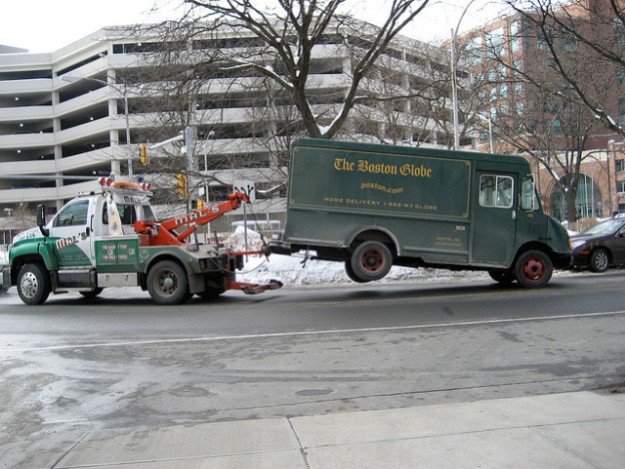
The situation with home delivery for Boston Globe customers doesn’t seem to be much better today. Judging from Twitter and other online comments, the only good news for the Globe is that people really miss their paper.
I’ve seen a few conspiratorial-minded commenters suggest that this is a deliberate attempt to get people to switch to digital. In fact, newspapers still make most of their money from print, especially on Sunday. Which makes the meltdown all the more inexplicable.
@dankennedy_nu @jbrady177 @BostonGlobe Maybe it's an evil plot to wean us off paper copies of newspaper.
— Kathy Cahill ❄ (@kathoderaytube) December 31, 2015
A few data points. A website called Customer Service Scoreboard reports that the Globe has received 193 negative comments and just one positive. The oldest comment goes back to 2010, and it’s certainly true that people aren’t going to check in to report that their paper arrived on time. Still, the top of the thread is loaded with comments from folks who haven’t received their paper this week and can’t get a response from the Globe.
In a “Note to Subscribers,” the Globe says in part, “This disruption is not unexpected, as the transition involves the hiring and deployment of approximately 600 drivers.” I find that statement surprising. Given the importance of getting it right, you’d think there would have been multiple meetings over many months beginning and ending with: “We can’t screw this up.”
The Globe‘s Beth Healy quotes chief executive Mike Sheehan as saying that, on Wednesday, only 5 percent of customers did not receive their paper in a timely manner. But look at all the zip codes where the new delivery service is still having problems.
Over at WBZ-TV (Channel 4), Boston University’s John Carroll tells Jon Keller that he has a message for Globe publisher John Henry: “Get in your car and start delivering some newspapers.”
Adam Gaffin of Universal Hub continues to track the story and post tweets. Comments are rolling in at my WGBHNews.org story from Wednesday as well.
A shaky debut for the Globe’s new home-delivery system

Previously published at WGBHNews.org.
It has come to my attention that there’s still an edition of The Boston Globe that’s printed on paper. I learned about this strange fact on Twitter this morning, where there is an outcry from home-delivery customers whose paper is nowhere to be found after the Globe switched to a new delivery system this week. Here’s Jason Tuohey, editor of BostonGlobe.com:
To readers experiencing home delivery delays, you can get today's paper here: https://t.co/J8bdrJraKb or on ePaper: https://t.co/bFxbpLWdJh
— Jason Tuohey (@jtuohey21) December 30, 2015
Well, yes, you can always do that. We’ve been unaffected because we’re Sunday-only print subscribers who read the Globe online the rest of the week. But people who pay a premium for home delivery of the print edition are not happy, and rightly so.
The Globe is changing to a new home delivery partner affecting service for many subscribers. We appreciate your patience during this time.
— Boston Globe Support (@GlobeSupport) December 30, 2015
We recently received a notice from our excellent delivery person that she’ll continue to deliver the Globe on Sundays, but not The New York Times; she had been handling both. So now there’s twice the opportunity for a screw-up as well as double the tip. After all, it’s as much work to deliver two papers as one, and now we’ll have two carriers.
@BostonGlobe @universalhub New boston globe delivery system a disaster
— Emily Rooney (@EmilyRooneyBTP) December 30, 2015
Good story for @universalhub, @DanKennedy_nu, even @BostonGlobe in problems with new delivery service. Time to go all digital? #noglobetoday
— Bill Mitchell (@bmitch) December 30, 2015
I know it’s the holidays. I’m certainly not going to do any heavy lifting this week. But I hope the Boston Business Journal, Boston magazine, the Boston Herald and even the Globe itself are gearing up to report on what went wrong with the transition. Adam Gaffin of Universal Hub has compiled some angry and amusing tweets from Globe home-delivery customers who sound like they might soon be former customers. And here’s one of my favorites, which didn’t make Adam’s cut:
Day 3: no @BostonGlobe. This new home delivery system sure saves John Henry money! Hope he uses it for better pitching!
— Scott Ferson (@scottferson) December 30, 2015
I’d say the Globe has until the end of this week to get it right. Otherwise there are going to be serious repercussions.
Northeastern j-students expose flaws in public records law

Our journalism students at Northeastern made a big splash over the weekend. Professor Mike Beaudet’s investigative reporting class partnered with The Boston Globe and WCVB-TV (Channel 5) to produce a story showing that the majority of the state’s 351 cities and towns failed to respond to public records requests.
Here is the Globe version of the story, written by staff reporter Todd Wallack. Here is the WCVB version, helmed by Beaudet, who was recently hired as an investigative reporter at the station.
Despite an intense focus on the state’s extraordinarily weak public records law (here is a letter written earlier this year by the Northeastern School of Journalism faculty and published by the Globe, the Boston Herald, and GateHouse Media community newspapers), 2015 is drawing to a close with the Massachusetts House having passed an inadequate reform bill and the Senate not having acted at all.
Let’s hope that in early 2016 the Senate fixes what the House got wrong. And congratulations to our students on a great job.
Boston Globe identifies a downtown spot for its new HQ
Not long after John Henry bought The Boston Globe in 2013, he announced that he planned to move the paper to a downtown location and sell the more than half-century-old plant at 135 Morrissey Blvd. News is now breaking that the Globe will move to 53 State St., a building known as Exchange Place. The memo from Globe Media chief executive Mike Sheehan follows.
Over Memorial Day Weekend in 1958, The Boston Globe left our home on Washington Street’s Newspaper Row and moved to Morrissey Boulevard in Dorchester. The move was a catalyst for the most dramatic transformation in our history, both in the depth and quality of our journalism and in the scope of our media operations. Under the leadership of seven world-class editors, 23 Pulitzer Prizes were earned here, and we’ve grown from a single media offering to over a dozen print, digital, and broadcast properties.
Today, we signed a Letter of Intent with UBS to move our editorial and business operations to 53 State Street, Exchange Place. Assuming this leads to a signed lease, and we have every expectation that it will, the move will mark a bit of a homecoming, bringing BGMP back to the same neighborhood we vacated 58 years before. We plan on occupying the second and third floors, which are the largest floor plates in the building, integrating the former Boston Stock Exchange space with the glass tower that was built in 1985.
I have a particular fondness for the building, having moved another company there eight years ago. The reasons for choosing Exchange Place extend far beyond the inarguable fact that I am a creature of habit. First and foremost are location and accessibility. For a journalistic enterprise, there is just no substitute for being able to walk to City Hall, the State House, and virtually every corporate headquarters in the city. If you had to drop a pushpin on the single location that’s most accessible by public transportation, this would be it. The MBTA’s Blue Line and Orange Line have a stop under the building, the Green Line is a block away at Government Center, and the Red Line is just down the street at Downtown Crossing. The building is equidistant and walkable from the North Station and South Station commuter rail terminals as well as the commuter boat.
This move would materially change the answer to “where do you want to meet for lunch?” Cosi and Au Bon Pain are in the building, and there must be a few hundred other dining options within walking distance.
What excites me most about the move is the ability to design our space around the vision of where we want to go. We have retained Gensler (gensler.com) to help us create our new work environment, and they have begun the process of space planning and design.
I honestly believe there is no greater opportunity to redefine and transform the culture of The Boston Globe than to move to and work in the ideal location, right in the heart of the city, in an environment designed for the future of journalism. It worked for us when we moved to Morrissey Boulevard in 1958. And it’ll be equally powerful when we move to Exchange Place which, if all goes according to plan, will be on January 1, 2017.
I should note that Adam Gaffin of Universal Hub beat me by a few minutes.
No word in Sheehan’s memo regarding the fate of the Morrissey Boulevard plant.
Also: By coincidence, Sheehan’s announcement comes at the same time that The Washington Post is moving into a new building.