Advance to go digital-only at four of its papers in Alabama and Mississippi

The sun is setting on print in Birmingham, Albama, and several other communities served by Advance newspapers. Photo (cc) 2020 by drjoshuawhitman.

When I speak to audiences about the future of local news, inevitably I’m asked if I think newspapers at some point will end their print editions once and for all. I always respond that I’m not a good person to answer that question — 25 years ago, I assumed they’d be long gone by now. Not only are they still here, but even as digitally focused a news outlet as The Boston Globe was still making more than half of its money from print as recently as a year ago.

I do think that we’re going to see newspapers cut back on print days, eventually moving to one big weekend print paper with digital distribution the rest of the week. But that’s not going to happen as long as publishers believe there’s still money in print advertising and circulation, both of which command a premium compared to digital.

Please support this free source of news and commentary by becoming a member of Media Nation for just $5 a month.

Which is why I was intrigued by an announcement by the Advance chain last week that its three Albama and one Mississippi newspaper will end their print editions altogether by early 2023.

“We remain deeply committed to serving our local communities and are producing high-quality journalism and reaching more people than ever before,” said Tom Bates, president of Alabama Media Group, in a statement published by AL.com. “At the same time, we’re adjusting to how Alabama readers want their information today, which increasingly is on a mobile device, not in a printed newspaper.”

I’m not going to snark. Advance is a privately held company owned by the Newhouse family, and I think they are genuinely trying to find a way forward. In Massachusetts, Advance owns The Republican of Springfield and MassLive.com, which are run more or less as separate operations.

A better analogy to Alabama and Mississippi, though, is Advance’s New Jersey properties. Advance publishes the largest daily newspaper in that state — The Star-Ledger of Newark — and two smaller dailies, The Times of Trenton and the South Jersey News, as well as several smaller publications. All of them operate under the NJ.com banner, and the emphasis is on digital subscriptions. There’s a unified newsroom of about 115 journalists who feed stories to both NJ.com and to the print editions. It’s similar to what Hearst is doing in Connecticut with one newsroom serving the New Haven Register, the Connecticut Post, several smaller papers and the digital-only CTInsider.

The difference in Alabama is that Advance is ending the print editions and focusing on its digital-only operations, shutting down three Alabama papers — The Birmingham News, the Huntsville Times and the Press-Register of Mobile — and The Mississippi Press.

Is this smart? In 2012, Advance cut The Times-Picayune back to three days of print at a time when broadband penetration in New Orleans and the surrounding area lagged behind other parts of the country. An outcry resulted, and the move was reversed the following year. But the damage had been done; The Times-Picayune, a once-great paper that had served as a lifeline following Hurricane Katrina in 2005, ended up being acquired in 2019 by an independent daily, The Advocate of Baton Rouge.

Even so, 2012 was a long time ago. Today, according to the Alabama Media Group, AL.com is in the top 10 of local news websites in the U.S., reaching about 11 million users each month. Statista reports that broadband penetration in 2019 was about 81% in Alabama and about 76% in Mississippi; no doubt those figure are higher today. (By comparison, that number was 88% in Massachusetts.) Still, Alabama and Mississippi are among our poorest states, and the move away from print is going to leave some people behind.

“The print side of our business does not make economic sense in Alabama,” Bates told Alexandra Bruell (free link) of The Wall Street Journal. Bruell reported that the circulation of Advance’s three Alabama papers is down to around 30,000, a drop from 260,000 a decade ago.

So this seems like a good time for Advance to try moving into a digital-only future. If it enhances the bottom line, then other publishers can be expected to follow suit. And if that, in turn, provides a boost to Advances local journalism, then that will be good news for everyone.

The Globe is hit with a subpoena despite new rules protecting journalists

Merrick Garland

Well, that didn’t last long.

Late last month, supporters of a free press were celebrating when Attorney General Merrick Garland announced new guidelines aimed at protecting journalists. As Hadley Baker and Katherine Pompilio wrote at Lawfare, the rules — codifying a policy that Garland had put into effect early in his term — would prohibit “the use of compulsory legal process — the use of subpoenas, search warrants, court orders, and other investigatory practices — against ‘newsgathering’ individuals who possess and/or publish classified information.”

The rules were specifically aimed at protecting journalists in leak investigations involving classified information. But surely the guidelines would inform the Justice Department’s behavior in lesser matters, no? No. Today The Boston Globe reports that one of its editors, Joshua Miller, has been subpoenaed by federal prosecutors who are demanding that Miller testify on Dec. 5 in a case involving the Harvard admissions scandal. Miller broke that story in 2019.

Please support this free source of news and commentary by becoming a member of Media Nation for only $5 a month. Just click here.

Miller would most likely not have to testify in 49 states or the District of Columbia because they either have a shield law or, as is the case in Massachusetts, a ruling from their highest state court that journalists are protected from being dragged into court at the whim of prosecutors. The only places that do not have shield protections are the state of Wyoming and the federal government. The courts, though, are supposed to balance the interests of the criminal-justice system against the importance of a free press. As Mike Damiano writes in the Globe:

In a memorandum supporting a motion to quash the subpoena, Globe counsel Jonathan M. Albano cited extensive legal precedents protecting journalists from subpoenas and referred to “the widespread recognition that the First Amendment protects journalists from the needless disclosure of sources, investigative techniques, and both confidential and non-confidential work product.”

The judge in the case may rule against the prosecution, but it shouldn’t get even that far. This is an outrage against the First Amendment. If U.S. Attorney Rachael Rollins didn’t know about it, she needs to step in immediately and put an end to it. And if she did know, then she needs to undergo the “comprehensive training” that the Garland memo refers to as soon as possible.

Nancy West talks about her entrepreneurial journey and the state of journalism in N.H.

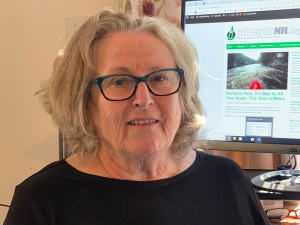
Nancy West of InDepthNH

On this week’s “What Works” podcast, Ellen Clegg and I talk with Nancy West, executive editor of InDepthNH.org. 

Nancy was an investigative reporter during her 30-year career at the New Hampshire Union Leader. Nancy founded the nonprofit New Hampshire Center for Public Interest Journalism in 2015, and has taught investigative reporting at a summer program for students at the New England Center for Investigative Reporting.

Ellen has a Quick Take on a recent article by Dan Froomkin in Washington Monthly. Froomkin, who is now editor of Press Watch, used to work for The Washington Post and has been critical of owner Jeff Bezos. Froomkin is taking aim at the content management system developed by the Post under Bezos. The Post licenses this system to other news outlets around the country. That kind of market power worries Froomkin.

My Quick Take is on the state of journalism in Vermont, a subject we talked about on a recent podcast with Anne Galloway, the founding editor of VTDigger, a well-regarded digital startup. Dan’s topic is about a good piece of media criticism. Bill Schubart, a journalist who writes a column for VTDigger, wrote a column critiquing a recent New Yorker piece by Bill McKibben on Vermont journalism. But Schubart also looked inward and wrote that Digger itself is having problems.

You can listen to our latest podcast here and subscribe through your favorite podcast app.

Seismic change comes to the New Haven Independent as Tom Breen moves up

Tom Breen. Photo (cc) 2021 by Dan Kennedy.

There is huge news today in the world of independent community journalism. Paul Bass, the founder of the New Haven Independent, is stepping aside as editor while Tom Breen, currently the managing editor, moves up to the top position. Bass has been talking about making this change for a while, and on Tuesday he made it official.

Bass, 62, isn’t going anywhere. He’ll continue as executive director of the Online Journalism Project, the nonprofit organization he set up to oversee the Independent, the Valley Independent Sentinel in New Haven’s northwest suburbs, and WNHH Radio, a low-power FM station that specializes in community programming. He’ll also continue to report the news for the Independent and host a show on WNHH.

Paul Bass. Photo (cc) 2021 by Maaisha Osman.

Breen, 34, joined the staff of the Independent as a reporter in 2018 and later became managing editor. Breen is a dogged journalist; last November, I accompanied him as he knocked on the doors of houses that had been foreclosed on, a regular practice of his that has yielded important stories.

The Independent is one of the oldest and still among the best nonprofit local news startups in the country. It was the primary subject of my 2013 book, “The Wired City,” and it will also be featured in “What Works: The Future of Local News,” a book-in-progress by Ellen Clegg and me.

Congratulations to Paul and Tom. This is a big change for a news organization that has been remarkably stable over the course of its 17-year existence.

Jackie Kucinich of The Daily Beast will be the Globe’s new DC bureau chief

Jackie Kucinich (via LinkedIn)

The Boston Globe has hired a new Washington bureau chief — Jackie Kucinich, who currently holds that position at The Daily Beast. Kucinich replaces Liz Goodwin, who left the Globe during the summer in order to cover Congress for The Washington Post.

Before starting at the Beast in 2014, Kucinich worked for the Post, USA Today, Roll Call and The Hill, and is a regular contributor to CNN.

“This is a big get for the Globe,” said Brian McGrory in a memo to the staff, which a trusted source forwarded to me Tuesday. “Jackie is heralded around Washington, rightly so, for her fresh eye and her appropriately skeptical view, for knowing the intricacies of the city without ever allowing herself to be part of the press pack within it.”

Kucinich, who lives in Washington with her husband and daughter, is the daughter of former Cleveland mayor and congressman Dennis Kucinich. She’ll begin her new job on Nov. 21.

Michael Reed tells E&P that everything is coming up Gannett

Photo (cc) 2008 by Patrickneil

You’ve seen plenty of bad news about Gannett here — layoffs, reassigning staff away from local news coverage, closing papers and, more recently, imposing furloughs, pension freezes and buyouts. With more than 200 daily newspapers across the country, what happens at Gannett matters. Its ongoing shrinkage is a significant part of the local news crisis.

So I was interested to see that Gannett chief executive Michael Reed talked — OK, exchanged emails — with Gretchen A. Peck of the trade publication Editor & Publisher. I wanted to see what sort of story he’s telling these days about the path forward for his debt-addled chain, which nevertheless found a way to pay him $7.7 million last year.

Please support this free source of news and commentary by becoming a member of Media Nation for only $5 a month. Just click here.

Not surprisingly, it turns out to be a lot of the same old, same old — an emphasis on digital subscriptions despite having little journalism to attract new readers as well as ancillary businesses ranging from events to sports betting. At least he didn’t mention NFTs this time.

One thing I didn’t know was that Gannett’s consumer product website, Reviewed.com, is based in Cambridge, and that it employs more than 100 people, including scientists, product experts, writers and editors. The idea is similar to Wirecutter, founded as an independent site and later acquired by The New York Times. Buy something through Reviewed.com and Gannett gets a cut of the action. Reed told Peck:

If you look across the larger media landscape throughout the last decade, we have seen expansion beyond traditional news into varied product offerings and different types of content. As the traditional revenue streams we largely relied on, such as print advertising and print subscriptions, continue to transition to digital, we are also adapting to new revenue opportunities. These diversifying revenue streams help us to ensure we can support our ongoing news efforts in an increasingly digital world.

Reed added that progress continues to be made in paying down the debt that Gannett took on when it merged with GateHouse Media in 2019. Gannett these days is essentially GateHouse under a different name; Reed himself was the head of GateHouse before the merger.

Despite Reed’s happy talk, the company continues to throw newspapers and staff members overboard. According to Ray Schultz of Publishers Daily, Gannett is selling two papers in New Mexico and has put its Phoenix printing facility on the block for $47.4 million. Urban Milwaukee’s Bruce Murphy reports that six veteran journalists are leaving Gannett’s Milwaukee Journal Sentinel. Local opinion content continues to be slashed as well, writes Mark Pickering in Contrarian Boston.

Essentially Reed is telling the same story he’s always told: Times are tough, and we have to keep cutting. Eventually, though, digital subscriptions and our non-news investments will begin to pay off and support our journalism. It’s just that “eventually” never seems to come. Still, there’s considerable value in reading about Reed’s assessment of how Gannett can pull out of its downward spiral; Peck and E&P deserve credit for getting him on the record.

Meanwhile, in Eastern Massachusetts and across the country, independent news projects are rising up to fill the gap left by Gannett’s retreat. The latest is The Concord Bridge, a digital-and-print nonprofit competing with Gannett’s Concord Journal, ghosted by the shift from local to regional coverage last spring.

You can access a complete list of independent local news outlets in Massachusetts by clicking here.

They’re banning books right and left these days

I want to call your attention this morning to two attempts to ban books — one from the left, which will ultimately prove futile, and one from the right, which may be more effective. Together, I think they tell us something important about our culture’s ongoing separation into two very different spheres of reality.

Let’s consider the right-wing book-banning campaign first. We tend to regard such efforts as something out of a Southern Gothic tale, but this one takes us no farther south than a few miles from Route 128. In Abington, a group of parents is attempting to ban “This Book Is Gay,” by Juno Dawson, from the Middle/High School Library. The book that has come under fire across the country.

“This Book Is Gay” was the subject of a recent meeting by the Abington School Committee. According to the Abington News, “It is traditionally kept in the section of the library reserved for high schoolers. However, during Pride Month last June it was included in a display along with other LGBTQ books.”

Please support this free source of news and commentary for only $5 a month. Just click here.

One parent told the committee that displaying the book was “a definite sign of indoctrination and endorsement by the schools,” adding: “Children become victims of the cultural environment that is highly suggested to them. I prefer an environment that is healthy and safe instead of installing ideologies not consistent with family values.”

One complicating factor: A gay selectman, Alex Hagerty, also spoke out against the book, saying that he believed it indulged in outdated stereotypes. But the superintendent of schools, Peter Schafer, said that he supported the book’s availability to older students because, even though parts of it are graphic, “those chapters are really warnings to the reader about safe sex and behavior.”

Because of what sounds like a clash between state and local policies, it’s not clear what will happen next. I hope common sense prevails and that “This Book Is Gay” will remain available in the library for any student who wishes to seek it out. But I’m not holding my breath.

***

Justice Barrett

The futility on the left comes in the form of a $2 million book contract given to Supreme Court Justice Amy Coney Barrett by Penguin Random House. According to Martin Pengelly of The Guardian, more than 250 people from the literary world have signed an open letter calling on the publisher to re-evaluate its decision to publish Barrett’s book, citing her vote to overturn overturn Roe v. Wade earlier this year. The letter states in part:

Barrett is free to say as she wishes, but Penguin Random House must decide whether to fund her position at the expense of human rights in order to inflate its bottom line, or to truly stand behind the values it proudly espouses to hold. We … cannot stand idly by while our industry misuses free speech to destroy our rights.

So, free speech is “misused” if it expresses views that you don’t agree with? Good Lord. Leaving aside the fact that the health of the First Amendment doesn’t depend on Barrett’s getting $2 million, this turns freedom of expression on its head.

According to Brittany Bernstein, writing in National Review, the protests are coming from inside Penguin Random House as well.

What’s especially absurd about this is that Barrett’s book will (or might?) be published by Sentinel, a Penguin Random House imprint that is specifically focused on conservative titles and whose authors include right-wing figures such as Rod Dreher, the late Ken Starr and Nikki Haley. If the campaign against Barrett’s book succeeds, will the entire Sentinel imprint be next?

The absurdity is that there are conservative publishing houses (Regnery comes to mind) that would be glad to take Barrett’s book and provide her with just as much publicity as she would get from Penguin Random House — maybe more, since they could use its cancellation as a marketing ploy.

In an ideal world, kids would be able to borrow “This Book Is Gay” from their school library and Amy Coney Barrett could publish her book with a mainstream outfit. But that’s not the world we live in anymore.

Biking with the AMC

Twenty-three-mile ride along the Charles out to Waltham and back. On the way home, I ran into about two dozen bikers from the Appalachian Mountain Club. I’m a member, so I’m going to have to check out their events. Anyway, I rode with them  to Alewife Station before splitting off to head back. Great people, plus they showed me the best connection between the Watertown-Cambridge Greenway and the river.

AMC riders near Fresh Pond

The shame of Musk’s takeover is that Twitter was starting to get (a little) better

Elon Musk. Photo (cc) 2019 by Daniel Oberhaus.

The shame of it is that Twitter was starting to get a little better. Some months back I decided to spend $3 a month for Twitter Blue. You had up to a minute to pull back a tweet if you saw a typo or if a picture didn’t display properly. More recently, they added an actual edit button, good for 30 minutes. Best of all is something called “Top Articles,” which shows stories that are most widely shared by your network and their networks. I almost always find a couple of stories worth reading — including the one from The Verge that I’ve shared below.

Anyway, here we are. Billionaire Elon Musk is now the sole owner of a social media platform that I check in with multiple times during the day and post to way too much. Twitter is much smaller than Facebook and YouTube, and smaller than TikTok and Instagram, too. In fact, it’s smaller than just about everything else. But it punches above its weight because it’s the preferred outlet for media and political people. It’s also a cesspool of sociopathy. We’re all worried that Musk will make it worse, but let’s be honest — it’s already pretty bad.

The smartest take I’ve seen so far is by Nilay Patel in The Verge. Headlined “Welcome to hell, Elon,” the piece argues that Musk isn’t going to be able to change Twitter as much as he might like to because to do so will drive advertisers away — something that’s already playing out in General Motors’ decision to suspend its ads until its executives can get a better handle on what the Chief Twit has in mind. Patel also points out that Musk is going to receive a lot of, er, advice about whom to ban on Twitter from countries where his electric car company, Tesla, does business, including Germany, China and India. Those are three very different cultures, but all of them have more restrictive laws regarding free speech than the United States. Patel writes:

The essential truth of every social network is that the product is content moderation, and everyone hates the people who decide how content moderation works. Content moderation is what Twitter makes — it is the thing that defines the user experience. It’s what YouTube makes, it’s what Instagram makes, it’s what TikTok makes. They all try to incentivize good stuff, disincentivize bad stuff, and delete the really bad stuff…. The longer you fight it or pretend that you can sell something else, the more Twitter will drag you into the deepest possible muck of defending indefensible speech.

Indeed, Twitter has already reinstated the noted antisemite formerly known as Kanye West, although Musk, weirdly enough, says he had nothing to do with it.

My approach to tweeting in Elon Musk’s private garden will be to do what I’ve always done and see what happens. I use it too much to walk away, but I don’t like it enough to wring my hands.