Calling on The Call

From 1976 to ’78, I was a Northeastern co-op student at The Woonsocket Call in Rhode Island, working full-time for about a year in three- and six-month stints. It was a great place to learn how to be a reporter. Managing editor Bill Crouse, city editor Ed Berman and assistant city editor Jim Anagnostos (whose family published The Hellenic Chronicle in Boston) were all first-rate journalists, and the Palmer family, who owned the paper, took their responsibilities seriously.

Late Monday afternoon, I was driving home from the Providence area and decided on a whim to head up Route 146 to see what The Call’s building and the city looked like these days. The building, at 75 Main St., was apparently closed during COVID and has not been reopened. But the outside was very much as I remembered it.

I don’t recall anyone ever mentioning Samuel S. Foss, who was, according to the plaque in the third photo, the “Father of Woonsocket Journalism.” But in the second photo you can just make out that the paper’s headquarters, built in 1922, was known as the Buell Building. According to Wikipedia, The Call was founded in 1892 by Samuel E. Hudson and Andrew J. McConnell, and among their descendants was Buell W. Hudson.

Today the paper is owned by RISN Operations, a small chain that was launched in Rhode Island in 2007 and that today operates eight small dailies across the country as well as a number of weeklies.

Leave a comment | Read comments

Bigfoot can’t spell

Shortly after the police raid on the Marion County Record and the death of its 98-year-old co-publisher, Joan Meyer, most news outlets spelled her name “Joan.” Then The New York Times came along and, in an otherwise lovely tribute, spelled her name “Joann.” A lot of us decided we were wrong, and I went back and changed everything. Now it turns out that it was the Times that couldn’t spell her name properly. It is, in fact, “Joan,” though it’s pronounced “jo-ANN.”

Leave a comment.

Greater Boston arts and local news get a boost from three new nonprofit projects

There’s good news about local news in Greater Boston today on three fronts. I’ll start with an attempt to revive arts reviews — at one time a staple of mainstream and alternative publications, but now relegated to niche outlets like The Arts Fuse, a high-quality website edited by Boston University professor and former Boston Phoenix arts writer Bill Marx.

Recently Paul Bass, the executive director of the nonprofit Online Journalism Project in New Haven, Connecticut, launched a grant-funded project called the Independent Review Crew (link now fixed). Freelancers in seven parts of the country are writing about music, theater and other in-person cultural events. Boston is among those seven, and freelance writer-photographer Sasha Patkin is weighing in with her take on everything from concerts to sand sculpture.

You can read Patkin’s work on the Review Crew’s website — and, this week, her reviews started running on Universal Hub as well, which gives her a much wider audience. Here’s her first contribution.

Bass is the founder of the New Haven Independent, started in 2005 as part of the first wave of nonprofit community websites. The Online Journalism Project is the nonprofit umbrella that publishes the Indy and a sister site in New Haven’s northwest suburbs; it also oversees a low-power radio station in New Haven, WNHH-LP. Before 2005, Bass was a fixture at the now-defunct New Haven Advocate, an alt-weekly that, like the Phoenix, led with local arts and was filled with reviews. The Review Crew is his bid to revive the long lost art, if you will, of arts reviewing.

Other places that are part of The Review Crew: New Haven; Tulsa, Oklahoma; Troy/Albany, New York; Oakland, California; Hartford, Connecticut; and Northwest Arkansas (the Fayetteville metro area is home to about 576,000 people).

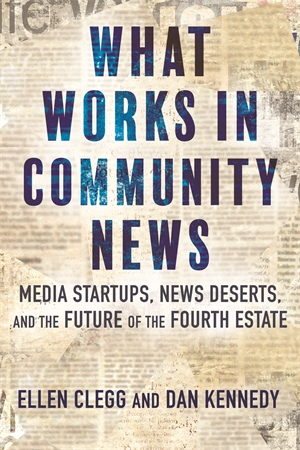
I’ve got all kinds of disclosures I need to share here. I gave Bass some guidance before he launched The Review Crew — not that he needed any. The Indy was the main subject of my 2013 book “The Wired City,” and I’ve got a lengthy update in “What Works in Community News,” the forthcoming book that Ellen Clegg and I have written. I also suggested Universal Hub to Bass as an additional outlet for The Review Crew; I’ve known Gaffin for years, and at one time I made a little money through a blogging network he set up. Gaffin was a recent guest on the “What Works” podcast.

In other words, I would wish Paul the best of luck in any case, but this time I’ve got a bit more of a stake in it.

***

The Phoenix was not the city’s last alt-weekly. For nearly a decade after the Phoenix shut down in 2013, DigBoston continued on with a mix of news and arts coverage. Unfortunately, the Dig, which struggled mightily during COVID, finally ended its run earlier this year. But Dig editors Chris Faraone and Jason Pramas are now morphing the paper into something else — HorizonMass, a statewide online news outlet. Pramas will serve as editor-in-chief and Faraone as editor-at-large, with a host of contributors.

HorizonMass will publish as part of the Boston Institute for Nonprofit Journalism, founded by Faraone and Pramas some years back to funnel long-form investigative coverage to a number of media outlets, including the Dig. HorizonMass will also have a significant student presence, Pramas writes, noting that the project’s tagline is “Independent, student-driven journalism in the public interest.” Pramas adds:

With interns working with us as reporters, designers, marketers, and (for the first time) editors, together with our ever-growing crew of professional freelance writers, we can continue to do our part to train the next generation of journalists while covering more Bay State happenings than ever before. We hope you enjoy our initial offerings and support our efforts with whatever donations you can afford.

***

Mark Pothier, a top editor at The Boston Globe, is leaving the paper to become the editor and CEO of the Plymouth Independent, a well-funded fledgling nonprofit. Pothier, a longtime Plymouth resident and former musician with the band Ministry, is already listed on the Independent’s masthead. Among the project’s advisers is Boston Globe journalist (and my former Northeastern colleague) Walter Robinson, also a Plymouth resident, who was instrumental in the launch of the New Bedford Light. Robby talked about the Plymouth Independent and other topics in a recent appearance on the “What Works” podcast.

Pothier started working at the Globe in 2001, but before that he was the executive editor of a group of papers that included the Old Colony Memorial, now part of the Gannett chain. When Gannett shifted its Eastern Massachusetts weeklies to regional coverage in the spring of 2022, the Memorial was one of just three that was allowed to continue covering local news — so it looks like Plymouth resident are about to be treated to something of a news war.

Leave a comment.

What’s the Buzz in Burlington, Mass.? Nicci Kadilak on what it’s like to be a one-person news source

Nicci Kadilak was among several local news entrepreneurs featured earlier this year by GBH News. Photo by Jeremy Siegel / GBH News. Used by permission.

On the latest “What Works” podcast, Ellen Clegg and I talk with Nicci Kadilak, an educator, author, mom and founder of Burlington Buzz. The Buzz is a hyperlocal online news site serving Burlington, Massachusetts, a town of 26,000 people north and west of Boston. Kadilak created the Buzz in early 2022, when a town election was on the horizon and the local Gannett weekly, the Burlington Union, switched to regional coverage — and later ended its print edition altogether. In the 1980s, Burlington was covered by two weekly papers and The Daily Times Chronicle of Woburn, where I worked for quite a few years.

Nicci uses the Substack platform and charges a range of subscription fees. She offers news stories about town government, cultural events, sports, and has a section that provides a platform for audio interviews of newsmakers. She allows reader comments, too. Nicci also writes essays at Nicci’s Notes, and her debut novel, “When We Were Mothers,” is available wherever you buy books online. (Nicci, Ellen and Dan met in a Zoom discussion of local news led by Simon Owens for his informative Media Newsletter.)

By the way, the Buzz was just named one of 74 finalists for a Lion Independent Online News (LION) Publishers’ Local Journalism Award. Listeners of this podcast will notice a number of other familiar news organizations as well.

In our Quick Takes on developments in local news, I report on another effort to leverage tax credits for local journalism, and Ellen checks in on the decline and apparent death of the Santa Barbara News-Press.

You can listen to our conversation here and subscribe through your favorite podcast app.

Journalism, public goods and the free rider problem

Watchdog journalism at its finest. Photo via Needpix.

One of the arguments that often comes up in discussions about how to pay for news is that journalism is a “public good.” I was thinking about this last night when I read Rebuild Local News president Steve Waldman’s latest piece in The Atlantic, in which he observes that journalism often saves more money than it costs. He cites some notable examples, including a ProPublica investigation that led to $435 million in fines and reporting by MLK50 in Memphis, Tennessee, that resulted in the cancellation of about $12 million in debt owed by hospital patients.

This is the very definition of a “public good.” When economists talk about a public good, they mean something similar, but not identical, to what we lay people mean. You and I might simply mean that a public good is good for the public, as tough, ethical journalism surely is. But what economists mean is that it’s also something that benefits the public whether they pay for it or not. Here’s how Investopedia puts it: “The two main criteria that distinguish a public good are that it must be non-rivalrous and non-excludable. Non-rivalrous means that the goods do not dwindle in supply as more people consume them; non-excludability means that the good is available to all citizens.” Thus, a public good carries with it a free rider problem.

This is what I wrote about public goods in my 2013 book “The Wired City”:

In economic terms, a public good is something that benefits everyone, whether each of us pays for it or not — which, perversely, creates incentives for us not to pay. That is why we must pay taxes rather than make voluntary contributions to fund national defense. “Public good” is a phrase that also comes up a lot in discussions of why it is so difficult to fix the news business. For example, the local newspaper reports that members of the school committee are taking bribes from a bus company with a record of safety violations. As a result of that reporting, those committee members are removed and prosecuted. Schoolchildren are safer. Yet people who don’t buy or even read the paper benefit just as much as those who do. Thus, there needs to be a way to pay or such journalism outside the for-profit, advertiser-based context that worked reasonably well until a few years ago. Seen in this light, community journalism is a public good that deserves funding beyond what the market is willing to pay.

The problem is that when tax money is used to fund journalism, it can create a conflict that interferes with the independence needed for a news organization to fulfill its role as a monitor of power. Watchdog reporting is difficult when the institutions you’re holding to account are also providing you with the money you need to operate. That makes journalism very different from the fire department, schools or public works, all of which may accept public money without any such conflicts.

In his Atlantic piece, Waldman advocates for tax credits for local publishers and advertisers, a variation of an idea that he’s been promoting for several years that was recently revived in the form of the Community News and Small Business Support Act, which I wrote about a few weeks ago. Now, tax credits are sufficiently arm’s-length that they don’t present much of a threat to journalistic independence. But the very fact that such indirect government assistance is being talked about helps illustrate why news isn’t just good for the public — it’s also a public good in every sense of the term.

At one time there was so much advertising money supporting journalism that we didn’t need to think about such things. These days, news has morphed from a highly profitable enterprise into a classic public good. It makes sense for us to find ways to fund that public good as long as we can do so without undermining the very qualities that make it a public good in the first place.

Judy Woodruff takes on the local news crisis

Earlier this week Judy Woodruff of the “PBS NewsHour” reported on the demise of The Canadian Record, an independently owned weekly newspaper that served the community of Canadian, Texas. Woodruff hits on themes familiar to readers of this space, including the loss of more than 2,000 newspapers in recent decades as well as the rise of polarization and the decline in voter turnout, both of which are related to a lack of reliable news and information at the local level.

The news from Canadian turns out to be not quite as grim as most of the story would suggest. We learn toward the end that publisher Laurie Brown and others continue to post occasional stories to the website and to the Record’s Facebook page, and that she’s currently seeking a buyer for the paper. But it’s certainly grim enough, as neither she nor her contributors are getting paid.

As optimistic as I am about the future of local news, there are parts of the country that are just hard. Places like Canadian, a small town in the rural Texas Panhandle, are especially difficult, as they lack the population base to sustain a news outlet now that most advertising has migrated to the internet. Such places also frequently lack the social capital needed to launch a nonprofit news organization.

I hope the Record finds a buyer, although, if she does, the new owner is going to face exactly the same kinds of challenges that proved insurmountable for Brown.

The Portland Phoenix, revived in 2019, makes its final flight

Media Nation is back. It’s not quite where I want it to be yet, but it’s good enough to resume posting. Look for more improvements in the days to come.

Unfortunately, I’m here to report some sad news. The Portland Phoenix, the last of the Phoenix newspapers where I worked for many years, has ceased publication. Editor Marian McCue’s farewell editorial begins:

It was easy to have a sense of optimism in the spring of 2019. It was a different time, when former Forecaster publisher Karen Wood and I hatched a plan to launch a new version of the Portland Phoenix, which had folded in February of that year. We wanted to build a strong and independent news alternative to the media monopoly that controlled the Press Herald and many of Maine’s newspapers.

Our timing was not great. Five months after the launch, the pandemic struck with a vengeance. Few alive had seen such a cataclysmic event, much was unknown and everybody was fearful. The advertising relationships we had suddenly vanished. We tried to keep going, but the advertising was not there.

The flagship Boston Phoenix closed in 2013. At one time there were Phoenix papers in Providence, Portland, Worcester as well as Stuff magazine, Stuff@Nite and an alternative rock radio station, WFNX. The Portland Phoenix staggered on under new ownership until 2019, and was then relaunched by McCue and Wood. The new Portland Phoenix was redesigned and built a reputation for quality journalism. In the end, it wasn’t enough.

I hope someone else will give it a try. Portland is a medium-size, semi-isolated city with a strong arts community — exactly the sort of place where an alt-weekly can still find a niche. And let’s not forget that Portland recently got some very good news, as the state’s largest daily, the Portland Press Herald, and most of its affiliated papers will be acquired by the nonprofit National Trust for Local News.

A new bill would boost local news with tax credits for advertisers and publishers

The U.S. Capitol. Photo (cc) 2013 by Mark Fischer.

I’ve written quite a bit here about the possibility of government assistance for local news. Though it’s not an idea I’m enthusiastic about, I think the indirect assistance laid out in the Local Journalism Sustainability Act is worth trying. The LJSA, which would provide tax credits for subscribers (or donors), advertisers and publishers, died at the end of the last congressional session despite having some bipartisan support.

Now a new, similar measure has surfaced. The Community News and Small Business Support Act would create five years’ worth of tax credits for advertisers and publishers, but not for subscribers. The bill is being sponsored by Rep. Claudia Tenney, R-N.Y., and co-sponsored by Suzan DelBene, D-Wash. The trade publication Editor & Publisher has gone all out in covering the story, and I emailed a few of my thoughts to E&P’s Gretchen Peck.

As I told Peck, the new bill, like the LJSA, is worth supporting for two reasons: the tax credits are indirect enough not to interfere with the independence that news organizations need to hold government to account; and the publishers’ tax credit for hiring and retaining journalists gives even the giant chain owners like Gannett and Alden Global Capital some incentive to do the right thing.

That said, it’s hard to imagine the bill emerging intact from a House that just this week featured Rep. Marjorie Taylor Greene waving around revenge porn starring Hunter Biden and Robert F. Kennedy Jr., indulged by the Republican leadership, denying that he made the antisemitic and racist comments we had all heard him make.

Steven Waldman, president of the Rebuild Local News coalition, has written an op-ed for E&P endorsing the Tenney-DelBene bill and hailing its emphasis on local news outlets and advertisers. “This will directly help the small businesses, many of which had to cut back on their marketing spending because of COVID and then inflation, to get customers in the doors,” Waldman writes. “It makes sense because saving local news should not be about saving journalism jobs per se. It should be about strengthening communities.”

The bill is also far better than the misguided Journalism Competition and Preservation Act, which would extract revenues from Google and Facebook as compensation for the news content they repurpose.

There is no substitute for news entrepreneurs on the ground, for-profit and nonprofit, doing the hard work of building sustainable local news organizations. But a little bit of indirect assistance from the government wouldn’t hurt.

From ‘Spotlight’ to a spotlight on local news: A conversation with Walter Robinson

Walter Robinson speaking at a New England First Amendment Coalition event

In the latest “What Works” podcast, Ellen Clegg and I talk with Walter Robinson, a longtime investigative journalist and editor of The Boston Globe’s Spotlight Team. Robby, as he is known, was instrumental in uncovering the clergy sex abuse scandal that rocked the Catholic Church in Boston and beyond. The series won the Pulitzer Prize for Public Service in 2003. The team’s work was captured onscreen in the movie “Spotlight,” where Robby was played by the actor Michael Keaton.

Robby is a former colleague — he was a Distinguished Professor of Journalism here at Northeastern. He was also a 1974 graduate of Northeastern’s journalism program and participated in co-op.

Robinson covered and edited local news at the Globe. But he ranged wide. He reported from 48 states and 33 countries. He covered the White House during the Reagan and George H.W. Bush administrations. He was also the Globe’s Middle East bureau chief and covered the first Persian Gulf War.

In recent years, Robby has been focused on the local news crisis in a big way. He has been deeply involved in the New Bedford Light, an impressive nonprofit digital news outlet. He lives in Plymouth, so it’s perhaps no surprise that he is a key adviser to the board of directors at the new Plymouth Independent.

I’ve got a Quick Take on developments in the junkyard known as Twitter. Ellen reports on a new podcast out of Memphis called “Civil Wrongs.” It’s produced by a Report for America corps member that examines a racist massacre in the aftermath of the Civil War.

You can listen to our conversation here and subscribe through your favorite podcast app.

There he goes again: Patrick Soon-Shiong delivers another paper to Alden Global Capital

Patrick Soon-Shiong. Photo (cc) 2014 by NHS Confederation.

Patrick Soon-Shiong, the wealthy surgeon who owns the Los Angeles Times, has delivered yet another daily newspaper into the greedy hands of the hedge fund Alden Global Capital. Soon-Shiong announced Monday that he’d sell The San Diego Union-Tribune to Alden’s MediaNews Group. By my count, the Union-Tribune becomes the 10th paper that Soon-Shiong has helped turn over to Alden. As Sara Fischer and Andrew Keatts report for Axios, the new owners immediately announced cuts to the newsroom.

When Soon-Shiong bought the LA Times in 2018, the Union-Tribune was thrown in as part of the deal. Soon-Shiong was hailed by optimistic media observers as someone who, like Jeff Bezos at The Washington Post and John Henry at The Boston Globe, would provide his papers with the runway they needed to become self-sustaining enterprises.

Please consider supporting this free source of news and commentary for just $5 a month. You can sign up here.

It’s been a mixed bag. Soon-Shiong’s main interest has been the LA Times, but he’s gone back and forth between investing and cutting. By no means has the Times been hollowed out as if it had been owned by, oh, let’s just say Alden Global Capital. But he’s run a lean ship, with the Times announcing just a few days ago that the recent sale of its press meant that game stories, box scores and standings would be eliminated from its print edition, according to Andrew Bucholtz of Awful Announcing.

Selling off the San Diego paper to one of the worst possible buyers is reminiscent of John Henry’s decision to sell the Telegram & Gazette of Worcester to a Florida chain back in 2014. As I recount in my book “The Return of the Moguls,” folks at the T&G thought Henry had promised not to sell unless a local buyer could be found; Henry told me his only promise had been not to sell to GateHouse Media. In any case, GateHouse managed to acquire the T&G within months and immediately began hollowing it out. GateHouse later morphed into Gannett, the country’s largest newspaper chain with about 200 dailies, which is notorious for its cost-cutting.

Alden Global Capital’s two newspaper chains, MediaNews Group and Tribune Publishing, make it the second largest owner with about 100 dailies. Alden is often described as the worst newspaper owner in the country, denounced as “vulture capitalists” who slash news coverage and sell off real estate in an attempt to squeeze out as much revenue as possible. Locally, Alden owns the Boston Herald, The Sun of Lowell and the Sentinel & Enterprise of Fitchburg.

Soon-Shiong was perhaps the central player in Alden’s acquisition of Tribune Publishing. Whereas MediaNews Group comprises mainly smaller papers, plus a few large dailies such as The Denver Post, Tribune owns eight of the largest, most iconic papers in the country, including the Chicago Tribune, The Baltimore Sun, the Orlando Sentinel and, closer to home, the Hartford Courant.

In the spring of 2021, Tribune, then comprising nine papers, was up for grabs, as it had been many times before. Stewart Bainum, a Baltimore hotel magnate, was attempting to buy the chain and sell off some of its properties to what he hoped would be public-spirited local owners. His main interest was in saving the Sun. Also bidding for the papers Alden. The hedge fund actually offered less money than Bainum, but its offer was reportedly less complicated as well.

The Tribune board ended up voting to sell the papers to Alden — a move that could have been halted by just one board member. Soon-Shiong, who was on the board, abstained, and he did so in a way that mean his vote essentially counted as a yes. As The Washington Post reported at the time, Soon-Shiong submitted his ballot without having checked the “abstain” box; if he had, his vote would have been counted as a “no.”

Bainum went on to found the nonprofit Baltimore Banner. Tribune, meanwhile, spun off one of its most prominent papers, the Daily News of New York, which remains part of the Alden empire as a separately owned entity.

So what’s next for The San Diego Union-Tribune? Nothing good, you can be sure. Voice of San Diego, a nonprofit news site, headlined its story “LA’s Richest Man Sells Union-Tribune to Feared ‘Chop Shop.’” Will Huntsberry and Scott Lewis interviewed the news-business analyst Ken Doctor, who predicted that San Diego will not be rid of Alden anytime soon.

“People get confused because these people are cut-throat capitalists,” Doctor told them. “But their papers are making money and they’re holding onto them for the time being.”