Yevgeniya Plakhina at the 2009 Eurasian Media Forum
My international travel portfolio is odd, to say the least. It consists of two countries: Canada — and Kazakhstan. I visited the former Soviet republic in the spring of 2009 after being invited to take part in the Eurasian Media Forum, which brought together several hundred journalists, academics and political figures.
At the time, Kazakhstan was a semi-authoritarian country that, we all hoped, was starting to open itself up to the West. Unfortunately, that didn’t happen. The longtime president, Nursultan Nazarbaev, tightened his control over the years. And now Nazarbaev’s successor, Kassym-Jomart Tokayev, has cracked down on protests and appealed to Russian President Vladimir Putin for help.
The country has slid from 125th on Reporters without Borders’ World Press Freedom Index in 2009 to 155th today. The organization’s report for 2021 says that
the state is modernizing its methods of repression and, in particular, exercising more control over the Internet, where surveillance is now widespread, news sites, social media and messaging services are now subjected to more “effective” periodic cuts, and bloggers have been jailed or confined to psychiatric clinics.
The Eurasian Media Forum was organized by Nazarbaev’s daughter, Dariga Nazarbayeva, who fancied herself as something of an intellectual. The event was aimed at providing the regime with some respectability. The most memorable part of the conference, though, was a protest by a group of young activists over Nazarbaev’s censorship of the internet, a protest that led to several arrests.
Adil Nurmakov in 2009
One of the activists, a young woman named Yevgeniya Plakhina, disrupted the proceedings and demanded that her friends be released. My friend the late Danny Schechter and I interviewed Plakhina, and I wrote about it for The Guardian. It was not exactly the sort of publicity the regime was hoping for. I also interviewed Adil Nurmakov, a political activist who at that time was an editor for Global Voices Online, a project then based at Harvard’s Berkman Klein Center that tracks citizen media around the world.
The conference ended with a party sponsored by the International Herald Tribune (owned by the New York Times Co.) and CNN International — a conflict of interest they would have been better off avoiding. We were treated to a troupe of scantily clad go-go dancers (“This is a nominally Muslim country!” Schechter yelled at me over the noise, laughing) and a chorus of singers anchored by none other than Dariga Nazarbayeva. Below is a video I recorded of their performance.
Needless to say, Kazakhstan is hardly alone in backsliding on the way to democracy. We’re not doing that well in the United States, either. Neverthess, it’s sad to see that the hopes people had a dozen years ago have ended in violence and the arrival of Russian troops.
Last October I took note when The Devil Strip, a cooperatively owned magazine in Akron, Ohio, shut down and laid off its staff. It sounded like the end of the line, but three board members launched a $75,000 GoFundMe effort. Now that has fallen short as well. The Akron Beacon Journal reports that the $22,000 that was raised will be refunded.
Later today we’ll be attending a wake for Paul Andrews, the retired superintendent of schools in Woburn, who died last Saturday at 84. Paul led a remarkably long and productive life. I didn’t even know about his service as chair of the board of directors at Winchester Hospital until I read this obituary. I got to know him when I was covering the Woburn Public Schools for The Daily Times Chronicle in the 1980s. At the same time, Paul’s children, Paul, Kevin and Marcia (and occasionally Paul himself), were taking photos for the paper.
I want to share one anecdote that shows Paul’s dedication to doing things the right way. I was covering the Woburn School Committee one evening when the committee voted to go into executive session. I don’t remember the reason; it probably had something to do with contract negotiations with the teachers union. The chair announced that the committee would not be returning to open session, which meant that members of the public — including me — were free to leave.
The next morning, Paul gave me a call to let me know that the committee had, in fact, returned to open session late that night and taken a vote. Of course, there was no one there to witness it. As superintendent, he was the committee’s secretary, so he told me the details of the motion and the vote so I could make some calls and write it up for that afternoon’s paper.
Later on, he told me that several committee members were peeved with him for giving me a head’s-up, and that he had to explain they had violated the open meeting law by returning to public session after announcing they would not do that. He took the hit for their illegal action — something that any reporter who’s dealt with local officials who either don’t understand or don’t respect the public’s right to know can appreciate.
Paul will be greatly missed, and I offer my condolences to his family and friends.
Boston Globe editor Brian McGrory’s year-end message came in a little later than expected — he sent it out on New Year’s Eve, and I only received it just now from one of my trusted sources. It’s unusual for its brevity.
There is one tidbit worth flagging: McGrory says the Globe now has “more than 230,000 digital-only subscribers.” Just a few weeks ago, Tom Brown, vice president for consumer revenue, put the number at 226,000. I’ll chalk it up either to different counting methods or the possibility that McGrory was writing off the top of his head. I doubt that the Globe added 4,000-plus subscribers in two weeks.
Here’s the full text of McGrory’s memo:
It’s taken me a lot of years to realize that perhaps an overly long note from the editor is not exactly the thing you’re looking for on New Year’s Eve. So when I say again I’ll be brief, I mean it more than in the past.
If 2020 was the year in which we rode massive adrenaline waves to do the best and most important work that the Globe has ever done, which we did, then 2021 is entirely different. Whole stretches of this year felt like metal grinding against metal. Exhaustion ran deep. The pandemic, and all that came with it, got really old. Hope kept getting trampled by reality.
And yet you wouldn’t ease up — every hour, every day. Maybe it’s because of your commitment to each other, the craft, the organization, or the community. Probably it’s a lot of each. What you accomplished this year, every single aspect of this newsroom, is nothing short of remarkable. There’s a good argument to be made that it was somehow even more impressive than the year before.
It matters, to the region and to the Globe’s future. We now have more than 230,000 digital-only subscribers. We are financially healthy and investing in our journalism, which you know is rare in the world of major metro news organizations. Every part of the Globe, beyond the newsroom, is operating at peak performance, which is truly something to behold. And there’s simply no region in the country better informed than ours.
Amid the exhaustion and anxiety and remaining bits of hope, take more than a moment tonight and this weekend to allow yourself a big dose of pride. The Globe just had another year for the ages, and everyone in the newsroom played a vital role.
Happy New Year might be a slight stretch on a day with 21,397 new cases. But I’m really proud of the whole organization and grateful to you all.
The media are filled with one-year retrospectives about the insurrection of Jan. 6, 2021. I can’t say I’m paying much attention to them. We’ve had a firehose of coverage from the moment it happened, and appropriately so. An anniversary doesn’t add anything to what we already know, and to what we still need to know.
Will we remember Jan. 6 the way we remember Sept. 11, 2001, or the way our parents and grandparents remembered Dec. 7, 1941? Probably not, though neither will it soon be forgotten. And one of the acts of remembering is recalling what we were doing on that day.
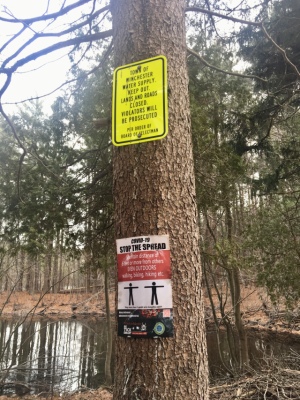
I was hiking in the Middlesex Fells, as I often do. I took a photo of two signs on a tree because I thought they were funny: one said “Keep Out”; the other urged hikers to maintain social distancing, which seemed like an odd admonition if you weren’t supposed to be there in the first place.
I emerged from the woods around 3 p.m. and turned on the car radio. NPR was carrying audio from the “PBS NewsHour,” and Judy Woodruff was freaking out. At first I figured the Republicans were trying to disrupt the counting of the electoral votes to delay Joe Biden’s being declared the official winner of the presidential election. That, after all, had been predicted.
Within a few moments, though, I learned the truth: that a mob of rioters had descended on the Capitol, had broken inside and were rampaging through the halls of Congress. It was our first attempted coup, aided and abetted by Donald Trump, and it may not be the last.
These are dark times, and I’m not optimistic about what the next few years will bring.
Axiosis building out its network of local newsletters. Here’s what it means to you:
Axios Local, as the initiative is called, will grow from 14 to 25 cities in the coming months, according to CEO Jim VandeHei — and could eventually reach as many as 100.
Why it matters: Bostonwill have its own Axios Local newsletter by mid-2022.
What you can expect: Axios says that “local reporters will deliver scoops, offer sharp insights and curate the best local reporting in our proven ‘Smart Brevity’ style.”
The big picture: Go deeper (1,038 words, 5 min. read).
All right, all right. You get the idea. Axios, the jittery, made-for-mobile news site that battles short attention spans with quick takes, boldface type and bullet points, has been expanding over the past year from national to regional news by unveiling a number of local daily newsletters.
Shades of its archrival, Politico? Well, not really. Because while Politico has gone deep with insider information for political junkies with newsletters like its Massachusetts Playbook, Axios is pursuing something different: general-interest news, heavy on business, lifestyle and entertainment, designed mainly to appeal to the young urban tech crowd.
In a “manifesto” released over the weekend, Axios put itself forth as nothing less than the savior that will solve the local news crisis. “Everyone needs — and deserves — high-quality reporting to understand the changes fast unfolding where they live,” the statement says in part. “Axios Local is the solution, synched elegantly to your smartphone.”
The trouble is, Axios Local is setting up shop in places that could hardly be considered news deserts. Instead of, say, Axios Worcester, Axios Newark or Axios Small City without a Newspaper, we’re getting newsletters targeted at affluent urban audiences in places that are already reasonably well served. And the Axios sites are so thinly staffed that it’s going to be difficult for them to make a real difference.
Let’s take Denver as an example. Thanks to the hollowing-out of The Denver Post at the hands of its hedge-fund owner, Alden Global Capital, Denver is often cited as a place that no longer has reliable regional journalism. But is that actually the case?
Not really. Consider that, even in its diminished state, the Post has a newsroom of about 60 full-timers. Colorado Public Radio has more than 60, including its Denverite website. The Colorado Sun, a highly regarded digital start-up, has 23 and continues to grow. About 90 full-time journalists work for a combined newsroom operated by The Gazette of Colorado Springs, Colorado Politics and the start-up Denver Gazette. Denver’s venerable alt-weekly, Westword, has about a half-dozen.
And Axios Denver? Two. As staff reporters John Frank and Alayna Alvarez put it in the introductory message you get when you subscribe, their aim is to provide some original journalism, curation from other news sources and “a little fun at the same time with everything from local beer picks to new outdoor adventures.”
Tuesday’s newsletter, for instance, ranged from an update on Denver’s homeless crisis to the latest on the Colorado wildfires, as well as how to take part in “Dry January.” (No, thank you.) The past week or so has consisted almost entirely of fire updates along with changes to the trash pickup schedule, things to do during the holidays and Colorado’s best beer and breweries.
Now, I can imagine that this would appeal to younger, well-educated professionals who don’t have much time for news and who are looking to connect with those of similar interests. But it’s certainly no competition for other news organizations in the Denver area.
And if that’s the case in Denver, it’s hard to imagine what sort of mindshare Axios is going to be able to command in a place like Boston, which has a healthy and growing daily newspaper, two thriving news-oriented public radio stations, a second daily, a multitude of television news operations and a number other niche and hyperlocal media. Even Politico’s aforementioned Massachusetts Playbook has competition in the form of State House News Service’s Masster List and CommonWealth Magazine’s Daily Download.
Nor will Axios Boston have the quick-hit general-interest-newsletter field to itself — although it is likely to be more robust than BosToday, a newsletter that launched recently under the auspices of a national network called 6AM City. BosToday promises “the inside scoop into what’s happening in your city in 5 minutes or less,” which I guess means that you’ll be a well-informed citizen by 6:05.
It will be interesting to see whether these advertising-backed new ventures can make enough money to justify their investment. In September, Sara Guaglione of Digiday reported that Axios Local was claiming it would pull in ad revenues of $4 million to $5 million in 2021, which isn’t bad for an estimated 30 to 40 full-time journalists; the eventual goal is to triple its staff. Rick Edmonds of Poynter reported around the same time that 6AM City has similar ambitions — a staff of about 30 that its executives hoped to build to around 100. The operation is being funded by venture capital, so look out below.
Axios Local is just the latest act in a drama that goes back to 2007, when Washington Post journalists VandeHei and John Harris left to found Politico after being turned down in their bid to launch a political website under their control inside the Post. They were joined by another Post journalist, Mike Allen, who wrote a widely read morning newsletter.
Politico is often accused by media observers (including me) of covering politics as a sporting event for insiders, and Allen’s newsletter was sometimes accused of crossing an ethical line by providing favorable coverage of advertisers, as the Post’s Erik Wemple has pointed out. But the project has certainly been successful.
Then, in 2017, VandeHei and Allen left to found Axios, setting up an intense rivalry with their former colleagues. Last year Politico was sold to a controversial German company called Axel Springer. According to Ben Smith, soon to be formerly of The New York Times, Axel Springer wanted to buy Axios, too, but VandeHei ended up nixing the deal. You have to imagine that there’s still some chance of that happening.
Axios Local began with Axios’ acquisition of the Charlotte Agenda in late 2020. The site, renamed Axios Charlotte, now has a staff of seven journalists, including an investigative reporter, according to its masthead. If the rest of Axios Local can grow into something equally robust, then VandeHei will genuinely have something to brag about.
For the moment, though, Axios Local is little more than an interesting project to watch as it tries to compete in a local news landscape that isn’t quite as barren as VandeHei and company seem to think it is.
It would have been nice if they’d genuinely tried to address the dearth of local journalism in places that have little or no coverage. Instead, they’re going where the money is. It’s an old story, and you don’t need boldface or bullet points to tell it.
The Jan. 6 select committee’s decision to ask Sean Hannity to testify carries with it a few nettlesome details.
The Fox News star’s lawyer, Jay Sekulow, has already invoked the First Amendment. But there is, in fact, no constitutional protection for journalists who are called to testify in court or, in this case, before a congressional committee. The problem, as the Supreme Court explained in its 1972 Branzburg v. Hayes decision, is that granting such a privilege requires defining who’s a journalist and who isn’t. And the First Amendment belongs to everyone.
That said, the government is generally loath to force journalists to testify because of the chilling effect it would have on the ability of news organizations to operate as independent monitors of power. It would be well within bounds for the committee to decide that Hannity is not a journalist. He was a close confidant of Donald Trump when Trump was president, was a featured speaker at a Trump rally and, in his communications with the White House, made it clear that he was a member of Team Trump.
But this brings us back to one of the central dilemmas of the Trump years. Hannity’s behavior was so over the top that it’s easy to say he’s not a journalist. Still, you can be sure that Trump’s defenders will point to far more ambiguous situations and say, “What about?” Ben Bradlee’s friendship with President John F. Kennedy comes to mind, as does Walter Lippmann, the ultimate insider.
The problem facing members of the select committee is that if they subpoena Hannity and other Fox News personalities, they would do so in the certain knowledge that Republicans will claim a precedent has been set and abuse it as soon as they’re in a position to do so. I have little doubt, for instance, that New York Times executive editor Dean Baquet and former Washington Post executive editor Marty Baron would be forced to testify about their papers’ coverage of the Russia scandal.
Which is why the select committee is hoping that Hannity will accept its invitation to testify voluntarily. If he refuses (as he almost certainly will), then it will have to decide whether to issue a subpoena — a move that could have far-reaching consequences.
Phil Balboni. Photo (cc) 2016 by Sylvia Stagg-Giuliano.
Phil Balboni is a journalistic legend. His latest venture is DailyChatter, a nonpartisan newsletter that covers international news. The newsletter’s staff of experienced journalists based in Europe, Asia and the United States searches for “meaning and context in this immensely complex world.”
Before creating DailyChatter, Balboni was the founder, president and CEO of GlobalPost, the highly acclaimed international news site he launched in 2008. He was also the founder and president of New England Cable News, and was vice president of news and editorial director for WCVB-TV (Channel 5) in Boston. He has been awarded almost every major honor in broadcasting, including the Peabody, Murrow and Emmy.
In our latest “What Works” podcast, Balboni talks with Ellen Clegg and me about his passion for local news as well as his hopes for a newly created professorship at the Columbia School of Journalism that was endowed in his honor.
In Quick Takes, I analyze the danger to the First Amendment posed by a New York court judge who ordered The New York Times to stop publishing confidential documents it had obtained about the notorious right-wing organization Project Veritas.
Ellen weighs in with news from Texas, where a right-wing activist named Frank Lopez Jr. is flooding the zone with disinformation about immigration, taking advantage of the void created when the local newspaper shut down.
Bill Gardner, who announced Monday that he won’t seek re-election as New Hampshire’s secretary of state after nearly a half-century in office, won a New England Muzzle Award from GBH News in 2017 for his obsession with cracking down on “ballot selfies.” Here’s the item:
Who would have thought that we’d end up awarding two Muzzles in connection with a New Hampshire ban on “ballot selfies”? Yet the absurd law, under which you could be fined $1,000 for taking a photo of your completed ballot and posting it on social media, simply will not die.
In 2015 we gave a Muzzle to the prime mover behind the legislation. This year we are awarding the statuette to New Hampshire Secretary of State Bill Gardner, who lost in the U.S. Court of Appeals last fall and then, this past April, failed to persuade the Supreme Court to take up the case. Even that wasn’t enough to stop his crusade. “There are other ways to deal with this, and there are people across the country that are addressing this,” Gardner told New Hampshire Public Radio. Has anyone got a wooden stake?
A little background: In 2015 the Muzzle went to Timothy Horrigan, a Democratic state legislator from Durham, who pushed the ban as a way of preventing vote-buying and voter coercion — never mind that there hadn’t been any reported instances of ballot selfies being linked to those nefarious practices.
Selfie-posting voters protested, including State Representative Leon Rideout, a Lancaster Republican. The federal courts got involved. Rather than backing off, the state continued to fight for the law, none more ardently than Gardner.
Theoretically, the concerns raised by Horrigan, Gardner, and others could become reality. But there is no evidence that they have, and the courts do no look favorably upon abridgements of the First Amendment without having a very good reason. New Hampshire is not the only state to ban ballot selfies, so the Supreme Court’s refusal to take up the case could have national implications.
The appeals court’s ruling said in part: “New Hampshire may not impose such a broad restriction on speech by banning ballot selfies in order to combat an unsubstantiated and hypothetical danger. We repeat the old adage: a picture is worth a thousand words.”
Gardner, nominally a Democrat, also came under fire for refusing to step down from President Donald Trump’s bogus voting commission after the chair of that commission wrote a piece for the right-wing website Breitbart falsely claiming that Trump had actually won New Hampshire in 2016.
Don’t let the door hit you on the way out, Mr. Secretary.
Over the past few years, revenues at The Bedford Citizen, a nonprofit community website in the Boston suburbs, have ramped up from zero to more than $100,000 a year. The Citizen has done it through voluntary memberships, sponsors, grants, the NewsMatch program and — perhaps most significant — an annual glossy publication called The Bedford Guide.
The Guide is a 64-page magazine that serves as an introduction to the town. It is loaded with ads, and from what I can tell, all of them are local, from life sciences giant Millipore Sigma, which has a facility in Bedford, to the Cat Doctor. According to the Citizen’s executive director, Teri Morrow, the 2022 Guide (the third) which came out in December, will produce about $40,000 in revenues.
Now Gene Kalb, a Citizen board member who’s the main force behind the Guide, has been recognized by the trade magazine Editor & Publisher as one of its “Sales Supernovas.” He told E&P’s Robin Blinder that flexibility is a key to the Guide’s success, explaining:
The pandemic hit us just as we started our second annual Bedford Guide. The initial strategy was to approach retail establishments in town. During 2020 with almost all restaurants and retail establishments closed, we shifted our focus to larger corporate industries in town. Our publication is all about supporting our community, and the corporate neighbors in town stepped up to help us. With the retail landscape improving this year, we had a nice combination of retail and corporate advertisers.
Such revenues have allowed the Citizen to grow from an all-volunteer project to a news organization with paid employees — a managing editor, a part-time reporter and a part-time operations manager — as well as freelance fees for contributors.
Founded in 2012, the Citizen continues to grow in other ways as well. According to Google Analytics, the site had more than a million page views in 2021. Those of us who follow such things know that’s a statistic of limited value, but here’s another that’s rock-solid: about 2,200 people have subscribed to the Citizen’s free daily newsletter in a town with fewer than 5,400 households, for a penetration rate of more than 40%. (Caveat: Email being what it is, no doubt there are a number of families with more than one subscription.)
The Citizen is one of the projects that Ellen Clegg and I are tracking for our “What Works” book project. It’s encouraging to see how people in the community have come together to create a vibrant and sustainable source of local news.




.jpg)

.jpg)