Downtown Laconia, N.H. Photo (cc) 2018 by capleez.
In Laconia, New Hampshire, publishing a letter from someone who denied that the Holocaust took place ended up leading to something positive — a long-term exercise in engaging the community around the paper’s opinion journalism.
The letter, according to an essay at the American Press Institute’s website by Julie Hart, The Laconia Daily Sun‘s digital editor, was from a well-known person who had said he was considering running for public office. That, and the paper’s longstanding policy of publishing virtually every letter it received, led to those hateful words making their way into print. Hart acknowledged that people at the Sun quickly realized they’d made a mistake.
With the help of grant money, the paper embarked on a project to bring together people with different points of view for some deep conversation and reflection to see if they could bridge the ideological divide. The exercise involved techniques such as “looping,” with Hart describes as helping people “re-state what they’re hearing from a partner in conversation to demonstrate active listening and objectively capturing information, regardless of whether or not they agree.”
The one sour note was the Sun’s decision to drop editorial cartoons after a Mike Luckovich effort critical of police shootings of Black people led to “angry phone calls, advertisers canceling their marketing campaigns, a slew of Facebook comments and calls to boycott.” As you can see, Luckovich’s cartoon was over the top, but using judgment in deciding which cartoons to publish would have made more sense than a blanket ban.
Still, the Sun’s efforts are admirable and fit in well with the idea that local journalism can be a vital spark for civic engagement. As I’ve written previously, community life can be an antidote to the hateful discourse that now pervades national politics (sorry, but I’d be remiss if I didn’t point out that it’s mostly on the Republican side), and that reliable journalism is a key to making it happen.
I’m finishing up this week’s Media Nation member newsletter, which goes out every Friday morning. If you’d like yours, please become a member for $5 a month by clicking here.
The COVID pandemic made the fall semester a challenge for everyone. As someone who teaches journalism, I found that challenge to be especially acute. I wanted to give my intermediate-reporting students the same real-life experience as I have with my previous classes, but I needed to do it with the understanding that pavement-pounding and door-knocking were out of the question.
The previous fall, we’d had some success with a group project. My Northeastern University undergradsvisited nine governmental offices in the Boston area and requested public records. They reported on their experience and whether they were asked to do anything forbidden by the law, such as produce identification. They also took photos of the places they had visited. Could a similar project be adapted to the age of Zoom?
Shiva Ayyadurai, in white hat. Photo (cc) 2019 by Marc Nozell.
Massachusetts Republican gadfly Shiva Ayyadurai has been banned from Twitter, most likely for claiming that he’d lost his most recent race for the U.S. Senate only because Secretary of State Bill Galvin’s office destroyed a million electronic ballots. Adam Gaffin of Universal Hub has the details.
In 2018, I gave the City of Cambridge a GBH News New England Muzzle Award for ordering Ayyadurai to dismantle an wildly offensive sign on his company’s Cambridge property that criticized Democratic Sen. Elizabeth Warren. City officials told him that the sign, which read “Only a REAL INDIAN Can Defeat the Fake Indian,” violated the city’s building code.
Ayyadurai threatened to sue, which led the city to back off.
Philadelphia City Hall. Photo (cc) 2016 by Dan Kennedy.
It’s one thing for the chain-owned Hartford Courant to outsource its printing. It’s quite another for an independent major metro like The Philadelphia Inquirer to do so.
The Inquirer, recently shorn of its online comments, is owned by a well-funded nonprofit organization, the Lenfest Institute, and it continues to be reasonably well-staffed. Nevertheless, Kristen Hare of Poynter Online reports that the Inquirer will sell off its suburban printing plant and outsource its production to a Gannett-owned facility instead.
The print edition of many newspapers has become such a small part of their operations that printing simply isn’t cost-effective unless they’re able to take on outside customers. No doubt they’re celebrating at Gannett, since the Inquirer deal means less time that their presses will be idle. But when the Inquirer’s shutdown takes place later this year, 500 people will lose their jobs.
You can be sure that Boston Globe owners John and Linda Henry are looking at this move closely. The launch of the Globe’s printing plant in Taunton in mid-2017 was plagued with problems, and after they were fixed the Globe found itself with fewer outside printing jobs than it had expected. With digital far outpacing print, at some point it may make sense simply to sell the Taunton plant and print the Globe elsewhere.
Become a member! For $5 a month, you can support Media Nation and receive a weekly newsletter with exclusive content. Just click here.
In a time of national crisis — make that crises — there’s plenty of important news that gets overlooked. Vaccine delays, President Joe Biden’s economic-rescue package and, of course, Impeachment: The Sequel have overshadowed other topics to which we ought to be paying attention.
Every semester, I ask my journalism ethics students at Northeastern University to come up with a list of undercovered stories. Their answers are always intriguing. Invariably they find Washington, D.C., politics to be less compelling than what’s going on internationally and locally.
From a farmers’ strike in India to Australia’s crackdown on Google and Facebook, from good news about the coronavirus to still more good news about struggling Massachusetts cities like Chelsea and Brockton, my students have come through with stories we all ought to know more about. Even better, they’ve pretty much written my column for me this week.
Here are some highlights. The ranking is mine, but the ideas are all theirs.
7. Pandemic puppies. The isolation created by COVID-19 has led to an enormous upsurge in pet adoption — which, in turn, has fueled demand for purebred puppies, a problematic development for anyone who cares about animal welfare.
“During lockdown, puppies appealed both to single people facing months without human contact and to desperate parents seeking playmates for their lonely, screen-addicted children,” according to the Robb Report.
But as Robb and The Guardian reported, this demand has kept so-called puppy mills in business and has given rise to dogs that are genetically predisposed to health issues such as epilepsy and immune-system disorders.
6. Chelsea morning. During the pandemic, the news out of low-income cities in the Boston area such as Chelsea and Brockton has usually been bad — people of color working in service jobs and living in cramped quarters have had some of the highest rates of disease in the state.
This challenge, though, has also created an opportunity for activists to improve life in the state’s gateway communities. The Boston Globe’s “On The Street” series has documented some of those efforts. In Chelsea, for instance, Roseann Bongiovanni, the executive director of GreenRoots, told the Globe that the pandemic has led to new levels of cooperation among the city’s social-service providers.
“We’ve really broken down the silos,” Bongiovanni was quoted as saying. “I think post-pandemic you’re going to see a lot of collaboration, and this might give us an opportunity to think about the larger structural issues. Like why are so many people in Chelsea food insecure? Why is it that Chelsea was so sick?”
5. A revolution in sports viewing. In some parts of the mediasphere this is very big news indeed: The New York Times reports that NBCUniversal is shutting down the NBC Sports Network, moving some of its programming to the USA Network and — of more relevance — some of it to Peacock, its internet streaming service.
As more and more viewers are cutting cable and moving to streaming, media companies are attempting to move with them. The result is a dizzying array of options that, when you add them up, start to look like the same high price tag that viewers were paying for cable for so many years.
Media executives in charge of sports programming have been slow to embrace streaming because their viewers tend to be older and more likely to stick with cable. Yet the revolution is coming. GeekWire observes that some NFL games are already being shown exclusively on Amazon Prime.
4. Down under with Big Tech. In a case that ought to be watched closely in the United States, Australian regulators are waging war against the American technology giants Google and Facebook. At issue: The Aussies are insisting that the platforms pay for the news content that they use. Google and Facebook say they’ll delete news from what they publish before they let that happen.
The BBC reported that Australian Prime Minister Scott Morrison said his government has the right to set its own rules for how the internet is governed within its borders. “Let me be clear: Australia makes our rules for things you can do in Australia,” Morrison said. “That’s done in our parliament.”
At a time when disgust with Big Tech has led to calls for regulation in the U.S., the standoff in Australia is well worth keeping an eye on. Local news is in crisis. If Google and Facebook can be persuaded — or pressured — into helping to fund community journalism, it could make an enormous difference to news organizations’ bottom lines.
3. The feminization of unemployment. The pandemic-related economic collapse has hit different communities and groups of people in different ways. Some have hardly been affected. Others are really suffering. What few news organizations point out, though, is that the burden of lost jobs has been disproportionately borne by women.
In December, according to the National Women’s Law Center, 156,000 jobs were lost in sectors that traditionally employ women, while male-dominated jobs actually increased by 16,000. Overall, since February of last year, women have lost more than 5.4 million jobs, amounting to 55% of net job losses since the beginning of the pandemic. The situation is even worse among Black and Latina women, the center reports.
This trend, though, has not broken through in media reports. A recent article in The New York Times made little mention of the disproportionate effect of pandemic-related unemployment on women, and a Washington Post story made no mention of it at all.
2. Farmers’ strike in India. One of the biggest stories on the planet right now is getting scant attention from the American media. Tens of thousands of farmers in India, the world’s largest democracy, are on strike, protesting attempts by the government of Prime Minister Narendra Modi to impose new laws that they say will make it harder for them to sell their crops at a fair price.
According to The New York Times, one of the few U.S. outlets to cover the strike in any detail, the farmers’ action represents a significant challenge to Modi. Hartosh Singh Bal of The Caravan, a New Delhi-based magazine, wrote in a Times op-ed: “For the first time in six years, Mr. Modi is encountering opposition that he has not been able to stifle or tar with his extensive propaganda machinery.”
Modi is one of a number of authoritarian-minded rulers who have dominated the international stage in recent years. But now Russia’s Vladimir Putin faces massive protests. Brazil’s Jair Bolsonaro is losing popularity over his handling of the pandemic and corruption. And, of course, former President Donald Trump is gone after encouraging an inept but deadly assault on Congress. Seen in that context, the challenges facing Modi may be further evidence that the autocratic wave has crested.
1. Good news on COVID-19. Despite the shimmering promise of highly effective vaccines that, so far, not nearly enough people have been able to get, the day-to-day news about the pandemic remains grim. Hospitals in some parts of the country are full, dangerous new variants are spreading across the globe and the U.S. death toll will likely hit an unimaginable 500,000 in a few weeks.
Yet the curve of new cases nationwide is trending sharply downward, The New York Times reports. In Massachusetts, too, the most recent surge is easing, from a seven-day average of more than 6,000 new daily cases in mid-January to around 3,400 today, as this Boston Globe chart shows. Maybe it’s because enough people have now been vaccinated to make a difference. Maybe it’s because admonitions about masking and social-distancing are being taken more seriously. Or maybe it’s just a lull before the next storm.
Regardless, fewer cases and fewer deaths are good news for all of us — and a reminder that, just like pandemics of decades past, this one, too, will end.
Gen. Michael Flynn. Photo (cc) 2016 by Gage Skidmore.
On Monday, The New York Times published the results of a massive investigation into Donald Trump’s attempts to overturn the results of the election.
Today comes the tragicomic conclusion: a report by Axios on an insane meeting that took place at the White House on Dec. 18 at which the conspiracy-addled lawyer Sidney Powell tried to get herself named a special counsel to investigate Dominion voting machines while Gen. Michael Flynn (he of the two guilty pleas) and the White House staff screamed profanities at each other.
The reporters are Jonathan Swan, who conducted a hard-hitting interview of Trump last year, and Zachary Basu. The whole thing is so crazy that it’s hard to pick any one excerpt, but this will do. Below, Byrne is Patrick Byrne, the chief executive of Overstock.com and a Trump backer. Herschmann is Eric Herschmann, a White House senior adviser. Patrick Cipollone was the White House counsel. Swain and Basu write:
At one point, with Flynn shouting, Byrne raised his hand to talk. He stood up and turned around to face Herschmann. “You’re a quitter,” he said. “You’ve been interfering with everything. You’ve been cutting us off.”
“Do you even know who the fuck I am, you idiot?” Herschmann snapped back.
“Yeah, you’re Patrick Cipollone,” Byrne said.
“Wrong! Wrong, you idiot!”
Herschmann and others who were at least partly tethered to reality were afraid that Trump was going to go along with Powell and unleash her upon state and local election officials. As Swain and Basu write, “Trump expressed skepticism at various points about Powell’s theories, but he said, ‘At least she’s out there fighting.'”
In the end, though, Trump was somehow coaxed into listening to reason. How bad was it? Toward the end, we see that Rudy Giuliani actually had a calming effect on the situation, which is surely the first time anyone has said that about him in many years.
Correction: I originally misspelled Jonathan Swan’s name.
The first time I read Thomas Moore’s “Care of the Soul,” nearly 30 years ago, was because our minister was enthusiastic about it. Other than recalling that I didn’t get much out of it, I hadn’t given it much thought in the intervening years.
Then, recently, Matthew Dowd started touting “Care of the Soul” on Twitter. Dowd, a former George W. Bush strategist and Never Trump conservative, was until recently the chief political analyst on ABC News. His Twitter feed is surprisingly spiritual and inspirational.
Well, I read it again, and I’m still struggling with it. I’d call it a hard book — not because it challenges and pushes you, which would be hard in a good way, but because it’s difficult to understand and make sense of. Some of it is clear enough — the importance of ritual, of the outdoors, of living a purpose-filled life. But too often Moore, a psychotherapist and former Catholic monk, throws us into the deep end without any preparation.
Become a member! For $5 a month, you can support Media Nation and receive a weekly newsletter with exclusive content. Just click here.
His method is to examine psychological problems such as depression and narcissism and try to help us understand what they are teaching us. These chapters are accompanied by extensive discussions of Greek and Roman mythology that are supposed to illuminate our path. But even though I moved through these sections slowly and tried to absorb what Moore was writing, I mainly came away scratching my head.
Other Moore-isms are simple enough to resonate. For instance:
Another aspect of modern life is a loss of formal religious practice in many people’s lives, which is not only a threat to spirituality as such, but also deprives the soul of valuable symbolic and reflective experience. Care of the soul might include a recovery of formal religion in a way that is both intellectually and emotionally satisfying. One obvious potential source of spiritual renewal is the religious tradition in which we were brought up.
As a skeptic who nevertheless has been attending church for most of my adult life, I found that to be a powerful affirmation. Moore also given some thought to the caricature of religion that is marked by dogmatism and the rejection of anyone who doesn’t believe the right way. He writes: “When spirituality loses contact with soul …, it can become rigid, simplistic, moralistic, and authoritarian — qualities that betray a loss of soul.”
I highlighted this as the quote that best sums up the entire book: “Wisdom is the marriage of intellect’s longing for truth and soul’s acceptance of the labyrinthine nature of the human condition.” Yet, in looking at it now, it strikes me that it’s difficult to make more than aphoristic sense out of it without truly understanding what Moore is driving at. Which brings me back to the difficulties I mentioned higher up.
What’s frustrating is that there really does seem to be deep wisdom in “Care of the Soul” that would make sense if only I could find my secret decoder ring. I’d be interested in knowing whether any of you have tried to make sense of Moore and what you took away from it.
The Philadelphia Inquirer is getting rid of most of its comments. Why?
Commenting on Inquirer.com was long ago hijacked by a small group of trolls who traffic in racism, misogyny, and homophobia. This group comprises a tiny fraction of the Inquirer.com audience. But its impact is disproportionate and enduring.
A few years ago, after a content-management system upgrade, GBH News killed its comment sections. If anyone complained, I’m not aware of it. Every news organization should consider emulating the Inquirer — including The Boston Globe.
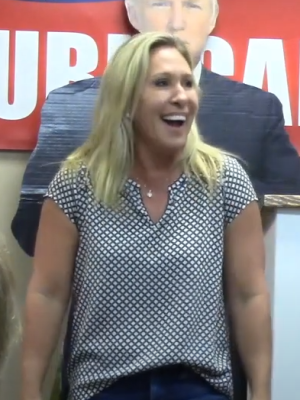
Marjorie Taylor Greene. Photo (cc) 2020 by FYNTV FetchYourNews.
Many mainstream news organizations are genuinely struggling to come to terms with the current dynamic in Washington: an often feckless Democratic Party opposed by crazy and dangerous Republicans. It’s not an entirely new scenario, and has in fact been building since Newt Gingrich’s speakership in the mid-1990s. But it’s become acute since the Trump-inspired insurrection of Jan. 6 and the embrace of QAnon and sedition by large swaths of the GOP.
But while responsible journalists are trying to figure out how to navigate this reality, there’s another group that continues to embrace #bothsides-ism at its most mindless. At the center of this is Axios, which combines the politics-as-sports sensibility of Politico, whence it sprang, with bullet points and lots of boldface.
Take, for instance, “The Mischief Makers.” According to Axios reporters Alayna Treene and Kadia Goba, leaders in each of the two major parties are being tormented by “troublemakers” and “political thorns” within their ranks. And who are these feisty backbenchers?
Well, on the Republican side is House member Marjorie Taylor Greene, who has called for the execution of Speaker Nancy Pelosi and other top Democrats and who believes that wildfires are caused by a Jewish-controlled laser in outer space. Also getting a nod are Matt Gaetz, Louie Gohmert and Mo Brooks, all of whom supported the insurrection.
What Democrats could possibly be as dastardly as that? Why, the Squad, of course! Because they’re liberal and/or progressive. So Alexandria Ocasio-Cortez, Ilhan Omar and Ayanna Pressley all get a shoutout, as well as like-minded newcomers such as Jamaal Bowman and Cori Bush.
In the Senate, Republicans Ted Cruz, Rand Paul and Josh Hawley, all of whom supported Trump’s coup attempt, are equated with Democrats Kyrsten Sinema and Joe Manchin, who are more conservative than most of their party peers, and independent Bernie Sanders, who’s to the left of most of his colleagues but who’s been notably supportive of President Joe Biden.
But wait! There’s to-be-sure paragraph buried amid all this:
Not all are created equal. Democrats often contend with an outspoken, very progressive wing of their caucus and try to keep centrists from crossing party lines. Republicans have senators who led efforts to invalidate the 2020 election results and flirted with the same conspiracy theories that fueled groups involved in the Capitol siege.
No kidding.
So, does anything Axios publishes cause genuine harm? It’s hard to say. But Axios is aimed primarily at insiders — congressional staff members, lobbyists and other journalists. And many of them would love nothing more than validation that they can return to business as usual.
Cynical takes such as this can serve to normalize what’s going on in Washington, providing the narcotic drip we need to help us forget that many powerful Republicans attempted to overthrow the results of the election less than a month ago. Five people died, and we haven’t even begun to get to the bottom of what happened.


.jpg)
