Microsoft’s president says Google and Facebook should pay for news content

Photo via Needpix.com

The Overton Window has opened a bit wider for the idea of requiring Google and Facebook to pay for news content. At Axios, Sara Fischer reports that Microsoft president Brad Smith has endorsed the Australian government’s move to do just that — and thinks such a system ought to be considered in the U.S. as well.

What’s taking place in Australia is complicated, but essentially it requires Google and Facebook to bargain with the news business and come up with a compensation system. Both companies have said they would stop offering some of their services if Australian authorities don’t back off.

In the U.S., the News Media Alliance, a lobbying group for news publishers, has been pushing for several years for an antitrust exemption that would allow them the right to bargain collectively with the tech giants — which is exactly what is going to happen in Australia. With the sheen wearing off Big Tech’s once-sterling image, the likelihood of Congress passing such an exemption has increased. A lawsuit brought by a group of West Virginia newspapers that I wrote about for GBH News last week may serve as a further goad.

In a blog post, Microsoft’s Smith cites a News Media Alliance study showing that Google makes an estimated $4.7 billion a year “from crawling and scraping news publishers’ content.” That study came under fire at the time of its release a couple of years ago. But regardless of the actual figure, Google — and Facebook — are surely making a lot of money from other people’s content without paying for any of it.

Smith makes no bones about his own business imperatives, saying that Microsoft is prepared to play by Australia’s rules through its Bing search engine, writing:

Microsoft’s Bing search service has less than 5% market share in Australia, substantially smaller than the 15-20% market share that we have across PC and mobile searches in the United States and the 10-15% share we have in Canada and the United Kingdom. But, with a realistic prospect of gaining usage share, we are confident we can build the service Australians want and need. And, unlike Google, if we can grow, we are prepared to sign up for the new law’s obligations, including sharing revenue as proposed with news organizations. The key would be to create a more competitive market, something the government can facilitate. But, as we made clear, we are comfortable running a high-quality search service at lower economic margins than Google and with more economic returns for the press.

A final thought. If Congress isn’t prepared to act, might it be possible to require Google and Facebook to compensate news publishers at the state level? Jack Nicas reports in today’s New York Times that a proposal has been made in North Dakota to forbid Apple and Google from collecting app-store fees from North Dakota-based businesses.

The legislation strikes me as more than a little half-baked. Yet the principle — that states can impose their own regulations on Big Tech — is one worth pondering.

Become a member of Media Nation.


McConnell’s hypocrisy shows why Democrats made the right call on witnesses

Mitch McConnell. Photo (cc) 2014 by Gage Skidmore.

And so it’s over. In the aftermath of Impeachment II, the main controversy is about whether the Democrats did the right thing in reversing themselves over calling witnesses. I think they made a wise judgment. And Senate Minority Leader Mitch McConnell’s hypocrisy shows why.

In a blistering speech, McConnell endorsed the entire factual basis of the Democrats’ case against Trump. “There is no question that President Trump is practically and morally responsible for provoking the events of that day,” McConnell said. “The people who stormed this building believed they were acting on the wishes and instructions of their president.” And there was this:

Even after it was clear to any reasonable observer that Vice President Pence was in danger, even as the mob carrying Trump banners was beating cops and breaching perimeters, the president sent a further tweet attacking his vice president. Predictably and foreseeably under the circumstances, members of the mob seemed to interpret this as further inspiration to lawlessness and violence.

Yet McConnell still voted against conviction, relying on the bogus argument that a vote to convict was unconstitutional because Trump is no longer in office.

At the end of all this, no reasonable person doubts that Trump incited the mob — not just on Jan. 6, but over the course of many months. No reasonable person doubts that he was reveling in the destruction, or that Republican Rep. Jaime Herrera Beutler was telling the truth about a toxic exchange between House Minority Leader Kevin McCarthy and Trump. Seven Republicans voted to convict Trump, making this the most bipartisan impeachment in history.

Given all that, it’s time for the Democrats to move on and let the center of gravity finally shift from Donald Trump to President Joe Biden.

Not everyone agrees, of course. The normally pragmatic Josh Marshall was apoplectic Saturday, writing in Talking Points Memo that the decision not to call witnesses was “inexplicable and maddening, to many or most Democrats outside the chamber because Democrats appeared to hold all the cards and all the votes and yet capitulated entirely.”

But I thought Boston College historian Heather Cox Richardson made a better argument:

While it’s reasonable to imagine that witnesses would illustrate Trump’s depravity, it seems entirely likely that, as Trump’s lawyers continued simply to lie and their lies got spread through right-wing media as truth, Americans would have learned the opposite of what they should have.

Instead, the issue of Trump’s guilt on January 6 will play out in a courtroom, where there are actual rules about telling the truth.

We have lived through a terrible time, and it’s not over yet. The future direction of the Republican Party is far from certain, and it’s easy to imagine a thoroughly Trumpified party recapturing the House in 2022 as a result of gerrymandering and low voter turnout.

What we all need to concentrate on for the next two years is good governance — pushing for policies and programs that help people and, as best we can, putting the Trump era behind us. Biden is off to a good start, but a continuing obsession with Trump will hold him back. And that will hurt everyone.

Become a member of Media Nation.
Kathleen Kingsbury: Endorsing two candidates confused Times readers

Kathleen Kingsbury. Photo via The New York Times.

The Nieman Journalism Lab’s Sarah Scire last week spoke with The New York Times’ recently named opinion editor, Kathleen Kingsbury. It’s an interesting conversation that defies easy summary, but I was struck that Kingsbury now says she and the Times “ended up confusing people” when they endorsed two presidential candidates, Sens. Elizabeth Warren and Amy Klobuchar, in last year’s Democratic primaries.

More than anything, I think Kingsbury represents steady leadership after the tumultuous James Bennet era, often caricatured as coming to an abrupt end over the infamous op-ed by Sen. Tom Cotton but that was in fact — as Scire points out — punctuated by numerous lapses in judgment. Kingsbury demonstrated that steadiness last week when she killed a piece by columnist Bret Stephens. If the commentary, an n-word-filled defense of Don McNeil, had run, critics would be wondering if Kingsbury were up to the position. (Stephens’ point, such as it was, is that it ought to be considered acceptable to quote others using the n-word as long as there was no racist intent.)

I was also interested to see that Kingsbury and publisher A.G. Sulzberger “tend to talk daily.” The rule of thumb for good publishers is that they should stay out of the newsroom but that involvement in the opinion section is appropriate. John and Linda Henry are certainly involved in The Boston Globe’s opinion operation. On the other hand, Washington Post owner Jeff Bezos is known to be as hands-off with opinion as he is with news coverage. Sulzberger is entitled to have his say, but maybe he ought to back off and let Kingsbury do her job.

I had a long interview with Kingsbury several years ago, when she was the Globe’s managing editor for digital. She struck me then as capable and creative. The Times’ gain was definitely the Globe’s loss.

Correction: Kingsbury objected to my original characterization that she had said the Times made a mistake by not endorsing just one of the Democratic candidates. “I still believe choosing the two candidates was the right thing to do,” she says. I’ve updated this post to reflect that.

Become a member of Media Nation.

Myth and reality about the Capitol Police

I heard a lot of unsupported criticism of the Capitol Police immediately after the Jan. 6 insurrection, much of it to the effect that they were in on it. Well, maybe a few were. But what I saw at the time, and what’s become even more clear during the impeachment trial this week, is that the vast majority of them did their jobs courageously even though they were badly outnumbered — maybe by design.

Northeastern journalism project to provide COVID news by text

The Scope, a social-justice website published by our School of Journalism, has unveiled a news-by-text pilot program so that Boston residents can receive information about testing sites, food pantries and other news related to the pandemic. The project is being led by Lex Weaver, one of our graduate students.

The initiative got a mention today from the American Press Institute.

Why I’m asking you to become a member of Media Nation

At the beginning of 2021, I decided to shift my online activities — I was going to blog more and use Facebook and Twitter less. At the same time, I decided to start offering memberships to Media Nation for $5 a month, following the lead of Boston College historian Heather Cox Richardson, pundits such as Andrew Sullivan, reporters such as Patrice Peck and others.

Most of these other folks are using Substack, a newsletter platform. I figured I had sunk way too many years — 16 — into writing Media Nation as a blog, and I didn’t want to switch to a platform that’s reliant on venture capital and could eventually go the way of most such companies. So here I am, still blogging at WordPress.com, and asking readers to consider becoming members by supporting me on Patreon.

And yes, I have been blogging more as I try to stay on top of various media stories, especially involving local journalism, as well as politics, culture and the news of the day. Just this week I’ve written about Larry Flynt and the First Amendment, Duke Ellington’s legacy, a new partnership between The Boston Globe and the Portland Press Herald, and a Louisiana reporter who’s been sued for — believe it or not — filing a public-records request.

If you value this work, I hope you’ll consider supporting it for $5 a month. Members receive a newsletter every Friday morning with exclusive content.

And if you’ve already become a member, thank you.

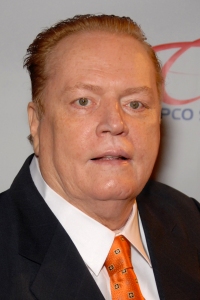
How Larry Flynt beat Jerry Falwell and expanded legal protections for parody

Larry Flynt in 2009. Photo (cc) by Glenn Francis.

Larry Flynt, who took mainstream pornography to a new low, was an unlikely champion of the First Amendment. Then again, most First Amendment champions are unlikely. As Oliver Wendell Holmes Jr. put it, it’s “freedom for the thought that we hate” that needs protecting, not anodyne statements that offend no one.

Flynt, who died Wednesday at 78, many years after surviving an assassination attempt that left him partially paralyzed, achieved freedom-of-speech immortality because of a parody that he published in his magazine Hustler. It took up a full page and was meant to look like an ad, although the words “Ad Parody — Not to Be Taken Seriously” did appear at the bottom. The fake ad was a takeoff on a series of a real ads for Campari liqueur in which various celebrities talked about their “first time.” The idea was to make it appear they were discussing the first time they’d had sex, only to reveal at the end that they were talking about the first time they drank Campari.

The Hustler parody starred the Rev. Jerry Falwell, founder of the Moral Majority, a leader of the first wave of right-wing television evangelists and a figure of revulsion among liberals. Among other things, Flynt’s Falwell spoke about the “first time” he’d had sex with his mother in an outhouse.

Falwell sued for libel and the intentional infliction of emotional distress, arguing on the latter count that the parody met the legal standard for “outrage.” The case, Hustler Magazine v. Falwell, decided by the U.S. Supreme Court in 1988, established two important principles.

First, on the libel claim, Falwell contended that the parody was false and defamatory. Since he was a public figure, he also had to establish that Hustler published it knowing or strongly suspecting that it was false. A federal appeals court had thrown out the libel count on the grounds that there were no statements in the ad that could be subjected to a true-or-false test. In other words, no reasonable person could possibly believe that Falwell had sex with his mother in an outhouse and had then talked about it for a liqueur ad. The Supreme Court upheld the lower court’s ruling.

Second, the Supreme Court overturned the appeals court’s ruling on the emotional-distress allegation. In so doing, the high court imposed the Times v. Sullivan “actual malice” libel test to claims of emotional distress: in order for a public official or public figure to win such a suit, they would have to show that the offending material contained a false statement of fact — again, with the knowledge that it was false or strongly suspecting it was false. The ruling established a significant new protection for parody and satire.

The unanimous decision, written by Chief Justice William Rehnquist, compared the parody to previous work by Thomas Nast about the corrupt Tweed ring in New York, vicious cartoons about George Washington, and other political and public figures. Rehnquist wrote:

There is no doubt that the caricature of respondent [Falwell] and his mother published in Hustler is at best a distant cousin of the political cartoons described above, and a rather poor relation at that. If it were possible by laying down a principled standard to separate the one from the other, public discourse would probably suffer little or no harm. But we doubt that there is any such standard, and we are quite sure that the pejorative description “outrageous” does not supply one. “Outrageousness” in the area of political and social discourse has an inherent subjectiveness about it which would allow a jury to impose liability on the basis of the jurors’ tastes or views, or perhaps on the basis of their dislike of a particular expression.

Whenever I teach our First Amendment course, I assign my students to write about a major case of their choosing. Inevitably, half the papers are about Hustler v. Falwell, nearly always accompanied by a copy of the ad — just in case I’d forgotten what it looked like, I suppose.

And if you ever get a chance to see the 1996 movie “The People v. Larry Flynt,” you should. It’s a rollicking good portrayal of the whole affair.

Become a member! For $5 a month, you can support Media Nation and receive a weekly newsletter with exclusive content. Just click here.

No, good government on Beacon Hill will not lead to bad government

You would think that reforming the opaque workings of the Massachusetts legislature would be something everyone could agree on. In fact, though, you can always find someone to defend the status quo.

Last summer, for example, New England School of Law Professor Lawrence Friedman wrote in The Boston Globe that the legislature should keep its exemption from the state’s public records law even though Massachusetts is only one of just four states with such a secrecy statute.

“It is not difficult to imagine state representatives and senators censoring themselves out of concern that their words might be taken out of context,” Friedman wrote. “Perspectives about proposed laws and their implications could go unshared and, therefore, unconsidered.”

Now Raymond La Raja, a political science professor at UMass Amherst, has written a commentary for CommonWealth magazine arguing that efforts to make committee votes public are misguided and would lead to more power for the legislative leadership. Such a move would also create incentives for grandstanding by members, La Raja argues, conjuring up the dysfunction in Washington as a warning:

Congress is an obvious example of where “messaging” has become more important to many than legislating. Using Twitter, members can score political points against opponents, shame colleagues, and try to torpedo discussions on policy. Calling out colleagues on committee votes or internal deliberations is especially valuable to extremists who value purity. The model here is the Freedom Caucus, whose members call other Republicans “RINOs” (Republicans in name only) and threaten to enlist primary opponents against them. This kind of behavior erodes goodwill and the ability to forge the kind of compromises that make democracy possible.

CommonWealth contributor Colman M. Herman disagrees, writing that the Massachusetts legislature “is one of the least transparent legislatures in the entire nation.” Herman is right. And the idea that good government will lead to bad government is absurd. If our elected officials need secrecy in order to do the right thing, then we are in mighty bad shape.