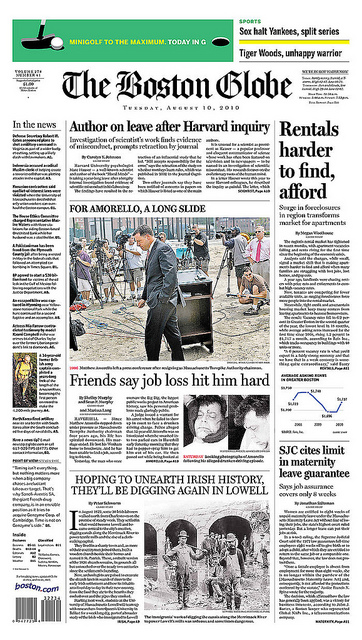
I usually make the New York Times my first Sunday read, but there’s so much local news going on that I reached for the Boston Globe instead. I’m glad I did.
1. Was it Hunter Thompson who coined the phrase “to make a jackal puke”? Whoever it was, it definitely applies to Todd Wallack’s story on Massachusetts CEOs who reward themselves with ever-larger compensation packages even as their revenues dip and they lay off workers. Special bonus: the poster boy for this bad behavior is Sean Healey, husband of former lieutenant governor Kerry Healey, who paid himself $18 million in 2009 — a 73 percent increase over the previous year.
2. Red Sox beat reporter Amalie Benjamin has a terrific overview of the disappointing season that ends today. She correctly observes that Terry Francona should get Manager of the Year for his skillful handling of a team decimated by injuries and underperformers. Then again, Francona should get Manager of the Year every year. While you’re at it, give a listen to general manager Theo Epstein’s interview with the “Sports Hub” (98.5 FM) — so interesting I found myself driving around on Friday so I could catch the whole thing.
3. I have no intention of seeing “The Town,” but I have little doubt that columnist Kevin Cullen’s profile of Charlestown lawyer Charlie Clifford, defender of small-time bank robbers, is a hell of a lot more enlightening — not to mention entertaining.
(Note: If the top of Media Nation looks mangled, please hit reload.)
I’m skeptical, but I’m impressed. Yesterday’s announcement that the Boston Globe will move most of its content to a subscription-based website sometime in the second half of 2011 shows that Globe executives know where their strengths are and that they’re prepared to think innovatively to protect those strengths.
The Globe’s dilemma is that it has an enormously successful free website, Boston.com, that is quite different from the paper itself. Start charging for access to Boston.com, and many of those 5 million unique visitors a month would vanish.
The solution: keep Boston.com free, but split off the Globe’s content into a separate, paid site called BostonGlobe.com, currently a free subsite. The decision raises lots of questions. Perhaps the biggest is how much free Globe content will be posted on Boston.com, and whether Boston.com will remain as popular once it has to stand on its own.
Still, it’s a far more interesting idea than the metered model embraced by the Globe’s parent company, the New York Times Co., which rolled it out at the Telegram & Gazette of Worcester recently and which will give it a go at the flagship paper sometime next year. Under the metered model, readers can access so many articles for free each month, after which they have to pay. It might work for the T&G and the Times, but it would have been deadly for Boston.com.
Yesterday I conducted an e-mail interview with Globe publisher Christopher Mayer, which he graciously agreed to do because I still can’t take notes. (Although it’s getting better. I’ve got a pillow propped up and am typing two-handed now for the first time since my accident.) Our unedited conversation follows. I’ve got a few closing thoughts after the jump.
Q: The metered model seemed to be the way the New York Times Co. was going.Why did you choose something different?
A: We’ve said all along that each organization would need to come up with a custom-made approach that takes into account unique market factors. We felt this was the best course for us, given the fact that we have two strong brands and essentially two different types of users of our Boston.com site. We have the opportunity to build a free site and a subscription-based site, and based upon extensive research, that emerged as the best option for us.
Q: The advantage of the metered model is that you’re not entirely cut off from the great conversation that’s taking place on blogs and in social media. Are you concerned about breaking a big story and not having as much impact as you should because people can’t link to you? Please address what Clay Shirky said about the importance of online sharing with respect to the Globe’s reporting on the pedophile-priest story.
A: We don’t intend to be cut off from the conversation. We haven’t announced, or even worked out, all the details of what will be on which site. But we can envision that some full-text Globe stories will be available on the free site. I suspect we would have put many of the initial priest sex-abuse stories on the free site because that Spotlight Team investigation was viewed as clear public service reporting. In the future, we’ll make those judgments as appropriate. Continue reading “Publisher Chris Mayer on the Globe’s new pay model”
As you may have heard, the Boston Globe today finally made its long-anticipated announcement on placing some of its online content behind a paywall. I think publisher Chris Mayer’s decision to offer a free Boston.com site and a paid BostonGlobe.com is interesting. I’ve got some questions. I’ve got concerns.
I’ll have more to say tomorrow. Meanwhile, Ralph Ranalli at Beatthepress.org and Boston Phoenix editor Carly Carioli have some worthwhile thoughts.
Over the past few years, we’ve grown accustomed to watching talented people leave the Boston Globe. But this one hurts more than most: David Beard, the editor of Boston.com, has accepted a top editing job with the Washington-based National Journal Group.
According to this announcement, posted at Romenesko, Beard will be deputy editor-in-chief and online editor of the group, which is adding a number of free online services to its subscription site in order to compete with Politico. Though there’s no mention of it in the announcement, the Journal is a sister publication of the Atlantic, which owner David Bradley yanked out of Boston, its ancestral home, in 2005.
Beard has done a great job of positioning Boston.com as something different from the Globe. Perhaps even more important, he has been a huge presence for the Globe outside 135 Morrissey Blvd., evangelizing not just on behalf of the Globe, but for new forms of journalism in general. Plus, he’s a great guy.
The Globe’s ability to replace key people and reinvent itself is impressive, but Dave is going to be a hard act to follow. Subscribe to his Twitter feed here.
What follows is a memo that Globe editor Marty Baron and deputy managing editor for multimedia Bennie DiNardo sent to the staff a little while ago, a copy of which was obtained by Media Nation:
To all:
David Beard has been many things for us since arriving at the Globe in 1998 — online evangelist, deputy foreign editor, tweeter-in-chief, Facebook promoter, soccer fan, zones chief, recruiter, community liaison, reader advocate, teacher, valued adviser, friend. Sadly for us, he is about to add another title to his portfolio — former colleague.
David is taking his unlimited energy and his enthusiasm for news to Washington, where he will become deputy editor-in-chief and online editor for the National Journal Group, which includes National Journal, CongressDaily, The Hotline, NationalJournal.com, and The Almanac of American Politics.
In a building full of amazing Rolodexes, no one has a more extensive list of contacts than Dave. He’s a human version of LinkedIn. Whether you are writing about Belmont or Bogota, David inevitably knows someone and connects you. Before coming to Boston to be our deputy foreign editor, Dave reported from South America, the Caribbean, the US South, and the Cleveland area for the Plain Dealer, Associated Press, and the South Florida Sun-Sentinel. He also served as Caribbean editor for the AP for three years, overseeing coverage of the US intervention to restore an elected president in Haiti. After his three-year stint on the Globe’s foreign desk, he immersed himself in local coverage, overseeing the regional editions.
Four years ago, he again staked out new territory, becoming editor of Boston.com. Since then, the website has grown from 150 million page views a month to almost 200 million, and our mobile traffic has gone from nonexistent to almost 13 million page views. In his recent digital years, he supervised online coverage of Barack Obama’s presidential election victory and the death of Senator Kennedy, cultivated a growing network of community bloggers, and helped launch “Secret Spaces,” an online project that turned into a book.
With Dave leaving us in two weeks, a search for the next editor of Boston.com begins immediately, but first things first: Please offer your thanks to Dave for the invaluable creativity and collegiality he brought to this organization for the past 12 years, and wish him well as he pursues a promising opportunity in Washington.
No doubt the best coding brains at the New York Times Co. are focused on iPad development these days. But as a paid subscriber to the Reader editions of the New York Times and the Boston Globe, I have a few suggestions for how they could be better. I’d want to see these ideas incorporated into the iPad app as well, so please consider this a two-fer:
1. A front-page image of the print edition should be included, just as it is on the papers’ websites. We Reader readers, to coin a phrase, exist in a sort of electronic halfway house: we still read the paper as the paper, but we don’t mind giving up ink on dead trees. So we, of all customers, want to get a sense of what the front looks like.
2. The Reader organizational scheme should be as clear and easy-to-follow as the simple list format the papers use on their websites for that day’s edition (Globe here; Times here). Yes, I can skim through every Reader story very quickly, but sometimes I’d like to select a section front, then pick and choose.
3. Mega-dittoes for the Globe’s “g” section, which is just a mess in Reader. Way too many short items are just thrown up there. It needs a complete rethink.
4. Folks at the Globe need to take photos more seriously when putting together the Reader edition. There are too many instances of context-free pictures with no captions.
5. Reader editions should always link to multimedia extras such as videos. I know of a few occasions when I’ve found out hours after reading the paper that I missed on a terrific video.
My fear is that the Reader platform hasn’t attracted enough users to make further development worthwhile. I almost never see an ad other than a house ad, for instance. I still think it’s a promising idea, though, and perhaps development can take place in parallel with the iPad.
The Boston Globe will soon start charging for online content, Eric Convey reports in the Boston Business Journal. As with plans being developed by its corporate cousin the New York Times, the Globe’s paywall will be deliberately porous so that bloggers and their readers can share a certain number of stories each month. Heavy users, though, will be expected to cough up.
I predict, at best, very limited success — so limited that it may prove not worth doing. The Times Co. reported today that its revenue from print advertising and circulation continues to fall, but that online ad revenues are up by 14 percent compared to a year ago. Yes, the overall volume is lower, but online is where the growth is.
Rupert Murdoch’s Times of London lost between two-thirds and 90 percent of its online readers when it erected an admittedly more rigid paywall earlier this year. The Globe’s website, Boston.com, draws about 5 million unique visitors each month. The paywall could wind up alienating readers and advertisers alike.
I’d keep Boston.com free but get rid of the “Today’s Globe” section, which is a perfect replica of the print edition. Post most Globe stories to Boston.com, but maybe not all of them. Make sure readers get the message that the Globe and Boston.com are not the same. And reserve the full contents of the Globe itself for paid platforms — not just print, but mobile, iPad, Reader, Kindle and the like.
The Boston Herald already does a good job of differentiating its print and online editions. And the Globe has a greater opportunity, because the Herald is lagging in alternative electronic platforms.
Writing in the American Journalism Review, Barb Palser argues that the new breed of hyperlocal news sites may fall short of expectations because there just isn’t enough demand:
According to a survey by the Pew Research Center for the People & the Press, only 20 percent of American adults reported using digital tools to communicate with their neighbors or stay informed about community issues at least once in the past year. Only one in 10 reported reading a community blog at least once in the past year.
Palser’s pessimism intersects nicely with an observation I (and others) have been making for some time: that disengagement from civic life is among the most persistent problems plaguing the news business. It doesn’t matter how good a job your local weekly newspaper or website does of covering your community if you fundamentally don’t care about what’s going on in your community. Thus, in order to succeed, a news organization must foster civic engagement in a way that actually builds an audience for its coverage of governmental meetings, neighborhood events and routine police-blotter news.
Palser is right that community journalism is not a big-money business. It never has been. Two or three generations ago, local newspapers were marginal businesses owned and operated by people who were rooted in the community. We see the same phenomenon today with grassroots news sites, whether they are for-profit, like Baristanet and the Batavian, or non-profit, like the New Haven Independent.
In Eastern Massachusetts, we have an interesting battle under way involving hyperlocal sites operated by the the New York Times Co. ( the Boston Globe’s Your Town), GateHouse Media (Wicked Local) and AOL’s Patch.com. The competition is good for readers and good for job-seeking journalists. Yet I suspect that the ones who are in it for the long haul are those who are passionate about their communities, and are trying to figure out how to transform that passion into a business. A good example of this is the network of sites operated at CentralMassNews.com, which aren’t beautiful, but which are chock full of news and advertising.
Palser’s argument, essentially, is that hyperlocal is not a promising strategy for large media corporations to return to the glory days of yesteryear. I agree. But that’s not what hyperlocal is or should be about. It should be about finding news ways of doing community journalism and making a living.
And though local ownership is not necessarily the key ingredient, I think it’s much more likely that grassroots sites will foster the civic engagement they need to build readership than those operated by large, out-of-state media companies.
Two years ago, the Phoenix newspapers bestowed one of their annual Muzzle Awards on Comcast for firing Barry Nolan, the Boston-based host of “Backstage,” which appeared locally on CN8.
Nolan’s apparent offense: speaking out against a decision by the National Academy of Arts & Sciences to present a coveted Governors Award to Fox News blowhard Bill O’Reilly. Nolan showed up at the Boston Emmy Awards to protest the choice.
“I got fired for saying demonstrably true things in a roomful of news people that people agreed with,” Nolan told me at the time. “Which tells you more, I think, about the times we live in than about the idiosyncrasies of somebody at Comcast.”
Now, at long last, Nolan’s story — and his $1.2 million wrongful-termination suit against Comcast — is getting a full airing. Earlier this week, the Columbia Journalism Review posted on its website a 2,700-word story by veteran Boston journalist Terry Ann Knopf. The chief revelation: a “carefully worded, lawyerly letter” from O’Reilly to Comcast chairman and CEO Brian Roberts in which O’Reilly said he considered Nolan’s one-man crusade to be “outrageous behavior” and “a disturbing situation.” O’Reilly wrote:
We at “The O’Reilly Factor” have always considered Comcast to be an excellent business partner and I believe the same holds true for the entire Fox News Channel. Therefore, it was puzzling to see a Comcast employee, Barry Nolan, use Comcast corporate assets to attack me and FNC.
(Disclosures: Knopf, a former longtime television critic for the Patriot Ledger of Quincy, interviewed me for her story, and quotes me. Also, I have spoken twice to her media-criticism students at Boston University.)
Now, it’s true that Nolan publicly referred to O’Reilly as “a mental case.” But the fact that O’Reilly would reach out to crush a critic who was in no position to do him any real harm only serves to underscore his reputation for bullying people. It’s even more disturbing that Comcast, which is now trying to acquire NBC, would cave.
Oddly enough, Knopf’s story was originally slated to run in the Boston Globe Magazine. When Knopf interviewed me, she was on assignment for the magazine. In late July, I received a call from a Globe Magazine fact-checker. Both Knopf and Globe Magazine editor Susanne Althoff declined to comment this week when I asked them why the piece was killed.
The story of Barry Nolan and Bill O’Reilly is the story of what happens when someone goes up against two of the most powerful media corporations on the planet. In the Age of the Internet, the moguls may not be what they used to be. But they’re still moguls. And they’ve still got a lot of power.
The Telegram & Gazette of Worcester began charging for online content today. It’s a move widely seen as a test run for the New York Times, which plans to start charging for Web access next year, and whose parent company also owns the T&G (as well as the Boston Globe).
The T&G model, explained in a memo from publisher Bruce Gaultney and editor Leah Lamson, is fairly complex, as the Times model reportedly will be. Here are the basics:
Print subscribers will have full access to Telegram.com for no additional charge.
Non-subscribers will be able to access up to 10 local stories per month without paying. But they will have to register.
Non-subscribers who wish to access more than 10 local stories will have to pay $14.95 per month or $1 for a day pass.
Some Web content will remain free, including breaking-news stories.
Will the plan succeed? It depends on your definition of success. It may bolster print circulation, or at least slow its decline. The tiered pricing system is clearly aimed at non-subscribers who make heavy use of the website. Anyone who’s thinking about dropping his print subscription will now have a good reason not to do so.
According to the Audit Bureau of Circulations, the T&G’s Monday-through-Friday circulation is about 70,000, and 81,000 buy the Sunday paper. Among other things, charging for Web access will allow management to count paying online readers in those numbers.
On the other hand, I doubt many people are going to fork over $14.95 a month to read Telegram.com without getting the paper. Even if the move bolsters the Telegram’s bottom line, the danger is that the website will wither. (According to Compete.com, the T&G’s website draws about 275,000 unique visitors each month. The T&G claims about 800,000. Measuring online traffic is notoriously difficult.)
I also don’t see how this amounts to a test run for the Times — the papers are too different. The T&G’s readership is almost entirely local, and I can’t imagine its website has ever been a major priority. The Times is a national paper whose website, NYTimes.com, with nearly 20 million unique vistors per month, is the most widely read newspaper.com in the country.
Yet the T&G may be better positioned to get away with this than the Times, which has any number of competitors for national and international news. There is little competition for news in Worcester and the surrounding area — although this does present an opportunity for an existing news organization to beef up its own free website.
Based on a sampling of the more than 300 comments to Gaultney and Lamson’s memo, it doesn’t seem that the T&G’s announcement has been well-received. Yet that’s a self-selecting group. I did like the comment from the reader who buys a copy on his way to work every morning and thus won’t get free Web access. Management needs to think about how to take care of good customers like him.
My prediction is that the move will be of limited benefit, but that it won’t look that way. Very few people will sign up for Web access, and print circulation will continue to decline — but the drop in print would be worse if the T&G hadn’t made this move.
Note: I spoke with WBUR Radio (90.9 FM) this morning about the T&G’s move. I’m not sure whether it made it on to the newscast, and it doesn’t seem to have been posted online yet.
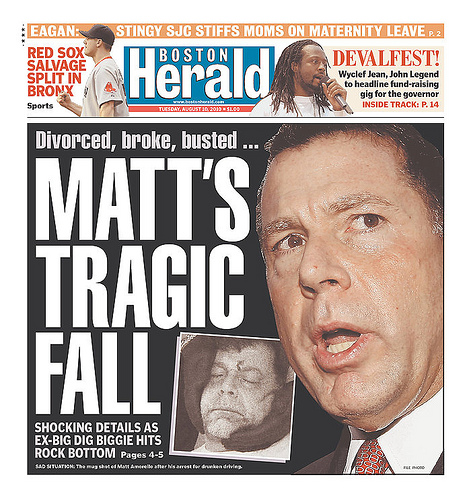
Both the Boston Globe and the Boston Herald give the front-page treatment today to former Big Dig chief Matt Amorello. Each paper also features those horrendous mug shots of Amorello, barely conscious, being held by a police officer so that his picture could be taken.
There’s a case to be made that the photos shouldn’t have been published, but I’m not going to make it here. I suspect that any impulse to hold back disappeared when Amorello himself disappeared. He later turned up at UMass Medical Center.
The two dailies offer some details (here and here) on Amorello’s slide following his forced resignation in 2006, after a woman was killed when a concrete slab fell from a Big Dig tunnel onto her car. You will find nothing surprising in either story.
The Eagle-Tribune of North Andover, whose coverage area includes Haverhill, where Amorello was arrested, sticks to what’s in the police report, as well as the observations of a few witnesses. “I’m just glad nobody got hurt,” Leonor Santos tells the paper. “We’re angry about him being drunk and driving. But thank God he’s OK. I’d rather he hit my car than the pole.”
Amorello easily could have killed someone. WBZ television and radio analyst Jon Keller writes that Amorello deserves compassion, but not forgiveness. I agree.