We have reached the let’s-hope-Canada-beams-in-news-that’s-being-censored-in-our-own-country stage of authoritarianism.
On Monday afternoon, the “60 Minutes” story on mostly Venezuelan detainees being sent to a notorious prison in El Salvador — canceled by CBS News editor-in-chief Bari Weiss — popped up on Canada’s Global TV app. It was taken down a short time later because of copyright issues, but it’s been showing up here and there on social media ever since. I’m hoping this broadcast-quality version, on Yashar Ali’s newsletter, The Reset, will stick around for a while.
As you’ll see, detainees, many of whom have not been accused of any crime other than being in the U.S. illegally, say there were subjected to beatings, torture and sexual abuse during their time in the CECOT prison. As for Weiss’ complaint that the story did not include any comment from the Trump regime, here’s what we hear toward the end of Sharyn Alfonsi’s report:
The Department of Homeland Security declined our request for an interview and referred all questions about CECOT to El Salvador. The government there did not respond to our request.
We’ve been having a debate on Facebook over whether it’s fair to say that Weiss “canceled” the story given that she has said she wants to run it after it’s re-edited. I contend that it was canceled, not delayed, because it was scheduled to run on Sunday evening and it wasn’t. Also, Weiss has made it clear that if the story does run, it won’t be what you see here.
As Alfonsi said, to cancel the story for lack of White House comment even though they were given an opportunity to weigh in is to hand a “veto” to the very officials that “60 Minutes” was trying to hold to account. As I tell my students, you need to give people you’re reporting on a fair chance to respond — but you can’t let it drag on for so long that their silence is used to kill the story.
Lesley Stahl of “60 Minutes” interviews Marjorie Taylor Greene. Photo via Paramount.
A Dec. 7 “60 Minutes” interview with Marjorie Taylor Greene by veteran correspondent Lesley Stahl raised hopes that new CBS News editor-in-chief Bari Weiss and her corporate overlords, Larry and David Ellison, wouldn’t destroy the legendary news program. Greene criticized Donald Trump, and Trump in turn complained that “60 Minutes” “has actually gotten WORSE!” since the Ellisons acquired CBS earlier this year, as CNN media reporter Brian Stelter writes.
Well, hope springs eternal — or, in this case, two weeks. Because now the worst has happened. On Sunday, “60 Minutes” postponed a heavily promoted story about the Trump regime’s cruel practice of sending Venezuelan migrants to El Salvador, where they have reportedly been mistreated and even tortured.
Liam Scott and Scott Nover report for The Washington Post that Weiss decreed that the story be postponed in order to give the White House another opportunity to respond, even though “60 Minutes” had already contacted administration officials in an unsuccessful effort to obtain comment.
CBS News said in a statement that the story “needed additional reporting.” But “60 Minutes” reporter Sharyn Alfonsi said in an internal email that Weiss was giving the White House a “kill switch,” explaining, “If the administration’s refusal to participate becomes a valid reason to spike a story, we have effectively handed them a ‘kill switch’ for any reporting they find inconvenient.” The Post story continues:
“Our story was screened five times and cleared by both CBS attorneys and Standards and Practices,” Alfonsi wrote in the note, a copy of which was obtained by The New York Times. “It is factually correct. In my view, pulling it now, after every rigorous internal check has been met, is not an editorial decision, it is a political one.”
Weiss said in a statement late Sunday: “My job is to make sure that all stories we publish are the best they can be. Holding stories that aren’t ready for whatever reason — that they lack sufficient context, say, or that they are missing critical voices — happens every day in every newsroom. I look forward to airing this important piece when it’s ready.”
Weiss, lest you have forgotten, is a right-leaning opinion journalist with no experience in straight-news reporting or in television journalism.
Times reporter Michael M. Grynbaum writes that CBS News announced the story would be pulled just three hours before airtime. Grynbaum also reminds us that the Ellisons’ path toward purchasing CBS was greased by the previous owner’s decision to settle a bogus lawsuit brought by Trump over the entirely routine manner in which “60 Minutes” edited an interview with Kamala Harris just before the 2024 election. Trump got $16 million from that corrupt transaction. And how’s this for condescension? Grynbaum writes:
One of Ms. Weiss’s suggestions was to include a fresh interview with Stephen Miller, a White House deputy chief of staff and the architect of Mr. Trump’s immigration crackdown, or a similarly high-ranking Trump administration official, two of the people said. Ms. Weiss provided contact information for Mr. Miller to the “60 Minutes” staff.
Now the Ellisons are seeking White House assistance in derailing Netflix’ pending acquisition of Warner Bros. Discovery. There are lots of reasons having to do with antitrust law that WBD shouldn’t end up in the hands of either Netflix or Paramount Skydance, as the Ellisons’ company is known. But Netflix, at least, plans to spin off CNN from WBD, giving the news outlet a fighting chance of remaining an independent voice.
An Ellison acquisition, on the other hand, would most likely put Weiss in charge of CNN.
I like to say that friends don’t let friends watch cable news. I rarely watch any of the prime-time talk shows on cable — certainly not Fox, but not MS NOW or CNN, either. They all rely on the same formula, which I’d describe as keeping you enraged and upset so that you don’t touch that dial.
On the other hand, I will tune in to CNN when there’s significant breaking news. And I think it’s vitally important that we have news organizations that aren’t totally in thrall to the Trump regime, which is why I’m glad that CNN and MS NOW are there even if I don’t watch them very often.
So I was relieved at the recent announcement that Warner Bros. Discovery would sell itself to Netflix, even though that left the fate of CNN uncertain. And I was horrified when the Trump-friendly Ellison family, the new owners of Paramount, decided to launch a hostile takeover attempt after losing the initial sweepstakes.
How bad is this? Let us count the ways.
► Paramount recently acquired CBS News, and its head, conservative opinion journalist Bari Weiss, is lined up to run CNN as well should the Ellison bid prevail. Not only does that raise ideological concerns, but it also would likely lead to major job cuts as the two operations are consolidated.
► After CBS News’ “60 Minutes” broadcast an interview in which ex-MAGA congresswoman Marjorie Taylor Greene criticized Trump, Paramount executives all but apologized to Trump, reports Charles Gasparino of the New York Post.
► Investors in the Paramount bid include the Saudi, Qatari and United Arab Emirates sovereign wealth funds. As Oliver Darcy of Status News observes, “Most startlingly, Saudi Arabia, which ordered the brutal killing of American journalist Jamal Khashoggi just a few short years ago, would effectively own a slice of one of the world’s leading newsrooms, if Ellison should get his way.
► Another investor in the Paramount quest is Trump’s son-in-law Jared Kushner, by way of his private equity firm, Affinity Partners. Dan Primack writes at Axios, “Paramount is telling WBD shareholders that it has a smoother path to regulatory approval than does Netflix, and Kushner’s involvement only strengthens that case.”
► Trump himself has been lashing out at CNN this week, pushing for a sale and saying he might get involved in any antitrust proceedings over whether the sale of WBD to Netflix would be legal or not, reports NPR’s David Folkenflik. It goes without saying that a sale to Paramount would be just as problematic, but we all know that Trump will use antitrust law to reward his friends and punish his enemies.
We should not be in the position of having to root for Netflix to win the WBD sweepstakes. Giant media monopolies are bad for the economy and bad for democracy. In this case, though, a sale to Netflix would at least give CNN a fighting chance of remaining an independent monitor of power — rather than yet another news outlet that’s sold its soul to the forces of authoritarianism.
“NJ Spotlight News” anchor Briana Vannozzi, right, interviews U.S. Rep. Bonnie Watson Coleman, D-N.J. Photo (cc) 2022 by Dan Kennedy.
NJ PBS chair Scott Kobler has issued a statement in which he criticizes New Jersey government officials for “intransigence or maybe even apathy” over the public broadcasting funding crisis.
As I noted Wednesday, NJ PBS may shut down in June 2026 following a breakdown in negotiations between the state and WNET of New York, the public media organization that runs the New Jersey operation. In addition to losing some $1.5 million in federal funds, NJ PBS’s allotment of state funds has been cut from $1 million for the coming year to just $250,000.
The cuts are likely to affect NJ Spotlight News, a website covering statewide politics and public policy as well as the name of NJ PBS’s daily half-hour newscast. The two operations merged in 2019. Although WNET has pledged to keep the news operation alive online and on its New York-based station, Thirteen, regardless of what happens, its reporting capacity is likely to be reduced unless a well-heeled benefactor or two steps up.
What would Walter Cronkite say? The legendary CBS News anchorman at the 1976 presidential debate between Jimmy Carter and Gerald Ford. Public domain photo.
Is there a media organization that’s fallen harder or faster in the Age of Trump II than CBS News? You might point to The Washington Post, but Jeff Bezos has thus far left its news coverage alone, contenting himself with taking a wrecking ball to the opinion section.
By contrast, CBS’s corporate overlords earlier this year settled a bogus lawsuit brought by Donald Trump against the network’s premier news program, “60 Minutes,” for $16 million in order to grease the skids for a sale to Skydance Media, headed by the Trump-friendly David Ellison.
And now comes the next act in this tragedy. According to a story first broken by Puck and since confirmed by other news outlets, Ellison is on the verge of acquiring The Free Press, a prominent right-leaning opinion outlet founded by Bari Weiss, the celebrity former New York Times opinion editor. The price tag could be somewhere between $100 million and $200 million. The idea is to bring Weiss inside the CBS tent and give her a major leadership role over CBS News.
What a revolting development. I’m not a regular reader of The Free Press, but its reputation is not so much right-wing as it is anti-anti-Trump. As CNN media reporter Brian Stelter wrote in July, when talk of a Weiss-Ellison alliance was starting to bubble up: “Earlier this year New York magazine described The Free Press as a media organ that ‘both wants to excoriate liberals but not fold fully into the MAGA wing.’”
Perhaps The Free Press’ most notorious piece was a takedown of NPR by one of the network’s former top editors, Uri Berliner. As I wrote at the time, Berliner’s screed was shot through with intellectual dishonesty, as he built his argument that NPR had fallen victim to liberal bias on a scaffolding of mischaracterizations and outright falsehoods. Look at its homepage this morning and you’ll see clickbait such as “How Zohran Mamdani Could Kill New York’s Schools,” “Is There a Dumber Housing Policy Than Rent Control?” and “The Democratic Socialists of America Don’t Know If They Should Condemn Murder.”
Media reporter Oliver Darcy on Wednesday wrote an excoriating takedown of the pending deal and the absurd notion that The Free Press is somehow worth $100 million or more, saying in part:
Ellison appears determined to replicate the John Malone playbook at CNN: nudge the newsroom into a posture more deferential to Trump, launder that shift as “balance,” and hope the MAGA crowd will suddenly reward him. But this formula is already tired and simply doesn’t work. Meddling at CNN, The Washington Post, and the Los Angeles Times has only destabilized those institutions. It chases away the core audience, while failing to win over the right-wing demographic, which has no interest in embracing legacy news brands no matter how many concessions are made. These audiences celebrate the destabilization of news institutions, not because they will ever turn to them for information, but because they despise them and want to see them burn to ash.
CBS News was never quite the “Tiffany network” of legend. Edward R. Murrow was gradually sidelined during the years after he publicly called out Red Scare-monger Joseph McCarthy. Dan Rather, still going strong at 93, was eased out as anchor of the “CBS Evening News” and producer Mary Mapes was fired after the short-lived “60 Minutes II” aired a report in 2004 about then-President George W. Bush’s sketchy service in the Air National Guard that was, admittedly, based in part on phony documents.
Never, though, has CBS News fallen as far as it has this year. Giving Bari Weiss some sort of oversight role may represent a new low, but I have a feeling that will soon be eclipsed by some other outrage. Walter Cronkite weeps.
Shari Redstone speaking at a Committee to Protect Journalists event. Photo (cc) 2022 by CPJ photos.
Given how long negotiations were dragged out, there was some reason to hope that Paramount Global wouldn’t give in and settle Donald Trump’s bogus lawsuit claiming that “60 Minutes” had deceptively edited an interview with Kamala Harris last October.
In the end, Trump got what he wanted. Paramount, CBS’s parent company, will settle the suit for $16 million. If you’re looking for one tiny reason to be hopeful, the settlement did not come with an apology. In agreeing to pay off Trump, Paramount’s major owner, Shari Redstone, will now presumably find smooth sailing through the regulatory waters in selling her company to Skydance Media. Skydance, in turn, is headed by David Ellison, the son of Oracle co-founder Larry Ellison, a friend of Trump’s.
NPR media reporter David Folkenflik has all the details. What’s clear is that this may well be the end of CBS News as a serious news organization. Just the possibility of a settlement has brought about the resignations of top executives as well as criticism from “60 Minutes” correspondent Scott Pelley. As recently as Monday, media reporter Oliver Darcy revealed that all seven “60 Minutes” correspondents had sent a message to their corporate overlords demanding that it stand firm. Murrow weeps, etc.
What I want to note, briefly, is that there are still two complications that Paramount and Skyline must contend with before wedded bliss can ensue.
The first is a threat by U.S. Sens. Elizabeth Warren, D-Mass., Ron Wyden, D-Ore., and Bernie Sanders, I-Vt., to launch an investigation into whether the payoff amounts to an illegal bribe. Given that every legal and journalistic expert who’s looked at the case believes the editing of the Harris interview was ordinary and unremarkable (among other things, “60 Minutes” edited out a clip of Harris complaining about her hay fever), that investigation might yield some headlines at least.
“Paramount appears to be attempting to appease the Administration in order to secure merger approval,” the three said in a May press release issued by Warren’s office. They added: “If Paramount officials make these concessions in a quid pro quo arrangement to influence President Trump or other Administration officials, they may be breaking the law.”
The second is a threatened shareholder lawsuit by the Freedom of the Press Foundation. In a May statement, the organization’s director of advocacy, Seth Stern, cited the three senators’ possible investigation and said this:
Corporations that own news outlets should not be in the business of settling baseless lawsuits that clearly violate the First Amendment and put other media outlets at risk. A settlement of Trump’s meritless lawsuit may well be a thinly veiled effort to launder bribes through the court system.
In this morning’s newsletter from CNN media reporter Brian Stelter, the foundation is reported to be moving ahead with its plans: “The group’s lawyers are huddling today, I’m told. A spokesperson said ‘Paramount’s spineless decision to settle Trump’s patently unconstitutional lawsuit is an insult to the First Amendment and to the journalists and viewers of “60 Minutes.” It’s a dark day for Paramount and for press freedom.’”
The Paramount settlement follows Disney’s disastrous and unnecessary $15 million settlement of a suit brought by Trump over a minor wording error by ABC News anchor George Stephanopoulos in describing the verdict against Trump in the E. Jean Carroll civil case. Stephanopoulos said Trump had been found to have “raped” Carroll, whereas the technical legal term was “sexual abuse.”
Trump’s claim failed on two grounds: What Stephanopoulos said was substantially true, and there was no evidence that the anchor had deliberately or recklessly mischaracterized the outcome of the case. But no matter. Disney settled anyway.
So far, at least, Gannett is holding firm in Trump’s suit against The Des Moines Register and pollster Ann Selzer over a survey that showed Trump trailing Harris in the Buckeye Hawkeye State (which he ended up winning easily) several days before the 2024 election.
Correction: Like the great Boston Brahmin writer Cleveland Amory, I regarded “the West” as anything west of Dedham. So, yes, Iowa is the Hawkeye State. I’m fixing that here and in Tuesday’s item as well.
For a brief moment Monday, it looked like Donald Trump had given up on his ridiculous lawsuit against The Des Moines Register and pollster Ann Selzer.
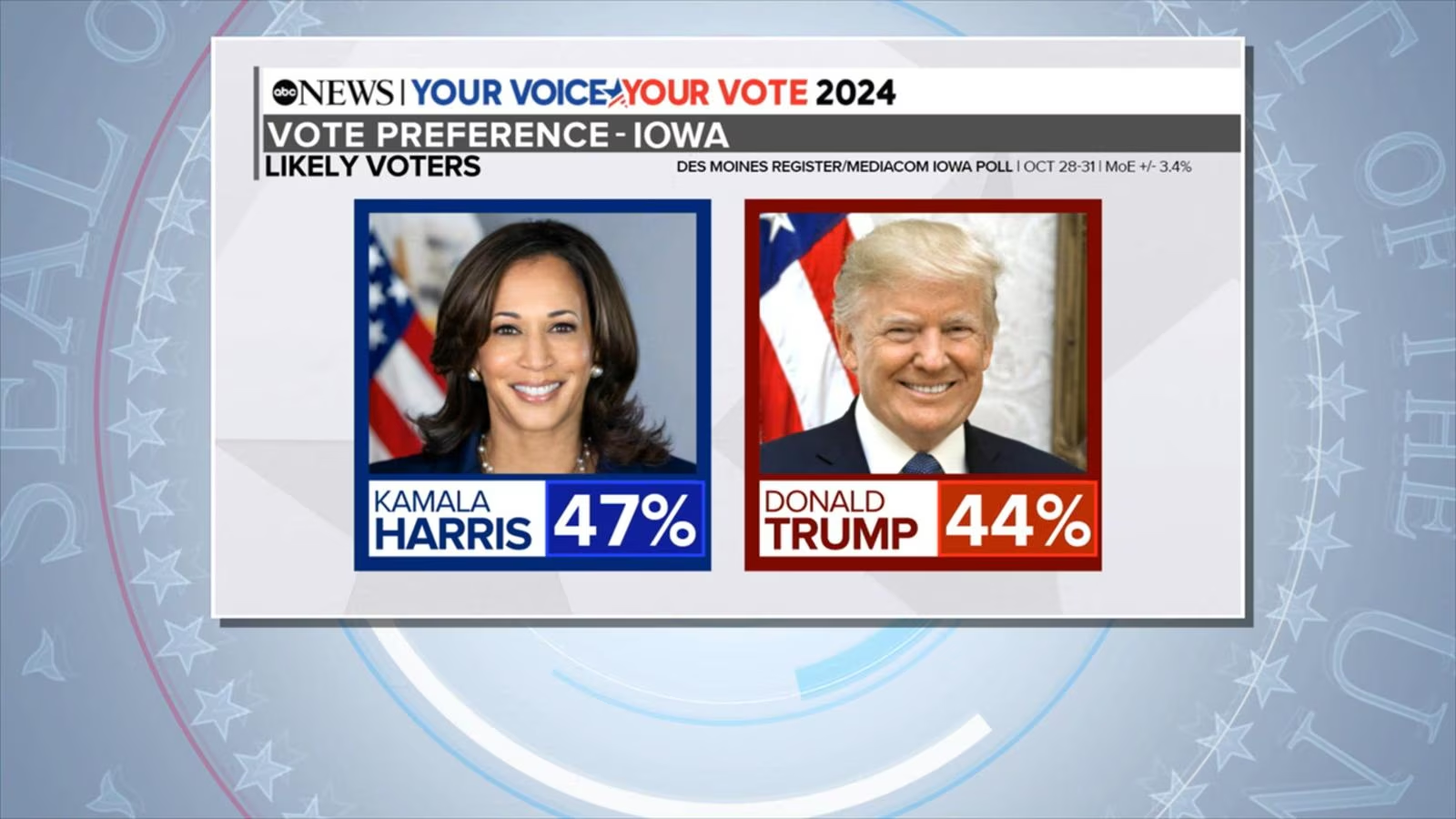
You may recall that Trump claimed they had committed consumer fraud because of a poll taken just before Election Day showing Kamala Harris with a 3-point lead in the Hawkeye State. Notwithstanding Selzer’s sterling reputation, Harris ended up losing Iowa by 13 points, which is about what you’d expect. She was wrong, and the error may have hastened her retirement, but the notion that she put out a false poll to help Harris is transparently ludicrous.
Well, Monday’s good news didn’t last. It turns out that Trump withdrew his suit from the federal courts and refiled it in state court one day before an Iowa anti-SLAPP law was scheduled to take effect, William Morris reports for the Register. SLAPP stands for “strategic lawsuits against political participation,” and it’s designed to give judges a reason to throw out garbage suits such as Trump’s. No such luck since Trump beat the deadline.
This isn’t the first time Trump has sought to have his Iowa case heard in state court. Apparently his lawyers believe the federal courts are unlikely to tolerate his foolishness. To its credit, the Register’s corporate owner, Gannett, has hung tough. A spokesperson for the paper, Lark-Marie Anton, said in a statement:
After losing his first attempt to send his case back to Iowa state court, and apparently recognizing that his appeal will be unsuccessful, President Trump is attempting to unilaterally dismiss his lawsuit from federal court and refile it in Iowa state court. Although such a procedural maneuver is improper, and may not be permitted by the court, it is clearly intended to avoid the inevitable outcome of the Des Moines Register’s motion to dismiss President Trump’s amended complaint currently pending in federal court.
The Foundation for Individual Rights and Expression, which is representing Selzer, said on social media that Trump’s attempt to move the case to state court was “a transparent attempt to avoid federal court review of the president’s transparently frivolous claims,” according to The Washington Post.
Meanwhile, there have been some developments in one of Trump’s other legal attempts to intimidate the press. According to media reporter Oliver Darcy, all seven correspondents at CBS News’ “60 Minutes” have sent a message to their corporate owner, Paramount, demanding that it stand firm in fighting Trump’s lawsuit over the way the program edited an interview with Harris last October. Darcy writes:
They pointedly expressed concern that Paramount is failing to put up a fierce and unrelenting fight in the face of Trump’s lawsuit over the program’s Kamala Harris interview, which has been widely denounced by the legal community as baseless, according to the people familiar with the matter. They said Trump’s allegations against the storied program are false and ripped his lawsuit as baseless. And they warned in no uncertain terms that if Paramount were to settle with Trump, it will stain the reputation of the company and undermine the First Amendment.
Trump is claiming consumer fraud in a Texas federal court under the state’s Deceptive Trade Practices Act, alleging that “60 Minutes” edited its interview with Harris to make her appear more coherent, thus helping her campaign. “60 Minutes” has defended the editing as normal and routine. The interview has been nominated for an Emmy in the editing category, no doubt to send a message to the White House.
Unfortunately, Darcy reports that Paramount continues to lurch toward a settlement with Trump in order to pave the way for federal approval of a merger with Skydance Media.
FCC chair Brendan Carr. Photo (cc) by Gage Skidmore.
Donald Trump is unleashing so much chaos in service to his authoritarian agenda that it is literally impossible to keep up. So today let’s just look at how Trump is threatening the broadcast news media.
Trump’s tool in this battle is Brendan Carr, whom he appointed to the Federal Communications Commission in 2017 and then recently elevated to the chairmanship. There are currently four members of the FCC — two Republicans, two Democrats and one vacancy, which Trump will presumably fill in the near future.
Not that the current tie matters. Carr helped author Project 2025, the right-wing blueprint for a second Trump term that Trump said he knew nothing about during the campaign. Among other things, Carr wrote that the FCC chair has extra special powers that the other members of the commission lack. Thus Carr is large and in charge, at least until someone with power challenges him.
I want to share with you just three actions that Carr has taken during his brief time as chair, all of which represent a threat to the media’s ability to provide us with the news and information we need in a democratic society.
◘ First, he is helping Trump with his bogus $10 billion lawsuit against CBS. Trump is suing the network over an interview that “60 Minutes” conducted last fall with his Democratic opponent, Kamala Harris, claiming that the program was edited to make Harris sound more coherent than she really was.
CBS responded that it edits all of its recorded interviews, and that there was nothing unusual about the way it handled its conversation with Harris. (And really? If you watched her debate Trump or listened to her long, unedited conversations with Howard Stern and Alexandra Cooper, you know she has no problem speaking extemporaneously.) Nevertheless, the network may be on the verge of settling the lawsuit, perhaps to ease the regulatory path for CBS’s parent company, Paramount, to merge with Skydance, as Alena Botros writes for Fortune.
Carr, for his part, placed the FCC’s heavy thumb on the scale by ordering CBS to turn over the raw footage and transcripts of the Harris interview, thus making use of a public agency’s regulatory authority to help Trump do his dirty work, as David Folkenflik reports for NPR. To be clear: Trump would likely have gotten those materials anyway in the course of pre-trial discovery. Carr’s actions serve the purpose of amplifying Trump’s fact-free claim that there was something corrupt about how the interview was edited.
“60 Minutes” executive producer Bill Owens has said he will not apologize as part of any settlement, according to Michael Grynbaum and Benjamin Mullin of The New York Times. Which raises a question: Will he resign? And if he does, will others follow him out the door?
◘ Second, and speaking of NPR, Carr has announced that he’s investigating NPR and PBS to see whether the public broadcasters’ underwriting practices violate their noncommercial mandate.
According to Liam Reilly of CNN, Carr is “concerned that NPR and PBS broadcasts could be violating federal law by airing commercials,” adding: “In particular, it is possible that NPR and PBS member stations are broadcasting underwriting announcements that cross the line into prohibited commercial advertisements.”
Well, guess what? A lot of underwriting announcements on NPR and PBS do seem like commercials. They’re more restrained than what’s on commercial television and radio, and but when a cruise line pops up before or after the “PBS NewsHour,” or when a rug company’s sponsorship is heard on WBUR Radio, it’s because they want you to take a cruise or buy a rug.
Public broadcasters have to get their money from somebody, and it can’t all come from viewers (and listeners) like you. Very little in the way of tax revenues support PBS and NPR. The rest of it has to come from foundation grants and corporate underwriting. Personally, I’m a huge fan of the BNSF Railway notice that sometimes appears on the “NewsHour,” but that’s because I like trains.
What Carr’s doing is pure harassment.
◘ Third, Carr said last week that the FCC is investigating a San Francisco radio station for the offense of committing journalism. Garrett Leahy reports in The San Francisco Standard that KCBS revealed the location of agents from the federal Immigration and Customs Enforcement agency (ICE) and identified their unmarked vehicles in a place “known for violent gang activity.”
“We have sent a letter of inquiry, a formal investigation into that matter, and they have just a matter of days left to respond to that inquiry and explain how this could possibly be consistent with their public-interest obligations,” said Carr, who made his remarks during an appearance on — where else? — Fox News.
According to Leahy, KCBS declined to comment. But Juan Carlos Lara of public radio station KQED interviewed David Loy, legal director of the California-based First Amendment Coalition, who said:
Law enforcement operations, immigration or otherwise, are matters of public interest. People generally have the right to report this on social media and in print and so on. So it’s very troubling because it’s possible the FCC is potentially being weaponized to crack down on reporting that the administration simply just doesn’t like.
No doubt there will be much more to say about Carr in the months ahead. For now, it’s enough to observe that he is off to a predictably ominous start.
Happy Easter, everyone! We attended the vigil service at our church early this morning, so I’m only now getting my bearings. We’ll have a family dinner later today, but otherwise things will be pretty quiet.
Right now I’d like to catch up in a piece of overdue media-critic business. Last week “60 Minutes” profiled Marjorie Taylor Greene, the extremist congresswoman from Georgia who was stripped of her committee assignments under the previous Democratic leadership after urging that the then-speaker, Nancy Pelosi, be executed for “treason,” and who is now a confidant of Pelosi’s successor, the loathsome, spineless Kevin McCarthy.
“60 Minutes” took a lot of criticism for providing someone like Greene with a platform. I did not watch it at the time but decided instead to watch it with my graduate ethics students on Wednesday evening. I want to see if their reactions and mine were the same.
I think most of us came away with the view that interviewer Lesley Stahl did an OK job of holding Greene to account. Stahl wasn’t as bad as some of her critics had claimed, although she wasn’t great. I’d give her a “B.” Stahl took a lot of heat for rolling her eyes and responding “Wow. OK.” when Greene doubled down on her horrific libel that Democrats promote pedophilia, but I thought her understated contempt was fairly effective. I also liked the use of Greene’s tweets to show that she was lying when she denied having said things that Stahl cited. Naturally, Greene threw her staff under the bus by claiming someone else wrote the tweets.
On the other hand, Stahl let Greene deny that she’s a QAnon adherent, even though the Democrats-are-pedophiles lie is a key part of QAnon ideology. Stahl also betrayed her establishment bias by asking Greene why she wouldn’t agree to some sort of compromise over the debt ceiling. “The two sides have to come together and hammer it out,” Stahl said. No. What she should have said was that the debt ceiling is a phony issue, and that Greene and other Republicans are refusing to approve borrowing to cover spending that was approved by Congress and has already taken place. What Greene and her ilk are engaged in is hostage-taking, and Stahl should have pointed that out.
Stahl also failed to challenge Greene when she whined that she has been falsely described as a racist and an antisemite. She is, in fact, both, and let’s not forget that she once went so far as to blame the California wildfires on Jewish space lasers.
The real problem with the piece, though, was the framing. Some of my students were put off by scenes of Greene mingling with enthusiastic supporters back in her district, where she’s very popular. I didn’t like the friendly stroll around Greene’s estate.
Greene has emerged as a powerful and influential government official as well as a malignant force in American society. She was eminently worthy of a story by “60 Minutes,” but she shouldn’t have been treated to a profile, even one as semi-tough as the one presided over by Stahl. Instead, it should have been a no-holds-barred look at a dangerous figure in U.S. politics. Greene would have been invited for an interview, but her participation would not have been necessary.
What “60 Minutes” and Stahl gave us wasn’t terrible, but they blew an opportunity to give us something much better.
Sunday’s “60 Minutes” episode on the local news crisis was a worthy if unoriginal treatment focusing on the depredations of Alden Global Capital, the hedge fund that is our worst newspaper owner. Viewers are also introduced to Report for America, the organization that’s placing journalists in underserved communities around the country. If you didn’t get a chance to see it, you can tune in here.