We used to get them on our doorsteps and they always went straight into the recycling bins. I never saw the appeal of a marketing channel that was 100% instant garbage, and which angered so many recipients.
Our latest “What Works” podcast features Kara Meyberg Guzman, CEO and co-founder of Santa Cruz Local in California. Before the Local, she was managing editor of the Santa Cruz Sentinel. In 2018 she left her job at the Sentinel, which is owned by Alden Global Capital’s MediaNews Group, citing differences with the company’s management.
Kara then connected with another former Sentinel reporter, Stephen Baxter, and the two of them hatched a plan for the Local. They focus on public policy issues that affect the whole county, like housing, development and public health. The Local is a private company, owned by the co-founders. The revenue model is a mix of memberships, business sponsorships, grants and advertising. But the mission is simple. As the website puts it: “We strive to understand Santa Cruz in all of its complexity.”
Santa Cruz may turn out to be the most talked-about community on our podcast. Not long ago we interviewed Ken Doctor, the longtime media analyst who launched a high-profile, well-funded project called Lookout Santa Cruz. It is encouraging to see that in a region whose legacy newspaper has been hollowed out by vulture capitalism, two digital start-ups are working to fill the gap.
I’ve got a Quick Take on a new report by LION Publishers that contains some really positive findings about funding and sustainability for local news startups. Anyone who’s thinking about starting a community news project ought to take a look at it. Ellen Clegg highlights the work of Katherine Massey, a columnist who was killed in the racist massacre at the Tops grocery store in Buffalo.
I also tip the hat to Anne Galloway, the founder and executive editor of VTDigger, who has announced that she’s giving up the editor’s position and is returning to the reporting ranks. She’ll be an editor-at-large focusing on investigative reporting. Galloway started Digger 13 years ago as a one-woman operation after she was laid off by the Rutland Herald. Today, Digger has 32 full-time employees and is regarded as one of the leading digital sources of regional news in the country.
The Vermont Statehouse in Montpelier. Photo (cc) 2015 by Dan Kennedy.
There is mega-news to report in the world of nonprofit digital journalism. Anne Galloway, the founder of VTDigger, is stepping aside as executive editor, taking on a new role as editor-at-large. She’s staying at Digger and will focus on investigative reporting. Here’s part of the official announcement from the Vermont Journalism Trust, the nonprofit that publishes Digger:
In the 13 years since Galloway launched VTDigger, it has grown from one reporter — Galloway herself — to become the largest newsroom in Vermont, with dozens of employees and more than 550,000 monthly readers. During that time, Galloway not only scaled up the organization while spearheading daily news coverage. She also wrote many investigative pieces that explained complex issues and uncovered corruption, most notably the EB-5 fraud scandal involving developers at Jay Peak. In her new role, Galloway intends to continue following that important story for VTDigger.
In a letter to readers, Galloway writes: “Today, VTDigger is Vermont’s newspaper of record, and the only online nonprofit news organization in the country that has replaced daily print newspapers in a local market. We have developed a sustainable funding model that is the envy of our competitors in print and broadcast.”
In late 2015 I traveled to Vermont to report on the media ecosystem that had grown up to fill gaps left by the Burlington Free Press, which had shrunk considerably under the not-so-tender ministrations of Gannett. This was the original, pre-GateHouse Gannett; but despite having a reputation that was better than the current iteration, the company had taken a chainsaw to Vermont’s paper of record. In response, the alt-weekly Seven Days, Vermont Public Radio and VTDigger had all stepped up. (I wrote about my findings in “The Return of the Moguls.”)
I visited Digger at its offices near the Vermont Statehouse in Montpelier. At that time the site had 13 full-time employees, seven of whom were journalists. That has since grown to 32. Galloway told me what it was like when she started the site in 2009 shortly after being laid off by the Rutland Herald.
“I didn’t have money to pay myself for two years, but I basically decided that I had to start a daily,” she said. “I started writing about the legislature. I went into the statehouse and I started covering the state budget in a very serious way. I started covering a few other issues. So it was me every day writing one to two stories.”
Now VTDigger is among the most respected nonprofits in the country covering state politics and policy. Congratulations to Galloway, and best wishes on whatever comes next.
Gannett is seeking charitable donations to cover the salary of the local government reporter at the Reno Gazette Journal, one of its dailies. According to executive editor Brian Duggan, the paper is trying to raise $100,000 over the next two years so that it can keep paying Mark Robison. Duggan writes:
Mark’s salary is entirely dependent on the RGJ Fund, which is a field of interest fund held by the Community Foundation of Northern Nevada. It was established by the RGJ in 2020 as a way to help our newsroom grow.
My first reaction was blind outrage. My second reaction was tempered outrage. Short term, there’s no question that this will help the community. More coverage is better than less coverage, and Robison’s stories are offered for free, outside the Gazette Journal’s paywall.
But in the medium and long term, helping Gannett — the largest newspaper chain in the country, notorious for cutting its newsrooms to the bone — makes it more difficult for anyone else to start or maintain an independent news project. In fact, there are two such projects in Reno — This Is Reno and the Reno News & Review. Why not help them beef up their coverage of local government?
It’s not unprecedented for nonprofit grant money to be given to for-profit news organizations. To be fair, it sounds like none of the foundation’s money are actually being given to the paper; the foundation is simply administering the fund. (I emailed the foundation seeking comment but did not receive a response.) But there are two aspects of the Reno situation that stand out:
1. Robison is covering a core beat, local government. Grant money is usually used for special reporting projects, such as The Boston Globe’s series on educational inequality, “The Great Divide,” paid for partly by the Barr Foundation. Because of the grant money, the Globe is providing more and different education coverage than it otherwise might. By contrast, would the Reno paper actually not cover local government without charitable contributions? (OK, maybe it wouldn’t.)
2. Gannett keeps slashing its coverage to pay down debt and to squeeze out as much revenue as possible. I’m sure Duggan and Robison are fine journalists. But the people who own their paper demonstrate little interest in providing deep reporting in the communities they serve. Thus the donors are, in effect, subsidizing Gannett’s cost-cutting.
There has to be a better way of helping local news in Reno.
I’m not going to keep doing this, but it’s only Week 2 of The Transcript & Journal. My capacity for outrage hasn’t faded away yet. So here it is.
The T&J, owned by the Gannett chain, is sent to people in Medford and Somerville who previously subscribed to the Medford Transcript or the Somerville Journal. There’s not a single Medford-specific story on the front, and the story about rats only glancingly mentions Somerville. The inside consists of press releases, a story about a dog park in Billerica, a report from State House News Service and an obit from Cambridge. Nothing on the mayor’s office, the city council, the school committee or the police department — not even a civil-rights complaint filed against the police several weeks ago, which even Patch managed to write up.
It would be amazing if Patch saw this as an opportunity to go back to its old formula, at least in some communities — one full-time journalist and a modest freelance budget. I doubt that’s going to happen, though. They seem happy with their current, profitable model in which one person produces content for multiple cities and towns. But who knows? I thought this was pretty encouraging:
I think Medford more than most communities deserves/could sustain multiple reporters. It’s not lost on me or us. I see the hole Gannett has left. We recently lost our Medford reporter who I thought did admirable work given the position. Making this work is THE priority for us.
I’d also love it if someone wanted to start a TAPinto site in Medford. TAPinto is a franchise model that allows entrepreneurs to get up and running very quickly with a local news site. Ellen Clegg and I recently interviewed TAPinto founder and CEO Michael Shapiro on the “What Works” podcast. If anyone wanted to start such a project here, I’d be happy to make introductions.
In this Encore Edition of “What Works,” freelance investigative journalist Julie Reynolds talks about her singular pursuit of the truth about Alden Global Capital, the secretive New York hedge fund that has gobbled up newspapers across the country, stripping assets and firing reporters. Reynolds connects the dots from Alden to Cerberus Capital Management, the “shadow bank” that backed Alden’s 2021 takeover of Tribune Publishing.
In Quick Takes, I explore pink slime news sites, and Ellen Clegg reports on some good news for newspaper readers in the town that inspired Frostbite Falls, home to Rocky and Bullwinkle.
Ellen and I interviewed Julie in October 2021, but her research is still valid today — an unfortunate circumstance for the future of independent local journalism. We’ll be back with fresh content next week.
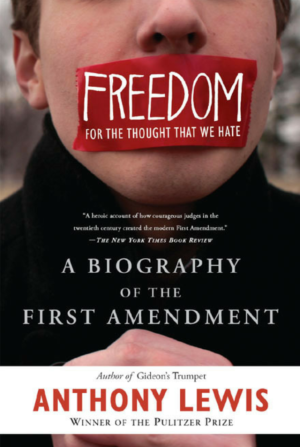
The late New York Times journalist Anthony Lewis, whose writings on the First Amendment are essential to understanding free speech and freedom of the press, wrote that the legal standard for incitement to violence may have swung too far in the direction of allowing just about anything. I wonder what he would have to say about the toxic right-wing stew in which the Buffalo shooter immersed himself — 4chan, according to reports, but reinforced by broader cultural developments in which Fox News and Trumper politicians have embraced virulent forms of racism.
In 1969, the Supreme Court ruled in Brandenburg v. Ohio that a Ku Klux Klan leader demanding “revengeance” against Black people and Jews did not engage in incitement because his threat was non-specific. That is, he didn’t urge the mob he was addressing to march down the street and attack the first African American they came across. The idea was that the threat had to be “directed at inciting or producing imminent lawless action” is “likely to incite or produce such action” in order for it to rise to the level of incitement.
In an age when words have inspired acts of mass murder and terrorism, it is not as easy for me as it once was to believe that the only remedy for evil counsels, in Brandeis’s phrase, should be good ones. The law of the American Constitution allows suppression only when violence or violation of law are intended by speakers and are likely to take place imminently. But perhaps judges, and the rest of us, will be more on guard now for the rare act of expression — not the burning of a flag or the racist slang of an undergraduate — that is genuinely dangerous. I think we should be able to punish speech that urges terrorist violence to an audience some of whose members are ready to act on the urging. That is imminence enough.
The Brandenburg standard came into being only after many decades of evolution toward a less stringent understanding of incitement, beginning with Schenck v. United States (1919), in which Justice Oliver Wendell Holmes Jr. articulated the “clear and present danger” test. The decision, which includes Holmes’ famous admonition that you can’t falsely shout “fire” in a crowded theater, is widely reviled today, but it represented a step forward: It was the first time the court suggested that speech couldn’t be punished unless it presented such a danger.
If Schenck didn’t go far enough, perhaps Brandenburg, as Lewis writes, went too far. How can we redefine incitement in the age of social media? Breaking the connection between speech and action would have the effect of outlawing hate speech, which is currently regarded as coming under the protections of the First Amendment. Should we go down that road? Can we trust the current Supreme Court to do it in a way that addresses the problem without creating collateral damage? What unintended consequences would there be?
We have a horrendous mess on our hands. Hate speech on the internet presents dangers unlike anything we have dealt with before. As someone who’s pretty close to being a free-speech absolutist, I have real problems with any new government restrictions. But I do find it interesting that no less a friend of the First Amendment than Anthony Lewis had reservations about incitement. And Lewis was writing before social media and the dark web had gotten much traction.
We need a national conversation. Sadly, we are at a moment when we are ill-equipped for such an exercise.
Correction: An earlier version of this post identified 4chan’s hosting service. In fact, it was a porn site that uses the name 4chan but is otherwise unrelated.
Our thoughts at this time need to be with the Black community of Buffalo — and everywhere — as we process the horror of one of the worst mass murders of recent years. We need to do something substantive about guns, racism and white supremacy. What actually happened, and what we can do to prevent such horrific events from happening again, must be at the top of our agenda.
This blog, though, is primarily about the media and often about free speech. So let me address some of the secondary issues. The shootings intersect with notions of hate speech, social media and the role of Fox News in mainstreaming dangerous racist ideologies such as so-called replacement theory, which holds that the left is trying to push out white people in favor of non-white immigrants in order to obtain an electoral advantage.
When pressed on how she planned to confront such hate speech online, without impinging on First Amendment rights, Ms. Hochul noted that “hate speech is not protected” and said she would soon be calling meetings with social media companies.
Hochul is wrong, and the Times shouldn’t have used “noted,” which implies that she knows what she’s talking about. If hate speech were illegal, Tucker Carlson would have been kicked off Fox long ago.
What’s illegal is incitement to violence, and you might think whipping up racist hatred would qualify. In fact, it does not — and the very Supreme Court case that made that clear was about a speaker at a rally who whipped up racist hatred. Brandenburg v. Ohio (1969) held that a ranting Ku Klux Klan thug demanding “revengeance” against Jews and Black people had not engaged in incitement because his threats were non-specific.
Hochul can cajole and threaten. And she should. But it’s going to be difficult to do much more than that.
As for the media themselves, that’s a morass, and it’s too early to start sorting this out. But the shooter reportedly fell down the 4chan hole during the pandemic, immersing himself in the racism and hate that permeate the dark corners of the internet. There are a lot of moving parts here, but it seems unlikely that a young mass murder-in-the-making was sitting around watching Fox, even if some of his rants paralleled Carlson’s rhetoric. Fox’s role is to mainstream such hatred for its frightened, elderly viewers. The radicalization itself happens elsewhere.
So, are we going to ban 4chan? How would that even work? If the government tried to shut them down, they could just go somewhere else. I’m sure Vladimir Putin would be happy to play host.
4chan represents the bottom of this toxic food chain; Fox News is at the top. In the middle are the mainstream social media platforms — Facebook, Twitter, Twitch (which allowed the shooter to livestream his rampage for nearly two minutes before taking it down) and the like. It’s too early to say what, if anything, will happen on that front. But it’s probably not a good time to be a billionaire who wants to buy Twitter so that there will be less moderation on the platform than there is currently.