Several years ago I tried to set up a Google AdSense account, did something wrong, and have never been able to recover. I just tried again, and the unexplained sins of the past continue to haunt me. If you think you can help, please send an e-mail to da {dot} kennedy {at} neu {dot} edu, and I’ll respond with a detailed explanation.
The pain over Spain is easy to explain
In my latest for the Guardian, I argue that complaints about Michelle Obama’s Spanish vacation are just the latest manifestation of a by-now-old ritual, in which the mainstream media allow themselves to be bullied by right-winger activists into promoting a non-story.
What Google and Verizon were really up to
Samuel Axton, writing at Mashable, is unstinting in his assessment of last week’s New York Times report that Google and Verizon were secretly negotiating a deal that would undermine net neutrality for their own benefit. The two companies yesterday announced a proposed regulatory framework that would more or less guarantee net neutrality on broadband land lines, but allow wireless providers to operate with fewer regulations. Axton writes:
The proposal we’re seeing is starkly different from what was described in The New York Times article from last week that accused Google and Verizon of conspiring to upend the principles of net neutrality. We didn’t believe it even then, and Google CEO Eric Schmidt said in the conference call that “almost all” of what the NYT reported was “completely wrong.” In particular, he stressed that this is not a business deal at all between Verizon and Google, but simply a joint policy statement.
You wouldn’t know it from reading today’s Times, which cites “reports that Google and Verizon had come to a private agreement.” I am not aware of any “reports” making quite that bold a claim except for the initial story in the Times, which Google and Verizon almost immediately said was wrong.
Still, there’s plenty not to like about the framework that Google and Verizon have proposed. As Jeff Jarvis points out at Buzz Machine, a wireless, ubiquitous connection is quickly becoming what we mean when think of the Internet. Guaranteeing net neutrality for a land-line network that may soon be obsolete not exactly in keeping with Google’s “Don’t Be Evil” philosophy. Jarvis writes:
Mobile will very soon become a meaningless word when — well, if telcos allow it, that is — we are connected everywhere all the time. Then who cares where you are? Mobile? doesn’t matter. You’re just connected. In your car, in your office, in your bedroom, on the street. You’re connected. To what? To the internet, damnit.
The Save the Internet Coalition puts it this way: “Google-Verizon Pact Worse Than Feared.” The FCC needs to be able to put a stop to this.
For Amorello, a sad and ugly ending
Both the Boston Globe and the Boston Herald give the front-page treatment today to former Big Dig chief Matt Amorello. Each paper also features those horrendous mug shots of Amorello, barely conscious, being held by a police officer so that his picture could be taken.
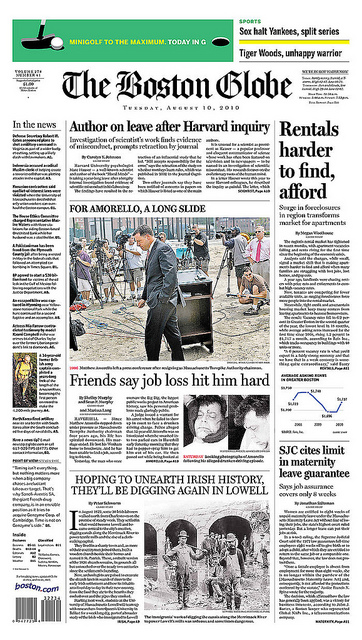
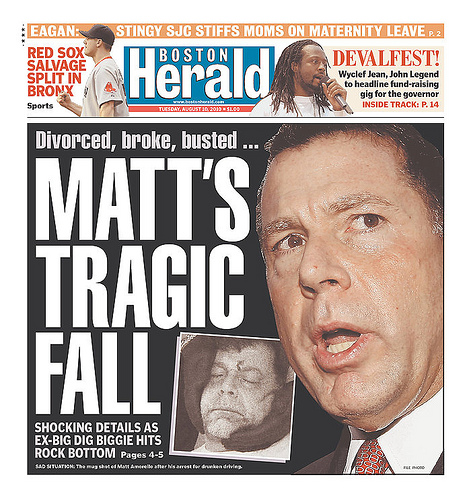
There’s a case to be made that the photos shouldn’t have been published, but I’m not going to make it here. I suspect that any impulse to hold back disappeared when Amorello himself disappeared. He later turned up at UMass Medical Center.
The two dailies offer some details (here and here) on Amorello’s slide following his forced resignation in 2006, after a woman was killed when a concrete slab fell from a Big Dig tunnel onto her car. You will find nothing surprising in either story.
The Eagle-Tribune of North Andover, whose coverage area includes Haverhill, where Amorello was arrested, sticks to what’s in the police report, as well as the observations of a few witnesses. “I’m just glad nobody got hurt,” Leonor Santos tells the paper. “We’re angry about him being drunk and driving. But thank God he’s OK. I’d rather he hit my car than the pole.”
Amorello easily could have killed someone. WBZ television and radio analyst Jon Keller writes that Amorello deserves compassion, but not forgiveness. I agree.
A man on the move

If I had known John Young when I was writing “Little People,” I might have devoted a chapter just to him. A 44-year-old math teacher school at the Pingree School in Hamilton, Young is a dedicated triathlete, an unlikely pursuit for someone with dwarfism.
On Saturday, the Salem News profiled Young on the eve of the Witch City Triathlon — a half-mile swim, a 13-mile bike race and a three-mile run. People with achondroplasia, the most common form of dwarfism, are generally advised against running because of structural challenges in their spinal columns. Yet Young told the News’ Michael Mastone that his exercise regiment actually saved him from the likelihood of major back surgery.
I don’t know what his secret is, but I do know that I’ve been taking a nutritional supplement he recommended in the hopes of extending my own running career for a few more years.
Young reports on Facebook that he finished the triathlon yesterday in 1:59:28, beating his time last year by 12 minutes.
This weekend, we’ll see John, his wife, Sue Casey, and their 7-year-old son, Owen, in Bedford, N.H., at Camp Come As You Are, an annual program for kids and families affected by dwarfism. (The banner photo on my “Little People” site is from a past camp.) John’s stories about his athletic prowess are always a highlight of Little People of America get-togethers, and I’m looking forward to catching up with him.
More: Check out Young’s blog.
Willowdale on a dry summer’s day
I’m not running because I’m trying to recover from a heel injury. I’m not riding because my bike’s in the shop with a snapped gear cable. So this afternoon I hiked through Willowdale State Forest in Topsfield (this link says it’s in Ipswich, but I stayed on the Topsfield side).
Because of the unusually dry summer, I was able to walk along trails that are almost always off-limits, including a particularly nice path that bisects a swamp. The horseflies and mosquitoes were obnoxious, but not overwhelmingly so.
Despite the dry weather, we’ve had some wild storms. Because of flooding damage, the footbridge that connects Willowdale with Bradley Palmer State Park is out — from the serious-looking chain-link fence that’s been built around it, I’d be surprised to see it reopen any time soon.
Anyway, hope you enjoy the photos.
Herald taken to task on sexual-assault stories
John Carroll takes the Boston Herald to task for two stories about underage sexual-assault victims — one of whom is a 14-year-old girl described as allegedly having an “affair” with a 30-year-old school security officer (it’s called rape, people), the other depicted (but not named) in a photo in the print edition.
“Something’s out of whack at the feisty local tabloid,” writes Carroll.
A few more thoughts on Patch.com
My Thursday posting of an e-mail from a Patch.com local editor who considers herself overworked and underappreciated brought an unusually strong reaction from Media Nation readers — many of them, no doubt, people who work for Patch or who are thinking about it. I received nearly 4,400 page views on Thursday, well over double the usual amount of traffic.
I received several e-mails from current and former Patch folks, also insisting on anonymity, and wary about whether they wanted their words posted at all. I am not normally in the habit of publishing anonymous e-mails, and I’d just as soon Media Nation not turn into a forum for anonymous pro- and anti-Patch missives. But I can say that a few folks agreed with the anonymous e-mail and a few disputed it. One even asked that I pressure my source into giving up her identity so that other local editors will not be suspected. (Uh, no.)
What’s beyond dispute is that community journalism is hard work, and has never been particularly lucrative. In Greater Boston, what’s shaping up is a three-way battle involving Patch, GateHouse Media’s Wicked Local sites and the Boston Globe’s Your Town sites. Here’s what I’m hearing from folks who’ve been in touch with me:
- Though no one is getting rich working for Patch, it offers better pay and benefits than its competitors. But that comes with an unusually heavy load of responsibilities, as outlined by my anonymous e-mailer. Local editors must manage every aspect of the site.
- Many GateHouse journalists earn less than Patch editors. But though they also put in dauntingly long hours, editors and reporters don’t have as many non-journalistic responsibilities.
- Correspondents for the Globe’s Your Town sites are freelancers, and receive no benefits at all.
I should note that nearly all Wicked Local content is repurposed from GateHouse’s newspapers, most of them weeklies. The Your Town sites combine online-only stories, an occasional Globe story and aggregation from other news sources (but not from Wicked Local). Patch is online-only.
I should also note that the Your Town/Wicked Local/Patch combination is far from the only game in community journalism. Medium-size dailies such as the Eagle-Tribune papers north of Boston, GateHouse’s own dailies west and south of Boston, and Rupert Murdoch’s (yes, believe it or not) Standard-Times of New Bedford and Cape Cod Times are among our most important sources of local news. Journalists at those papers tend to be more experienced and better paid, too.
There are two pieces of good news in all of this: there’s a lot of competition for local news in Greater Boston, and competition is good for readers; and, a year after the news business seemed to be collapsing, news outlets are hiring young reporters at a healthy clip in order to staff new hyperlocal sites.
Now it’s the Times versus Google and Verizon
For now, at least, it looks like the New York Times is doubling down on its report that Google and Verizon are negotiating a deal that would allow Verizon to offer tiered levels of service for content-providers — a deal that would severely undermine the principle of net neutrality.
In a follow-up today, the Times’ Edward Wyatt reports that FCC chairman Julius Genachowski would oppose such a deal. The story continues:
His remarks came in response to press reports that Google and Verizon were nearing an agreement about broadband management that could clear the way for Verizon to consider offering such a service. The two companies declined to comment on any potential deal.
You will note that the link to “press reports” (plural) brings you to Wyatt’s Thursday story (singular), now disputed by Google. Indeed, writing that Google and Verizon have declined to comment may be true in a technical sense, but it strikes me as disingenuous given Google’s full-throated denial. Verizon has since denied it as well.
Scott Morrison of Dow Jones has more on the sniping between the Times and the two companies, quoting Google spokeswoman Mistique Cano as saying, “The New York Times is quite simply wrong. We have not had any conversations with Verizon about paying for carriage of Google or YouTube traffic.”
But Times spokeswoman Diane McNulty says her paper is sticking by its story, commenting, “Google’s comment about the New York Times story refutes something the Times story didn’t say.”
A Times commenter, Dan K of Brooklyn (not me, I swear!), has some links to other coverage that raise the possibility that Google is pursuing separate strategies regarding Verizon’s broadband and cellular networks, and that the Times may have confused the two.
But the Times story, if accurate, is a huge embarrassment for Google, which has long been a corporate leader in the fight to preserve the principle that all Internet traffic should be treated equally. Net neutrality is what allowed an upstart like Google to become a major media player in the first place, and it’s fostered independent news outlets ranging from Talking Points Memo to the guy in his mother’s basement who blogs about local zoning issues.
Save the Internet has responded to all this with a new campaign called “Dear Google: Don’t Be Evil.”
The closing of the Internet*
Imagine you are trying to start a news site in your community. Your competitor, part of a national chain, offers instant-on, full-screen HD video and a host of other data-intensive features that load the moment you hit “click.” But though you have a broadband connection, even simple videos that you’ve posted load slowly and play in fits and starts.
So you call your Internet provider — most likely Verizon and Comcast — and ask what’s going on. A sales person explains to you that if you want your readers to enjoy the same rich multimedia content as you competitor, then all you have to do is pay another $1,000 a month.
You can’t. You struggle on. And, within six months, you shut down.
That is a likely scenario if we move away from net neutrality — a vitally important principle that all Internet traffic should be treated the same. The FCC has been trying to mandate net neutrality, only to be shot down in the federal courts. And today the New York Times reports that Google and Verizon have been involved in negotiations to come up with a multi-tiered Internet with different levels of service and different levels of pricing. [Update: Or perhaps not. See below.]
“It’s like the end of ‘Animal Farm’ where pigs and humans sit down at the dinner table,” tweeted new-media strategist Steve Yelvington. In fact, Google at one time had been a leader in pushing for net neturality.
Please understand what net neutrality is not. There is nothing wrong with charging consumers more for better Internet service. Broadband costs more than dial-up, and fast broadband costs more than slow broadband. That’s life.
Rather, this involves the other end of the pipe, to fees that content-providers would pay in order to receive preferential service. It would make it far more difficult for start-ups, low-budget projects and non-profits to compete with big media sites. You might say that’s the whole idea.
Net neutrality is the baseline requirement for diverse, independent media. Those of us who spent years railing against corporate media consolidation have been pleasantly surprised, as numerous little guys — including significant players at the international, national and local levels — have been able to make their voices heard.
Along with the advent of closed systems such as Apple’s iPad and iPhone, the demise of net neutrality could mark the beginning of the end of this media explosion, and a return to business as usual.
Josh Silver, president of the advocacy organization Free Press, calls the pending Google-Verizon deal “the end of the Internet as we know it.” Timothy Karr, campaign director of Free Press, offers some further thoughts.
For more information, including what you can do, check out Save the Internet.
*Update: Sharp-eyed reader Nick Mendez found a tweet from Google Public Policy claiming that the Times got the story wrong. According to @googlepubpolicy: “@NYTimes is wrong. We’ve not had any convos with VZN about paying for carriage of our traffic. We remain committed to an open internet.”
Wow. This bears watching. Will the Times retract the story?