We closed out 2016 the right way—with good friends, the Three Stooges, and Alicia Keys instead of Mariah Carey. I hope that bodes well for 2017.
May all of you have a wonderful, happy, healthy 2017. And thank you for reading.
By Dan Kennedy • Tracking the future of local news and other passions since 2005
We closed out 2016 the right way—with good friends, the Three Stooges, and Alicia Keys instead of Mariah Carey. I hope that bodes well for 2017.
May all of you have a wonderful, happy, healthy 2017. And thank you for reading.
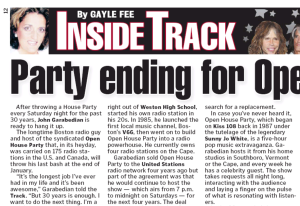 Time was when the “Inside Track,” the Boston Herald‘s gossip column, was among the most read—and feared—media outposts in the city. For years, Laura Raposa and Gayle Fee tracked the famous and tormented the powerful. And before them was the late Norma Nathan, whose column was called “The Eye.”
Well, gossip isn’t what it used to be. Raposa retired a few years ago into order to become a professional foodie along with her husband (and former Media Nation roommate) Steve Syre, a retired business columnist for the Boston Globe. Together they operate the Foodsmith in Duxbury.
And now Fee is leaving the Herald, according to an email she sent to colleagues that I obtained a little while ago. Her last day is Friday, but she’s working right up until the end: today she has a piece on the retirement of local man-about-town John Garabedian as well as a compilation of tidbits.
Here is the text of Fee’s email:
Moving On …
Hello Everyone—Please excuse the mass email—I wanted to let you all know that Friday will be my last column for the Boston Herald. After 33 years at the paper, 25 at the Inside Track, it’s time for me to say goodbye….
I wanted to say what a pleasure it has been to work with all of you over the years and hopefully we will stay in touch.
Thanks for everything—
Best, Gayle
And best wishes to Fee as she embarks on the next phase of her life.
As 2016 draws to a close, another great artist has died. This one, though, was not a celebrity. Alphonse Mouzon was a terrific jazz drummer with a long, varied career. I know him best from McCoy Tyner’s Enlightenment (above), a suite that was recorded live at Montreux in 1973. (If you’ve never heard it, I recommend it. It is deeply spiritual in the manner of John Coltrane’s A Love Supreme, on which Tyner played.)
According to the New York Times obit, Mouzon “learned this fall that he had neuroendocrine cancer and used a crowdfunding platform to help pay for treatment.” Not that the deaths of Prince, David Bowie, George Michael, Carrie Fisher, et al. weren’t every bit as tragic. But that’s a detail you don’t often see when reading about the death of a musician who at one time was fairly well known.

A friend just forwarded this to me. I have edited out his name, but the blank spot after “Your new weekly rate will be” is entirely the doing of the Boston Globe. Note that you can’t respond to the email.
Adam Gaffin of Universal Hub got one of these as well.
Pay whatever you think it’s worth?
OK, I looked it up. Assuming this is up to date, a seven-day print subscription will cost you $14.34 a week after you get past the introductory offer.

Usually this is the week when I post a list of the most-trafficked stories on Media Nation during the past year. Since this blog in 2016 was mainly a repository for my weekly column at WGBHNews.org, I don’t think that makes a lot of sense.
Fortunately, my friends at WGBH have compiled my five most-read columns from the past year. I hope you’ll take a look.

Don’t say I didn’t warn you. A little over a month ago I wrote that if we tried to expand the definition of “fake news” beyond for-profit clickfarms, then the movement to eradicate hoaxes from Facebook and other venues would quickly degenerate into ideologically motivated name-calling.
And so it came to pass. The New York Times on Monday published two stories that, for all purposes, mark the end of the nascent battle against fake news.
The first, by Jeremy Peters, details the efforts of Rush Limbaugh, Breitbart, and other right-wingers to label anything they don’t like that’s reported by the mainstream media as fake news. The second, by David Streitfeld, documents how the right has unleashed its flying monkeys against Snopes.com, the venerable fact-checking site that is the gold standard for exposing online falsehoods.
Read the rest at WGBHNews.org. And talk about this post on Facebook.
The Boston Globe’s Tuesday print edition is getting a little smaller, per this “Editor’s Note” in today’s paper:
Starting today, Tuesday Stories will no longer appear as a separate section of the paper. The content that usually appears in that section will be spread across the rest of the Globe. Look on Page B9 for the theater directory, and Page B10 for television listings. The section’s array of narrative tales can be found throughout the remaining sections of the paper.
A perusal of last week’s Tuesday Stories section reveals exactly one ad—the movie directory—along with a house ad for a Globe-branded book about David Ortiz. That’s not the sort of situation that can continue. The Globe’s future is selling digital subscriptions. As print advertising continues to fade away, the Globe is going to have to start offering more online content that isn’t available in print.
Meanwhile, friend of Media Nation John Carroll has noticed that the Globe’s Friday Weekend section has literally gotten smaller, as the height and width have been trimmed. “Doesn’t seem like much difference,” says John, “but multiply by about 220,000 papers and you’re talking real money.”

A few years ago Paul Bass and I appeared on a Connecticut radio station to talk about the future of local journalism. Bass was and is the founder, editor, and publisher of the New Haven Independent, a nonprofit, online-only news organization that is the main subject of my book The Wired City.
Bass and I both came out of the world of alternative weeklies. He was the star reporter for the New Haven Advocate. I was the media columnist for the Boston Phoenix. While we were on the air, he told a story about a club owner in New Haven who had once advertised heavily in the Advocate—but had found he could reach a better-targeted audience on Facebook while spending next to nothing.
Need I tell you that both the Advocate and the Phoenix have gone out of business?
I’m dredging up this anecdote because the Columbia Journalism Review has published a much-talked-about essay arguing that newspapers made a huge mistake by embracing all things digital and should instead have doubled down on print. Michael Rosenwald writes that instead of chasing ephemeral digital revenues, newspapers should have built up their print editions and offered more value to their readers.
Read the rest at WGBHNews.org. And talk about this post on Facebook.
Doug Franklin, the incoming chief executive officer of the Boston Globe, sent an email to employees earlier this morning. As these things often do, a copy landed in my inbox. Franklin will succeed Mike Sheehan on January 1. The full text of Franklin’s message follows.
Dear Boston Globe Team,
I’m honored to have the opportunity to be part of your very special institution. When I met with John Henry and the senior team, I knew immediately there was a “fit” that would allow us to do great work in the coming years. My career started in newspapers and I’m excited to partner with everyone to build the Globe’s pathway for future success.
There are great foundations in place, including outstanding journalism, a state-of-the-art printing plant in Taunton, new offices on State Street coming soon, important advertiser relationships, a strong digital subscription model with still more potential, and most importantly—you. Your work contributes to the important role the Globe plays in the community every day.
I have a lot to learn from you about the Globe and the Boston community, but there are a few common goals in all media organizations. We need to listen to our market—our readers, audiences and advertisers—and equally important, to those we don’t connect with so we can grow. We need to channel our talented team into a few important strategies that insure the best pathway forward. I believe our best competitive advantage is the incredibly talented staff of Globe.
Given the industry challenges, we have no choice but to move with speed and urgency. We won’t be reckless in our decision-making, but we must be fearless. I, working with the leadership team, will be as transparent, fair and timely as possible about the strategic decisions we make. We are fortunate to be privately held by John Henry, because it allows us flexibility in our approach. But it does not absolve us of the need to sustain ourselves financially. I know you’ve been making difficult decisions already, but we have more tough decisions ahead in terms of deploying our resources and talent toward new, promising strategies so the Globe can serve the Boston community for decades to come.
You will find me accessible; in return, I encourage your honest feedback. I’m a straight shooter with everyone. I will be a champion for the Globe and your work. You will have an aligned senior leadership team next year driving important strategies, and we will communicate regularly with you.
While there are no silver bullets in our business, I’m bullish about our pathway forward. Mobile and social platforms allow us to reach more readers than ever before with your expert storytelling. Our mission is unique: informing, improving and inspiring Boston. Our brand is among the best in the region—and the industry.
Some have asked why I’m returning to a metropolitan news organization. The answer is really pretty simple. I believe your work is important to our democracy and the greater good, now more than ever. John and I are determined to nurture a strategy that will keep the Globe at the center of civic life in New England for the foreseeable future.
Thank you for your hard work and commitment to the Globe. I’m looking forward to meeting everyone in the weeks and months ahead. I also hope you get time this holiday season with your family and friends. It’s important. Get recharged and look ahead to our important work in 2017.
All the best and happy holidays!
Doug

Politico last Monday revealed the existence of a longshot effort to deny Donald Trump the presidency: a plan for members of the Electoral College to coalesce around Ohio Gov. John Kasich as an alternative. The idea would be to persuade Democratic electors to switch to Kasich, and then hope a decent-size share of Republican electors could be persuaded to abandon Trump.
With the Washington Post reporting that the CIA has concluded what has long been evident—that the Russians intervened in the election on Trump’s behalf—the moment for such an audacious gamble may have arrived. Kasich, who is deeply conservative, especially on social issues, may not be the best choice. Jeb Bush or Mitt Romney might be better. But anyone who resembles a normal politician would be preferable in what is turning into a real moment of national crisis.
The need is so obvious that it feels wrong to say this is almost certainly not going to happen. But that is the truth. If there is any chance of this taking place, here’s what has to happen:
If no candidate wins the minimum 270 votes when the electors meet on December 19, the election will be decided by the Republican-controlled House of Representatives. Then we’ll see whether the members prefer Trump—or will instead switch to the Kasich/Romney/Bush alternative.
Talk about this post on Facebook. And in case you missed it, here is my WGBH News article from earlier this week on the Electoral College and slavery.

