Australian libel ruling shows what happens without Section 230 protections

Photo (cc) 2011 by Scott Calleja

I’m not familiar with the fine points of Australian libel law. But a decision this week by the High Court of Australia that publishers are liable for third-party comments posted on their Facebook pages demonstrates the power of Section 230 in the United States.

Section 230, part of the Communications Decency Act of 1996, does two things. First, it carves out an exception to the principle that publishers are legally responsible for all content, including advertisements and letters to the editor. By contrast, publishers are not liable for online comments in any way.

Second, in what is sometimes called the “Good Samaritan” provision, publishers may remove some third-party content without taking on liability for other content. For example, a lawyer might argue that a news organization that removed a libelous comment has taken on an editing role and could therefore be sued for other libelous comments that weren’t removed. Under Section 230, you can’t do that.

The Australian court’s ruling strikes me as a straightforward application of libel law in the absence of Section 230. Mike Cherney of The Wall Street Journal puts it this way:

The High Court of Australia determined that media companies, by creating a public Facebook page and posting content on that page, facilitated and encouraged comments from other users on those posts. That means the media companies should be considered publishers of the comments and are therefore responsible for any defamatory content that appears in them, according to a summary of the judgment from the court.

Over at the Nieman Journalism Lab, Joshua Benton has a markedly different take, arguing that the court is holding publishers responsible for content they did not publish. Benton writes:

Pandora’s box isn’t big enough to hold all the potential implications of that idea. That a news publisher should be held accountable for the journalism it publishes is obvious. That it should be held accountable for reader comments left on its own website (which it fully controls) is, at a minimum, debatable.

But that it should be held legally liable for the comments of every rando who visits its Facebook page — in other words, the speech of people it doesn’t control, on a platform it doesn’t control — is a big, big step.

I disagree. As I said, publishers are traditionally liable for every piece of content that appears under their name. Section 230 was a deviation from that tradition — a special carve-out providing publishers with immunity they wouldn’t otherwise have. If Benton is right, then we never needed 230. But of course we did. There’s a reason that the Electronic Frontier Foundation calls 230 “the most important law protecting internet speech.”

I also don’t see much difference between comments posted on a publisher’s website or on its Facebook page. A Facebook page is something you set up, add content to and manage. It’s not yours in the same way as your website, but it is part of your brand and under your control. If you should be liable for third-party content on your website, then it’s hardly a stretch to say that you should also be liable for third-party content on your Facebook page.

As the role of social media in our political discourse has become increasingly fraught, there have been a number of calls to abolish or reform 230. Abolition would mean the end of Facebook — and, for that matter, the comments sections on websites. (There are days when I’m tempted…) Personally, I’d look into abolishing 230 protections for sites that use algorithms to drive engagement and, thus, divisiveness. Such a change would make Facebook less profitable, but I think we could live with that.

Australia, meanwhile, has a dilemma on its hands. Maybe Parliament will pass a law equivalent to Section 230, but (I hope) with less sweeping protections. In any case, Australia should serve as an interesting test case to see what happens when toxic, often libelous third-party comments no longer get a free pass.

What’s wrong with Politico

In one sentence: Politico provides insider gossip at a time when democracy faces an existential threat. Washington Post columnist Perry Bacon Jr. explains:

The Politico approach is probably fine if you are covering parties and politicians who share some values and norms. And the election of Barack Obama looked like it could usher in a politics that was less divisive than George W. Bush’s presidency and a full break from the conflicts over race and identity that had in many ways defined U.S. politics since the 1960s.

But early in the Obama years, it became clear that the fights of the past weren’t over; they were, instead, perhaps becoming even more tense.

Apple’s attempted crackdown on child sexual abuse leads to a battle over privacy

Apple CEO Tim Cook. Photo (cc) 2017 by Austin Community College.

Previously published at GBH News.

There is no privacy on the internet.

You would think such a commonplace observation hardly needs to be said out loud. In recent years, though, Apple has tried to market itself as the great exception.

“Privacy is built in from the beginning,” reads Apple’s privacy policy. “Our products and features include innovative privacy technologies and techniques designed to minimize how much of your data we — or anyone else — can access. And powerful security features help prevent anyone except you from being able to access your information. We are constantly working on new ways to keep your personal information safe.”

All that has now blown up in Apple’s face. Last Friday, the company backed off from a controversial initiative that would have allowed its iOS devices — that is, iPhones and iPads — to be scanned for the presence of child sexual abuse material, or CSAM. The policy, announced in early August, proved wildly unpopular with privacy advocates, who warned that it could open a backdoor to repressive governments seeking to spy on dissidents. Apple cooperates with China, for instance, arguing that it is bound by the laws of the countries in which it operates.

What made Apple’s efforts especially vulnerable to criticism was that it involved placing spyware directly on users’ devices. Although surveillance wouldn’t actually kick in unless users backed up their devices to Apple’s iCloud service, it raised alarms that the company was planning to engage in phone-level snooping.

“Apple has put in place elaborate measures to stop abuse from happening,” wrote Tatum Hunter and Reed Albergotti in The Washington Post. “But part of the problem is the unknown. iPhone users don’t know exactly where this is all headed, and while they might trust Apple, there is a nagging suspicion among privacy advocates and security researchers that something could go wrong.”

The initiative has proved to be a public-relations disaster for Apple. Albergotti, who apparently had enough of the company’s attempts at spin, wrote a remarkable sentence in his Friday story reporting the abrupt reversal: “Apple spokesman Fred Sainz said he would not provide a statement on Friday’s announcement because The Washington Post would not agree to use it without naming the spokesperson.”

That, in turn, brought an attaboy tweet from Albergotti’s Post colleague Christiano Lima, complete with flames and applauding hands, which promptly went viral.

“We in the press ought to do this far, far more often,” tweeted Troy Wolverton, managing editor of the Silicon Valley Business Journal, in a characteristically supportive response.

Even though the media rely on unnamed sources far too often, my own view is that there would have been nothing wrong with Albergotti’s going along with Sainz’s request. Sainz was essentially offering an on-the-record quote from Apple.

(Still, it’s hard not to experience a zing of delight at Albergotti’s insouciance. Now let’s see the Post do the same with politicians and government officials.)

Apple has gotten a lot of mileage out of its embrace of privacy. Tim Cook, the company’s chief executive, delivered a speech earlier this year in which he attempted to position Apple as the ethical alternative to Google, Facebook and Amazon, whose business models depend on hoovering up vast amounts of data from their customers in order to sell them more stuff.

“If we accept as normal and unavoidable that everything in our lives can be aggregated and sold, we lose so much more than data, we lose the freedom to be human,” Cook said. “And yet, this is a hopeful new season, a time of thoughtfulness and reform.”

The current controversy comes just months after Apple unveiled new features in its iOS operating software that made it more difficult for users to be tracked in a variety of ways, offering greater security for their email and more protection from being tracked by advertisers.

Yet it always seemed that there was something performative about Apple’s embrace of privacy. For instance, although Apple allows users to maintain tight control over their iPhones and iMessages, the company continues to hold the encryption keys to iCloud — which, in turn, makes the company liable to a court order to turn over user data.

“The dirty little secret with nearly all of Apple’s privacy promises is that there’s been a backdoor all along,” wrote privacy advocates Albert Fox Cahn and Evan Selinger in a recent commentary for Wired. “Whether it’s iPhone data from Apple’s latest devices or the iMessage data that the company constantly championed as being ‘end-to-end encrypted,’ all of this data is vulnerable when using iCloud.”

Of course, you might argue that there ought to be reasonable limits to privacy. Just as the First Amendment does not protect obscenity, libel or serious breaches of national security, privacy laws — or, in this case, a powerful company’s policies — shouldn’t protect child pornography or certain other activities such as terrorist threats. Fair enough.

But as the aforementioned Selinger, a professor of philosophy at MIT and an affiliate scholar at Northeastern University, argued over the weekend in a Boston Globe Ideas piece, there are times when slippery-slope arguments, often bogus, are sometimes valid.

“Governments worldwide have a strong incentive to ask, if not demand, that Apple extend its monitoring to search for evidence of interest in politically controversial material and participation in politically contentious activities,” Selinger wrote, adding: “The strong incentives to push for intensified surveillance combined with the low costs for repurposing Apple’s technology make this situation a real slippery slope.”

Five years ago, the FBI sought a court order that would have forced Apple to provide the encryption keys so they could access the data on an iPhone used by one of the shooters in a deadly terrorist attack in San Bernardino, California. Apple refused, which set off a public controversy, including a debate between former CIA director John Deutsch and Harvard Law School professor Jonathan Zittrain that I covered for GBH News.

The controversy proved to be for naught. In the end, the FBI was able to break into the phone without Apple’s help. Which suggests a solution, however imperfect, to the current controversy.

Apple should withdraw its plan to install spyware directly on users’ iPhones and iPads. And it should remind users that anything stored in iCloud might be revealed in response to a legitimate court order. More than anything, Apple needs to stop making unrealistic promises and remind its users:

There is no privacy on the internet.

The media trust gap between Democrats and Republicans continues to widen

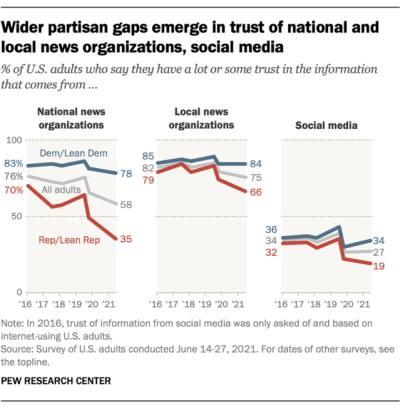
The latest findings from the Pew Research Center about trust in journalism are depressing but not surprising. Pew’s report, written by Jeffrey Gottfried and Jacob Liedke and published last week, shows that the gap between Democrats and Republicans continues to widen.

Over the past five years, the percentage of Republicans and Republican leaners who have some trust in national news has dropped from 70% to 35%. Meanwhile, 78% of Democrats and Democratic leaners say they have “a lot” or “some” trust in national news organizations.

The problem, as always, is the asymmetric polarization that has come to define our politics and our media consumption. If you spend all your time engaging with media outlets that tell you Donald Trump won the 2020 election, the Jan. 6 insurrection was no big deal, vaccines are dangerous and critical race theory is poisoning your (white) children’s minds, then you are going to distrust any news to the contrary. Essentially it’s a small number of right-wing sources of propaganda, led by Fox News, versus everyone else. New York University journalism professor Jay Rosen put it this way:

Trust is higher for local news organizations than it is for the national media, but even here there’s a partisan gap. Two weeks ago I wrote about ways that community journalists could connect with conservatives, and yes, they should try. If we are ever going to overcome the partisan divide, it’s going to have to start at the local level. At the same time, though, we can’t pander to false beliefs. So it’s a dilemma with no obvious solution.

A new book illuminates the lives of those who built the Appalachian Trail

Looking south from the trail up Mount Washington at Mount Monroe, the Lake of the Clouds and the Lake of the Clouds Hut. Photo (cc) 2003 by Dan Kennedy.

I’ve never considered hiking the Appalachian Trail from one end to the other. It always struck me as too time-consuming and too boring. But for many years I loved backpacking in the mountains and hills of New Hampshire, Vermont and Western Massachusetts — and those journeys often involved traveling along sections of the AT.

Recently I read Philip D’Anieri’s new book about the AT, titled “The Appalachian Trail: A Biography.” It’s thoroughly enjoyable for anyone who loves the trail. D’Anieri’s approach is indeed biographical — he profiles some of the key people in the AT’s development, ranging from Arnold Guyot, a 19th-century Swiss immigrant scientist who was among the first people to advocate for the recreational uses of the Appalachian Mountains, to Dave Richie, Pam Underhill and Dave Startzell, government officials who in the 1970s rescued the AT from developers and helped make it what it is today.

D’Anieri also devotes a chapter to Bill Bryson, author of the 1998 bestseller “A Walk in the Woods.” So popular was Bryson’s entertaining tale about his failed attempt to hike the entire trail from Georgia to Maine that it led to an explosion of use — and overuse. I’ve gone on five 50-mile backpacking trips along the AT in the Berkshires and Vermont, three times as a Boy Scout and adult leader in the 1970s and twice as a scoutmaster in the 2000s. I can attest that the trail was far more crowded in the years after Bryson’s book was published than it was previously. Back in the ’70s we rarely encountered anyone; later on, we were never alone, encountering thru-hikers and wanna-bes on a daily basis.

Much of “A Walk in the Woods” focuses on Bryson’s relationship with his eccentric friend and hiking partner Stephen Katz. So I was taken aback when, some years ago, a few people who had encountered Bryson on the trail insisted that Bryson was alone and that Katz didn’t actually exist. I was pleased to learn from D’Anieri that Katz was real, although Bryson changed his name and some details about his personality.

It was scouting that introduced me to hiking and camping, activities that were entirely alien to my parents, and a real gift that led to my lifelong interest in the outdoors. I’ve hiked all 48 of New Hampshire’s 4,000-foot summits, finishing with North and South Hancock in 2007 with my son, Tim, as well as around 250 miles of the AT. Like many of us, I’ve slowed down as I’ve gotten older, though I still love hiking in the Middlesex Fells and on the North Shore. I haven’t ruled out a return to the mountains, either.

“For all that the AT is a human construction,” D’Anieri writes in conclusion, “its opening up to nature still has the power to inspire. We do not need a simplistic fantasy of unsullied Creation to appreciate the parts of the universe that aren’t us. It is enough to hold the contemporary world somewhat at bay, to make the intentional effort to see a bigger picture. Over 2,100 miles, in landscapes majestic and ordinary, that is the opportunity the trail affords us.”

I recommend D’Anieri’s book for anyone who has hiked along the Appalachian Trail, or has thought about it. As D’Anieri makes clear, the AT is not a natural wonder. Rather, it is the result of a deliberate effort on the part of a small group of visionaries — some eccentric, some difficult, but every one of them dedicated to the idea that the outdoors can inspire us all.

This post was originally included as part of last week’s Media Nation member newsletter. To become a member for just $5 a month, please click here.

Several Gannett papers, including the Worcester T&G, won’t print on Labor Day

The Telegram & Gazette of Worcester is taking a day off. According to an announcement in the print edition, the paper won’t publish tomorrow, which is Labor Day.

The 016, which has the story, observes that “the last date the Telegram & Gazette was not printed is not immediately known,” and that the T&G will be joined by some other Gannett papers, including the Milwaukee Journal Sentinel and the Tallahassee Democrat.

A highly unusual move to say the least.

More: Add the Cape Cod Times to the list. It’s starting to look like this applies to many if not most of Gannett’s dailies.

The Supreme Court’s vote to uphold the Texas abortion law is an affront to democracy

Photo (cc) 2006 by OZinOH

In analyzing the U.S. Supreme Court’s 5-4 vote not to overturn Texas’ drastic new abortion restrictions, a number of commentators have focused on the role played by the three justices nominated by Donald Trump — Neil Gorsuch, Brett Kavanaugh and Amy Coney Barrett.

All three, needless to say, are wildly controversial. Gorsuch was chosen after then-Senate majority leader Mitch McConnell refused even to take up Barack Obama’s nomination of Merrick Garland, who’s now attorney general. Kavanaugh was confirmed despite serious and credible allegations of sexual assault. Barrett was rushed through before the 2020 election following the death of Ruth Bader Ginsburg.

But there is a more systemic problem, and that’s the failure of democracy that made last’s week’s decision possible. Trump, as we all know, lost the popular vote to Hillary Clinton in 2016 by about 3 million votes. He won only because the Electoral College, a relic of slavery, provides small rural states with disproportionate power. Yet he got to appoint one-third of the current court.

Moreover, all three of Trump’s justices were confirmed by a Senate controlled by the Republicans even though they represented fewer people than the Democrats. Gorsuch and Kavanaugh were confirmed during the first two years of Trump’s term, when the Democratic senators represented 56% of the population nationwide compared to the Republican share of 44%. That margin had narrowed slightly by the time Barrett was confirmed, but 53% of the population was still represented by Democratic senators compared to 47% by Republicans. (See my analysis.)

The other two justices who voted to uphold the Texas law were Clarence Thomas, appointed by George H.W. Bush, who was a majority president, and Samuel Alito, appointed by George W. Bush during his second term, which he won by a majority after losing the popular vote the first time around. But that’s just two votes. If Obama and Clinton had named three justices instead of Trump, it’s easy to imagine that the Texas law would have been suspended by a 7-2 vote. It’s just as easy to imagine that the Texas legislature wouldn’t have passed such a perverse and draconian law in the first place.

This is not democracy. Nor is it republicanism, since a properly designed republic is supposed to represent a majority of the electorate by proxy. It’s fair to ask how long this can go on before the majority stands up and demands an end to government by the minority.

Black newspapers across the country collaborate via Word In Black

The trade magazine Editor & Publisher reports that 10 Black newspapers have created a network to provide news in communities of color across the country. The Effort, called Word In Black, is part of the Fund for Black Journalism, which was launched a year ago by the Local Media Association, according to E&P’s Evelyn Mateos.

Word In Black, she adds, “covers racial equity, K-12 education, police reform, healthcare disparities, social justice, politics, opinion, sports and LGBTQ.” Nick Charles, who’s heading up the project, tells Mateos:

[These] 10 different publishers sometimes have different mindsets, different politics, and they live in different parts of the country. So, people in Texas don’t have the same ideas about a lot of things that people in New York may have. But their affection and love for communities are what binds them. Collaboration is going on because people realize that to survive and to meet our mission as journalists, we have to band together.

The papers range from New York to Sacramento, but nothing locally. It would be great to see The Bay State Banner become part of this. It would also be interesting to see if The Emancipator, a nationally focused website sponsored by The Boston Globe and BU’s Center for Antiracist Research, could find a way to collaborate.

Facebook’s tortured relationship with journalism gets a few more tweaks

Facebook has long had a tortured relationship with journalism. When I was reporting for “The Return of the Moguls” in 2015 and ’16, news publishers were embracing Instant Articles, news stories that would load quickly but that would also live on Facebook’s platform rather than the publisher’s.

The Washington Post was so committed to the project that it published every single piece of content as an Instant Article. Shailesh Prakash, the Post’s chief technologist, would talk about the “Facebook barbell,” a strategy that aimed to convert users at the Facebook end of the barbell into paying subscribers at the Post end.

Instant Articles never really went away, but enthusiasm waned — especially when, in 2018, Facebook began downgrading news in its algorithm in favor of posts from family and friends.

Nor was that the first time Facebook pulled a bait-and-switch. Earlier it had something called the Social Reader, inviting news organizations to develop apps that would live within that space. Then, in 2012, it made changes that resulted in a collapse in traffic. Former Post digital editor David Beard told me that’s when he began turning his attention to newsletters, which the Post could control directly rather than having to depend on Mark Zuckerberg’s whims.

Now they’re doing it again. Mathew Ingram of the Columbia Journalism Review reports that Facebook is experimenting with its news feed to see what the effect would be of showing users less political news as well as the way it measures how users interact with the site. The change, needless to say, comes after years of controversy over Facebook’s role in promoting misinformation and disinformation about politics, the Jan. 6 insurrection and the COVID-19 pandemic.

I’m sure Zuckerberg would be very happy if Facebook could serve solely as a platform for people to share uplifting personal news and cat photos. It would make his life a lot easier. But I’m also sure that he would be unwilling to see Facebook’s revenues drop even a little in order to make that happen. Remember that story about Facebook tweaking its algorithm to favor reliable news just before the 2020 election — and then changing it back afterwards because they found that users spent less time on the platform? So he keeps trying this and that, hoping to alight up on the magic formula that will make him and his company less hated, and less likely to be hauled before congressional committees, without hurting his bottom line.

One of the latest efforts is his foray into local news. If Facebook can be a solution to the local news crisis, well, what’s not to like? Earlier this year Facebook and Substack announced initiatives to bring local news projects to their platforms for some very, very short money.

Earlier today, Sarah Scire of the Nieman Journalism Lab profiled some of the 25 local journalists who are setting up shop on Bulletin, Facebook’s new newsletter platform. They seem like an idealistic lot, with about half the newsletters being produced by journalists of color. But there are warning signs. Scire writes:

Facebook says it’s providing “licensing fees” to the local journalists as part of a “multi-year commitment” but spokesperson Erin Miller would not specify how much the company is paying the writers or for how long. The company has said it won’t take a cut of subscription revenue “for the length of these partnerships.” But, again, it’s not saying how long those partnerships will last.

How long will Facebook’s commitment to local news last before it goes the way of the Social Reader and Instant Articles? I don’t like playing the cynic, especially about a program that could help community journalists and the audiences they serve. But cynicism about Facebook is the only stance that seems realistic after years of bad behavior and broken promises.

Digital drives a circulation increase at the Globe while the Herald keeps sliding

The Boston Globe’s strategy of focusing on digital subscriptions is paying off, according to the latest figures from the Alliance for Audited Media. For the six-month period ending on March 31 of this year, the Globe’s paid weekday circulation was 331,482, up 81,201, or 32%, over the same period a year earlier. On Sundays, the Globe’s paid circulation was 387,312, up 73,347, or 23%.

The increase came despite the continued shrinkage of the print edition. Weekday print was 77,679, a decline of 16%. Sunday print is 135,696, down nearly 15%. Paid digital now accounts for nearly 77% of the Globe’s circulation on weekdays and 65% on Sundays — numbers that no doubt had a lot to do with the hunger for local and regional news during the COVID-19 pandemic.

The numbers were not nearly as rosy at the Boston Herald, which has been gutted by its hedge-fund owner, Alden Global Capital. Paid weekday circulation, print and digital, is now 56,791, a decline of 9,686, or more than 14%. Sunday circulation is 58,461, down 14%. Digital is essentially flat, with nearly all of the decrease coming from the Herald’s fading print product. The Herald today sells an average of 22,032 print papers every weekday and 25,892 on Sundays.

The new circulation figures at the Globe and the Herald come amid a massive decline in print circulation nationwide. According to the Press Gazette, a British website that covers the news business, print circulation of the top 25 U.S. dailies fell from 4.2 million to 3.4 million over the past year, a decline of 20%.

Especially harrowing was USA Today, which lost 303,000, or 62%. As we all know, the paper is highly dependent on hotel distribution, which took a massive hit during the pandemic. Gannett recently announced that some of USA Today’s content would move behind a paywall.

Correction: I botched one of the numbers and have updated this post.