Looking south from the Eliot Bridge. Nineteen-plus miles along the Minuteman, Alewife and Charles River bike paths to Watertown Square and back. It was a beautiful day for a ride.

By Dan Kennedy • The press, politics, technology, culture and other passions
Looking south from the Eliot Bridge. Nineteen-plus miles along the Minuteman, Alewife and Charles River bike paths to Watertown Square and back. It was a beautiful day for a ride.
 Like Axios Local, 6AM City is being described as a response to the decline of legacy newspapers. Like Axios Local, 6AM City employs two journalists in each of the cities in which it operates. So how are they going to compete with even the most hollowed-out daily newspaper, public radio station and digital start-ups that are already on the scene in most places?
The answer is that they’re not. Which is why the news that 6AM City is going to ramp up from eight to 24 markets (including Boston) later this year, broken by Sara Fischer of Axios earlier this week, should be taken with a grain of salt.
At Poynter Online, Rick Edmonds quotes 6AM City co-founder Ryan Heafy as saying that his project has little interest in the sort of journalism that actually matters. Edmonds writes:
As time goes on, Heafy continued, the selective editorial focus has sharpened. “We don’t do investigative reporting, and we steer completely clear of politics” — topics newspapers continue to emphasize as their strategic strength.
Instead, 6AM City is heavy on news about small businesses and development, local events and the dining scene and charity and philanthropy. That draws advertising interest in the local business community. “We even are beginning to have development groups — in Lakeland, Florida, for instance — invite us to come in.”
Take a look at LALToday, the 6AM product that covers Lakeland. I can see where some people might like that sort of thing, but it pretty much defines the term “non-essential.” This press release has a rather mind-boggling sentence explaining how the new markets were picked: “These cities were identified as expansion markets for 6AM City because of their level of Pride in Place™.” Yes, that’s right. A trademark symbol.
Fundamentally, 6AM City is about money — money it’s raising from private investors and money it hopes to pull in from advertising. Fischer’s piece is all about the $9 million they’ve raised, the $5 million they expect to earn this year, and the investors they’ve attracted.
Well, good luck to them. Local news is being rebuilt from the bottom up — not from the top down by masters of the universe whose interest begins and ends with what they can extract from other people’s work.
And, as always: Local doesn’t scale.
Speaking of money: Please become a member of Media Nation for just $5 a month.
The Boston Globe keeps growing, announcing on Thursday that it’s adding a new section and newsletter on technology — an expansion made possible by two recent hires. It’s hard to think of a large regional paper other that the Globe that is actually building up rather than trying to stave off another round of cuts.
Yet labor strife at New England’s largest news organization seems to be getting worse. The Boston Newspaper Guild has targeted Globe Summit 2021 as a public relations opportunity in its nearly three-year-old quest for a new contract. Sens. Elizabeth Warren and Ed Markey have pulled out of the event in solidarity with the union, according to a Guild press release.
It takes two sides to come to an agreement, and I know that management has its issues with the way the Guild has conducted negotiations — just as the Guild has issues with what it describes as hardball tactics and unreasonable demands.
But it’s way past time for Globe owners John and Linda Henry to figure out a way to wrap this up to everyone’s satisfaction. There are just too many other good things happening for them to continue to let this drag the paper down.

The NewsGuild is investigating Gannett for allegations of unpaid overtime work, according to Kerry Flynn of CNN. Flynn writes:
NewsGuild President Jon Schleuss sent a letter to Gannett CEO Mike Reed last Friday about the union’s plan to launch an investigation and requested the company do the same. The union also called on Gannett, which owns USA Today and more than 260 local publications including The Arizona Republic, the Detroit Free Press and The Indianapolis Star, to agree to other labor protections proposed in the ongoing union bargaining taking place in some of its newsrooms.
This is long overdue, and I hope the Guild doesn’t limit itself to Gannett’s unionized papers, which tend to be the larger dailies. Small dailies and its 1,000 or so community weeklies, many of which are in Eastern Massachusetts, need to be investigated as well.
Gannett journalists are grossly underpaid even at 40 hours a week. The only way Gannett has been able to keep its debt-addled ship afloat is by demanding sacrifice after sacrifice from its employees. It’s great that the Guild is taking action. Now let’s see federal authorities get involved as well.
Good move: The Boston Globe and Boston Black News are launching a monthly radio show called “Black News Hour Presented by The Boston Globe.” Its Friday debut will feature Boston mayoral candidates Michelle Wu and Annissa Essaibi George.

Previously published at GBH News.
For the first time in a quarter century, serious efforts are under way to make fundamental changes to the Boston School Committee, whose members have been chosen by the mayor since 1992.
City Councilors Ricardo Arroyo and Julia Mejia have filed a home-rule petition with the state Legislature that would replace the current seven-member appointed body with a 13-member panel, all chosen by the voters. A nonbinding question will be on the ballot in November asking voters whether they want to return to an elected school committee. Mayoral candidate Michelle Wu has proposed a committee that would be partly elected and partly appointed by the mayor. Wu’s opponent, Annissa Essaibi George, has suggested a more modest change, with members being chosen by the mayor and city council.
With the exception of Essaibi George’s plan, the proposals are being touted as a way to restore democracy to the school system, overturning decades of having an appointed elite run public education in the city.
“The whole idea of giving up any vote for anything, [even if] it’s dog catcher, you don’t give it away,” said Jean Maguire, who lost her seat when the elected committee was abolished, in a recent interview with GBH News’ Meg Woolhouse. “That’s power!”
Yet in 1996, when voters defeated a referendum that would have dissolved the then-newly appointed committee and brought back an elected board, one of the main arguments was that putting the mayor firmly in charge of the school system was actually more democratic.
“They elect me,” then-Mayor Tom Menino told me in an interview for The Boston Phoenix at the time. “Hold me accountable for what’s going on in the schools. I’m willing to face the issue head-on.”
The idea that too much democracy can actually work against democracy was articulated in 1909 by the Progressive-era thinker Herbert Croly in his book “The Promise of American Life.” A founder of The New Republic, Croly argued that elections ought to be about big offices and big issues, and that minor elected offices should be eliminated as a way of cutting down on voter confusion and the corrupting influence of “the professional politician.”
“At present, an administration is organized chiefly upon the principle that the executive shall not be permitted to do much good for fear that he will do harm,” Croly wrote. “It ought to be organized on the principle that he shall have full power to do either well or ill, but that if he does do ill, he will have no defense against punishment.”
He added: “A democracy has no interest in making good government complicated, difficult, and costly. It has, on the contrary, every interest in so simplifying its machinery that only decisive decisions and choices are submitted to the voter.”
In 1996, there was another significant reason that voters were reluctant to return to an elected school committee: the legacy of racism. Dominated by white racists like John Kerrigan and Elvira “Pixie” Palladino, the school committee of the 1960s and ’70s resisted desegregation, forcing the intervention of the federal courts. By 1992, when then-Mayor Ray Flynn headed an effort to eliminate the elected committee, matters had improved and the board was more diverse. But memories were still fresh when the fate of the appointed committee appeared on the ballot in 1996.
“We have to remind voters that what they’re returning to is not an unknown alternative. It’s well-known. And its record is disastrous,” the Rev. Ray Hammond said at the time. Or as Ricardo Arroyo’s father, Felix Arroyo, then a member of the appointed school committee, wrote in Otherwise magazine: “Until the voting population reflects the general population of Boston, an elected school committee will not reflect the cultures and rich backgrounds of Boston’s children.” (Otherwise, by the way, was founded and edited by GBH News’ Jim Braude.)
Of course, what was true in 1996 is not necessarily true today. The appointed committee has had a rough year. A white member resigned in October after he was caught mocking the Asian names of several members of the public who were appearing before the panel. Two Latinx members stepped down after it was revealed that they had exchanged texts critical of white parents from West Roxbury. And despite the best efforts of many good people, the school system itself remains troubled.
So maybe it’s time to restore some measure of democracy to the school committee. Wu’s plan is incremental, and Arroyo himself, despite co-sponsoring the home-rule petition, has said he would not object to a hybrid committee of elected and appointed members.
But voters and officials ought to be careful about what they wish for. The next mayor will be a woman of color, which represents substantial progress. Yet all three Black candidates were eliminated in last week’s preliminary election. Boston has come a long way, but it still has a long way to go.
Advocates of an elected school committee might believe that we can’t do any worse. Well, we can, and we have. That doesn’t mean the mayor should be allowed to appoint the members in perpetuity. It does mean that changes need to be made carefully lest some new version of the bad old days is unleashed once again.
David Joyner is leaving his position as executive editor of the North of Boston Media Group newspapers, which comprise four dailies — The Eagle-Tribune of North Andover, The Daily News of Newburyport, The Salem News and the Gloucester Daily Times — as well as some affiliated publications. His announcement to the staff, which I obtained from a trusted source earlier today, is as follows:
Good morning,
I hope this note gets ahead of the rumor mill but it may only serve to confirm it. I want to let you all know that I will be moving on from my role as executive editor of the North of Boston Media Group, effective Oct. 1. John Celestino, our publisher, will announce plans as to my successor in the near future.
I want to take this opportunity to tell you all what a privilege it’s been to work with you. The work we do is important. When news breaks or we land a big story, it’s super-energizing. But the most rewarding part of this job is — always has been — working with you.
I’m not certain of next steps, apart from taking a few days to finish a couple of books and go to hockey practice and the bus stop. But we’re not planning to leave Andover. So, if I don’t get a chance to see you in the next couple of weeks, please don’t be a stranger.
My best to all of you,
David
The North of Boston papers are owned by the CNHI chain of Montgomery, Alabama.

Community events give local news organizations an opportunity to connect with their audience — and to expand their audience as well. With that in mind, I drove to Bedford, Massachusetts, on Saturday morning for Bedford Town Day in order to check in with The Bedford Citizen, a nonprofit website that combines paid and volunteer staff.
The Citizen, like about 100 other organizations, had set up a booth. Four or five volunteers rotated in and out while managing editor Julie McCay Turner and staff reporter Mike Rosenberg made their way through the crowd, which I’d estimate in the hundreds but could have been larger.
“We hope to get a few sign-ups,” said executive director Teri Morrow. She added that another goal was to get story ideas from community members. One person she had talked to, she said, had suggested profiles of interesting but relatively unknown people and organizations.
On the table were business cards and a larger sign with a QR code taking you to the Citizen’s website as well as free copies of the Citizen’s 2020 and 2021 Bedford Guide, a glossy publication that’s fill with ads and that serves as a fundraiser for the organization.
Turner was making her way through the fairgrounds, taking pictures and greeting people. She connected with Brian O’Donnell, a Bedford representative on the Shawsheen Valley Technical High School in nearby Billerica. O’Donnell introduced her to Allison Cammarata, the school’s brand-new director of community services and workforce development, who serves as the school’s public relations person.

“We are relentlessly local,” Turner told Cammarata, explaining that she wants to run stories about Shawsheen in the Citizen but only if they feature Bedford students. Turner then called out “Bob! Bob!” Police Chief Robert Bongiorno, was walking by, and he stopped and chatted.
The Citizen competes with a Gannett weekly, the Bedford Minuteman, a once independent paper that now provides minimal coverage of the town. The Minuteman did not have a booth at Town Day, although it did send a photographer.
O’Donnell praised the Minuteman’s coverage of Shawsheen, saying that the school, which serves five towns, fits with the paper’s mission of reporting on regional news. “But in terms of what’s happening in Bedford — events, issues, discussions, exchanges — that’s happening in the Citizen now,” he said.
As I made the rounds and talked with people about where they get their local news, I found a high level of awareness about the Citizen, which was founded in 2012.
“The thing I like about the Citizen is that if there’s anything with the school committee or the select board or any issues that come up, they report on both sides of the issue,” said Alice Churella. “It seems to me to be totally unbiased.”
Others, though, said they got their news mainly through word of mouth, Facebook groups, the official town website and emails from the school department.
“I don’t read it regularly,” said Anna Smiechowski of the Citizen. “If I know something’s happening in town or I want to look something up, I’ll search it.”

Great day of reporting in Denver followed by food on the mall.
 It’s something I’ve seen over and over in tracking the state of local news for the past dozen years. Despite the very real challenges community journalism faces from technological and cultural change, news organizations that are not burdened by corporate chain ownership can continue to serve as vital, financially sustainable operations.
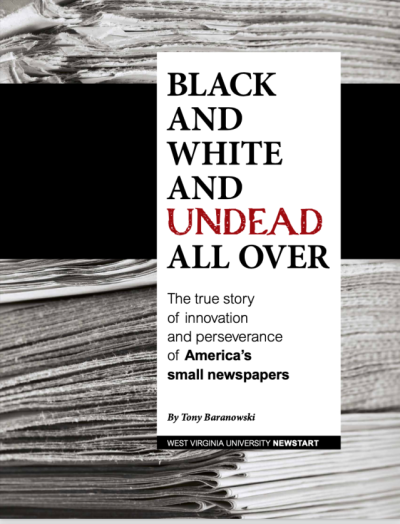
A new report by Tony Baranowski, director of local media for Times Citizen Communications in Iowa Falls, Iowa, makes the point. While he was a fellow at the West Virginia University Reed College of Media and the West Virginia Press Association’s NewStart Program, he studied several newspapers in the Upper Midwest in depth and surveyed more than 50 small newspaper publishers across the country.
Become a member of Media Nation for just $5 a month!
What he found was that, despite the narrative that local newspapers are dying, these independent papers were keeping their heads above water. Baranowski writes:
The strongest community news outlets are locally owned and managed by families or individuals with local ties that stretch back decades. That’s not an easy circumstance to replicate for a would-be publisher looking to buy or launch a news organization in a rural town, but it’s not a prerequisite, either. In fact, the common denominator is less longevity than fostering community spirit and pride within both staff-generated content and advertising in a traditional newspaper’s pages.
Among the people interviewed in Baranowski’s report is Jim Slonoff, the co-founder and publisher of The Hinsdalean, a free paper launched in suburban Chicago in 2006. I wrote about The Hinsdalean a couple of months ago to highlight its practice of signing up members of the community to write essays on a variety of topics. Although running unpaid columns is hardly new territory for local newspapers, The Hinsdalean actively recruits writers and limits them to a two-year term, ensuring a steady stream of fresh voices.
Like many of the people Baranowski spoke with, Slonoff said The Hinsdalean’s emphasis remains on print rather than digital. Slonoff said:
That’s the thing I don’t get about newspapers in general, because so many of them put so much money and resources into their websites with no return. We took the 180 degrees approach and said our money is coming from display advertising and real estate advertising. Why would we not focus on that? Facebook doesn’t bring us any money, Twitter and Instagram don’t. There’s nothing I get out of it that I know of, except we’re there. And we get a lot of likes and things and get a lot of this and comments and that feels good.
That might seem like a retrograde approach, but it’s one I’ve heard from a number of publishers who have to figure out how to break even.
The Provincetown Independent actually charges more for digital subscriptions than for a print-plus-digital combination, telling readers that “if we were to go online only, the savings in not having to print and mail the paper would not be anywhere near enough to make up for the loss of print advertising revenue.”
Last week I interviewed Jerry and Ann Healey, who sold their Colorado Community Media newspaper group earlier this year to The Colorado Sun, a start-up digital news organization, in a deal put together by the National Trust for Local News. They told me that, in many cases, when they offered a package combining digital and print, their advertisers weren’t interested — they wanted to be seen in the print newspaper. “In the community newspaper space, print is still a viable thing,” Jerry Healey said, “and the advertisers know that too.”
Then there’s Kris O’Leary of Central Wisconsin Newspapers, who told Baranowski that her readership includes Amish and Mennonite communities. Not much digital potential there.
Another of Baranowski’s findings is that newspapers with offices in the communities they cover tend to be healthier than those that have consolidated operations far from the people they serve.
If this sounds like Baranowski is recommending a back-to-the-future approach, it may be because he’s surveying local journalism in the rural heartland. A digital-first approach makes sense in affluent urban and suburban areas where readers can be persuaded to sign up for online-only subscriptions.
But in some parts of the country, technological advances have not changed the media all that much over the past several decades. It is in such places that journalism can do well by following a model that would have been familiar to our grandparents — independently owned newspapers, rooted in the community and supported by local businesses.
.jpg)