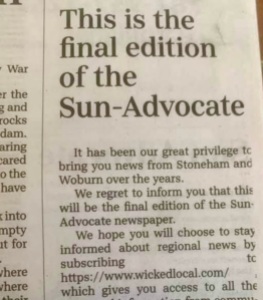
Alden Global Capital is wasting no time in taking a chainsaw to its newly acquired newspapers. NPR media reporter David Folkenflik tweeted a thread that contains some horrifying details about what the hedge fund has in store for Tribune Publishing:
$60MM of that debt carries a 13% rate – it was borrowed from Media News – Alden Global's other newspaper division.
h/t to @benyt for initial tweet about NYDNews & memo
— David Folkenflik (@davidfolkenflik) May 26, 2021
How about that? A $60 million loan with a 13% interest rate that Alden will pay to itself.
The cuts, by the way, will come on top of massive downsizing that took place in 2020, when Alden was a mere minority shareholder. Tribune’s Chicago Tribune reports:
Last year, Tribune Publishing employment fell by 30%, dropping from 4,114 employees at the end of 2019 to 2,865 employees at the end of 2020, according to the company’s annual reports. The company had a total of 896 newsroom employees across its eight markets entering this year.
Finally, the New York Post’s Keith Kelly writes that Los Angeles Times owner Patrick Soon-Shiong, who was in a better position than anyone to stop the sale of Tribune to Alden, is “taking a lot of heat” for not voting against it — or at least for not abstaining in a way that would have stopped the deal.
Kelly quotes an unnamed source who calls Soon-Shiong “second most despised man in newspapers today behind Heath Freeman,” Alden’s president. Nice quote. I wonder who said it?
A big announcement from Ellen Clegg and me: We are working on a book about successful community journalism projects across the country. The tentative title: “What Works: The Future of Local News.” Today we outline our plans for the Nieman Journalism Lab.
This hasn’t been a secret. We actually started our reporting more than a year ago but had to hit pause when the pandemic came. Now we’re starting up again. And I’m really excited to be working with a pro like Ellen. Much, much more to come.
The book is scheduled to be published by Beacon Press in the second half of 2023.
The Chicago Tribune Tower — no longer the home of its namesake newspaper, which is now falling into the hands of our worst newspaper owner. Photo (cc) 2013 by R Boed.
It was, in a sense, the perfect ending to the disastrous $630 million sale of Tribune Publishing to the hedge fund Alden Global Capital. After Tribune’s board voted earlier today to turn over its nine major-market dailies to the worst newspaper owner in the country, it wasn’t entirely clear that the vote was valid. And I’m guessing that the Newspaper Guild, which has been fighting the sale, will file a challenge. Elahe Izadi and Sarah Ellison of The Washington Post explain:
But participants alsoremained uncertain well into Friday afternoonabout the potential impact of Patrick Soon-Shiong’s surprise announcement, made via a spokeswoman, that he “abstained” from the vote. The California biotech billionaire owns the Los Angeles Times — which is unaffected by the sale — and about one-quarter of Tribune shares, meaning he had enough votes to torpedo the takeover.
According to Tribune Publishing proxy filed on April 20 with the Securities and Exchange Commission, an “abstain” vote would be counted as “against” the merger. Yet it appears that Soon-Shiong ultimately did not cast his ballots in a way that would have stopped the Alden sale. Unnamed Tribune Publishing officials told the Chicago Tribune that the proxy ballots registered to Soon-Shiong were submitted without the “abstain” box checked, and that his votes were counted as “yes” for the merger.
Had he not voted at all, his silence would have been recorded as a vote “against” the merger. But ballot submitted without any boxes checked at all were understood as endorsing the board’s recommendation to approve the merger.
David Folkenflik of NPR has a comprehensive account of what went down today and what it means for the future.
There are two villains here in the looming destruction of some of our most important newspapers, including the Chicago Tribune, The Baltimore Sun and, closer to home, the Hartford Courant. One is Soon-Shiong. I realize he has his hands full with the LA Times, and I’m glad that he appears to be recommitted to that paper after rumors circulated earlier this year that he was looking to sell. But all he had to do today was vote “no,” buying more time for another bidder to emerge. Instead, Soon-Shiong will walk away with $150 million.
The other villain is a Swiss billionaire named Hansjörg Wyss. At one point, Baltimore hotel magnate Stewart Bainum put together a $680 million bid that was largely aimed at breaking up the chain and finding local buyers. Wyss wanted the Chicago Tribune — but reportedly decided against it once he learned that its finances were in worse shape than he’d been led to believe. He also reportedly lost interest after his advisers convinced him that, no, the Trib couldn’t be transformed into a national paper in league with The New York Times or the Post. With a net worth of $6.4 billion, though, Wyss easily could have sucked it up rather than walking away.
I’m not going to single out mega-billionaire Jeff Bezos as a villain, even though I recently argued that he should add Tribune to his ownership of the Post. It would have been nice, but there was never a hint that he had any interest.
And here’s a really terrible wrinkle. Earlier this year, Alden had agreed to buy Tribune and then sell The Baltimore Sun to Bainum, who in turn planned to donate it to a nonprofit. Bainum decided to try to buy the entire chain after concluding that Alden was trying to chisel him on the terms of the deal. Now Alden will keep all nine Tribune metros plus some pretty vital smaller papers, such as the Capital Gazette of Annapolis, Maryland.
Alden will soon control two newspaper chains. In addition to Tribune, Alden owns MediaNews Group (also known as Digital First Media), whose 100 or so papers include The Denver Post, the Orange County Register in Southern California and, in Massachusetts, The Sun of Lowell, the Sentinel & Enterprise of Fitchburg and the Boston Herald. Its papers are mere shadows of their former selves, barely able to cover the communities they purportedly serve.
If there’s a bright spot — and there is — it’s that entrepreneurial journalists move in where there is market failure. Former Denver Post journalists are now operating The Colorado Sun, a digital operation that recently acquired a chain of 24 regional newspapers around Denver. In Northern California, two former Alden journalists are now running a news co-op called The Mendocino Voice. And in Baltimore, Bainum says he’s going to investigate launching a nonprofit alternative to the Sun.
This may be the darkest day in the history of American newspapers. My hope is that, five years from now, we’ll look back and see that something good came out of it.
New York Mayor Bill de Blasio. Photo (cc) 2010 by Public Advocate Bill de Blasio.
One of the more vexing dilemmas in thinking about ways that the government can help ease the local news crisis is how to maintain independence between the dog and the watchdog.
It’s not easy. Nonprofit status brings with it tax advantages that amount to an indirect benefit. Steven Waldman, the co-founder of Report for America, has proposed a $250 refundable tax credit to pay for local news subscriptions or to donate to nonprofit media outlets. Such approaches, though useful, fall far short of what’s needed.
In New York, Mayor Bill de Blasio has come through with something much more direct and substantial: a vast increase in what the city spends on advertising in community newspapers and websites. As a result of his executive order in May 2019, city agencies must devote 50% of their print and digital ad budgets to such outlets. According to a study of the initiative by CUNY’s Newmark School of Journalism:
In its first year of implementation, the executive order far outperformed its own expectations, delivering 84 percent of the budget, nearly $10 million, to more than 220 outlets serving New Yorkers in every neighborhood in all five boroughs in 36 languages besides English.
Keep in mind that Facebook recently announced that it would set aside just $5 million to help local news organizations across the entire country — only if they would agree to set up shop on Facebook, of course.
In a commentary for The New York Times, Newmark Dean Sarah Bartlett and Julie Sandorf, Charles H. Revson Foundation, president of the Charles H. Revson Foundation, wrote that de Blasio’s program has had a dramatic effect. For instance, Brooklyn’s Haitian Times, which nearly went out of business in 2013, received $73,489 in advertising revenues from the city and was able to continue covering its community during the COVID pandemic. Bartlett and Sandorf add:
The federal government has an advertising budget of $5 billion, so a program like New York City’s could provide an enormous boost to community news organizations at a time when local journalism around the country is in crisis.
A program such as New York’s doesn’t provide the true firewall that would be needed to ensure that news organizations aren’t slanting their coverage in order to keep the money rolling in. City officials could cut back or eliminate spending on media outlets whose coverage has offended them. Community groups that are insulated from politics could be charged with making the spending decisions, but those have their own biases.
Still, give de Blasio credit for finding a way to help local news organizations at a time when viable solutions are few and far between.
The Gannett newspaper chain, like nearly all publishers, is staking its future on reader revenue. Which raises a question: What is the company prepared to do to make that happen?
In its most recent quarterly report, the country’s largest newspaper chain said that its total number of digital subscribers is now 1.2 million — an increase of 37% over the previous year, but not especially impressive for a company that owns about 250 daily papers, including USA Today, and hundreds more weeklies. Gannett CEO Mike Reed said he’s aiming for 10 million in five years.
At least the subscription total is heading in the right direction. Overall, the company lost $142 million, largely due to pandemic-related declines in print and digital advertising.
The focus on digital subscriptions isn’t smart so much as it is the only option available. Newspaper advertising has been tanking for years as ad spending has moved to Craigslist, Google and Facebook. National papers and a few big regionals, including The Boston Globe, have succeeded in making the shift to reader revenue. But if Gannett wants to emulate them, it’s going to have to overcome its reluctance to invest in journalism and technology.
For years, Gannett and the chain that essentially took it over, GateHouse Media, have been decimating their newsrooms in order to squeeze out enough revenues to keep their creditors at bay. (Reed claims a recently completed loan restructuring should help.) As I’ve written before, our local Gannett weekly, serving a city of nearly 60,000 people, hasn’t had a full-time staff reporter since the pre-pandemic days of late 2019. Yet it is also the only print paper I subscribe to because reading it online is such a dismal experience.
Lately I’ve noticed an increase in stories from something called “the USA Today Network,” which is to say they’re not local. Some are from one or two towns over. Some are from afar. They are nothing but space-fillers.
Gannett announced several other moves as well, including a paywall for USA Today, sports betting and even an attempt to sell non-fungible tokens (NFTs). I’ve been trying to grasp exactly what that last means, but I’m still confused even after reading this New York Times story.
Gannett owns nearly all of the community papers in Eastern Massachusetts and environs, and in very few cases are they meeting the information needs of their communities. If the company is determined to offer a better product, with more local coverage and a better user experience, then it will deserve to sell more digital subscriptions.
But I can’t imagine that the chain will be able to build its digital subscriber base significantly with what it’s offering now.
This is one of the most exciting developments I’ve seen in local news in a long time — certainly more exciting than the news that Substack and Facebook were going to toss some spare change in a tin cup in the hopes of enticing community journalists to set up shop on their platforms.
Earliest this week David Folkenflik of NPR reported that The Colorado Sun, a digital startup that arose from the ashes of The Denver Post, would acquire a chain of 24 small newspapers in the Denver suburbs in partnership with a new nonprofit organization called the National Trust for Local News. As Sun editor and co-founder Larry Ryckman told Folkenflik:
These are the folks who are covering school boards, city councils, county commissions that no one else is covering. They provide unique local coverage. And we’re doing this so that we can preserve those voices.
Denver is the best-known example of the damage inflicted on newspapers by the hedge fund Alden Global Capital. Three years ago, journalists at The Denver Post rebelled at Alden’s brutal budget cuts. But guess who won? That led Ryckman and others to leave and launch the Sun. Ryckman described what happened last fall at the Radically Rural conference sponsored by the Keene (N.H.) Sentinel, which I covered for the Nieman Journalism Lab:
We endured cut after cut after cut. I had to lay people off. We were under assault, really, from our own owners, and nothing that we did — not being faster, smarter, more digital — none of those things really matter when a hedge fund doesn’t really care about the community or the journalism that the newspaper it owns produces. It’s really about this quarter’s return.
At one time, Denver’s newspapers employed about 600 journalists, Ryckman said. But the Rocky Mountain News shut down in 2009, and, as of last fall, Ryckman estimated the head count at the Post as being somewhere around 60. The Sun employs 10 people. But as a public benefit corporation, it can reinvest whatever money it makes in improving its journalism.
Could such a model work elsewhere? I don’t see why not. Take Eastern Massachusetts, whose weekly and daily community newspapers are nearly all owned by Alden’s rival in cost-cutting, Gannett. Could some sort of nonprofit entity be formed that would attempt to buy back Gannett’s properties in the Boston area? Gannett does sell papers from time to time. Maybe it’s possible to make them an offer they wouldn’t refuse.
The situation is dire. And what’s taking place in Denver suggests a possible way forward.
I’ll be talking about the crisis in local news today at 7 p.m. in a conversation sponsored by the Waltham Public Library. You’ll be able to watch here.
All of a sudden, platform companies are deciding that local is the place to be.
Two weeks ago, Substack announced Substack Local, a program to seed $1 million worth of local news projects. It was a bit like Dr. Doom announcing he’d destroy the earth unless he was paid $1 million — the Substack initiative would only be enough to get 30 local journalists up and running. But no doubt there will be more to come if the first round proves successful.
Then, earlier this week, Facebook said it would pay $5 million to fund a similar program, with an emphasis on “Black, Indigenous, Latinx, Asian or other audiences of color.” You are free to conclude that this gives Mark Zuckerberg something positive to talk about the next time he gets dragged before a congressional committee. But I’m sure he’d like it to succeed as well, since anything that keeps people glued to Facebook is good for his bottom line.
In both cases, these are drops in the bucket — especially for Facebook, whose revenues in 2020 approached $86 billion. But even though the platforms themselves are paying next to nothing, it should help us find out whether they can help local news entrepreneurs solve some of the problems in building successful projects.
It’s going to take a miracle to save the Chicago Tribune, the Hartford Courant, New York’s Daily News and six other large-market dailies from the greedy clutches of Alden Global Capital, the hedge fund that’s widely regarded as the worst newspaper owner in the country.
On May 21, Tribune Publishing’s board is scheduled to vote on selling its papers. At this point, it looks like the only viable bid is from Alden, which has offered $635 million to boost its share of the company from 32% to 100%. A competing bid from the Baltimore hotel magnate Stewart Bainum was dealt a huge setback recently when his partner, the Swiss philanthropist Hansjörg Wyss, pulled out. Bainum, who wants to acquire Tribune’s Baltimore Sun and turn it over to a nonprofit, said he hasn’t given up. Right now, though, money and momentum are on Alden’s side.
Alden’s holdings include The Denver Post, The Mercury News of San Jose and, locally, the Boston Herald, The Sun of Lowell and the Sentinel & Enterprise of Fitchburg. All have been decimated, a fate that you can be sure is in store for Tribune’s papers if the hedge fund’s bid is accepted.
But it’s not too late if someone with vast riches and a demonstrated interest in journalism is willing to step up. Someone, for instance, like Jeff Bezos. The mega-billionaire owner of The Washington Post would be the perfect savior for the Tribune papers. Would he do it? I have no idea. If he were willing, though, he could breathe new life into some of our most important journalistic institutions.
Now, I know what you’re thinking. Bezos’ ruthlessness in running Amazon has caught up with him; his public image has taken some well-deserved hits since 2013, when he found $250 million in a spare pants pocket and bought the Post. Do we really want someone whose drivers have to pee into bottles in order to make their appointed rounds having even more power than he does already? Yes, Alden already owns about 100 papers via its MediaNews Group subsidiary. But whoever wins Tribune will control some of the most influential daily newspapers in the country. How can we be sure that Bezos wouldn’t use that power for ill?
To answer that question, we have to look at the record. And however brutal his treatment of Amazon employees may be, he has been an exceptionally good steward of The Washington Post. There is no evidence that he has interfered in the Post’s news coverage, or even in its editorial pages.
Then-executive editor Marty Baron stressed that Bezos had been hands-off when I interviewed him for my 2018 book “The Return Of The Moguls.” And Baron repeated that at a recent event sponsored by Northeastern’s School of Journalism. “His involvement on the news side was nothing beyond approving our budget,” Baron said. (Note: I’m on the faculty.)
What evidence exists to the contrary is, frankly, pretty thin gruel. In his new book, “Fulfillment: Winning And Losing In One-Click America,” ProPublica reporter Alec MacGillis observed that, after buying the Post, Bezos bought a mansion in Washington, D.C., and greatly increased Amazon’s lobbying presence in the capital.
MacGillis also noted that the Post ran a cheerleading editorial in favor of Amazon’s second headquarters, known as HQ2, coming to the D.C. subrub of Arlington, Virginia. “It would be left to a local business journal, not the Post, to uncover the emails showing the lengths to which Arlington officials had gone to ease Amazon’s path,” MacGillis writes. OK, fine. But the Post was hardly the only newspaper that expressed enthusiasm for HQ2 and the thousands of jobs it would bring. As a reminder, take a look at some of The Boston Globe’s coverage.
Indeed, Bezos has built such a sterling reputation for his leadership of the Post that Hamilton Nolan, who keeps tabs on the paper for the Columbia Journalism Review, recently devoted an entire piece to speculating about what would happen if Bezos woke up one morning and decided to weaponize the paper on behalf of his business and personal interests. Nolan wrote that “the editorial independence of the Post should never be taken for granted.” No, it shouldn’t. But after more than seven years of ownership, Bezos has done very little to raise concerns about his vision for the proper role of a newspaper owner.
Needless to say, Bezos could afford to buy Tribune. Even so, it’s worth reminding ourselves just how rich he is. In January 2020, his net worth was $118 billion, according to the Bloomberg Billionaire Index. By early 2021, it had risen to $196 billion as the pandemic super-charged Amazon’s business even while millions of Americans were being thrown out of work.
In other words, it would cost Bezos less than 1% of the money he’s made just over the last year to buy Tribune in its entirety. The latest news about Alden, meanwhile, is that the hedge fund “probably violated federal pension protections by putting $294 million of its newspaper employees’ pension savings into its own funds, according to a Labor Department investigation.” The story, reported by Bezos’ Washington Post, noted that Alden has admitted no wrongdoing and paid the money back. But still.
Bezos is 57, an age when many successful people start thinking about their legacy. He’s stepping down as Amazon’s CEO later this year. By investing resources in The Washington Post, he transformed it into a profitable, growing, digitally focused news organization in just a few years. Attempting to work the same magic with Tribune’s papers would be a worthy challenge.
Is this any way to ensure the future of journalism? No, it is not. As I wrote recently, the fate of great news organizations shouldn’t be left solely to the whims of unregulated, predatory capitalism. Unfortunately, that’s the system we have, and it’s not going to change between now and May 21.
So please, Mr. Bezos. Is it OK if I call you Jeff? Give these papers a chance to thrive. You did it with the Post. You can do it again.