On the brand-new edition of “Beat the Press with Emily Rooney,” we analyze media coverage of the war against Iran.
In other topics, we examine the implications of Paramount’s acquisition of Warner Bros. Discovery, which will put CNN in the hands of Trump-friendly executives Larry and David Ellison, and the failure of Bari Weiss — who may soon be running CNN in addition to CBS News — to hang on to a Jeffrey Epstein associate. We also give the hairy eyeball to AI’s ongoing encroachment into journalism and weigh in with our Rants and Raves.
Even as major media organizations like ABC’s parent company, Disney, and CBS’s, Paramount, were settling bogus lawsuits filed by Donald Trump in order to demonstrate their submissiveness, an unlikely defender of the First Amendment has emerged: USA Today Co., which until earlier this week was known as Gannett.
A federal judge on Thursday threw out a class-action lawsuit charging that Gannett’s Des Moines Register and pollster J. Ann Selzer committed fraud when they reported days before the 2024 election that Kamala Harris held a three-point lead over Trump in Iowa. As you may recall, the poll results created a sensation, but they turned out to be wrong: Trump won Iowa by 13 points, which was about what you’d expect.
The class-action suit was brought by a resident of West Des Moines named Dennis Donnelly, who claimed that he and other Register subscribers were victims of fraud because the Register acted with “intentional deceit or reckless disregard,” according to Emma Brustkern of WFAA-TV.
The suit is similar to one brought by Trump himself against Gannett, the Register and Selzer (he later dropped Selzer from the claim), calling the poll “brazen election interference.” That is, of course, a ridiculous allegation. More than anything, pollsters want to get it right, but sometimes they get it wrong. And sometimes, as in the case of Selzer in 2024, they get it very wrong. As U.S. District Judge Rebecca Goodgame Ebinger writes in her decision:
No false representation was made. Defendants conducted a poll using a particular methodology which yielded results that later turned out to be different from the event the poll sought to measure. The results of an opinion poll are not an actionable false represention merely because the anticipated results differ from what eventually occurred.
Trump’s own lawsuit is likely to meet a similar fate. So good for USA Today Co., which has shown a stiffer spine than some other media companies. Rather than allowing itself to be used by the Trump regime as a way of weakening the First Amendment, it is standing up to authoritarianism.
Jon Keller, left, and I kicked around some media topics on WBZ-TV back in 2018, when we were both a little less gray.
Old friend Jon Keller was laid off Thursday by WBZ-TV (Channel 4) as part of wide-ranging cuts at Paramount-owned CBS, writes Boston Globe media reporter Aidan Ryan (sub. req). Keller, a political analyst at the station for 20 years, was one of five staff members who lost their jobs, although he was the only on-air journalist.
Earlier this year the station laid off medical reporter Dr. Mallika Marshall, and veteran reporter Beth Germano retired. The departures represent a significant blow to the station given that television news depends on recognizable, trusted journalists.
Church Street Marketplace in Burlington, Vt. Photo (cc) 2017 by Kenneth C. Zirkel.
The mayor of Burlington, Vermont, has rescinded a gag order that had prevented the city’s police department from issuing press releases without the approval of her office. The contentious order was one of two reasons that the mayor, Emma Mulvaney-Stanak, was given a New England Muzzle Award earlier this year.
The original, restrictive executive order was enacted on January 10, under former Police Chief Jon Murad, who did not seek reappointment. It required all BPD press releases, including emergency alerts, to be submitted to the mayor’s office for approval before public dissemination.
As LaMarche observes, the gag order was aimed more at Murad than at the police department as a whole, and with Murad gone, there wasn’t much incentive for Mulvaney-Stanak to keep the cone of silence in place. The mayor targeted Murad for speaking out about a local man who’d had nearly 2,000 encounters with police. Among other things, Murad’s lament was reported on WBUR Radio (90.9 FM) in Boston, which couldn’t have endeared him to Mulvaney-Stanak.
What sealed the Muzzle, though, was that the mayor then called an invitation-only news conference without letting at least two outlets that had been critical of her know about it. Those outlets were Seven Days and Vermont News First. Vermont First Amendment legend Michael Donoghue, who writes for Vermont News First, told me last winter that he believed only local television newscasts had been invited.
• Good/bad/good news in Dallas. Last week I wrote that the notorious cost-cutting hedge fund Alden Global Capital was ready to swoop in and upset the pending sale of The Dallas Morning News to the Hearst chain, a privately held company known for quality regional and statewide journalism. Now Joshua Benton reports for Nieman Lab that the sale to Hearst is back on track. “This morning,” Benton wrote Monday, “the DallasNews Corporation (formerly A.H. Belo) announced that its board had ‘reviewed and rejected’ Alden’s offer. (It also added a ‘poison pill’ shareholder rights plan, just in case Alden tries anything funny.)”
• An overdue Globe update. Last week The Boston Guardian and Contrarian Boston reported that two Boston Globe journalists, along with two South End residents who were accompanying them, had been attacked while on assignment as they were reporting in the notorious Mass and Cass area of Boston. The story was subsequently picked up by Universal Hub, Hub Blog and Media Nation. But there was no mention of it in the Globe until this morning, as part of a larger story by the two journalists, reporter Niki Griswold and Barry Chin. Griswold wrote:
While reporting this story, two Globe journalists were confronted by at least three men on the Melnea Cass bike path as they toured the area on a July afternoon with [Brian] McCarter and another longtime South End resident. The men approached and threatened the group after spotting the Globephotographer taking pictures from a distance. The men, two holding hammer-like tools, followed the group, which took shelter in a nearby building.
The incident prompted Globe editor Nancy Barnes to issue a memo to the newsroom about security precautions.
• The wages of sin. Paramount wasted no time in making up for some of the $16 million it paid to Donald Trump in order to settle a bogus lawsuit the president had brought against “60 Minutes” — a settlement widely believed to pave the way for a merger with Trump-friendly Skydance Media. Last week WBZ-TV (Channel 4) in Boston announced that a number of employees had been offered buyouts, while longtime reporter Beth Germano said she’d retire and health reporter Dr. Mallika Marshall said she’d been laid off, according to Ross Cristantiello of Boston.com. “I gotta believe it has something to do with the merger,” union official Fletcher Fischer was quoted as saying. At a time when trust in the media is at an all-time low, local television news stands out as an exception. Moves like this, though, erode that trust.
• Here’s some fresh AI hell. Gannett, the country’s largest newspaper chain as well as a steady source of terrible news about layoffs, closures and other cuts, is offering buyouts to many of its journalists so that it can replace them with artificial intelligence. Sean Burch of The Verge quotes a memo from Mike Reed, who writes in his characteristically inimitable style: “Given our static revenue trends, we need to adjust our organization to effectively meet the needs of our business today and position ourselves for sustainable growth in the future as we continue to use AI and leverage automation to realize efficiencies.”
Gannett’s weeklies are pretty much gone, but it still publishes several dailies in New England, most notably The Providence Journal and the Telegram & Gazette of Worcester, as well as about 200 dailies across the country, anchored by USA Today.
Correction: Sorry for rushing this. I’ve fixed a few botched names.
There is so much awful Trump-related news to make sense of today that I’m going to offer a roundup, though I doubt I’ll attain the eloquence or profundity of Heather Cox Richardson. I’ll begin with two stories that are puzzling once you look beneath the surface — CBS’s decision to cancel Stephen Colbert’s late-night show and The Wall Street Journal’s report on Trump’s pervy birthday greetings to Jeffrey Epstein.
First, Colbert. Late-night television isn’t what it used to be, though Colbert’s program was the highest-rated among the genre. Like most people, I never watched, and what little I did see of it was through YouTube clips. Still, it’s only natural to think that he was canceled because CBS’s owner, Paramount, which recently gifted Trump $16 million to settle a bogus lawsuit, is trying to win favor as it seeks regulatory approval for its merger with Skydance. Colbert is an outspoken Trump critic, and he hasn’t been shy about taking on his corporate overlords, either.
If that’s the case, it seems odd to announce that Colbert’s show will run through next May. That makes no sense if the idea is to appease Trump. If it’s a contractual matter, Colbert could be paid to stay home. Now he’s free to unload on Trump and network executives every night without having to worry about whether his show will be renewed. And for those who argue that Colbert is on a short leash: No, he isn’t. I suspect we’ll learn more.
Now for that Wall Street Journal story (gift link). I don’t want to minimize the importance of Trump’s demented message and R-rated drawings that he gave to Epstein for his 50th birthday. There was a time in public life when it would have — and should have — been a major scandal. But I didn’t think the article quite lived up to its advance billing. Before publication, media reporter Oliver Darcy called it “potentially explosive” and wrote about Trump’s personal efforts to kill it, but I’m not sure that it is.
For a brief moment Monday, it looked like Donald Trump had given up on his ridiculous lawsuit against The Des Moines Register and pollster Ann Selzer.
You may recall that Trump claimed they had committed consumer fraud because of a poll taken just before Election Day showing Kamala Harris with a 3-point lead in the Hawkeye State. Notwithstanding Selzer’s sterling reputation, Harris ended up losing Iowa by 13 points, which is about what you’d expect. She was wrong, and the error may have hastened her retirement, but the notion that she put out a false poll to help Harris is transparently ludicrous.
Well, Monday’s good news didn’t last. It turns out that Trump withdrew his suit from the federal courts and refiled it in state court one day before an Iowa anti-SLAPP law was scheduled to take effect, William Morris reports for the Register. SLAPP stands for “strategic lawsuits against political participation,” and it’s designed to give judges a reason to throw out garbage suits such as Trump’s. No such luck since Trump beat the deadline.
This isn’t the first time Trump has sought to have his Iowa case heard in state court. Apparently his lawyers believe the federal courts are unlikely to tolerate his foolishness. To its credit, the Register’s corporate owner, Gannett, has hung tough. A spokesperson for the paper, Lark-Marie Anton, said in a statement:
After losing his first attempt to send his case back to Iowa state court, and apparently recognizing that his appeal will be unsuccessful, President Trump is attempting to unilaterally dismiss his lawsuit from federal court and refile it in Iowa state court. Although such a procedural maneuver is improper, and may not be permitted by the court, it is clearly intended to avoid the inevitable outcome of the Des Moines Register’s motion to dismiss President Trump’s amended complaint currently pending in federal court.
The Foundation for Individual Rights and Expression, which is representing Selzer, said on social media that Trump’s attempt to move the case to state court was “a transparent attempt to avoid federal court review of the president’s transparently frivolous claims,” according to The Washington Post.
Meanwhile, there have been some developments in one of Trump’s other legal attempts to intimidate the press. According to media reporter Oliver Darcy, all seven correspondents at CBS News’ “60 Minutes” have sent a message to their corporate owner, Paramount, demanding that it stand firm in fighting Trump’s lawsuit over the way the program edited an interview with Harris last October. Darcy writes:
They pointedly expressed concern that Paramount is failing to put up a fierce and unrelenting fight in the face of Trump’s lawsuit over the program’s Kamala Harris interview, which has been widely denounced by the legal community as baseless, according to the people familiar with the matter. They said Trump’s allegations against the storied program are false and ripped his lawsuit as baseless. And they warned in no uncertain terms that if Paramount were to settle with Trump, it will stain the reputation of the company and undermine the First Amendment.
Trump is claiming consumer fraud in a Texas federal court under the state’s Deceptive Trade Practices Act, alleging that “60 Minutes” edited its interview with Harris to make her appear more coherent, thus helping her campaign. “60 Minutes” has defended the editing as normal and routine. The interview has been nominated for an Emmy in the editing category, no doubt to send a message to the White House.
Unfortunately, Darcy reports that Paramount continues to lurch toward a settlement with Trump in order to pave the way for federal approval of a merger with Skydance Media.
FCC chair Brendan Carr. Photo (cc) by Gage Skidmore.
Donald Trump is unleashing so much chaos in service to his authoritarian agenda that it is literally impossible to keep up. So today let’s just look at how Trump is threatening the broadcast news media.
Trump’s tool in this battle is Brendan Carr, whom he appointed to the Federal Communications Commission in 2017 and then recently elevated to the chairmanship. There are currently four members of the FCC — two Republicans, two Democrats and one vacancy, which Trump will presumably fill in the near future.
Not that the current tie matters. Carr helped author Project 2025, the right-wing blueprint for a second Trump term that Trump said he knew nothing about during the campaign. Among other things, Carr wrote that the FCC chair has extra special powers that the other members of the commission lack. Thus Carr is large and in charge, at least until someone with power challenges him.
I want to share with you just three actions that Carr has taken during his brief time as chair, all of which represent a threat to the media’s ability to provide us with the news and information we need in a democratic society.
◘ First, he is helping Trump with his bogus $10 billion lawsuit against CBS. Trump is suing the network over an interview that “60 Minutes” conducted last fall with his Democratic opponent, Kamala Harris, claiming that the program was edited to make Harris sound more coherent than she really was.
CBS responded that it edits all of its recorded interviews, and that there was nothing unusual about the way it handled its conversation with Harris. (And really? If you watched her debate Trump or listened to her long, unedited conversations with Howard Stern and Alexandra Cooper, you know she has no problem speaking extemporaneously.) Nevertheless, the network may be on the verge of settling the lawsuit, perhaps to ease the regulatory path for CBS’s parent company, Paramount, to merge with Skydance, as Alena Botros writes for Fortune.
Carr, for his part, placed the FCC’s heavy thumb on the scale by ordering CBS to turn over the raw footage and transcripts of the Harris interview, thus making use of a public agency’s regulatory authority to help Trump do his dirty work, as David Folkenflik reports for NPR. To be clear: Trump would likely have gotten those materials anyway in the course of pre-trial discovery. Carr’s actions serve the purpose of amplifying Trump’s fact-free claim that there was something corrupt about how the interview was edited.
“60 Minutes” executive producer Bill Owens has said he will not apologize as part of any settlement, according to Michael Grynbaum and Benjamin Mullin of The New York Times. Which raises a question: Will he resign? And if he does, will others follow him out the door?
◘ Second, and speaking of NPR, Carr has announced that he’s investigating NPR and PBS to see whether the public broadcasters’ underwriting practices violate their noncommercial mandate.
According to Liam Reilly of CNN, Carr is “concerned that NPR and PBS broadcasts could be violating federal law by airing commercials,” adding: “In particular, it is possible that NPR and PBS member stations are broadcasting underwriting announcements that cross the line into prohibited commercial advertisements.”
Well, guess what? A lot of underwriting announcements on NPR and PBS do seem like commercials. They’re more restrained than what’s on commercial television and radio, and but when a cruise line pops up before or after the “PBS NewsHour,” or when a rug company’s sponsorship is heard on WBUR Radio, it’s because they want you to take a cruise or buy a rug.
Public broadcasters have to get their money from somebody, and it can’t all come from viewers (and listeners) like you. Very little in the way of tax revenues support PBS and NPR. The rest of it has to come from foundation grants and corporate underwriting. Personally, I’m a huge fan of the BNSF Railway notice that sometimes appears on the “NewsHour,” but that’s because I like trains.
What Carr’s doing is pure harassment.
◘ Third, Carr said last week that the FCC is investigating a San Francisco radio station for the offense of committing journalism. Garrett Leahy reports in The San Francisco Standard that KCBS revealed the location of agents from the federal Immigration and Customs Enforcement agency (ICE) and identified their unmarked vehicles in a place “known for violent gang activity.”
“We have sent a letter of inquiry, a formal investigation into that matter, and they have just a matter of days left to respond to that inquiry and explain how this could possibly be consistent with their public-interest obligations,” said Carr, who made his remarks during an appearance on — where else? — Fox News.
According to Leahy, KCBS declined to comment. But Juan Carlos Lara of public radio station KQED interviewed David Loy, legal director of the California-based First Amendment Coalition, who said:
Law enforcement operations, immigration or otherwise, are matters of public interest. People generally have the right to report this on social media and in print and so on. So it’s very troubling because it’s possible the FCC is potentially being weaponized to crack down on reporting that the administration simply just doesn’t like.
No doubt there will be much more to say about Carr in the months ahead. For now, it’s enough to observe that he is off to a predictably ominous start.


 As LaMarche observes, the gag order was aimed more at Murad than at the police department as a whole, and with Murad gone, there wasn’t much incentive for Mulvaney-Stanak to keep the cone of silence in place. The mayor targeted Murad for speaking out about a local man who’d had nearly 2,000 encounters with police. Among other things, Murad’s lament was reported on WBUR Radio (90.9 FM) in Boston, which couldn’t have endeared him to Mulvaney-Stanak.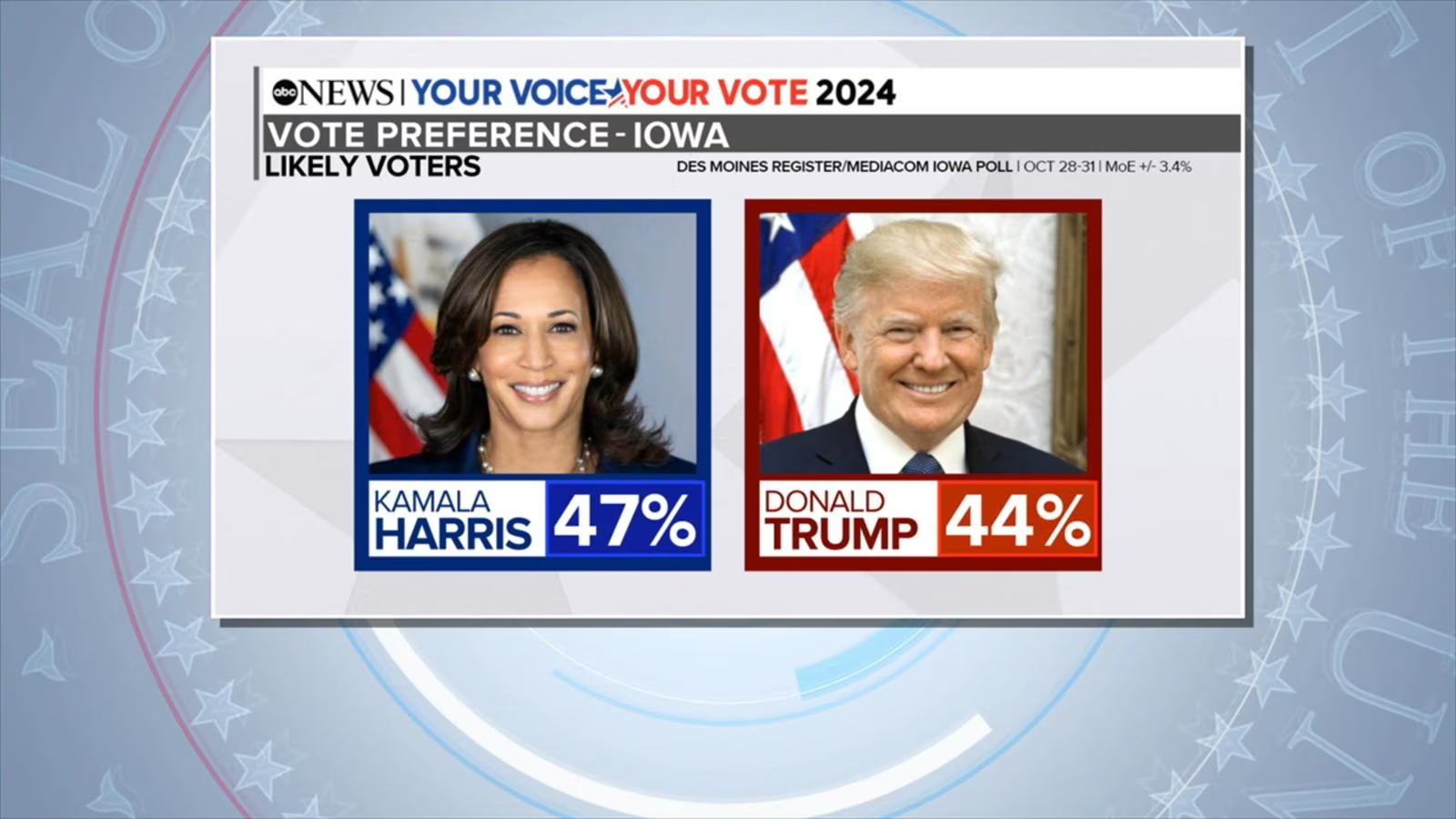

.jpg)