I’ll be on “The Emily Rooney Show” today from noon to 1 p.m. (WGBH Radio, 89.7 FM) with Emily and Wendy Kaminer to talk about the Tucson shootings.
Times lets Palin aide lie about gunsight map
 The New York Times today fails to call a Sarah Palin spokeswoman on what has all the appearances of a flat-out lie.
In a story on the political fallout of the weekend carnage in Tucson that claimed the lives of six people and left U.S. Rep. Gabrielle Giffords gravely injured, Times reporters Jeff Zeleny and Jim Rutenberg tell us that Palin adviser Rebecca Mansour denied that those were gunsights on Palin’s infamous map identifying House Democrats she had targeted for defeat. Zeleny and Rutenberg write of Mansour’s appearance on a conservative radio talk show:
Ms. Mansour said that the cross hairs, in fact, were not meant to be an allusion to guns, and agreed with her interviewer’s reference to them as “surveyors symbols.” Aides to Ms. Palin did not respond to interview requests on Sunday.
Yet we already knew otherwise on Sunday, as a Talking Points Memo reader dug up a tweet purportedly written by Palin herself referring to the map symbols in explicitly gun-oriented terms. Palin or her designated tweeter wrote:
Remember months ago “bullseye” icon used 2 target the 20 Obamacare-lovin’ incumbent seats? We won 18 of 20 (90% success rate;T’aint bad)
And let’s not forget that those symbols turned red whenever one of the targeted Democrats went down — just like surveyors symbols, eh?
Few people are blaming Palin for the actions of Jared Lee Loughner, who has been charged with the Saturday shootings. Loughner appears to have been motivated by mental illness rather than politics. Still, Palin’s map was mind-blowingly irresponsible, as Giffords herself said some months ago. This should mark the end of Palin’s public career as anything other than a sideshow freak, much as Ann Coulter all but disappeared after she mocked 9/11 widows. Are the media really going to let Palin and her minions get away with this?
Traditional journalism is incredibly uncomfortable when given proof that someone is flat-out lying. But that’s no excuse for the Times’ ignoring the fact that there was already proof Mansour was lying — or, at best, was incredibly uninformed about her boss’ intentions.
Murder, politics and mental illness

One day in 1993, when I was managing editor of the Boston Phoenix, I received a letter from a man named David Taber, who claimed that the CIA and his father had conspired to implant a computer chip in his brain so they could monitor his thoughts. Such letters are not as unusual as you might suppose; what made this one stand out was that it was well-written enough that it took me a couple of pages to realize the writer was mentally ill.
Not long after that, Taber showed up at the Phoenix, looking for me, in order to discuss when we might publish his letter. I couldn’t be found, and didn’t know about his visit until after a colleague had talked him into leaving.
And then, within a few weeks, Taber walked into an elementary school in the Southeastern Massachusetts town of Acushnet, took hostages and murdered the school nurse.* Unfortunately, I had discarded his letter.
It’s because of that experience — and, frankly, because of common sense — that I’m put off by those who are trying to politicize yesterday’s carnage in Arizona, which included the attempted murder of U.S. Rep. Gabrielle Giffords and the murder of federal judge John Roll and a 9-year-old girl, Christina Green.
The suspected shooter, Jared Lee Loughner, appears to be very mentally ill. If you haven’t seen this video yet, take a look. I was especially struck by this Loughner statement: “I’m able to control every belief and religion by being the mind controller!” That kind of says it all, doesn’t it?
Now, by no means do I want to let anyone off the hook. I was appalled to learn that Giffords’ district was among those targeted on Sarah Palin’s truly demented gunsight map. I hope yesterday will bring the whole Palin phenomenon to a long-overdue end. And I scarcely know where to begin with this piece of incendiary garbage.
As Tucson Sheriff Clarence Dupnik said, careless rhetoric can have consequences. But that rhetoric did not create Jared Loughner. If he hadn’t gone after Congresswoman Giffords, he might have gunned down a school nurse instead.
*After posting this earlier today, I searched the Boston Globe’s archives and found a story published on April 17, 1993, that reported the details of Taber’s rampage in Acushnet. I’ve updated this post to include what I learned in that article.

Best wishes to Paul Cellucci

Media Nation pauses this morning in order to offer its best wishes to former governor Paul Cellucci, who announced last week that he is suffering from Lou Gehrig’s disease.
I dug up this profile of Cellucci that I wrote for the Boston Phoenix in 1997. It’s a lot harsher than I remember; it came out at a time when Cellucci’s political fortunes seemed to be at a low ebb. But I distinctly remember being impressed with what a good guy Cellucci was (and is), friendly and down-to-earth with everyone he met.
Going back even further, I recall covering a debate between him and then-Democratic state senator Dick Kraus in 1988 at the Arlington public-access studio. Cellucci was a Republican state senator from Hudson at the time, and he and Kraus were acting as surrogates for presidential candidates George H.W. Bush and Michael Dukakis. I remember being impressed with Cellucci and Kraus’ substantive, civil discussion.
Cellucci was a big deal at the 2000 Republican National Convention in Philadelphia. My then-Phoenix colleague Seth Gitell (now spokesman for Massachusetts House Speaker Robert DeLeo) and I were assigned to stay at the same hotel as the Massachusetts delegates — and, as it turned out, George W. Bush was staying there, too, which at the time was taken as a sign of Cellucci’s close ties to the Bush family. It didn’t hurt that Cellucci was a friend of Andrew Card, who would become Bush’s first-term chief of staff.
Cellucci also threw the party of the week, a great outdoor affair at what I believe was the 9th Street Italian Market. (Seth will correct me if I’m wrong.) At one point we were hit with a downpour, and Seth, the Boston Globe’s Joanna Weiss and I sought shelter under an awning.
Cellucci’s reward — the ambassadorship to Canada — may have fallen short of his hopes, but he served without complaint.
Lou Gehrig’s is a devastating illness, but may Cellucci nevertheless enjoy as long and healthy a life as is possible with that diagnosis.
It’s still news when a sportswriter comes out
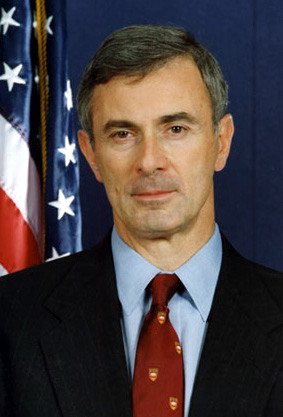
I find it interesting that it’s 2011 and it’s still occasionally noteworthy when we learn that a journalist is gay. Today Boston Herald sports columnist Steve Buckley writes a heartfelt piece — teased on page one — headlined “Welcome to my coming-out party.”
No surprise. I’d heard several times over the years that Buckley was gay, though, as Buckley makes clear, he wasn’t fully, publicly out. What makes his sexual orientation newsworthy are two factors:
- He covers sports, a macho world where such things still matter, if not nearly as much as they used to. You can be sure that if Buckley’s beat were the Statehouse, he would not have written about being gay.
- He’s probably best known as a regular presence on sports radio station WEEI (AM 850), where homophobia has been part of the mix for many years. Here’s just a taste. I don’t listen to ‘EEI as much as I used to, and perhaps the gay-baiting isn’t as bad as it was in the past. In any case, Buckley’s coming-out may encourage the station to clean up its act.
This is actually the second time a Herald sportswriter has come out — Buckley was preceded by Ed Gray in 2003. So let’s not make too much of this. Still, it’s a good thing that Buckley has decided to be who he is in public as well as in private. Somewhere today there’s a gay teenager feeling just a little bit better about himself.
Herald exclusive: Democrat says Republican could lose
 In today’s episode of “Let’s Play Editor,” you receive an entirely predictable op-ed from a prominent Democratic political consultant who writes that Republican Sen. Scott Brown could lose in 2012. What do you do?
- Write a polite rejection letter to the consultant and hope it won’t affect his willingness to return your calls.
- Curry favor with the consultant by publishing his piece on the op-ed page, secure in the knowledge that no one will read it.
- Blast the piece all over the front page, label it an “exclusive” and slap a headline on it pronouncing Brown to be “THE NEXT COAKLEY.”
If you’re Herald editor Joe Sciacca, then the answer is #3. Although Rubin’s affiliation is disclosed, today’s front page will make me pause the next time I criticize the tabloid for allowing Republican operative Howie Carr to rip Democrats.
Parole in police officer’s murder not so easy

Maybe it’s my imagination, but it seems that the media and elected officials alike have been somewhat guarded in criticizing the state Parole Board for releasing Dominic Cinelli, a violent career criminal who murdered Woburn police officer John Maguire last week.
Yes, everyone is saying what you would expect. The Boston Globe and the Boston Herald have both published editorials saying the board erred in releasing Cinelli. Yes, the board made a huge mistake in not notifying the Middlesex County district attorney’s office before the 2008 hearing at which Cinelli’s parole was approved. And Cinelli, whom a dying Maguire shot to death in the course of an attempted robbery at Kohl’s, seems to have been an unusually poor risk.
Here is another wrinkle. According to a report by Gordon Vincent of Woburn’s Daily Times Chronicle, Cinelli would not have been eligible for parole until 2023 were it not for a decision by the state Appeals Court that overturned a ruling made by the Parole Board regarding the start date of Cinelli’s sentence.
Yet today’s Globe story by Jonathan Saltzman includes some facts worth pondering:
- The Parole Board apparently did not think releasing Cinelli was a close call, as it voted 6-0 in favor. Of those six (three appointed by Democratic Gov. Deval Patrick and three by Republican governors), two were retired police officers and one worked in the Hampshire County Sheriff’s Department. In other words, it doesn’t sound like the board can be caricatured as a bunch of soft-on-crime types.
- About 6,000 inmates are granted parole every year, which suggests that the county and state prison systems could be thrown into chaos if parole standards were tightened significantly.
- Since 2005, according to Saltzman’s reporting, the board has granted parole to about two-thirds of those applying, and to somewhere between 27 percent and 40 percent of the lifers seeking parole, depending on the year.
- Lifers and older inmates, Saltzman reports, tend to pose the lowest risk of recidivism. Cinelli was 57 when he shot Officer Maguire.
The death of Jack Maguire, a 60-year-old policeman on the verge of retirement, is a terrible tragedy. Back in the 1980s, I covered Woburn for the Daily Times Chronicle, and though I did not know Maguire, I knew of him. I did know the future police chief, Philip Mahoney, an impressive, compassionate policeman who has served as an outstanding spokesman for his city’s grief this week.
It may well turn out that the Parole Board made a mistake in releasing Cinelli. We already know that it made a mistake by not giving the district attorney a chance to testify. But the issue is not as simple as locking up people like Cinelli and throwing away the key.
Based on the Globe’s reporting, it appears that inmates whose past crimes were as serious as Cinelli’s are released regularly, and that society benefits. The investigation that’s now under way is the right way to go, and the media should give it a chance to play out — as they seem to be doing so far. The situation calls for intelligent analysis, not a witch hunt.
Howie Carr’s big, fat Christmas coming-out
Media Nation has been on hiatus, so I missed Howie Carr’s encounter with liposuction, which took up nearly all of the Boston Herald’s front page this past Sunday. Ralph Ranalli has all the details. The late Jack Cole would have known exactly what to call this: “alleged news.” Pathetic.
Net neutrality and the politics of pizza
 Imagine living in a world in which Domino’s could pay your phone company to make it impossible for you to call other pizza joints. That can’t happen because, legally, phone services are considered “common carriers,” which must accept all traffic in a non-discriminatory manner. Which is what the battle over net neutrality is all about.
This week the FCC’s three Democrats backed a too-weak proposal to ensure net neutrality that the Republicans vowed to oppose anyway. I don’t pretend to understand all the technical arcana, but, according to news reports like this one, net neutrality will be more or less assured on wired broadband networks such as cable and FIOS, while the market will have its way on wireless networks.
Which network do you suppose will be more important in 10 years — or two, for that matter? Wired or wireless?
Take a look at this post on Engadget, which obtained an actual proposal for wireless broadband providers to charge extra for access to Facebook, Skype and YouTube. It’s a variation on a theme that Sen. Al Franken sounded in a must-read essay. Franken points out that, without net neutrality, Verizon could block Google Maps and charge you extra to use its own inferior mapping service. Franken writes:
Imagine if big corporations with their own agenda could decide who wins or loses online. The Internet as we know it would cease to exist. That’s why net neutrality is the most important free speech issue of our time.
Back when the debate was over media concentration, old-school conservative organizations like the National Rifle Association and the Christian Coalition made common cause with liberal groups to stop the FCC from making a bad situation worse. Unfortunately, the newly ascendant Tea Party right is so hostile to government activism that it opposes efforts to ensure net neutrality.
This week’s action by the FCC was not definitive. Net neutrality is an issue that we’ll be revisiting again and again in the years ahead. But given President Obama’s stated support for neutrality, this may be as good as it gets. And it’s not very good.
To learn more, and to take action, visit Free Press.
Ross Douthat and the politics of self-pity

Those of us who are non-Christians would like to apologize to New York Times columnist Ross Douthat for our continued existence.
In a piece remarkable for its self-pity, Douthat declares, “Christmas is hard for everyone. But it’s particularly hard for people who actually believe in it.” Among other things, Douthat declares that Christians feel “embattled” by “Christmukkwanzaa multiculturalism.”
But according to a survey by Trinity College, about 76 percent of Americans identify themselves as Christians, which surely makes them our largest oppressed minority group, both proportionately and by sheer numbers.
Douthat is slick enough to poke fun at bozos on the right who rail about the “war” against Christmas. Yet he’s essentially engaging in the same tactic. Since Barry Goldwater, if not before, the conservative movement has been fueled in large measure by whipping up a sense of resentment. The laughable idea that it’s somehow difficult to be a Christian in this country has become a big part of that.
When Douthat was hired to replace William Kristol on the Times op-ed page, he was supposed to represent something new, different and better: a younger, more analytical thinker who might not persuade liberals but who would at least be worth reading for the strength of his arguments.
Instead, he’s proved to be a hack who offers neither entertainment nor insight.
Michelangelo’s “Martyrdom” via Wikimedia Commons. Click here or on image for a larger view.