The Boston Globe has published a terrific story by reporter Lisa Wangsness and photographer Dina Rudick about a Congregational church in our West Medford neighborhood.
It was right down the street from us when we lived here in the early ’80s. When we returned to a different part of West Medford in late 2015, we noticed it had become a Haitian church and that the Congregationalists had moved into a storefront in West Medford Square. The storefront is called the Sanctuary United Church of Christ.
Two newspapers have dramatically improved their digital offerings. The Boston Globe has unveiled four radically redesigned web pages for the Boston’s professional teams—the Red Sox, the Celtics, the Patriots, and the Bruins. The emphasis is on huge photos and on gathering together in one place everything you want to know about your favorite team. Sports editor Joe Sullivan offers a rundown.
The Washington Post, meanwhile, is testing a new mobile website that it is calling its Progressive Web App, which you can access by clicking here. The PWA uses new technology to load instantly—as fast as Facebook Instant Articles, Apple News, or news stories coded for Google’s new Accelerated Mobile Pages (AMP) standard.
These are both a couple of leaps forward. Even though the Globe‘s online presence is better than that of many newspapers, it needs to communicate to its readers that digital is a superior experience to print. The sports pages could be a prelude of things to come in other parts of the paper. The Post is well-known for its cutting-edge technology, but the speed of PWA is—as chief information officer Shailesh Prakash is quoted as saying in this press release—”a game-changing experience.”
A couple of quibbles. First of all, the Globe needs to focus on speed. Its responsive website is loads quickly enough on my Mac, but it’s slower on my phone and slower still on my aging iPad. That’s as true of the new sports pages as it is of the rest of the site. Second, it would be nice if the Post‘s PWA site loaded on a tablet and not just on a phone.
Finally, I found the type size a bit on the small side in both products with no way to make it bigger.
I still haven’t gotten around to writing anything more substantive about the controversy over Facebook’s “Trending Topics.” But this Storify lays out my main arguments.
Before the emergence of digital tools, recording and (especially) transcribing an interview was a tedious affair. The little micro-cassette tapes were of dubious reliability—and yes, I once had one fail on me during a crucial and contentious encounter. Transcribing was worse, as you’d sit there constantly hitting the “play” and “rewind” buttons, an imprecise process that risked damage to the tape.
I’ve been all-digital for maybe 10 years now. But I didn’t really begin upping my game until I tested my little Olympus recorder in a New Haven hotel room one morning in 2011 only to discover that it was pining for the fjords.
Since then, I have assembled a digital recording toolkit that I hope will be useful for journalists. By now, of course, nearly all of us are recording interviews on our smartphones. But I’ve been surprised by reporters who’ve told me their transcription technique consists of nothing more than playing back the audio on their phones. These tips, I hope, will make it easier for you to record and transcribe.
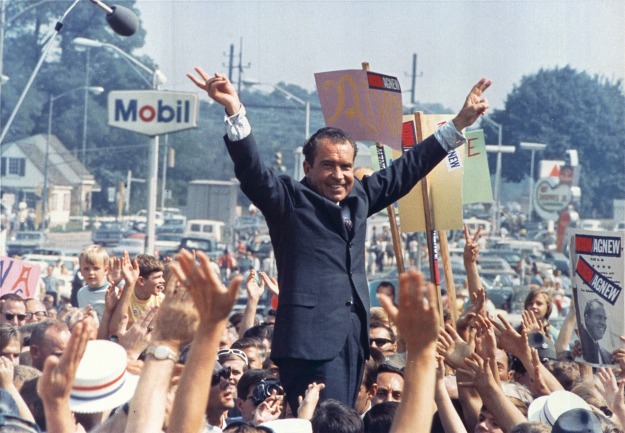
More than 40 years after he resigned as president, Richard Nixon remains the lodestar for political skullduggery. And so it was when Donald Trump threatened to retaliate against Washington Post owner Jeff Bezos in response to news that the Post is siccing 20 reporters on Trump to look into every aspect of his life and career.
Details about the Post’s Trump project, which will include a book, emanated from the lips of Post associate editor Bob Woodward, a twist that made it all the more cosmically significant. For it was Woodward, along with fellow Post reporter Carl Bernstein, who helped end Nixon’s presidency in 1974—but not before the Post had endured some fearsome attacks from the Nixon White House that threatened not just the newspaper but the First Amendment’s guarantee of a free press.
As you may have heard, Bezos’s day job is running Amazon, the online retailing behemoth that he founded. Trump, the presumptive Republican presidential nominee, told Fox News host Sean Hannity that Amazon has “a huge antitrust problem” and “is getting away with murder, tax-wise.” He added that Bezos is “using the Washington Post for power so that the politicians in Washington don’t tax Amazon like they should be taxed.”
Never mind that there is zero evidence for Trump’s accusation. His implied threat was utterly Nixonian in its stark assertion that he’d use the powers of government to harm Bezos in retaliation for journalism that he doesn’t like.
The roots of Nixon’s hatred for the Post extend back to the 1950s. David Halberstam, in his book The Powers That Be, wrote that it began over the cartoonist Herbert Block. Herblock, as he was known, regularly portrayed Nixon as a malign figure with a perpetual five-o’clock shadow, and his work was syndicated in hundreds of papers around the country. According to Halberstam, Herblock’s cartoons “became part of Nixon’s permanent dossier, reflecting all the public doubts and questions about him.”
It wasn’t until the 1970s, though, that Nixon attempted to translate that anger into action. In 1971, the Post joined the New York Times in publishing the Pentagon Papers, the government’s secret history of the Vietnam War, which showed that American officials had continued the fighting out of political cowardice for years after concluding that it was unwinnable.
According to then-publisher Katharine Graham in her autobiography, Personal History, the Nixon White House issued “a not very veiled threat” that the paper might face a criminal prosecution if it didn’t turn over its copy of the Pentagon Papers to the government. At the time, the Post was on the verge of becoming a publicly traded company, and it would have been devastating to the paper’s plan to raise money from the stock market if it had been convicted of a crime. And as my fellow WGBH News contributor Harvey Silverglate wrote for the Phoenix newspapers some years back, the Nixon administration actually considered prosecuting the Times and the Post even after the Supreme Court ruled in favor of the papers’ right to publish.
Woodward and Bernstein’s reporting on the Watergate scandal brought about perhaps the most infamous threat ever made against a newspaper. When Bernstein asked Nixon henchman John Mitchell to comment on a particularly damaging story, Mitchell responded: “Katie Graham’s gonna get her tit caught in a big fat wringer if that’s published.” More substantively, Nixon allies arose from the swamp to challenge the Post’s ownership of two television stations in Florida—challenges that faded away once Nixon had resigned from office.
“Henry Kissinger told me he felt that Nixon had always hated the Post,” Graham wrote, quoting Kissinger as saying of Nixon: “He was convinced that the Post had it in for him.” As Graham described it, the Post’s reporting on Nixon during the Watergate years became an existential crisis. If the paper hadn’t been able to prove Nixon’s involvement in the Watergate break-in and related crimes and thus force Nixon from office, the Post itself would have been destroyed.
Although the showdown between Nixon and the Post is the most dramatic example of the government’s attempting to destroy its journalistic adversaries, it is not the only one.
In the early days of World War II, after Colonel Robert McCormick’s Chicago Tribune reported that the United States may have cracked Japanese codes, President Franklin Roosevelt considered trying McCormick for treason, which could have resulted in the death penalty. FDR was talked out of it only because his advisers convinced him that such a drastic measure would only serve to alert the Japanese.
More recently, President George W. Bush’s Justice Department raised the possibility that the New York Times and the Washington Post could be prosecuted under espionage laws for reporting on a National Security Agency surveillance program (the Times) and on the rendition of terrorism suspects to countries that engage in torture (the Post).
And, of course, there is President Barack Obama’s relentless pursuit of government officials who leak information to the media—a pursuit that has ensnared a number of journalists, including James Risen of the New York Times. Risen fought the government for seven years so that he wouldn’t have to reveal the identity of the sources who had told him how the CIA had sought to wreak havoc with Iran’s nuclear program. Last year Risen called the Obama administration “the greatest enemy of press freedom in a generation.”
But note that Roosevelt’s, Bush’s, and Obama’s attacks on the press were grounded in legitimate concerns about national security, misguided though Bush may have been and Obama may be. (It’s hard to argue with FDR’s fury at McCormick, whose actions would not be protected by even the most expansive reading of the First Amendment.)
By contrast, Trump, like Nixon during Watergate, would go after the press purely for personal reasons—not by denouncing the media (or, rather, not just by denouncing the media) but by abusing his powers as president. Bring negative information to light about Nixon and you might lose your television stations. Report harshly on Trump and your tax status might be threatened—and you may even face an antitrust suit.
This is the way authoritarians reinforce their power—through fear and intimidation, the rule of law be damned. Despite all the benefit he has received in the form of free media, Trump hates the press. He has threatened to rewrite the libel laws, and now he’s threatened the owner of one of our great newspapers.
Trump is a menace on so many levels that it’s hard to know where to begin. But we can add this: Like Nixon, he is a threat to the First Amendment, our most important tool in holding the government accountable to the governed.
Compare and contrast. In the New York Times, Senator Ted Cruz whips up the fear regarding the nuclear deal between the United States and Iran:
The mullahs’ policy is, by their own admission, unchanged. It is the same one that inspired the so-called revolutionaries of 1979 to take 52 Americans as hostages for 444 days, and motivated murderous attacks on Israelis and Americans from Buenos Aires to Beirut to Baghdad over the subsequent decades. The only thing that is changing now is the potential scale of this violence, as they seek to replace truck bombs and roadside explosive devices with the most destructive weapons on the planet and the means to deliver them.
Extremists in the United States and Iran have joined to derail this 10-month-old deal. They share a horror scenario: an Iran that is successfully integrated into the Middle East and the wider world, increasingly free at home and responsible in its neighborhood. Militants in Washington fear that this would give Iran a regional role commensurate with its history, size, and power, while they wish to see it tied down forever. Militants in Tehran fear that cooperating with the outside world will erode their authority and possibly lead to collapse of the Islamic Republic. These are reasonable fears.
Editor & Publisher, a trade magazine that covers the newspaper business, posted a story last week predicting a startling technological change in the way we consume news. Believe it or not, it would involve grinding trees into pulp, transforming that pulp into paper, printing news articles, photos, and ads on that paper, and then loading the finished product onto trucks so that it could be delivered hither and yon.
“With the saturation of news, the toxicity of online harassment, and the amount of poor Web experiences, readers will soon want to come back to print,” wrote Nu Yang in an article headlined “As Digital Fatigue Sets In, Readers are Waking Up to Newspapers.”
Yang’s yearnings aside, print newspapers are no more likely to come back than the proverbial horse and buggy. Yes, they have proved more enduring than we might have expected 10 years ago, and Yang may be right they they’ll persist as “a premium, boutique product” for some time to come.
And the shortcomings of digital news that Yang describes are real enough. Too much information really does leave us feeling overwhelmed. Ad-blocking software is depriving digital news publishers of one of their very few routes for paying for the journalism they produce.
At root, though, Yang’s article represents little more than an assertion that because the post-print era has proved disastrous for the economics of news, then the answer must be to dial back the clock.
I wish I could be more optimistic about the road in front of us. In January I sketched out a starkly dystopian future for newspapers headlined “Print Is Dying, Digital Is No Savior: The Long, Ugly Decline Of The Newspaper Business Continues Apace.” Most of it had to do with the collapse of advertising-funded news.
Recently Nicco Mele, former senior vice president and deputy publisher of the Los Angeles Times and the incoming director of the Shorenstein Center on Media, Politics and Public Policy at Harvard’s Kennedy School, spoke at a Shorenstein seminar and outlined just how grim the advertising situation has become. Consider some figures he offered:
The cost of a full-page weekday ad in the print edition of the LA Times, reaching 500,000 people, is about $50,000.
The cost of an ad on LATimes.com to reach the same 500,000 people is about $7,000.
The cost of an ad reaching 500,000 people that’s served up by Google and appears on LATimes.com might be as little as (are you sitting down?) $20.
“Digital advertising rates … have done nothing but decline for a decade, and they’re only going to keep declining,” Mele said, “because Google has basically arbitraged the price of advertising to such a bargain basement.”
One possible solution, Mele added, is for Google and Facebook to pay for the news content they make so much use of. But there are obvious problems with that, starting with the fact that Google and Facebook don’t want to pay, and that news organizations don’t dare withdraw from such massive distribution platforms.
A more promising possibility is to charge digital advertisers for time spent with an article rather than on how many times people click. The Financial Times is one of a growing number of news organizations now trying out this new model. “The only way you can actually look at the amount of value someone’s placed on content is how much time they’re spending with it,” the FT’s Brendan Spain was quoted as telling the International Business Times.
Given the challenges facing news organizations trying to get by with digital advertising, many newspapers in recent years have switched from free websites to an online-subscription model. Yet here, too, success has been limited.
The New York Times reported last week that it now has 1.2 million digital subscribers, which is far more than any other general-interest newspaper. But because print and online advertising revenues continue to fall, the paper lost $16 million during the first quarter of 2016.
The New York Post has reported that the Times may lay off hundreds from its newsroom of 1,300 people later this year—and though executive editor Dean Baquet denied it, Emily Jane Fox recently observed in Vanity Fair that on other occasions Baquet has acknowledged the need to get smaller (as it recently did by eliminating 70 jobs in Paris).
Given all this, it’s understandable that some people in the newspaper business are nostalgic for print. You can charge quite a bit. It’s finite and self-contained, which means that the advertising has maintained some value. And a lot of people like their print newspaper.
A lot—but not enough. The paid print circulation of virtually every newspaper continues to plummet. Overall, print advertising revenues dropped from about $47 billion in 2004 to about $16 billion in 2014, and there’s no bottom in sight. The digital share of that total has been stuck just north of $3 billion since 2007.
Back to the Future was a fun movie—but it was also a fantasy. In the search for a sustainable business model for journalism, there is no going back to print. Nor is there any substitute for the hard and painful work of experimenting in the hopes that a new idea or a combination of new ideas will stop the financial slide.
On Sunday, more than 14 years after the Boston Globe launched its Pulitzer Prize-winning series of articles on the pedophile-priest crisis in the Catholic Church, the paper’s Spotlight Team produced a harrowing account of sexual abuse in New England’s private schools.
The new story, as with the earlier coverage, may prove to be the tip of a very large iceberg. The Globe is soliciting tips for follow-ups, conjuring up images of the way the movie Spotlight ends, with reporters overwhelmed with phone calls from victims.
Sadly, we’ve become so accustomed to the notion that predators will sexually prey on children that the details sometimes seem to blend together. But I found this paragraph to be absolutely riveting in its evocation of a dystopian alternate universe:
One winter day around 1964, Hooper said, he wet his bed, infuriating his dorm master, Claude Hasbrouck, who was also the school’s glee club and drama director. Children feared Hasbrouck, who was known for squeezing the flesh under boys’ chins—“chinnies,” he called them—and for his Nazi memorabilia collection, including a Nazi flag on his apartment wall.
It gets worse. But can you imagine being 13 years old, as one of his victims was, and to have your entire world defined by that horrifying environment?
If Facebook wanted to call its trending news section “Editors’ Picks” or some such thing, then it wouldn’t matter if the stories reflected liberal leanings, conservative leanings, or whatever. In fact, it is simply called “Trending.” And it’s not illogical for us to believe that it’s an accurate reflection of news that Facebook users are sharing.
Now the tech site Gizmodo is reporting that Facebook editors have actually manipulated the trending-news list to suppress stories that are favorable to conservatives or critical of Facebook. Michael Nunez reports that a source told him “that workers prevented stories about the right-wing CPAC gathering, Mitt Romney, Rand Paul, and other conservative topics from appearing in the highly-influential section, even though they were organically trending among the site’s users.”
Let’s be clear about what was going on. This wasn’t the New York Times putting together a front page that reflects the liberal biases of its editors. This was much more like the phone company deciding to blocks calls from people and organizations if it doesn’t like their views.
It’s bad enough that we don’t understand the algorithms that go into deciding what we see in the news feed. Trending news is supposed to be transparent and on the level. I can’t say I’m surprised to learn that it isn’t, but I’m horrified nevertheless.
Gizmodo reports that no one from Facebook would comment on its story. So we don’t know whether the company admits this took place in the past or, if it is, if it’s still going on.
Update: Facebook has issued a statement in which it says that it’s taking the Gizmodo allegations “very seriously.”
Could it finally be time for Mitt Romney? Photo (cc) 2008 by Talk Radio News Service.
Here we go! From Robert Costa in the Washington Post:
In spite of his insistence that he will not run, Mitt Romney is being courted this week by a leading conservative commentator to reconsider and jump into the volatile 2016 presidential race as an independent candidate.
William Kristol, the longtime editor of the Weekly Standard magazine and a leading voice on the right, met privately with the 2012 nominee on Thursday afternoon to discuss the possibility of launching an independent bid, potentially with Romney as its standard-bearer.
I think Romney could win if he got on the ballot in all 50 states. He’s smarter and tougher than Jeb!, and he’s absolutely shameless, which is important. Romney says he won’t run, but that’s only because he hasn’t worked through the math.