Local news isn’t dying — it’s being murdered by greed

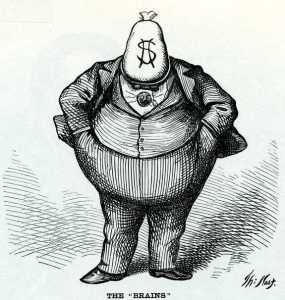
Illustration by Thomas Nast

Previously published at WGBHNews.org.

There are two elephants in the room that are threatening to destroy local news.

One, technological disruption, is widely understood: the internet has undermined the value of advertising and driven it to Craigslist, Facebook and Google, thus eliminating most of the revenues that used to pay for journalism.

But the other, corporate greed, is too often regarded as an effect rather than as a cause. The standard argument is that chain owners moved in to suck the last few drops of blood out of local newspapers because no one else wanted them. In fact, the opposite is the case. Ownership by hedge funds and publicly traded corporations has squeezed newspapers that might otherwise be holding their own and deprived them of the runway they need to invest in the future.

The last several weeks have been brutal for local newspapers. GateHouse Media and Gannett merged (the new company is known simply as Gannett), a union of two bottom-feeding chains that are reported to be considering at least another $400 million in cuts. MediaNews Group, owned by the hedge fund Alden Global Capital, acquired a 32% share of the Tribune newspapers. McClatchy may be moving toward bankruptcy.

And yet, here and there, independent community news projects are thriving. Free of the debt that must be taken on to build a chain and of the need to ship revenues to their corporate overlords, the indies — both for-profit and nonprofit — are meeting the information needs of their communities.

The narrative about the death of local journalism is an easy one to grasp, because the tale of technological disruption used to explain it has quite a bit of truth to it, as Lehigh University journalism professor Jeremy Littau wrote in a widely quoted Twitter thread over the weekend. The narrative of the ongoing vitality of local journalism doesn’t get heard often enough because it’s harder to wrap your arms around. It’s happening here and there, with different approaches and without a one-size-fits-all solution.

As such, examples are necessarily anecdotal — and you know the saying that anecdotes aren’t data. Still, good things are happening at the grassroots. For instance:

• The small daily newspaper where I worked for my first 10 years out of college, The Daily Times Chronicle of Woburn, is still owned by the founding Haggerty family and still providing decent coverage of the communities it serves. The paper is smaller than it used to be, but it’s doing far better work than a typical chain-owned paper.

• Several months ago I had an opportunity to attend the fall conference of the New York Press Association, which comprises upstate independent publishers. Those folks told me that though business was more challenging than ever, their papers were doing reasonably well.

• New Haven, Connecticut, may enjoy the best coverage of any medium-sized city in the country. Why? One veteran journalist, Paul Bass, had the vision to create the nonprofit, online-only New Haven Independent, supported by grants and donations, and still thriving 14 years after its founding. (The Independent is the main subject of my 2013 book, “The Wired City.”)

• For-profit digital news sites are doing well in some places, too. Among them: The Batavian, in Western New York, also profiled in “The Wired City.” Overall, there are enough for-profit and nonprofit sites that they have their own trade organization, LION (Local Independent Online News) Publishers. No, their numbers are too small to offset the overall decline. But the opportunity is out there for entrepreneurial-minded journalists. The chains, sadly, are creating more opportunities every day.

• Among the regions I reported on in my 2018 book, “The Return of the Moguls,” was Burlington, Vermont, whose daily, the Burlington Free Press, had been decimated by Gannett. What happened? An excellent, for-profit alternative weekly, Seven Days, bolstered its online news coverage. Two nonprofit news organizations, Vermont Public Radio and VT Digger, beefed up their local coverage as well.

• In Western Massachusetts, the once-great Berkshire Eagle is being rebuilt by local owners who bought it from MediaNews Group several years ago. That could provide a roadmap for other communities — at some point, chain owners will no longer be able to keep cutting their way to profits and will presumably be looking for a way out.

• Regional newspapers are experimenting with new forms of ownership. The Salt Lake Tribune recently won IRS approval to become a nonprofit organization. The Philadelphia Inquirer, though still a for-profit, is now owned by the nonprofit Lenfest Foundation. Neither of these moves guarantees salvation. But it has bought them time to shift to a new business model built less on advertising and more on support from their readers.

• Speaking of which: It’s been nearly a year since The Boston Globe announced it had achieved profitability despite continuing to employ a newsroom far larger than any chain owner would tolerate.

No, there is little hope of returning to the old days. Newspapers will never be as richly staffed as they were before the early 2000s, when the internet began to take a toll on revenues. Papers will continue to die. Nonprofits will have to become an increasingly important part of the mix.

Washington Post media columnist Margaret Sullivan wrote the other day that “the recent news about the news could hardly be worse. What was terribly worrisome has tumbled into disaster.”

She’s right. But in all too many instances, local news isn’t dying — it’s being murdered. The solution, if there is to be one, has to start with getting the corporate chains out of the way and paving a path for a new generation of independent publishers.

Talk about this post on Facebook.

A reinterpretation of Title IX threatens student journalism about sexual assault

Photo (cc) 2016 via Wikimedia Commons

My Northeastern colleagues Laurel Leff and Meg Heckman report on a new, serious threat to freedom of the press on college campuses: a federal reinterpretation of Title IX that puts faculty members at risk if they advise students who are reporting on sexual assault. They write at The Conversation:

At issue are increasingly common policies that require virtually every university employee to alert school officials if they hear even the slightest rumor of sexual misconduct — on or off campus — involving students or employees.

On most campuses, clergy members, mental health counselors and health care providers are exempt from such mandatory reporting requirements. University-affiliated journalists are not despite the fact that they also often need confidentiality to do their jobs effectively.

Yet, journalism professors routinely learn of possible sexual misconduct in their roles as advisors to student newspapers, or in critiquing students’ classroom work. (It’s also increasingly common for journalism educators to serve as editors in charge of school-sponsored news organizations designed to fill gaps in the local media ecosystem.)

I heard about this for the first time last week. I immediately went through a mental checklist as I tried to remember whether any of my students was working on a story about sexual misconduct. They weren’t. But I’ve dealt with such stories in the past, and apparently I will not be dealing with them in the future.

This is an outrageous attack on the First Amendment. It even pertains to NPR affiliates associated with colleges and universities, which is to say most of them. What’s needed, as Leff and Heckman write, is a state law “exempting university-affiliated journalists and journalism educators from mandatory reporting requirements when they are advising student journalists.”

Talk about this post on Facebook.

A Northeastern study takes the measure of our controversy-driven political coverage

Illustration by Emily Judem for WGBH News

Previously published at WGBHNews.org.

For observers of the media, there are few spectacles more dispiriting than the way the press covers presidential campaigns. Rather than digging into what really matters, such as the candidates’ experience, leadership ability and positions on important issues, reporters focus on controversies, attacks on one another, gotcha moments and, of course, polls, polls and more polls.

Now a study conducted by the School of Journalism at Northeastern University has quantified just how bad things are. Looking at about 10,000 news articles from 28 ideologically diverse news outlets published between March and October, my colleagues and I found that coverage of the Democratic candidates “tracks with the ebbs and flows of scandals, viral moments and news items.”

Our findings were posted last week at Storybench, a vertical published by the School of Journalism that covers media innovation. The data analysis was performed by Aleszu Bajak with an assist from John Wihbey. Among the key points in our report:

• The televised debates have driven some of the issues-based coverage. For instance, mentions of the candidates’ positions on immigration and health care increased during and immediately after the debates but then quickly subsided.

• Kirsten Gillibrand made reproductive choice one of her signature issues — and after she dropped out of the race, that issue faded from media coverage. Similarly, coverage of gun control was tied mainly to Beto O’Rourke’s now-defunct campaign. LGBTQ rights and climate change have been virtually ignored.

• The Ukraine story has dominated recently coverage of the Democratic candidates, with much of it focused on President Trump’s false accusations that Joe Biden and his son Hunter Biden acted corruptly.

Of course, to some extent the media can’t help but be reactive. It would be irresponsible not to cover what the candidates are saying about themselves and each other. But the press’ urge to chase controversies at the expense of more substantive matters shows that little has been learned since its disastrous performance four years ago.

As Thomas Patterson of Harvard’s Shorenstein Center on Media, Politics and Public Policy wrote in an analysis of the 2016 campaign, coverage of Hillary Clinton and Donald Trump was unrelentingly negative, creating the impression that the controversy over Clinton’s emails was somehow equivalent to massive corruption at Trump’s charitable foundation, his racist remarks and his boasting about sexual assault as revealed on the infamous “Access Hollywood” tape.

“The real bias of the press is not that it’s liberal,” Patterson wrote. “Its bias is a decided preference for the negative.”

It doesn’t have to be that way. Earlier this year, New York University journalism professor Jay Rosen proposed campaign coverage built around a “citizens agenda.” Rosen proposed that news organizations should identify their audience, listen to what they believe the candidates should be focusing on, and cover the race accordingly.

“Given a chance to ask questions of the people competing for office, you can turn to the citizens agenda,” Rosen wrote on his influential blog, Press Think. “And if you need a way of declining the controversy of the day, there it is. The agenda you got by listening to voters helps you hold to mission when temptation is to ride the latest media storm.”

Some coverage of presidential politics has been quite good. Quality news organizations such as The New York Times and The Washington Post have published in-depth articles on challenges the candidates have overcome and how that helps shape their approach to governing. The Boston Globe has been running a series called “Back to the Battleground” in which it has reported on four key states that unexpectedly went with Trump in 2016. Reports aimed at making sense of the Ukraine story, explaining Elizabeth Warren’s Medicare for All plan and the like are worthy examples of campaign journalism aimed at informing the public. But such efforts tend to be overshadowed by day-to-day horse-race coverage.

The latest poll-driven narrative is the rise of Pete Buttigieg, who’s emerged as the clear frontrunner in Iowa, according to a Des Moines Register/CNN/Mediacom survey. You can be sure that he’ll be watched closely at this week’s televised debate. Will his rivals attack him? Will he fight back? Can he take the heat?

Little of it will have much to do with what kind of president Buttigieg or any of the other candidates would be. The horse race is paramount. Who’s up, who’s down and the latest controversies are what matter to the political press.

The data my Northeastern colleagues have compiled provides a measurement of how badly political coverage has run off the rails. What’s needed is a commitment on the part of the media to do a better job of serving the public interest.

Talk about this post on Facebook.

Two pioneering women editors take on gender inequity in the newsroom

Previously published at WGBHNews.org.

Where are all the women? For those of us who’ve spent much of our lives working in newsrooms, it’s a question that has no good answer. As far back as the 1970s, when I was in journalism school, women outnumbered men in the classroom by a substantial margin — a phenomenon that, if anything, has become even more pronounced. Yet at news organizations everywhere, men predominate. And that is especially true in leadership positions.

Now two longtime journalists have written a book aimed at explaining that imbalance and, more important, offering case studies and advice for young women seeking to survive and thrive. “There’s No Crying in Newsrooms: What Women Have Learned about What It Takes to Lead,” by Kristin Grady Gilger and Julia Wallace (Rowman & Littlefield, 216 pages, $32), ought to be required reading for journalism students (as it is for my ethics class at Northeastern) — and not just for women but also for men, who need to understand the obstacles that women face.

Gilger and Wallace are colleagues in the Walter Cronkite School of Journalism and Mass Communication at Arizona State University. More to the point, they both helped blaze a trail for women who seek to move up into the highest ranks of journalism. Wallace was the first woman to serve as editor-in-chief of The Atlanta Journal-Constitution. Gilger worked in top editing positions at The Arizona Republic, The Statesman Journal of Salem, Oregon, and The Times-Picayune of New Orleans.

“There’s No Crying in Newsrooms” comprises a series of chapters on the challenges that women must deal with, from proving their worth to pay equity, from sexual harassment to finding the right balance between work and life — something that ought to be taken as a given for journalists of any gender, but whose burden still falls more heavily on women. Each chapter ends with a personal essay and advice from one of the two authors, giving it the feel of a how-to book.

How bad can it get? According to Gilger and Wallace, “When one female reporter who covered health asked for a raise, the metro editor replied, ‘Your husband is a dentist. What are you worried about?’”

Among the many fascinating case studies (Gilger and Wallace interviewed more than 100 women) are those of Marcy McGinnis, who rose from working as a secretary at CBS News to senior vice president of news, and Wanda Lloyd, an African American journalist who was raised in the South during segregation and served for more than eight years in Alabama as executive editor of the Montgomery Advertiser.

Lloyd’s story is especially poignant. In an effort to make the Advertiser more welcoming to African American readers, Lloyd banished front-page mug shots of black men and ended the annual practice of photographing a birthday cake for Robert E. Lee Those initiatives were not always supported by the paper’s white readers — and Gilger and Wallace write about a moment after one of those readers complained that the Advertiser was giving too much coverage to African Americans.

“I had never in my life lost it like that before,” Lloyd is quoted as saying. “I sobbed uncontrollably for at least five minutes. My whole body was shaking. I just had never encountered anything like that. I had encountered racism all my life, but this racism was directed directly at me as an employee, as a journalist, as a person. Later, I was surprised they didn’t call an ambulance for me; that’s how bad it was.”

The Advertiser is a Gannett paper, and Gilger and Wallace go out of their way to praise the company’s late chief executive Al Neuharth for his commitment to diversity; both authors worked for Gannett at various times. Neuharth believed that appointing more women and people of color to leadership positions would broaden his papers’ audience.

Which leads to my only complaint about “There’s No Crying in Newsrooms.” The Neuharth years were profitable ones for Gannett — very profitable. As the late Ben Bagidikian documented in his oft-updated book “The Media Monopoly,” Gannett’s papers regularly ran up profits of 30% to 50%, margins that are wildly incompatible with quality journalism. When the bad times came, Gannett, like other chain owners, failed to invest in the future.

Today, Gannett is about to merge with GateHouse Media, another cost-slashing chain, while its Newseum is on the verge of closing. I don’t doubt Neuharth’s sincerity with regard to diversity. I just wish Gilger and Wallace had at least made a mention of Gannett’s role in the decline of the newspaper business — brought about by larger forces, to be sure, but worsened by corporate greed.

The authors devote a chapter to Jill Abramson, the first executive editor of The New York Times, who was fired by then-publisher Arthur Sulzberger Jr. under circumstances that have never been adequately explained. Gilger and Wallace come to roughly the same conclusion that Abramson herself did in her book “Merchants of Truth” — that is, it was a combination of sexism and her own shortcomings as a manager and a leader.

They also offer this choice tidbit about Abramson: “During one meeting, she pointed out that the headline on a story posted on the Times’ website was incorrect. When the editor responsible for the page didn’t get up immediately to fix it, Abramson asked him what he was still doing in the room.” If I were Sulzberger, I’d have been tempted to make her editor for life just for that.

The book ends on something of a down note, as the authors observe that, as of 2018, “women in media held fewer positions of power, were promoted more slowly, and made less money than their male counterparts.” Women in the news media also continue to deal with bad behavior in the workplace, ranging from disrespect to sexual harassment and assault.

Ultimately, though, Gilger and Wallace argue that the fight is worth it — that journalism and democracy are better served if newsrooms more closely reflect the broader culture. I hope this book is read not just by aspiring journalists but by newsroom leaders as well. A problem can’t be solved unless it’s first understood, and “There’s No Crying in Newsrooms” explains it well.

Talk about this post on Facebook.

How the media are setting the 2020 agenda: Chasing daily controversies, burying policy

By Aleszu Bajak, Dan Kennedy and John Wihbey

It’s a paradox of examining political coverage. Are news media just reporting what the political candidates are talking about? Or does political journalism really set the agenda by selecting stories around specific news items, scandals and issues du jour?

Our topic analysis of ~10,000 news articles on the 2020 Democratic candidates, published between March and October in an ideological diverse range of 28 news outlets, reveals that political coverage, at least this cycle, tracks with the ebbs and flows of scandals, viral moments and news items, from accusations of Joe Biden’s inappropriate behavior towards women to President Trump’s phone call with Ukraine.

Read the rest at Storybench, a media innovation vertical published by Northeastern University’s School of Journalism. And talk about this post on Facebook.

Here are three new reasons to be optimistic about local news

Note: Make that four reasons. See update below.

The crisis in local news won’t be solved all at once. Rather, it will be solved community by community as entrepreneurial-minded journalists seek to fill the gaps left behind by corporate-owned chain newspapers. Here are three new reasons to be optimistic.

In Maine, the Portland Phoenix, the last of the great Phoenix alternative weeklies, is scheduled to relaunch this coming Wednesday under new ownership after ceasing publication earlier this year. The free paper and website are part of New Portland Publishing Co., headed by Marian McCue and Karen Wood.

The relaunch was announced Oct. 22 by Marian McCue and Karen Wood, principals of New Portland Publishing Co. McCue will serve as the editor and Mo Mehlsak, most recently executive editor of The Forecaster, American Journal and Lakes Region Weekly newspapers, will be managing editor.

“While we always admired the energy of the Phoenix, and the strong entertainment coverage, our focus will be more on news and analysis, and in-depth investigative stories that explore the challenges facing this area,” McCue said in a press release announcing the new venture.

Added Wood: “We’ve had a very positive response from early conversations with advertisers and people in the community. We are convinced that a free distribution newspaper will be successful, and provide an effective forum for our advertisers.”

The new Portland Phoenix has a stiff challenge ahead of it in the form of the daily Portland Press Herald, the flagship of a Maine-based chain. The Press Herald is considerably more robust than papers owned by the national chains, and the publisher — Lisa DeSisto — is an alumnus of The Boston Phoenix who knows how to put out a paper oriented toward arts and entertainment. (Note: I worked with Lisa at the Phoenix for several years.)

Still, it’s fantastic news that someone is going to try to revive the Phoenix in Portland, which is the sort of smaller city that ought to be able to support an alt-weekly.

***

Bill Wasserman is one of Eastern Massachusetts’ legendary local newspaper owners. Founder of the Ipswich Chronicle, he built that into a chain of about a dozen North Shore papers and sold them in 1986. Those papers eventually were acquired by GateHouse Media, and Wasserman has been grousing about what happened to them ever since. Earlier this year, GateHouse got rid of the Ipswich Chronicle as a standalone title, merging it with two other papers.

In an interview for CommonWealth Magazine in 2008, Wasserman told me the main problem with corporate ownership was a failure to understand that, even in the best of times, community journalism is little more than a break-even proposition. “I was paid a salary, which was modest,” said Wasserman. “The reward was not in the profit. The reward was having a lot of fun putting out a community paper.”

Now Wasserman has gone back to the future, lending his expertise as a consultant and ad salesman to a start-up called Ipswich Local News — a free paper and website that is seeking nonprofit status. The editor and publisher is John Muldoon.

***

Jenn Lord Paluzzi holds the distinction of being laid off by two national chains — GateHouse (at The MetroWest Daily News) and MediaNews Group (at The Sun of Lowell). Now she’s launched a community news site in her hometown of Grafton called Grafton Common that is loaded with local news.

Some years back, Lord Paluzzi was involved in a startup called Greater Grafton. But that venture ended up getting sold to a chain of local websites that ended up going out of business. Best of luck to her as she goes off on her own once again.

Update: And a fourth — how could I forget the recently launched Provincetown Independent?

Talk about this post on Facebook.

Political ads on Facebook can be fixed. Is Mark Zuckerberg willing to try?

Photo via Wikimedia Commons

Previously published at WGBHNews.org.

If nothing else, Twitter CEO Jack Dorsey proved himself to be a master of timing when he announced last week that his social network will ban all political ads.

Anger was still raging over Mark Zuckerberg’s recent statement that Facebook would not attempt to fact-check political advertising, thus opening the door to a flood of falsehoods. Taking direct aim at Zuckerberg, Dorsey tweeted: “It‘s not credible for us to say: ‘We’re working hard to stop people from gaming our systems to spread misleading info, buuut if someone pays us to target and force people to see their political ad…well…they can say whatever they want!’”

Not surprisingly, Twitter’s ad ban won widespread praise.

“This is a good call,” tweeted U.S. Rep. Alexandria Ocasio-Cortez, D-N.Y., who had only recently tormented Zuckerberg at a congressional hearing. “Technology — and social media especially — has a powerful responsibility in preserving the integrity of our elections. Not allowing for paid disinformation is one of the most basic, ethical decisions a company can make.”

Added Hillary Clinton: “This is the right thing to do for democracy in America and all over the world. What say you, @Facebook?”

Oh, but if only it were that simple. Advertising on social media is a cheap and effective way for underfunded candidates seeking less prominent offices to reach prospective voters. No, it’s not good for democracy if we are overwhelmed with lies. But, with some controls in place, Facebook and Twitter can be crucial for political candidates who can’t afford television ads. To get rid of all political advertising would be to favor incumbents over outsiders and longshots.

“Twitter’s ban on political ads disadvantages challengers and political newcomers,” wrote University of Utah communications researcher Shannon C. MacGregor in The Guardian. “Digital ads are much cheaper than television ads, drawing in a wider scope of candidates, especially for down-ballot races.”

And let’s be clear: Facebook, not Twitter, is what really matters. Journalists pay a lot of attention to Twitter because other journalists use it — as do politicians, bots and sociopaths. Facebook, with more than 2 billion active users around the world, is exponentially larger and much richer. For instance, the 2020 presidential candidates so far have spent an estimated $46 million on political ads on Facebook, compared to less than $3 million spent by all candidates on Twitter ads during the 2018 midterms.

But is political advertising on Facebook worth saving given the falsehoods, the attempts to deceive, that go way beyond anything you’re likely to see on TV?

In fact, there are some common-sense steps that might help fix Facebook ads.

Writing in The Boston Globe, technology journalist Josh Bernoff suggested that Facebook ban all targeting for political ads except for geography. In other words, candidates for statewide office ought to be able to target their ads so they’re not paying to reach Facebook users in other states. But they shouldn’t be able to target certain slices of the electorate, like liberals or conservatives, homeowners or renters, white people or African Americans (or “Jew haters,” as ProPublica discovered was possible in a nauseating exposé a couple of years ago.)

Bernoff also suggested that politicians be required to provide documentation to back up the facts in their ads. It’s a good idea, though it may prove impractical.

“Facebook is incapable of vetting political ads effectively and consistently at the global scale. And political ads are essential to maintaining the company’s presence in countries around the world,” wrote Siva Vaidhyanathan, author of “Antisocial Media: How Facebook Disconnects Us and Undermines Democracy,” in The New York Times.

But we may not have to go that far. The reason ads spreading disinformation are so effective on Facebook is that they fly under the radar, seen by tiny slices of the electorate and thus evading broader scrutiny. In an op-ed piece in The Washington Post, Ellen L. Weintraub, chair of the Federal Election Commission, argued that the elimination of microtargeting could result in more truthful, less toxic advertising.

“Ads that are more widely available will contribute to the robust and wide-open debate that is central to our First Amendment values,” Weintraub wrote. “Political advertisers will have greater incentives to be truthful in ads when they can more easily and publicly be called to account for them.”

Calling for political ads to be banned on Facebook is futile. We live our lives on the internet these days, and Facebook has become (God help us) our most important distributor of news and information.

As Supreme Court Justice Louis Brandeis once wrote, “If there be time to expose through discussion the falsehood and fallacies, to avert the evil by the process of education, the remedy to be applied is more speech, not enforced silence.”

Nonprofit news update

Earlier this week The Salt Lake Tribune reported that the IRS had approved its application to become a nonprofit organization, making it the first daily newspaper to take that step. Unlike The Philadelphia Inquirer and the Tampa Bay Times, for-profit newspapers owned by nonprofit foundations, the Tribune will be fully nonprofit, making it eligible for tax-deductible donations.

Nonprofit news isn’t exactly a novelty. Public media organizations like PBS, NPR and, yes, WGBH are nonprofit organizations. So are a number of pioneering community websites such as the New Haven Independent and Voice of San Diego. And if the Tribune succeeds, it could pave the way for other legacy newspapers.

Last May I wrote about what nonprofit status in Salt Lake could mean for the struggling newspaper business. This week’s announcement is a huge step forward.

Talk about this post on Facebook.

Kirk Davis leaving GateHouse Media just ahead of the merger with Gannett

Kirk Davis (via LinkedIn)

I posted this on Twitter and Facebook on Thursday, but it seems significant enough that I ought to share it here as well. Kirk Davis, chief executive officer at GateHouse Media and number two to Mike Reed in the GateHouse-New Media combo, is leaving just as the company is merging with Gannett.

I’ve known Davis for a very long time, having interviewed him for The Boston Phoenix in the 1990s when he and Mary Jo Meisner were running Community Newspaper Co. for Fidelity. CNC, which comprised more than 100 newspapers in Eastern Massachusetts, was later sold to then-Boston Herald publisher Pat Purcell, who in turn sold out to GateHouse.

In 2008, I interviewed Davis — then the head of GateHouse Media New England — for CommonWealth Magazine.

Earlier this week, Chris Faraone wrote for Boston magazine about a familiar subject: the brutal cuts in news coverage and staff at GateHouse papers in Greater Boston. It’s not going to get any better now that the company has merged with Gannett.

Although Davis’ departure is being portrayed as his decision, it’s worth noting that Don Seiffert wrote in the Boston Business Journal back in August that Davis “may not have a role at the new, combined company.” Still, it wouldn’t surprise me if Davis decided he’d had enough.

On Thursday a source sent me a memo that Reed sent to GateHouse staff members announcing Davis’ departure. I present it here in full:

TO: GateHouse Media employees
FROM: Mike Reed
RE: Kirk Davis
Date: October 31, 2019

I am writing to inform you that Kirk has shared with me that he intends to leave New Media upon the close of the Gannett acquisition. I know this decision did not come easily for him; his commitment to our company and each of you is unmatched. I have worked very closely with Kirk for the past 13 years and not only have we become great business partners, but also great friends.

I want to personally offer my deepest appreciation and respect for Kirk’s work and leadership over the years. From our roots as a small collection of local newspapers, we’ve become one of the largest publishers of locally-based media in the United States. We are nationally recognized for our growth in digital marketing services and local and national events and most importantly, celebrated for our multi-platform, local journalism. Kirk’s leadership, building and guiding a high performing organization, has led to our opportunity with Gannett. I know without doubt that Kirk will be incredibly successful in his next endeavor and we wish him all the best in that effort. I know Kirk will want to share some thoughts with you before he departs. And, we will provide channels for staff to acknowledge and commemorate Kirk’s service to GateHouse.

Please join me in thanking Kirk for his many contributions to us and our company and wishing him all the best on his next adventure.

Talk about this post on Facebook.

Facebook News may be a boon to big media. But will local news get left behind?

Mark Zuckerberg. Photo (cc) 2012 by JD Lasica.

Previously published at WGBHNews.org.

Imagine for a moment that you run a small community newspaper or website. You have a Facebook page. But people tell you that even though they’ve “liked” it, they almost never see content from your page show up in their News Feed. And thus one of the most important channels for distributing journalism in the social-media era isn’t working for you.

According to some estimates, “organic reach” — that is, the percentage of users who’ve liked your page and who actually see your content — can be as low as 2 percent. What can you do? Well, you can give Mark Zuckerberg access to your credit card, which will boost your reach considerably. But if you can’t afford to pay, you’d be better off handing out refrigerator magnets with your website’s URL on them than depending on Facebook.

Now imagine that you’re the publisher of a major national news organization like The New York Times, The Washington Post or BuzzFeed. The Zuckerborg is about to bestow upon you millions of dollars. That’s because you’ve agreed to be part of Facebook News, a new tab in the service’s mobile app for curated, reliable journalism. (The feature is being rolled out slowly, and I have not seen it yet.)

There are many reasons to be skeptical of Facebook’s latest foray into news, but surely one of the most important is this: At a time when local news is under unprecedented economic pressure, the News Tab will only widen the gap between relatively well-off, highly visible national news organizations and small local projects. The national sites will get paid; the local sites will be billed monthly.

It’s possible that this could change over time. According to Facebook’s announcement. “we’ll showcase local original reporting by surfacing local publications from the largest major metro areas across the country, beginning with New York, Los Angeles, Chicago, Dallas-Fort Worth, Philadelphia, Houston, Washington DC, Miami, Atlanta and Boston. In the coming months, we’ll include local news from Today In, our local news and community information tab, which recently expanded to over 6,000 US towns and cities.”

So, at least at first, it sounds like large regional news organizations will be included. But it’s not clear how or if any of that money will ever trickle down to the laid-off community-news reporter who’s trying to start a hyperlocal site, or to the volunteers who provide coverage that their chain-owned weekly ignores.

There are other potential hazards as well. Let’s start with the conflicts of interest posed by news organizations choosing to do business with our most controversial tech company.

“Payments to publishers for stories that Facebook might otherwise aggregate for free is a boon for journalism,” wrote Emily Bell at the Columbia Journalism Review. “The idea that there will be a daily, regular newsfeed that’s not filled with nonsense is a boon for Facebook users. The delineation of news as a category distinct from other ‘content’ is a boon for democracy. Yet the readiness with which publishers are seemingly embracing this new business arrangement is discomfiting, given Facebook’s track record, and the total lack of regulation. Will News Corp. [parent company of The Wall Street Journal and Fox News, both part of the News Tab] and others disclose their relationship with Facebook when they cover the tech world? One can only hope so.”

Another problem is the very odd presence of Breitbart News as part of the News Tab. It’s one thing to want to include a conservative-leaning news organization; it’s quite another to add weaponized propaganda to a list that is supposed to be comprise factual, verified journalism. More than anything, the inclusion of Breitbart appears to be part of Zuckerberg’s continued efforts to suck up to right-wing critics who accuse Facebook and other social-media platforms of liberal bias.

Finally, there is the question of whether Facebook this time will stick with its newfound embrace of news. Over the years the company has alternately accepted its role as a platform for journalism and walked away from it. About a decade ago, it unveiled a program called the Social Reader, inviting news organizations to use it and set up shop inside Facebook. The Washington Post and The Guardian, in particular, had considerable success with it. And then Zuckerberg changed his mind.

David Beard, a veteran journalist who was working on social-media strategies for the Post at that time, told me in a 2015 interview that he began developing email newsletters for the paper in direct response to the Social Reader fiasco. “For a while, we had tons of readers in India and the Philippines and some other places,” he said. “And then Facebook changed the algorithm, and we suddenly had none. So my learning from that episode was, is there something we can do without a mercenary, where we own the machinery?”

Now, once again, news organizations are relying on Mark Zuckerberg’s machinery. Will it be different this time? I hope so. Zuckerberg is under fire from all directions these days. He may sincerely hope that leading people away from disinformation and toward real news will not only ease the pressure on him and his company, but will be good for democracy as well.

But few things are more vital for fixing democracy than bolstering local news. At the very least, Facebook News is off to an unacceptably slow start at the local level. If that doesn’t change, then Zuckerberg’s latest idea may wind up being just one more example of a promise unfulfilled.

Talk about this post on, well, you know, Facebook.