After Alden Global Capital destroyed The Denver Post, everyone assumed it was lights out. A city that had long had two vibrant daily papers (the Rocky Mountain News closed down in 2009) now barely had one.
Suddenly, though, news sources are proliferating in Denver. Today the all-digital Denver Gazette makes its debut, joining an earlier start-up, The Colorado Sun. The alt-weekly Westword continues to publish.
The lesson, as always, is that when legacy media fail, entrepreneurial journalists seize the opportunity to move in.
There are three albums on my list that are what you might call black-swan events — they are so much better than anything else the performer recorded that all you can do is gape in awe. One of them is Van Morrison’s “Astral Weeks” (No. 12). Another is yet to come.
Today’s entry is Eric Clapton’s greatest moment as a recording artist. “Layla and Other Assorted Love Songs” is better than what he did with Cream and, sadly, far better than anything from his long, mostly disappointing solo career. Released in 1970, “Layla” is perhaps the ultimate guitar album. Clapton has never sounded better, pushed to unequaled heights by guest guitarist Duane Allman, who contributes stinging slide guitar. Solos are double- and triple-tracked; it can be hard to tell who’s playing what.
Clapton has always been obsessed with the blues, and he is at his best on “Nobody Knows You When You’re Down and Out,” “Key to the Highway” and especially “Have You Ever Loved a Woman” — all of which are grounded in an authenticity that’s utterly lacking from his derivative 1994 all-blues album, “From the Cradle.”
The title song, with its famous piano coda by drummer Jim Gordon (or perhaps, as I learned in researching this post, Rita Coolidge), is considered by most observers to be the best on the album. But it’s suffered from overexposure during the past 50 years, and I actually prefer some of the rave-ups co-written by Clapton and organist Bobby Whitlock. Songs like “Anyday,” “Keep on Growing,” “Tell the Truth” and “Why Does Love Got to Be So Sad?” are so drenched in guitar heroics by Clapton and Allman that you feel spent just listening to them.
The vocals, by Clapton and Whitlock, are on one level some of the worst ever committed to tape; on another level, though, they add to the feeling of over-the-top chaos that pervades the entire album and makes it so exciting to listen to. Unfortunately, though the original vinyl struck me as bright and well-produced (by Tom Dowd), the CD I later bought and now the Spotify version sound muddy, even though it’s supposedly been remastered. The crystalline sound I remember from my teen years doesn’t quite come through.
“Layla” ranks a little lower here than it did on my Facebook list because the idea on Facebook was to list the albums that most influenced your music tastes. Here I am simply ranking my favorites — and as outstanding as “Layla” is, I’ve got five I like more.
Derek and Dominos only recorded one album and came to a bad end. Whitlock, like Clapton, is still with us and continues to work. But Allman died in a motorcycle accident. Bassist Carl Radle died from alcohol and drug abuse. Gordon, a terrific drummer, murdered his mother during a psychotic episode and was sentenced to life in prison.
For one brief moment, though, they made magic together.
There are three albums on my list that I discovered because of great music writing. The first, Charlie Parker’s “Bird/The Savoy Recordings (Master Takes),” comes in at No. 14. Another will come later.
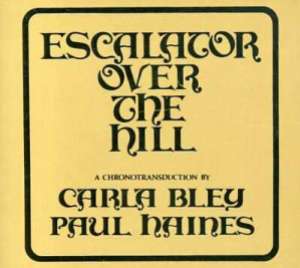
Today’s entry is “Escalator over the Hill,” a two-hour 1971 release written by Carla Bley and performed by her, the Jazz Composers Orchestra (which she co-founded) and a cast of stars. I discovered this remarkable album because of a review by Stephen Davis that appeared in either The Phoenix or Boston After Dark; I suspect it was the former, though I didn’t make a note of it on the clip that I kept. (For you alt-weekly trivia buffs, Boston After Dark became The Boston Phoenix, and The Phoenix became The Real Paper. It’s complicated.)
Davis describes “Escalator” as “a phantasmagoria of sound, imagination, and virtuousity,” and Bley’s writing as “a mingling of the immediacy of rock with the harmonic and thematic intelligence of jazz.” What music-obsessed 15-year-old could resist? Especially since you could order the three-record set, with notes, pictures and “a handsome gilt-letter box,” for just $12, not a lot of money even then.
“Escalator” was No. 5 in my Facebook list earlier this year. I’ve moved it down a bit. Great as it is, it’s just not the sort of thing I find myself listening to very often. It’s too big, too ambitious. The music comes at you relentlessly, in waves. How to describe it? A jazz-rock opera? (Or, rather, a jazz and rock opera; there is no jazz-rock on “Escalator,” thank you very much.) A “chronotransduction,” as Bley calls it?
I listened to “Escalator” in full this week for the first time in a few years. It doesn’t merely hold up. It sounds as fresh as it did when it was first released. The 13-minute “Hotel Overture” is as stunning a piece of music as I’ve heard, a gonzo big-band performance that ranges from a rather traditional opening to free jazz, anchored by Gato Barbieri’s screeching tenor sax.
And there’s so much more. Much of it is indescribable, but I should note that, among some of the finest jazz musicians of their era, we also get to hear Linda Ronstadt, nearly unknown at the time; Jack Bruce, a couple of years past Cream; and Viva, part of Andy Warhol’s entourage, who provides occasional narration with an utter emotional flatness will make you laugh.
A word about Bruce: He’s all over the album, and his singing and bass playing are among the highlights. Davis called “Escalator” “the zenith of Jack Bruce’s long and amazingly checkered career.” You could also say that Cream was not the best power trio Bruce ever played in; rather, it’s Jack’s Traveling Band on “Escalator,” in which he’s joined by Mahavishnu John McLaughlin on guitar and Paul Motian on drums (and Bley on organ). “Businessmen,” in particular, rocks so hard that there’s really no place else to go.
I could go on. But let me express my one reservation: Paul Haines’ maddeningly obtuse lyrics. Depending on my mood, I find them either hilariously inventive or hopelessly pompous and esoteric. The story is supposed to be about the weird characters who inhabit Cecil Clark’s hotel, set in Rawalpindi. But it really isn’t. Bruce and Ronstadt supposedly play the lead characters, David and Ginger — but that idea is haphazardly executed at best. Here’s a taste of Haines from “Detective Writer Daughter”:
Detective writer of English She was once the queen of Sweden. His father’s horse was something like a house Dad was a German where they lived.
But never mind the lyrics, although you might love them. This is incredible music that stands up to repeated listenings — oom-pah music, Indian music, ominous noise, trumpeter Don Cherry’s atonal soloing, chanting.
I started with Stephen Davis. I’ll close with Marcello Carlin, who began a 2003 essay about “Escalator” with this: “So here I am, faced with the task of explaining and justifying to you the piece of music which I regard as the greatest ever made, the gold standard against which I qualitatively measure all other music, the definitive record which, 30 years after its original appearance, may still render all other records redundant.”
The greatest record ever. How can you resist? Oh, and did I mention that, for all its strangeness, “Escalator” is also surprisingly accessible? Set aside some time and give “Escalator over the Hill” a chance. Everything else is melancholy and industrial.
After Jeffrey Goldberg of The Atlantic reported that President Donald Trump had derided Americans who’ve died in war as “losers” and “suckers,” Trump did what he always does. He attacked Goldberg, editor-in-chief of the venerable magazine, as a “slimeball.” He urged his followers to launch a campaign aimed at harassing The Atlantic’s principal owner, Laureen Powell Jobs. And he called on Fox News to fire reporter Jennifer Griffin for having the temerity to verify Goldberg’s reporting.
But what if Trump actually had the power to do something about journalism that he doesn’t like? Unfortunately, we already know the answer. A number of media organizations operate under government auspices, and until recently they’ve enjoyed a well-deserved reputation for independence and truth-telling. Now, though, they are in danger of being dismantled or turned into organs of Trumpist propaganda.
In each case, the threats are different; some are farther along than others. But they are real, and they are worth watching closely. At this point, it’s probably not too late to undo the damage. But it could spell the end if Trump wins re-election. I’ll take them one at a time.
• Stars and Stripes. If you were half-paying attention last week, you might have thought that Trump intervened to save the military newspaper Stars and Stripes from those dastardly Deep Staters at the Pentagon who wanted to shut it down.
Not true. In fact, the White House had been planning to put the legendary paper out of business for months, and only reversed course when the president saw saving it as an expedient way to divert attention from The Atlantic’s story.
“We trimmed the support for Stars and Stripes because we need to invest that money, as we did with many, many other programs, into higher-priority issues,” Secretary of Defense Mark Esper was quoted as saying last February. Yet operating the paper cost just $15.5 million in a defense budget of $700 billion.
The fate of Stars and Stripes — launched during the Civil War — came to a head last Friday, when USA Today reported that the defunding timetable had been moved up and that the paper would close by the end of September. Fortunately, Trump simultaneously found himself under fire for reportedly denigrating the country’s war dead, leading to the president’s announcement that he was saving Stars and Stripes. As Matt Pearce of the Los Angeles Times tweeted, “I think the Atlantic just saved some newspaper jobs.”
Reporter Helene Cooper wrote in The New York Times that Stars and Stripes has “frustrated presidents and defense secretaries” in recent years “by elevating the voices of those in uniform who contradicted commanders and political leaders.” Stars and Stripes ombudsman Ernie Gates told Jon Allsop of the Columbia Journalism Review that even if Trump wasn’t directly involved in the decision to cut funding, “three-plus years of the message that ‘the press is the enemy of the people’ emboldened some in the Pentagon who regard Stars and Stripes’ independent reporting as an annoyance.”
The Trump administration tried to silence that critical voice, and the president backed down to solve a political problem. If he gets a second term, you can be sure he’ll try again.
• Voice of America. Founded in 1942, Voice of America was best known during the Cold War for broadcasting news to residents of communist countries behind what we used to call the Iron Curtain. The service has always enjoyed a reputation for providing reliable information. After all, citizens of those regimes were already being subjected to a steady diet of propaganda. Voice of America aimed to counter that with the truth.
VOA continues to be a vital source of news and information around the world — or at least it did until recently, when Trump put Steve Bannon associate Michael Pack in charge. As Julian Borger reported in The Guardian, Pack has led a purge of journalists at VOA, claiming without evidence that they represented a threat to national security, sparking a revolt among the staff.
Shawn Powers, who recently left a top position at the U.S. Agency for Global Media, which oversees VOA, told NPR media reporter David Folkenflik: “What we’re seeing now is the step-by-step and wholescale dismantling of the institutions that protect the independence and the integrity of our journalism.”
A great deal of work would have to be done to repair VOA and restore its reputation. Needless to say, that isn’t going to happen during a second Trump term.
• National Public Radio. Unlike Voice of America and Stars and Stripes, NPR, our leading free, nonprofit source of news, is not under the direct control of the Trump administration. Very little of its funding comes from the government — although dues from member stations are its largest source of funding, and some of those stations are highly dependent on government money.
Which is to say that NPR is relatively immune from retribution, though not as immune as, say, The New York Times and The Washington Post.
NPR is hardly a bastion of the Resistance. If you listen regularly, you’ll often hear the network’s journalists bend over backwards to normalize this most abnormal of presidents. But, to their credit, they have their limits, and they push back in defense of their reporting.
The most recent example arose after 17-year-old Kyle Rittenhouse shot three protesters, two fatally, in Kenosha, Wisconsin — protests sparked by the unprovoked police shooting of Jacob Blake. Trump claimed that Rittenhouse appeared to have acted in self-defense, a claim for which NPR said Trump had “no evidence” because, well, there wasn’t. Rittenhouse may have been afraid, but that doesn’t make it self-defense.
NPR’s straight-up reporting brought about calls on the right to defund NPR. That, in turn, led to a timid column by NPR public editor Kelly McBride, who wrote, “The evidence may be confusing or inconclusive, but it exists, and it’s inaccurate to say that Trump had none.”
Trump himself did not specifically call for funds to be cut — but he has in the past. Last February, after NPR’s Mary Louise Kelly conducted a tough but fair interview with Secretary of State Mike Pompeo, Trump called it a “very good question” as to why the organization received public funds. Moreover, Trump has sought the zeroing out of the Corporation for Public Broadcasting, which helps fund both NPR and PBS.
During his more than three and a half years in the White House, and for that matter over the course of his entire career, Trump has made it clear that he’ll do anything to silence and punish critics. On one level, his assault on the mainstream media has been ineffective; but on another, it’s worked brilliantly, since he has succeeded in delegitimizing them as “fake news” in the eyes of his followers.
The threat facing media institutions tied to the government is more direct, more serious — and, if Trump manages to win a second term, perhaps insurmountable.
Back when I was researching “Little People,” my 2003 book about dwarfism, the only treatment for achondroplasia — the most common form of dwarfism — was painful, dangerous limb-lengthening surgery. Understandably, very few people opted for such a drastic treatment, and families whose children had such surgery (it doesn’t work well on adults) were thought to have insufficient “dwarf pride.”
Now an actual treatment for achondroplasia is on the horizon. The New York Times reports that a drug called vosoritide seems to target the genetic anomaly that stops the long bones of the arms and legs from growing. Since that anomaly also causes spinal and respiratory problems, the treatment could prove to be a real breakthrough in improving people’s quality of life.
One of the main themes of “Little People” is the social and cultural meaning of difference — whether we are as comfortable with it as we claim to be, and if we’d eliminate it if we could. At the time, the main threat to dwarfism, and all kinds of genetic differences, was the rise of cheap, routine in-utero genetic-screening tests. Now that an actual treatment for achondroplasia is upon us, the calculation has changed considerably. As the Times’ Serena Solomon writes:
Vosoritide, said Mark Povinelli, the L.P.A.’s [Little People of America’s] president, “is one of the most divisive things that we’ve come across in our 63-year existence.”
The organization does not endorse specific treatments, but encourages members to consider more than height in medical decisions. “We want to show that you can have a completely fulfilling life without having to worry about growth velocity,” said Mr. Povinelli, calling fixations on height a societal issue.
Unlike limb-lengthening surgery, if vosoritide proves to be safe, effective and affordable, I suspect most average-size couples who have a child with achondroplasia will opt for the treatment. Drugs available for several decades have all but eliminated dwarfism caused by hormonal deficiencies, and I can’t imagine why achondroplasia would be any different. We would have chosen it for our adult daughter, Becky, who has achondroplasia.
Doctors are not going to educate new parents about dwarf pride or the advantages of diversity. Instead, they’re going to tell them about a treatment. This not an unalloyed good, but it is reality.
This Ross Douthat column gets at something I’ve found myself wondering: How many lives could have been saved in the United States if a normal president had been in the White House?
A Columbia study showed that 36,000 people would not have died if the shutdown had started a week earlier, and 54,000 if it had started two weeks earlier. But might they have died later on during the summer surge?
The real problem has been Trump’s complete lack of seriousness and empathy. Maybe the death toll wouldn’t be all that different. But we wouldn’t feel completely abandoned.
Jeffrey Goldberg of The Atlantic posted a blockbuster Thursday evening, reporting that President Donald Trump has repeatedly disparaged those who died in war as “losers” and “suckers.”
But the story probably won’t have the devastating effect that it should because Goldberg’s sources refused to go on the record. I’m outraged, as I have been many times over the past four years, at the gutlessness of these insiders and former insiders, who privately express their disgust with Trump while acting as his enablers.
Yes, attaching their names to this report would subject them to withering criticism and possibly even place them in danger. But the country is in danger, too. It’s time to step up.
If those sources claim to be patriots it's time to step out from the shadows. Otherwise they will be complicit if Trump steals the election https://t.co/qQladBguVp
Sen. Ed Markey at a rally for the Green New Deal. Photo (cc) 2019 by Victoria Pickering.
Now that U.S. Ed Markey has survived a Democracy primary challenge by U.S. Rep. Joe Kennedy, I want to offer a few observations. I didn’t say much during the campaign because I’ve never met Kennedy, and because it didn’t strike me that the outcome would make much difference in terms of policy. Kennedy probably would have made a perfectly fine senator. But, like many liberals and progressives, I didn’t think his decision to run against Markey made much sense except in terms of sheer personal ambition and a cynical calculation that the Kennedy name was all he needed.
I covered Markey for The Daily Times Chronicle of Woburn back in the 1980s, including his toughest re-election fight, in 1984. That’s when Markey decided to run for the Senate following Paul Tsongas’ announcement that he would be leaving because of ill health. At the last minute, though, Markey got cold feet, pulled out and announced he’d run for re-election to the House instead. Most of the Democrats who were running for Markey’s seat immediately dropped out. But Sam Rotondi, a state senator from Winchester, decided to stay in. (John Kerry won the Senate seat, by the way.)
Rotondi ran a spirited race, but the power of incumbency and Markey’s considerable skills as a politician were too much to overcome. You may have heard that the COVID pandemic put Kennedy at a disadvantage since he’s a better retail politician than Markey. That’s ridiculous. Markey is an excellent one-on-one campaigner and, at 74, his energy seems to be undiminished. And his rapport with young voters, always strong, may have been the difference.
There was a time when the sky seemed to be the limit for Markey. He was a leader in the nuclear-freeze movement of the 1980s, which sought to pressure the Reagan administration to negotiate a no-more-nuclear-weapons deal with the Soviet Union. Some people even talked about him as a future presidential candidate. But his decision to stay in the House in 1984 led to a lowering of his profile, although he continued to be a hard-working legislator in both the House and later the Senate. By the time Kennedy jumped in, Markey was kind of an after-thought, and the challenge forced him not to redefine himself, as lazy pundit spin would have it, but to remind voters of who he is.
The one development in the Markey-Kennedy campaign that didn’t fit what I know about Markey was when the parents of Danroy “DJ” Henry Jr. accused him of acting indifferently — even using the term “colored” — at a meeting over the 2010 killing of their son by a white police officer. There was certainly no reason to doubt the Henrys’ account, and I thought it might be the beginning of the end for Markey. For some reason, though, it seemed to have little or no effect.
What did have an effect, in my opinion, was Kennedy’s indefensible decision to attack Markey because internet trolls were saying hateful things about the Kennedys. I was stunned when Kennedy rolled that out at the third debate, and Markey seemed stunned, too. But Kennedy doubled down on it during the final days of the campaign. It came across as desperate, especially when Kennedy and his supporters also cried foul at Markey’s ad that mildly and humorously played off an old John F. Kennedy quote by saying, “With all due respect, it’s time to start asking what your country can do for you.” Given the events of the past four years, JFK would probably agree.
I found it interesting that Kennedy, who’d built a reputation for not relying on his family’s name, went all in and clung to Camelot like a life raft once it became clear that his campaign was in trouble. Unfortunately for him, the number of elderly voters who have side-by-side portraits of Pope John and JFK in their homes is considerably smaller than it used to be.
Frankly, Joe Kennedy never struck me as someone who’s comfortable in his own skin. He has much to contribute — but maybe he ought to consider whether elective office is really the right place for him to make that contribution.
As of Wednesday morning, it was still unclear who had won the Democratic primary in the Fourth Congressional District. In a field of nine candidates, including two who had dropped out before the primary, Jesse Mermell was running ahead of Jake Auchincloss by the razor-thin margin of 22.4% to 22.3%. One thing we can be sure of, though, is that whoever is nominated in the race to succeed U.S. Rep. Joe Kennedy will have received far fewer than a majority of the votes.
That also happened two years ago in the Third Congressional District, when Lori Trahan edged out Dan Koh in a 10-candidate Democratic primary. Trahan received 21.7% to Koh’s 21.5%, which was enough to propel her to victory that November against token Republican and independent opposition. This time around, Trahan, now the incumbent congresswoman, ran unopposed in the primary.
This is no way to run a democracy. Elections that produce winners lacking majority support fail to reflect the will of the voters. But it doesn’t have to be that way.
One solution would be to have a runoff election between the top two finishers. That’s the way they do it in some states, and it would be preferable to what we have currently in Massachusetts. But that’s expensive and time-consuming. Even then, it looks like Mermell and Auchincloss together will receive less than 50%, as was the case with Trahan and Koh in 2018 — which means that a majority of Democratic voters wanted someone else.
That’s why ranked-choice voting — also known as the instant runoff — is a better solution. And it’s on the ballot this fall. If Question 2 is approved, the system would go into effect in 2022, covering most state and federal offices but exempting presidential and local elections.
Here’s how ranked-choice voting works. Let’s say five candidates are running. You can vote for one, just as you do now. Or you can designate a second choice and, if you like, keep right on going from one to five in order of preference. It’s entirely up to you.
If no one wins a majority, the fifth-place finisher would be eliminated, and the second choices of voters who supported that candidate would be awarded among the remaining candidates. The instant runoff continues until someone emerges with a majority. Third-place (or lower) votes would be counted if more rounds are needed to produce a majority winner. (For more information about ranked-choice voting, visit Yes on 2.)
This accomplishes two things. First, it eliminates the possibility that a minority winner might be someone who is loathed by voters who backed other candidates. Instead, the winner will be someone who had broad enough support to have been the second or third choice of many voters. Second, it eliminates gamesmanship at the polls. No longer would voters have an incentive to pick someone who isn’t their top choice in order to block someone else. Instead, they could rank their favorite first and their backup second.
The bane of this sort of strategic voting — or, rather, non-strategic voting — is why Maine adopted ranked choice in 2018. The bombastic Republican Paul LePage was elected governor in 2010 and 2014, each time with less than a majority, because a strong independent candidate split the anti-LePage vote with the Democratic nominee. Given what a polarizing figure LePage was, it seems likely that most independent voters would have picked the Democrat as their second choice (and vice versa), thus reflecting the will of the majority that someone other than LePage serve as governor.
I’ve been a fan of ranked-choice voting since 2000, when Ralph Nader’s independent candidacy may very well have cost Al Gore the election and handed the presidency to George W. Bush. As I wrote for The Boston Phoenix at the time, if you make the reasonable assumption that most Nader voters would have ranked Gore second, Gore would have taken Florida and thus the White House.
The question now is whether Question 2 will pass muster with voters in Massachusetts. It’s got a lot of support. According to State House News Service, all but one Democratic candidate in the Fourth Congressional District, including Mermell and Auchincloss, said they supported ranked choice.
Moreover, a recent poll by WBUR and the MassINC Polling Group showed that respondents were evenly split on the measure — but that among those who said they understood ranked choice “very well,” 52% were in favor and 37% were against. With two months to go before the November election, proponents have a chance to win over skeptics.
Of course, the power of inertia is difficult to overcome. Ranked-choice voting isn’t as simple as the system we have now, and there’s a lot to be said for simplicity. But elections should reflect the will of the voters as closely as possible. Ranked choice does that. Which is why I’m voting “yes” on Question 2.