A remarkable editorial in the Orlando Sentinel pleads for deliverance from Alden

Orlando, Florida. Photo (cc) 2020 by Joe Flood.

The Orlando Sentinel — one of nine Tribune Publishing newspapers that are either on the verge of being bought and destroyed by Alden Global Capital or rescued by a group of would-be billionaire saviors — has published a remarkable editorial about its fate.

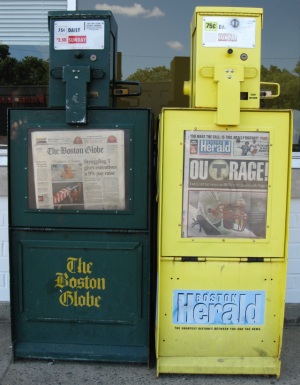
“Alden’s history with newspaper ownership is akin to a biblical plague of locusts — it devours newsroom resources to maximize profits, leaving ruin in its wake,” the editorial says. Indeed, Alden, the hedge fund behind MediaNews Group, has destroyed papers from coast (the Orange County Register) to coast (the Boston Herald) and at various points in between (The Denver Post).

Become a member of Media Nation today

The Sentinel’s local and regional coverage would be valuable to its community in any case. But as the editorial notes, it’s the paper’s reporting on indicted former elected official Joel Greenberg that led the national press to U.S. Rep. Matt Goetz, a Florida Republican whose meltdown encompasses so much alleged wrongdoing that it can’t be easily summarized here.

As I wrote earlier this week, a group led by the hotel magnate Stewart Bainum, who hopes to take Tribune’s Baltimore Sun nonprofit, has offered Tribune’s board slightly more money than Alden ($650 million to $630 million). But the board has been leaning Alden’s way because the Bainum group hasn’t pulled its financing together yet. The Sentinel editorial puts it this way:

This is the kind of principled ownership the Sentinel and other Tribune papers like the Chicago Tribune and South Florida Sun Sentinel need to survive and thrive, investors who see not just an opportunity to make money (because many papers, ours included, still make money) but also a way to strengthen their communities.

With chains of varying levels of greed such as Gannett, Advance and McClatchy controlling almost everything else, the fight of Tribune really feels like it’s the last battle in a long war for the soul of American newspaper journalism.

If the Bainum group loses, the only thing left will be the hard work of building an alternative local news ecosystem.

How FCC ownership regulations helped shape the Boston media landscape

Photo (cc) 2008 by Dan Kennedy

The U.S. Supreme Court on Thursday unanimously upheld a 2017 ruling by the FCC to loosen media ownership regulations, including an end to the so-called cross-ownership ban. That ban prohibits one entity from owning a newspaper and a TV or radio station in the same market.

The FCC’s long, tortured history on cross-ownership shaped the Boston media scene from the 1950s through the ’80s. Although the ban wasn’t formalized until 1975, the FCC had much to say about the issue well before that. No one told the story better than John Aloysius Farrell in his 2001 book “Tip O’Neill and the Democratic Century,” which I wrote about for The Boston Phoenix.

It’s a pretty amazing tale, and it’s crucial if you want to understand how the dynamic between The Boston Globe and the Boston Herald played out over the course of those decades. The very short version: the Boston Herald Traveler, with the support of the Kennedys, obtained the license to Channel 5 in the 1950s through corrupt means. The Globe, with the help of O’Neill, then a young congressman, exposed that corruption. That, in turn, led to the Herald’s losing the license to Channel 5 in the early 1970s, thus cementing the Globe’s status as the city’s dominant daily newspaper.

The final act played out in the late 1980s when Rupert Murdoch, who then owned the Herald, bought Channel 25 and sought a waiver from the FCC that would have allowed him to keep both. Sen. Ted Kennedy slipped an amendment into a bill that made it virtually impossible for the FCC to grant such a waiver. Several years later Murdoch sold the Herald to Pat Purcell, a longtime lieutenant. Although the Herald enjoyed a few years of prosperity under Purcell, it eventually entered a long, slow decline, ending in bankruptcy and the sale to the hedge fund Alden Global Capital in 2018.

So now that the cross-ownership ban is gone, what’s next? A number of organizations, including the media-reform group Free Press, opposed the FCC’s move, arguing that it will make it more difficult for local groups, including those representing women and people of color, to acquire media outlets. I agree, although there’s also a case to be made that newspapers and, to some extent, broadcast media are so moribund that ownership regulations are more about the last century than this one.

It does seem likely to me that we’re going to see newsrooms that combine newspaper and broadcast operations in an attempt to save money. We’ll see less diversity and less coverage as a result. But given that virtually all media have shifted to the unregulated internet, the ultimate effect of such consolidation is yet to be determined.

A leading media ethicist picks up the pieces of the David Brooks story

Edward Wasserman. Photo (cc) 2019 by the Knight Foundation.

The controversy over New York Times columnist and “PBS NewsHour” commentator David Brooks’ conflicts of interest has all but faded away. But before everyone just, you know, moves on, I’d like to share with you a new blog post by Edward Wasserman, former dean of the Graduate School of Journalism at UC Berkeley and one of the country’s leading media ethicists. If you’ve forgotten the backstory, Wasserman has recapitulated it for you.

Wasserman begins with the valuable observation that conflicts tend to arise at the opposite ends of the economic spectrum — low-paid journalists caught in the realities of a shrinking news business have to take on outside work, meaning that “every story we read may be an audition for future work (or a thank-you for past employment), and we’re left to wonder how single-minded the writer’s commitment to us can be.” Or, for that matter, they might have an incentive to write nice things about McDonald’s. That, at least is understandable.

On the Brooksian end of the spectrum, though, the corruption is much more clear. Wasserman writes:

Star journalists cash in on notoriety from their day jobs, and the lead commentator for a prestige publication who moonlights on cable TV can make tens of thousands to speak at a trade association confab or corporate retreat. That’s a powerful incentive to pick subjects and grind axes that sharpen the journalist’s brand — which again raises the question, when we read their work, of who else they’re working for.

Another important point Wasserman makes is that the full disclosure Brooks failed to provide until he was caught by BuzzFeed News is no substitute for avoiding the conflict in the first place. Now, I’m among a younger (not that young) generation of media critics influenced by New York University Jay Rosen, which means that I tend to favor full disclosure without worrying quite as much about conflicts as earlier generations did.

But it’s hard to disagree with Wasserman when he writes: “Disclosure can never cleanse work of its bias; it can only alert readers to the possibility that bias exists and dare them to find it.” I would differ with Wasserman on his use of the word “bias.” Of course Brooks is biased. He’s an opinion journalist. But Brooks does owe us his independence, and he compromised that through his entanglements with Facebook and the Bezos family, among others.

I’m not sure whether Brooks could have survived this if he hadn’t apparently disclosed his conflicts to his previous editors (though not to readers or viewers). In any case, he’s still standing, and though he can drive me crazy sometimes, I agree with Wasserman that he is “a lucid and humane writer.” I’d miss him if he were gone. But I don’t know that I’ll ever trust him again — and there were already reasons to approach Brooks’ work with tweezers and a pair of rubber gloves.

Brooks has undermined trust in the Times, the “NewsHour” and himself. I guess the calculation is that he still has value; otherwise, he’d be gone. But he’s definitely moved himself to the discount rack, perhaps permanently.

Previous coverage.

A moment of fury and grace from the late Gil-Scott Heron

This morning is a time when the racial injustice that continues to run rampant is hitting home particularly hard. The Derek Chauvin trial, which is proving to be every bit as heartbreaking and enraging as it was a year ago, when we watched him kill George Floyd. The ongoing struggle over Georgia’s new racist voter-suppression law.

And it turns out that it’s the late, great Gil Scott-Heron’s birthday, which Brendan was taking note of on WUMB. So here he is performing the incandescent “Johannesburg” in 1976.

Love Live Local offers a useful guide to independent media on Cape Cod

Photo (cc) 2013 by Arek Olek

A nonprofit organization called Love Live Local has published a useful guide to independent local news organizations on Cape Cod.

Included in its roundup is The Enterprise of Falmouth, Mashpee, Bourne and Sandwich; The Cape Cod Chronicle, which covers Chatham, Harwich and Orleans; Cape Cod Broadcasting, which includes four FM radio stations that provide local news; and The Provincetown Independent, whose coverage area comprises Provincetown, Truro, Wellfleet and Eastham. I recently wrote about the Independent.

As Love Live Local points out, the Cape’s legacy newspapers are now owned by Gannett, which, along with its predecessor company, GateHouse Media, has cut them repeatedly over the years. If residents really want to be informed about what’s going on in their communities, they need to seek out independent sources of news.

So what is Love Live Local? Here is what the About page says:

When Love Live Local started in 2013, how it would evolve was a bit of an unknown. The intention was to highlight positive stories, Cape Cod happenings and connect local businesses with customers and supporters. As the founders began to appreciate not only how important small business was to the region, but also how much they were struggling, the messaging evolved, and they began to advocate much more strongly on behalf of small, local businesses — the backbone of this community.

Locally owned media and other types of businesses are all part of the same ecosystem that makes for a vibrant community. It’s good to see that there’s an organization on the Cape dedicated to helping them thrive.

How the COVID pandemic hypercharged Stat

Illustration (cc) 2020 by Prachatai

Luke Winkie has a terrific piece up at the Nieman Journalism Lab about the five-years-in-the-making overnight success of Stat, the health- and life-sciences site that’s part of Boston Globe Media.

The newly unionized Stat was designed as a niche site at is launch in 2015, which I wrote about for GBH News. Now the project is growing by leaps and bounds — from 1.5 million unique visitors a month in 2019 to 23 million, and, more recently, back to around 7 million. Stat has about 50 employees, which is about the same as when it started, though up slightly over its pre-pandemic head count. And it’s looking to hire another 20. Executive editor Rick Berke tells Winkie:

Stat has changed forever after last year. As a media company, we were on a good trajectory before the pandemic. But there’s no going back to the pre-pandemic reach that we had.

Rich guys band together in a final push to stop Alden from buying Tribune Publishing

Photo (cc) 2009 by Thomas Hawk

Less than a week ago, efforts to keep Tribune Publishing out of the clutches of the hedge fund Alden Global Capital appeared to be faltering.

The hotelier Stewart Bainum, who originally got involved so that he could acquire Tribune’s Baltimore Sun and its affiliated papers in order to turn them over to a nonprofit, was seeking to outbid Alden’s $630 million offer. But according to Rick Edmonds of Poynter, the Alden deal was a simple cash offer that could be consummated quickly, which meant that Bainum was likely to lose out.

On Saturday, though, Marc Tracy of The New York Times reported that a Swiss billionaire named Hansjörg Wyss had teamed up with Bainum, with each man pledging to put up $100 million apiece.

Then, on Monday, we learned from Lukas I. Alpert of The Wall Street Journal that yet another wealthy patron, the technology investor Mason Slaine, had also agreed to put up $100 million. Slaine, who already owns a small chunk of Tribune, wants to acquire Tribune’s two Florida papers, the Orlando Sentinel and the South Florida Sun Sentinel of Fort Lauderdale.

Become a member of Media Nation today.

Also over the weekend, Gary Lutin, a Manhattan investment banker, revealed that he wants to buy The Morning Call of Allentown, Pennsylvania, telling the paper: “There are many encouraging examples of both large global news organizations as well as small community news organizations that survive and eventually prosper based on improving the quality of the news service.” Lutin’s interest is not dependent on the Bainum group’s success — he says he’ll attempt to cut a deal with whoever the eventual buyer turns out to be.

Meanwhile, Patrick Soon-Shiong, the possibly reluctant owner of the Los Angeles Times and The San Diego Union-Tribune, remains in a position to veto any deal with Alden, though Edmonds has speculated that Soon-Shiong would be happy to cash in.

“Hope is what Tribune staffers are feeling,” writes CNN media reporter Kerry Flynn, “as it looks more and more feasible that local ownership could be in their futures — instead of Alden.”

The Tribune saga has been years in the making as the chain — which currently consists of nine papers — has lurched from one ownership melodrama to another. There was the epic era of Sam Zell, the foul-mouthed Chicago real-estate magnate who hated newspapers, documented memorably by the late David Carr. There was the rudderless period when the company was known as tronc.

Now the struggle over Tribune may represent the last best chance to stop Alden from destroying what’s left of some of the most important papers in the country — among them the Chicago Tribune, New York’s Daily News and, closer to home, the Hartford Courant.

“Maybe I’m naive,” Wyss told the Times, “but the combination of giving enough money to a professional staff to do the right things and putting quite a bit of money into digital will eventually make it a very profitable newspaper.”

Wyss isn’t being naive at all. Not only have The New York Times and The Washington Post shown it can be done, but regional papers such as The Boston Globe, the Star Tribune of Minneapolis and The Seattle Times are all doing well under local ownership committed to the transition from print to digital and from a mostly advertising-based model to one mainly supported by reader revenue.

Journalism is too important to be left to the whims of unbridled capitalism. We shouldn’t be reduced to having to root for one group of rich guys over another. But that’s where we’re at. In that spirit, may Bainum, Wyss, Slaine and Lutin win.

Previous coverage.

‘Atomic Cover-Up’ reveals a previously unseen story of human devastation

Previously published at GBH News.

The documentary “Atomic Cover-Up” begins on an oddly hopeful note. In December 1945, four months after the bombing of Nagasaki, Lt. Col. Daniel McGovern was leading a film crew through the rubble when he picked up the strains of “Silent Night.”

“I heard voices singing,” he says, adding that at first he thought he was imagining it. He wasn’t. He and the crew set up their equipment inside the cathedral where the voices were coming from and began filming. We see a priest and children singing.

“And I look out and see complete devastation,” McGovern says. “And hear the voices.” The singing continues as the camera pans across the ruins of a city that had been utterly destroyed by the second of two atomic bombs dropped by U.S. forces.

Written and directed by the journalist Greg Mitchell, the recently released “Atomic Cover-Up” is the culmination of a decades-long quest to release footage of the human suffering caused by the atomic bombs dropped on Hiroshima and Nagasaki in August 1945. Mitchell himself put years into the effort, writing a book about it in 2011 whose subtitle refers to “the greatest movie never made.”

Well, now it’s been made, and the terrible images captured after the bombings — including color film seen for the first time — are a testament to the lives lost and ruined. It is the visual equivalent of John Hersey’s classic 1946 New Yorker article and book “Hiroshima.” (The 52-minute documentary can be seen online through Tuesday, March 30. Details are below.)

The story is told mainly by McGovern and Lt. Herbert Sussan, who died in 1985, possibly from exposure to radiation, and to whom the film is dedicated. They as well as Japanese filmmakers set about documenting the human suffering caused by the bombs only to have their work censored and suppressed.

When Gen. Douglas MacArthur, the leader of the American occupation, ordered the Japanese footage confiscated, the Japanese made a copy and hid it in a ceiling. “We knew that we risked a long sentence in a U.S. military prison,” says one of the filmmakers, Ito Sueo.

McGovern and Sussan, meanwhile, were blocked from releasing their footage because the U.S. military had classified it, preferring to show images that depicted the destruction of buildings but leaving out the price paid by the people on the ground — the overwhelming majority of them civilians, many of them women and children.

Sussan later worked for CBS and NBC, where he implored the likes of Edward R. Murrow, Chet Huntley and David Brinkley to help him get the footage released. He even tried to enlist the help of the president who ordered the bombings, Harry Truman. All of it was to no avail. Over time, though, the footage was declassified. In 1967, Japanese films seized by the U.S. were repatriated. And so began the long process of bringing these unsettling truths before the public.

For more than three-quarters of a century, we have debated whether it was necessary to use atomic weapons in order to bring about an end to the war in Japan. There’s crucial context that must be considered — atomic bombs had never been used before, so it was hard to imagine that the U.S. would hold back from unleashing a powerful new weapon in what was total war. The conventional bombing of Dresden, Germany, in February 1945 had claimed 25,000 lives. At the time, dropping atomic bombs on Japan must have seemed like just another ratcheting-up of the war effort.

Yet we soon knew better. More than 100,000 people were killed immediately in the two bombings, and nearly as many were injured. We learned about the horrors of radiation poisoning. And — let us hope — we learned that humankind can never use such weapons again.

Mitchell, who has long argued that the bombings were unnecessary, tells us toward the end of the film that U.S. military officials and Gen. Dwight Eisenhower himself believed that the Japanese would have surrendered in a matter of months even if atomic bombs hadn’t been used. Thus, in Mitchell’s view, we all bear moral responsibility for what happened to the people of Hiroshima and Nagasaki.

There is much in “Atomic Cover-Up” that’s difficult to look at. Perhaps the most gut-wrenching scene is that of a teenage boy who is lying on his stomach, every bit of skin peeled off his back so that his muscles are fully exposed. We are told that he was kept alive in what was essentially a penicillin bath, and that doctors persisted with their efforts despite the boy’s pleas that he be allowed to die.

Yet that leads to a moment of grace as moving as the sounds of “Silent Night.” We later learn that the boy survived and, as an adult, became an anti-nuclear activist. There are very few moments in the film that transcend despair. As a viewer, I found myself holding on to such moments as a way to get through the rest of it.

Mitchell has brought to us a story that is both excruciating and of paramount importance. Everyone should see it. We have never come to terms with the horror of what was done in our name in August 1945. People of goodwill can differ over whether we did the right thing in order to bring a terrible war to its conclusion or if, instead, we committed unforgivable crimes against humanity.

What none of us can do is look away.

How to watch: “Atomic Cover-Up,” written and directed by Greg Mitchell, may be seen for two more days, today and on Tuesday, March 30, as part of the Cinejoy Virtual Film Festival, where it premiered on March 20. Click here to purchase tickets and view the film. Mitchell is working on plans for further distribution and asks that anyone interested send him an email; his contact information is here.

Salem mayor calls for the Legislature to be covered by the open meeting law

Salem Mayor Kim Driscoll. Photo (cc) 2020 by the office of Gov. Charlie Baker.

Well, isn’t this a lovely surprise on a Monday morning. Salem Mayor Kim Driscoll has written an op-ed piece for The Boston Globe calling for an end to the state Legislature’s exemption from the open meeting law — a law that requires virtually all city and town boards and many state commissions to conduct their business in public. It’s a bit too late for Sunshine Week, but we’ll take it. Driscoll writes:

If 351 cities and towns can adopt budgets, engage in policy debates, hire and evaluate staff, and create local laws — all while meeting the rightly rigorous standards of the Commonwealth’s Open Meeting Law — there is no valid reason why our state colleagues cannot do the same.

Driscoll also notes that Massachusetts is one of only 11 states whose legislature is exempt from open meeting laws.

Similarly, the Legislature and the courts are exempt from the state’s public records law, and a succession of governors, including Charlie Baker, have claimed that their immediate staff is exempt as well.

Become a member of Media Nation today

Last fall, our Northeastern journalism students contacted all 257 candidates for House and Senate seats and asked them whether they would support ending that exemption. Sadly, only 71 responded despite repeated emails and phone calls; but of those who did respond, 72% said they favored applying the public records law to the Legislature.

As with the open meeting law, Massachusetts is an outlier: it is one of only four states whose public records laws do not cover legislative proceedings.

The central argument Driscoll offers is unassailable. If cities, towns and state agencies can comply with the open meeting and public records laws, so, too, can the Legislature. It’s long past time to drag the proceedings of the Great and General Court out into the sunlight.