In the beginning: Emily Rooney and the early days of the WGBH-WBUR rivalry

Photo (cc) 2019 by Dan Kennedy

Twenty-four years ago, Emily Rooney — whose long-running media-criticism program, “Beat the Press,” on which I was a panelist, was canceled last week by GBH News — was just beginning a new phase of her career, as host and executive editor of the news and public-affairs program “Greater Boston.” I wrote a piece for The Boston Phoenix about her debut as well as the state of the rivalry between WGBH and WBUR — a rivalry that, if anything, is more intense today than it was then. This story was published on Feb. 7, 1997. I’m republishing it here courtesy of the Northeastern University Archives.

Making waves

With commercial stations going lowbrow, Boston’s public broadcasters are fine-tuning their strategies. The question: are WGBH & WBUR doing their duty?

The Boston Phoenix • Feb. 7, 1997

Emily Rooney is taping the intro to a segment of WGBH-TV’s new local public-affairs show, Greater Boston. Or trying to, anyway. It’s been a long day. Her feet are killing her. And her first few attempts at hyping an interview with Charles Murray, the controversial academic who’s currently promoting his new book on libertarianism, haven’t gone particularly well.

After several tries, though, she nails it. “That was warmer,” says a voice in the control room. “That was very nice.”

She sighs, visibly relieved at getting a break from the unblinking eye of the lens.

Rooney, the former news director of WCVB-TV (Channel 5), may be a respected newswoman, but the debut of Greater Boston last week showed that her transition to an on-camera role is going to take some time. And if Rooney and Greater Boston are struggling to find their voice, so, too, is WGBH.

Continue reading “In the beginning: Emily Rooney and the early days of the WGBH-WBUR rivalry”

In which Mike Beaudet and I try to make sense of CNN’s Chris Cuomo problem

By Peter Ramjug

Chris Cuomo is expected to be back on the air at CNN this week. Questions still swirl around him following the resignation of his older brother, New York Gov. Andrew Cuomo, and the role the cable network star played in advising the governor through his political crisis and how the network will handle one of the biggest stories of the year going forward.

Cuomo will likely keep his job, say Northeastern journalism faculty experts Dan Kennedy and Mike Beaudet, even as media watchdog groups and others have called for him to step down or be fired for his involvement with the matter. They say network management and Chris Cuomo himself share blame for a “messy situation” that blurred personal and professional lines between the anchor and his embattled sibling.

Read the rest at News@Northeastern.

Best wishes to Emily Rooney as ‘Beat the Press’ comes to an end after 22 years

Our 20th anniversary show, Dec. 7, 2018

Major local media news today as GBH News has announced that it’s canceling “Beat the Press” after a 22-year run. I am proud to have been part of the show since its first year, 1998, and to have been a regular for many of those years. And I’m grateful to Emily Rooney, the host and creator of the show. We’ve been on hiatus since June 11; as it turns out, that was our finale.

I’ll continue writing my weekly column on media and politics for GBH News.

It’s hard to put into words what I’m feeling right now. For so many years, heading over to GBH to record “Beat the Press” was simply what I did on Friday afternoons. I hugely enjoyed getting to know Emily, Callie Crossley and everyone else. (I’ll stop at Emily and Callie because if I start naming names, I’ll leave too many out.)

Emily began hosting “Greater Boston” in the mid-’90s. From the beginning it was a Monday-through-Thursday show, with the Friday slot originally taken up by something called “The Long and the Short of It,” with Robert Reich and Alan Simpson. After that show had run its course, Emily pitched “Beat the Press” to WGBH executives (yes, the station still had a “W” back then), and we were off and running.

I haven’t had a chance to talk with Emily yet, but I wish her all the best. She is a legendary figure in Boston media, as news director of WCVB-TV (Channel 5), at the national level and, for the past quarter century, at GBH News. It will be interesting to see what she does next.

Finally, best wishes to Kara Miller, whose program on WGBH Radio (89.7 FM), “Innovation Hub,” will be coming to an end later this year as well.

What follows is the press release from GBH News:

GBH continues to build a multiplatform news organization that provides our community with the most distinctive, relevant and interesting stories of the day. GBH News is deepening its focus on audience-centered local stories, and concentrating its editorial efforts on the critical issues of education, social justice, Covid/public health and politics. As a result, GBH will discontinue production of two weekly programs, Beat the Press with Emily Rooney, which examines the local and national media, and the national radio series Innovation Hub with Kara Miller.

“This was a difficult decision. Beat the Press has been one of GBH’s longest running news shows and has provided viewers with informative and thought-provoking insight, commentary and perspective on the workings of the media. We are grateful to Emily Rooney for her award-winning work, her dedication to her craft, and her many contributions to GBH over 24 years.”

Innovation Hub has given us a deeper understanding of the inventive spirit of human ideas and technology over the course of a decade. We thank Kara Miller and the Innovation Hub production team for their exceptional work, creativity and contributions to public media.”

– Pam Johnston, General Manager GBH News

Beat the Press is currently on summer hiatus and will not return in September; Innovation Hub will continue to air through mid-November in national distribution with PRX.

Kara Swisher to Patrick Soon-Shiong: How could you let Alden buy Tribune?

Kara Swisher. Photo (cc) 2017 by nrkbeta.

I just skimmed the transcript of Kara Swisher’s interview with Los Angeles Times owner Patrick Soon-Shiong. It gets off to a slow start — but eventually she lets him have it in the chops over his pathetic rationalizations for not stopping the hedge fund Alden Global Capital from buying Tribune Publishing earlier this year.

The short version, for those who aren’t sure what I’m talking about: Soon-Shiong, a billionaire surgeon and medical entrepreneur, owned 24% of Tribune, which publishes nine major-market daily newspapers. He could have blocked Alden by voting no or by voting to abstain, thus giving Baltimore hotel magnate Stewart Bainum more time to put a deal together — or to see if another buyer might emerge.

Instead, Soon-Shiong declined to vote at all, which allowed the deal to go through. Here’s the heart of what Swisher told him:

So essentially you’re saying I couldn’t save them. And I’m — I don’t quite know what to say. There’s some point where you do make a stand and say, you can’t do this. And especially with Alden Global Capital having a reputation it does, you might have stood up for it. You might have said no. But you felt the current owners weren’t going to really do anything with your money. As you said, they had an agenda. It seems like you have a theory of their agenda. But they weren’t going to make it better. And so any port in the storm, is that what you’re saying?

Soon-Shiong’s hedging is pretty much in line with his recent interview with Brian Stelter of CNN. But this response screams out:

Well, it’s a little more than that, right? I think there should be enough civic responsibility in Chicago, enough civic responsibility in Florida, civic responsibility wherever these — Baltimore. And obviously, as you knew, there were certain billionaires and multimillionaires. So to be fair, it should be really the responsibility of people living in their community. I live in California. So I can’t personally be responsible for Florida or Baltimore and Chicago.

Baltimore? Baltimore? Is the good doctor kidding? Bainum originally had an agreement to acquire The Baltimore Sun from Alden after Tribune was sold and then donate the Sun to a nonprofit. After he concluded that Alden was jerking him around, he tried to put together a group that would buy the entire chain. (Bainum is now launching a nonprofit news project in Baltimore.)

Look, it’s great that Soon-Shiong seemed to be committed to the Times and his other paper, The San Diego Union-Tribune. But if you look up the word “disingenuous” in the dictionary, you just might find his photo.

Previous coverage.

Become a member of Media Nation for just $5 a month!


Spurned by Tribune, Stewart Bainum moves ahead with nonprofit news in Baltimore

Baltimore. Photo (cc) 2014 by Patrick Gillespie.

Among the worst outcomes of Stewart Bainum’s failed bid to purchase Tribune Publishing is that he lost out on an earlier deal to buy The Baltimore Sun and donate it to a nonprofit organization.

The hedge fund Alden Global Capital had originally agreed to spin off the Sun to Bainum after buying Tribune’s nine major-market dailies. That deal fell through when Bainum, a Baltimore hotel magnate, balked at Alden’s terms and tried to buy the entire chain.

So it’s very good news that Bainum appears to be moving ahead with a nonprofit venture that would compete with the Sun. Rick Edmonds of Poynter reported earlier this week that Bainum is advertising for a chief product officer who’ll work for a “well-funded startup” aimed at becoming “a new paradigm for digital first, cross-channel local media.”

The project will include the web, mobile, terrestrial and satellite radio and video, both on television and online, according to the ad, which adds that the “vision is to be the leading provider of news and lifestyle content in the Baltimore area.”

Bainum was originally willing to pay $65 million for the Sun. Assuming that money is still on the table, this should be a well-funded regional news product. Bloomberg and the Lenfest Institute are involved, too, though Edmonds suggests their role will be minimal.

One aspect I find interesting is the cross-platform nature of the project. The biggest challenge facing online-only media is getting the word out that they exist. As a former newspaper executive once told me, the problem with dumping the print edition in favor of digital is that print is essentially a billboard for digital. If print goes away, you disappear to non-subscribers. Bainum might avoid that problem by moving into radio and television as well as digital.

I also wonder whether there’s an underlying strategy to wrest the Sun away from Alden. Given the way the hedge fund is already decimating its holdings, which include the Chicago Tribune, New York’s Daily News and the Hartford Courant, there is little doubt that the Bainum project will be a better, more comprehensive news organization than the Sun on the day that it debuts.

If the Sun’s audience and advertisers (yes, nonprofits can accept ads) move en masse to Bainum’s venture, Alden might prove willing to walk away.

Previous coverage.

Become a member of Media Nation for just $5 a month!

A media scholar explains why news for the liberal elite is hurting us all

Previously published at GBH News.

As technological and cultural forces have ripped apart the economic foundations of local and regional journalism, news executives have desperately sought out audiences with the money and inclination to pay.

These audiences — affluent, well-educated, liberal and overwhelmingly white — favor news organizations with a national focus such as The New York Times, NPR and the “PBS NewsHour.” Meanwhile, marginalized Americans, from urban communities of color to the rural white working class, have been left behind.

In her new book, “News for the Rich, White, and Blue: How Place and Power Distort American Journalism,” Nikki Usher tracks the decline of what she calls “Goldilocks newspapers” — large regional papers like The Boston Globe, The Dallas Morning News and The Philadelphia Inquirer. Unlike the fairy tale, though, Usher’s definition of Goldilocks papers are places where everything is just wrong — the outlets are too large to serve local communities, too small to contend with national media and unable to compete with Google and Facebook in the digital advertising market. (Disclosure: Usher interviewed me for her book.)

“Losing local news … leaves national news to pick up the slack,” Usher writes, “meaning many people in the United States do not see where they live or people like them authentically presented in the news.”

Usher, a journalism professor at the University of Illinois Urbana-Champaign, earned her Ph.D. and M.A. from the University of Southern California’s Annenberg School for Communication and is a Harvard graduate. The following email interview has been lightly edited.

Q: You argue that the economic challenges facing journalism have led news organizations to pursue an audience that is mostly white, liberal and affluent. How did we get here?

A: For decades, news organizations have sought to reach so-called quality audiences, or audiences that advertisers want to reach — so trying to reach those with disposable income is always the goal, right? It’s important to remember that for most of contemporary history, newspapers, magazines, broadcast television and radio made their money by selling audiences to advertisers. However, since the 1960s and 1970s, newspapers strategically moved away from selling to working-class audiences to focus on those profiting from the post-war boom.

But now we’re in a really different era. The traditional advertising model for newspapers, in particular, has collapsed, thanks to the upside-down logics of digital advertising and the changing dynamics, interests and behavior of digital audiences. When it comes to digital, audiences for local news are especially tiny. And we have market failure for local newspapers, meaning that the market is no longer supporting the costs of production and distribution. This is a real, actual crisis, with at least 1,800 communities losing a local newspaper since 2004.

So this is the context: the audiences for newspapers are smaller and the traditional ad model is broken. In a state of market failure, pre-existing inequities in coverage and access are amplified. News organizations have to focus on those most likely to pay for a digital subscription. The news organizations most likely to survive are large, national news organizations like The New York Times, which can scale these digital subscriptions.

Who are those who can and will pay? Well, those with disposable income who have the cultural capital to recognize that local journalism matters. That veers affluent, although “rich” is more tied to an elite outlook and framing than it is actual income. For instance, a student at Harvard might choose to pay for a student-rate for a digital subscription and get hooked for life, or at least that’s the hope.

Income and class are horribly correlated with race in this country, but the reality of white audiences comes out of a much larger problem: the longstanding whiteness of the institutional news media. At the moment we’re having a reckoning, but, for too long, white voices have dominated the production of news in this country, excluding and stereotyping historically marginalized communities and journalists from these communities. Institutional news media has for decades been for and by white.

And, well, the Blue? Liberal audiences? Oh boy, that’s a whole depressing conversation, but the only people who still trust the mainstream news media are liberals, which poll after poll shows is the case. Additional data suggests liberals believe in the civic value of local news enough to pay for it. Markets shape journalism and journalists, and here is where we are: digital subscriptions are not for everyone, and the news produced is coming from journalists who have a white, largely culturally elite background — especially as it becomes more and more financially precarious to become a journalist.

Q: What are the implications for democracy?

A: So, there are lots of different ways to think about democracy. The cynic in me would like to point out that much of the kind of locally specific accountability journalism we worry about losing has been a historical anomaly, mainly present only in major cities at large news outlets as a post-Watergate phenomenon. So news equals democracy isn’t a historically accurate framing.

But journalism is more than just about information; it’s about creating a shared culture. That shared culture reflects the biases of its creators, but it’s important to have journalism to document the shared meaning and history of a place — and I worry so much about what happens when that is no longer present.

When we just have large national news organizations telling the stories about American life, and quality news is available only to those who will pay, we get a super-distorted version of democracy. You can have democracy — but it’s an elite democracy that serves the interests and information needs of elites, rather than journalism that facilitates the pluralistic multicultural democracy that we need.

Q: You and I talked about The Boston Globe’s success, one of a few exceptions to the overall decline of large regional newspapers. Do you think that’s because of committed local ownership — and could that be replicated elsewhere? Or is it simply a consequence of Boston being one of the last great news towns?

A: Boston is a great news town. Have they finally caught Whitey Bulger’s ghost, or are there other mobsters still lurking around in Southie? I had a blast as a Globe intern eons ago.

But in all seriousness, Boston has a lot of advantages that structurally predispose it to being a place where local news thrives: there is a large sector of wealthy, educated, liberal Americans who see the value of paying for news. Boston also has famously corrupt institutions, like the Catholic Church, and the value of exposing corruption is not lost on Boston area residents. Boston sports fans are rabid.

So yes, local ownership makes a huge difference. John Henry’s tolerance for loss is likely a little greater than some of the other billionaires investing in news, plus he’s really in the billionaire class. That gives the Globe a bit of a cushion that isn’t present elsewhere.

Q: Could a healthier media environment help overcome the political and cultural polarization that is tearing us apart? How?

A: How we define health reflects our normative and partisan bias about what constitutes a healthy news environment. For those who are on the far right, the present news environment, where conservative media now reaches deep into the trenches of American life, this is a golden time for a historical correction.

Before having this conversation, we need to remember that diagnoses of health, civility and incivility, and polarization can be turned into variables, but they are also in the eye of the beholder. Some data suggests that what is tearing us apart is not just our views but how we actually feel about people who are not like us. To overcome this, it might be helpful to have the press stop demonizing people who don’t act or behave the way you wish they would — at present, anti-vaxxers in rural America — and stop stereotyping historically marginalized communities that have long been harmed by problematic and extractive news coverage.

The seeds of our dysfunction are baked into the press, yes, but also, as I argue in the book, are part and parcel of the larger social, regional, structural and racial inequities that we have let grow.

Q: Choosing from among the possible solutions you outline at the end of your book, please identify one that you think would have the greatest impact.

A: Can I pick two? Antitrust breakup of Big Tech, which might restore some competition to the digital advertising market and undermine the monopoly over consumer data that advantages big tech companies.

The unlikely one? Having the Democratic Party or party donors start funding local news media directly, as the Republicans are already doing.

The media should learn from the Times Union’s example on ethics and independence

New York Gov. Andrew Cuomo. Photo (cc) 2014 by Diana Robinson.

Just last week I praised the Times Union of Albany, New York, for its reporting on Gov. Andrew Cuomo’s history of sexual harassment and assault. Now the paper is having “a moment,” as a headline at the Columbia Journalism Review puts it, earning widespread plaudits for its principled — and colorful — refusal to accept off-the-record documents that were apparently aimed at smearing one of Cuomo’s accusers.

As Azi Paybarah reported in The New York Times, Times Union editor-in-chief Casey Seiler and managing editor Brendan Lyons were on a call last March with Cuomo’s then-top aide, Melissa DeRosa, when DeRosa told them she was going to send them documents about Lindsey Boylan, one of Cuomo’s alleged victims. It turned out that the governor’s office was secretly recording the conversation, and the transcript was included in last week’s report by state Attorney General Letitia James. (Secretly recording someone in New York State is legal.)

Seiler’s response: “Ugh, no, no! Not off the record. No, don’t send us anything unless it’s on the record, Melissa, OK?”

This is the way to do it. Although off-the-record conversations and documents can sometimes be helpful in establishing context, they are also incredibly dangerous, tying the hands of journalists and making them complicit.

As Jon Allsop notes at the CJR, the Times Union’s stand has nothing to do with the ongoing debate about objectivity; rather, it’s about independence:

There is, as Paybarah and others have suggested, something pleasingly old school about the Times Union’s approach to the Cuomo story. But at a moment of profound media-industry debate — that cuts, in caricature at least, down generational lines — as to the value of traditional journalistic norms and practices, it’s worth noting that what’s good about the paper’s journalism, as presented in the report, is not old-schoolness, in itself, but its strict critical distance from power, a value that many of the industry’s would-be reformers are trying to reassert, not muddy.

Washington Post media columnist Margaret Sullivan praised the Times Union as well, writing that it “maintained proper journalistic distance from sources, even when there was a price to pay in terms of access. Refused off-the-record information. Served the public interest.”

Of course, it’s worth nothing that the Times, the Post and some of the other major news outlets that have lauded the Times Union over the past week regularly allow the powerful to go off the record even when they shouldn’t. So in addition to ladling on the hosannas, I hope they’ll also treat the example of the Times Union as a learning experience.

Become a member of Media Nation for just $5 a month.

A community journalist nails The New York Times on COVID misinformation

Last week The New York Times reported on local news outlets that report COVID vaccine misinformation. The story, by Sheera Frenkel and Tiffany Hsu, focused on the Freedom’s Phoenix of, well, Phoenix and the Atlanta Business Journal, which were pushing falsehoods from Joseph Mercola, described as “a top spreader of misleading COVID-19 information.”

The story attributes the rise of misinformation on local news sites to the financial squeeze that has left community journalists bereft of the resources they would need to fact-check outside contributions from the likes of Mercola. Frenkel and Hsu also write, “Vaccine misinformation has also been published on sites that purport to be local news, but which are pay-for-play content websites,” but they do not describe the Freedom’s Phoenix or the Atlanta Business Journal as such.

Big mistake — and the Times got nailed by Ed Miller, the editor and co-founder of The Provincetown Independent. “This atrocious piece of sloppy reporting in the country’s best newspaper makes my heart ache,” Miller writes in his most recent commentary. He explains:

Ten minutes of online research would have revealed that the Freedom’s Phoenix is not “a local news site.” It is a national propaganda machine launched in 2015 by Ernest Hancock, a longtime libertarian publisher and radio host who was associated with the paramilitary Viper Militia that conspired to blow up government buildings in Phoenix. The Times reported in 1996 that Hancock defended the militia leaders, saying, “Their crime is educating other people.”

To which I would add: Come on, people. Take a look at the site. This isn’t even a pink-slime project purporting to be a local news organization. It’s pure nut-job right-wing conspiracy-mongering.

Miller wasn’t able to find out much about the Atlanta Business Journal, but suffice it to say that it’s not the Atlanta version of the Boston Business Journal. In fact, there is such a thing, but it goes under the name of the Atlanta Business Chronicle. The Atlanta Business Journal, by contrast, doesn’t appear to be especially business-oriented, and it includes oddities such as a disingenuously straight-up story about the Arizona vote-audit fiasco and a livestream of a church service.

Great work by Miller. All I can add that it’s disheartening to see a Times story I took at face value turn out to be such a steaming pile of — well — misinformation.

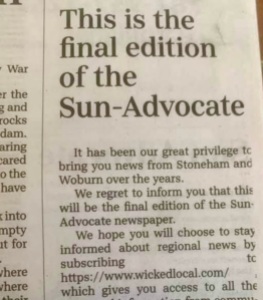
Gannett’s closing spree comes to Woburn and Stoneham

On and on it goes. I was a reporter at The Daily Times Chronicle of Woburn in the 1980s when the Woburn Advocate was launched by a local developer. It eventually fell into GateHouse Media’s and then Gannett’s hands. The Times Chronicle, still owned by the Haggerty family, continues to do good work. The Advocate, meanwhile, was merged with another GateHouse/Gannett paper, the Stoneham Sun, and now is no more.

To the extent that Gannett has any strategy with its most recent closings, the emphasis seems to be on getting out of places where there is competition. The Haggertys, in addition to running the Times Chronicle, also operate The Stoneham Independent.

I’ve heard there may be a couple of other Gannett weeklies in Eastern Massachusetts that have been shut down as well. Keep those tips coming. I’d also love to see any internal memos that lay out all of the closings. Send them along to dan dot kennedy at northeastern dot edu. As always, discretion is assured.

Earlier:

Gannett purge hits Upper Cape

Gannett has gone on a spree of closing print weeklies. The latest: The Sandwich Broadsider and The Bourne Courier, both of which were founded to serve the Upper Cape in the 1970s. Katie M. Goers of the independent Sandwich Enterprise has the story.

In addition to Sandwich, the Enterprise papers serve Bourne, Falmouth and Mashpee, so I’m guessing that the impact of Gannett’s action on local coverage will be minimal.

I’m hearing that Gannett is walking away from other weeklies in Eastern Massachusetts as well. If you’ve got a tip or (be still my heart) an internal memo, please pass it along to me at dan dot kennedy at northeastern dot edu. Discretion assured.

Update, Aug. 8: The Courier, Bulletin which covered Mashpee and Falmouth, was also shut down by Gannett, I’m told.

Earlier: