Joe Biden could be the next president. And he has issued a “demand” (via his campaign) that the networks stop booking Rudy Giuliani, which they have a First Amendment right to do.
Yes, Giuliani is lying about the Bidens. But Biden, who may soon have the power to appoint FCC commissioners, could have “urged” or “requested” that the networks stop giving Giuliani a platform. “Demand” suggests consequences. Does Biden want to join Trump in eroding constitutional norms?
For the first time in Donald Trump’s 33-month presidency, his impeachment seems possible — maybe even probable. The dam that withstood the Mueller Report has broken in recent days over the news that Trump may have withheld military aid from Ukraine in order to strong-arm that country’s president, Volodymyr Zelensky, into investigating Joe Biden. As “Never Trump” conservative Tom Nichols put it in The Atlantic: “If this in itself is not impeachable, then the concept has no meaning.”
Yet media fecklessness (and worse) has already pretty much guaranteed that the scandal will be seen in entirely partisan terms. To wit:
• In an appearance on MSNBC last Friday, New York Times reporter Kenneth Vogel breathed life into a discredited theory promoted by Trump and his lawyer Rudy Giuliani that the real story is Biden and his son Hunter’s dealings with Ukraine. Vogel called it “a significant liability for Joe Biden,” adding that Giuliani should back off “and just kind of leave the reporters to do the work on it.”
• On Monday, NPR.org published a headline that was a parody of false equivalence: “What’s The Ukraine Story About? Trump Says It’s Biden. Democrats Say It’s Trump.” I captured an image of it as I was gathering string for this column. Good thing. Because within a few hours, someone had the sense to change it to “Trump And The Ukraine Call — What Happened And What’s Next?” (The old headline is still in the URL.)
• In the fever swamps of the right, Trump’s enablers are working hard to transform this into another Benghazi/ Uranium One/ “her emails” distraction. In The Hill, John Solomon wrote that the Obama administration leaned on Ukrainian officials to drop an investigation into Burisma Holdings, a Ukrainian energy company that had Hunter Biden on retainer. “Politics. Pressure. Opposition research,” Solomon wrote. “All were part of the Democrats’ playbook on Ukraine long before Trump ever called Zelensky this summer.” Naturally, Solomon popped up on Fox News on Monday evening, sharing his conspiracy theories with a rapt Sean Hannity.
As Washington Post media columnist Margaret Sullivan put it: “Instead of snuffing out false and misleading claims, news stories give them oxygen. Then pundits come along to fan the flames — while simultaneously bemoaning what’s happened to our democratic norms.”
The Biden-Ukraine story is incredibly complicated, but the simplified version is this: Then-Vice President Biden served as the point man to pressure the Ukrainian government into removing that country’s prosecutor general, Victor Shokin, who had been investigating Burisma. Officials in both the United States and the United Kingdom were frustrated with Shokin for not moving aggressively enough in pursuing corruption. Shokin was in fact removed, and Biden took credit for it — more than he deserved, but that’s our Uncle Joe. There is no evidence that Hunter Biden benefited in any way or that the elder and younger Bidens even talked about the Burisma matter beyond one brief, non-substantive exchange.
Now this is where you, the fair-minded reader, probably find yourself wondering if there really is anything to the Biden angle. I wondered myself. What I discovered is every major fact-checking organization has concluded that neither of the Bidens did anything wrong. It’s fair to observe that Hunter Biden traded on his family connections in an unseemly way, collecting some $50,000 a month to serve on the Burisma board of directors. But as best as journalists have been able to determine, nothing illegal or corrupt took place.
You can check for yourself: Here is what Vox (“bogus”), PolitiFact (“nothing”), The Washington Post (“no equivalency”), The New York Times (“no evidence”; by Ken Vogel, no less) and The Wall Street Journal (“Neither Mr. Biden nor his son have been accused of any wrongdoing”) have had to say about the allegations against the Bidens.
It seems like a long time ago now, but this all started coming into focus two weeks ago, when U.S. Rep. Adam Schiff, chair of the House Intelligence Committee, publicly charged the Trump administration with violating the federal whistleblower law by not allowing an official who reportedly had damaging information about the president to come forward.
It all unraveled pretty quickly last week, with the Post and the Times moving the story forward and the Journal hitting what the Columbia Journalism Review’s Jon Allsop called “the motherlode”: the news that Trump had pressured Zelensky in a phone call last July, repeating about eight times that Zelensky should investigate the Bidens.
Trump’s various explanations for what happened have shifted. He’s admitted to putting the squeeze on Zelensky to go after the Bidens, but his latest explanation for suspending some $400 million in military aid was that he wanted the Europeans to contribute more. He also has promised to release the transcript of his call with Zelensky sometime today. It’s not clear what if any steps are being taken to ensure that the transcript is accurate. Nor has the whistleblower information been turned over to Congress.
House Speaker Nancy Pelosi announced late Tuesday afternoon that the House will begin a formal impeachment inquiry. In the weeks and months ahead, it is crucial that journalists do their job and not let themselves be sidetracked by Trump’s diversionary tactics about Joe and Hunter Biden.
Trump has actually admitted to demanding that a foreign government investigate one of his political opponents — as shocking a development as anything we have learned about Trump in his four-plus years as a national political figure. It remains to be seen if he also threatened to withhold military aid if the Ukrainians failed to comply, though the evidence suggests that’s exactly what he did.
Of course, if any legitimate concerns about the Bidens emerge, they should be investigated. What the press needs to avoid, though, is the urge to balance truthful information about Trump with his false accusations about one of his leading Democratic challengers.
Have the media engaged in false equivalence when it comes to political lying? Do fact-checkers nitpick statements by Democrats in order to seem fair and balanced when they go after President Trump’s numerous and blatant falsehoods?
That proposition might seem ludicrous. After all, The Washington Post last month announced that Trump had mademore than 12,000 false or misleading statements since his inauguration in 2017. Daniel Dale of CNN tracks every Trumpian falsehood — writing, for example, that the president“made at least 26 false claims” at a rally in New Mexico on Monday. PolitiFact has rated fully 69 percent of Trump’s public utterances asfalse to some degree, and 14 percent as being so at odds with reality that they have earned the coveted “Pants on Fire” rating.
And that’s just the tip of the journalistic iceberg. Indeed, if the media have told us anything about Trump over these past few years, it’s that he spews lies so freely that his every word and every tweet is suspect. So what do Democrats have to complain about?
This: Despite the media’s admirably tough-minded stance on Trump’s falsehoods, they are nevertheless holding Democrats to a much higher standard. Most politicians exaggerate, butcher the facts or shade the truth, and journalists should take note when they do. But the press should also be careful to point out the difference between standard-issue rhetorical excesses and the sort of gaslighting that Trump engages in on a daily basis.
Last week Michael Calderone of Politico wrote an important story about Democratic complaints regarding the fact-checkers’ embrace of false equivalence. He began with the example of Bernie Sanders’ claim that “500,000 Americans will go bankrupt this year from medical bills.” The Washington Post’s Fact Checker column awarded three Pinocchios (out of a possible four) to Sanders — not because he was completely wrong, but because medical bills were only one factor in those 500,000 bankruptcies. Meanwhile, Calderone noted, the Post also gave Trump three Pinocchios for claiming that large swaths of his border wall have been already built when, in fact, none of it has.
The Sanders example is a matter of factual interpretation. The Trump example is somewhere between a hallucination and a lie. Yet they each got the same rating. How can this be?
One explanation is that journalism, steeped as it is in notions of fairness and balance, is unequipped for the extraordinary challenge of the Trump era. Calderone offered several other instances of Democrats’ words being parsed for shades of nuance so that they could be labeled as lies. He also wrote that “several prominent fact checkers said they don’t believe their job has changed when it comes to holding politicians accountable for their words on the stump and in TV studios, despite Trump’s persistence falsehoods.” And he quoted PolitiFact editor Angie Drobnic Holan as saying, “Two wrongs don’t make a right.” OK. But everything is not the same.
Consider an example that Calderone didn’t cite: Joe Biden’s recent mixing up of three separate stories about honoring a heroic soldier who had tried to save a comrade in Afghanistan. Yes, Biden botched it pretty badly, but the essential truth of what he was trying to say came through. Yet The Washington Post headlined it, “As he campaigns for president, Joe Biden tells a moving but false war story.” False? Not really. More like Biden being Biden, lacking the discipline to master the details and not understanding why it matters.
Or how about two years of obsessing over Hillary Clinton’s private email server while the news that Trump uses an unsecured cell phone, reported last October in The New York Times, got about two minutes’ worth of attention — even though Chinese and Russian spies were reportedly listening in on Trump’s calls.
Those last examples aren’t about lies and fact-checking. But all of this is grounded in a larger, more enduring issue — accusations of liberal bias on the part of conservatives, and the duck-and-cover response from too many journalists whose politics may indeed be liberal but who bend over backwards to torment liberal politicians. Eric Alterman, in his 2003 book, “What Liberal Media?,” called it “working the refs,” and it goes back at least to Spiro Agnew’s famous nattering nabobs of negativism speech of 1970.
In 2012 — a more innocent time — I wrote in The Huffington Post that one of the big problems with fact-checking was that politicians’ false or partly false statements were rarely full-blown lies, but that ratings like Pinocchios or “Pants on Fire” suggested that every falsehood was a lie. “The fact-checkers are shifting from judging facts to indulging in opinion, but they’re not necessarily doing it because they want to,” I wrote. “They’re doing it because politicians don’t flat-out lie as frequently as we might suppose.” Now we have a president who lies so promiscuously that the fact-checkers seek out minor factual discrepancies among Democrats so it won’t seem like they’re picking on Trump.
“Indiscriminate criticism has the effect of blurring important distinctions,” Patterson wrote. “Were the allegations surrounding Clinton of the same order of magnitude as those surrounding Trump? It’s a question that journalists made no serious effort to answer during the 2016 campaign. They reported all the ugly stuff they could find, and left it to the voters to decide what to make of it.”
Now we are moving into yet another presidential election season. The problem for 2020, as it was for 2016, isn’t that the media won’t report negative information about Trump. It’s that they will report negative information about his opponents in such a way that it all looks the same. In that respect, Democratic complaints about fact-checking that may seem trivial are actually emblematic of a much deeper problem with journalism: the primal urge to treat both sides equally, to be seen as fair, to avoid accusations of liberal bias.
It’s going to be an ugly, brutal campaign, and Trump’s going to drive the agenda once again. Are the media up to the challenge? The evidence suggests that the answer to that question is no.
The story of Madeleine Westerhout, the 28-year-old aide to President Trump who was fired for sharing nasty gossip about the Trump family after having a few drinks with reporters, is fascinating (the original Politico story is here; some background from The New York Times is here).
Westerhout reportedly despised Trump so much that she burst into tears the night he was elected. Yet she went to work for him, brought into the White House by former chief of staff Reince Priebus despite an exceedingly thin résumé. She grasped for more power. And she showed no loyalty to the president whatsoever.
These are the kinds of people Trump surrounds himself with, because no one with integrity will have anything to do with him.
It would be interesting to learn how her off-the-record remarks became public. Daniel Lippman of Politico, who broke the story, wasn’t there, so he’s in the clear. Trump ally Arthur Schwartz, he of the media attack squad, has pointed the finger at Philip Rucker of The Washington Post, who was there. His editor issued a statement vouching for Rucker’s integrity without quite denying that Rucker was the source. Rucker has not written about the incident.
Most likely we’re not going to get to the bottom of this.
We’ve become accustomed to Trump outrages that seem OMG in the moment only to fade quickly into obscurity — replaced, as such things inevitably are, by the next insult, outburst or tweet. But even by those standards, a New York Times story reporting that Republican operatives with White House ties were seeking to embarrass President Trump’s adversaries in the media had an unusually short half-life.
Yes, there were stern condemnations from the usual suspects. Times publisher A.G. Sulzberger posted a memo to the staff calling it “an unprecedented campaign,” saying of the operatives: “Their goal is to silence critics and undermine the public’s faith in independent journalism.” A CNN spokesman said that when government officials and their allies “threaten and retaliate against reporters as a means of suppression, it’s a clear abandonment of democracy for something very dangerous.”
Others, though, were less impressed with this latest so-called threat to the First Amendment. Will Sommer of The Daily Beast tweeted, “This piece sure makes a big deal about a couple of guys using Twitter Advanced Search.”
This piece sure makes a big deal about a couple of guys using Twitter Advanced Search. https://t.co/wF308tV1iN
CNN’s Oliver Darcy wrote that another Daily Beast reporter, Maxwell Tani, had actually revealed the existence of the campaign, and of Trump fanboy Arthur Schwartz’s involvement, many months ago. And Jack Shafer of Politico saw no problem with digging up social-media dirt on journalists, citing similar efforts by watchdog groups such as Media Matters for America on the left and, many years earlier, Accuracy in Media on the right.
“As much as I would like to sympathize with my fellow journalists,” Shafer wrote, “it doesn’t strike me as unreasonable to ask them to own or repudiate vile or impolitic things they might have stated in the past. Nor is it remotely unfair for the president’s supporters to demand that journalists, who are forever denouncing him as a racist (because he is), be held accountable for their bigoted speech, on Twitter or anywhere else.”
Here’s the background according to the Times story, reported by Kenneth P. Vogel and Jeremy W. Peters. Schwartz, an ally of Donald Trump Jr. and former Trump-whisperer Steve Bannon, has reportedly gathered material on journalists at several news organizations perceived to be hostile to the president, including the Times, The Washington Post, and CNN. The fruits of Schwartz’s labors were on display recently when a Times editor named Tom Wright-Piersanti was forced to apologize after Breitbart reported that he had posted anti-Semitic tweets many years earlier.
The Breitbart hit, in turn, was supposedly in retaliation for a Times story on the checkered past of Trump’s new press secretary, Stephanie Grisham, who reportedly has a history of unethical workplace behavior as well as two drunken-driving arrests.
“If the @nytimes thinks this settles the matter we can expose a few of their other bigots,” Schwartz tweeted after the Breitbart story on Wright-Piersanti was published. “Lots more where this came from.”
What’s fair is fair? Not quite. There are, in fact, some troubling aspects to all this. Unlike Shafer’s examples, Media Matters and Accuracy in Media, Schwartz’s shop has ties to the White House. It’s not entirely clear how close those ties are, but they’re close enough that we ought to be concerned. The First Amendment, after all, was designed to protect the press so it could monitor the powerful, not protect the powerful so they can monitor the press.
Moreover, we expect our leaders and the people who work for them to meet certain basic moral and ethical standards, or at least we used to. Journalists, on the other hand, are judged by their work. If what they report is true and fair, then it should be irrelevant whether they drink to excess, jaywalk, or posted embarrassing and offensive tweets years ago.
Tom Jones put it this way in The Poynter Report: “Yes, absolutely, the media should be held accountable, too. But stories published or aired by reputable news organizations stand up to scrutiny through the use of facts, sources and citations. Because this [Schwartz’s] operation can’t discredit such stories, the next best thing to do is discredit the journalists and outlets by combing through tweets and Facebook and Instagram posts from years gone by.”
As attacks on the media go, this is fairly small. It’s not as serious as calling news organizations “Enemies of the People,” or banning reporters from the White House, or putting the safety of journalists at risk by whipping up angry mobs at Trump rallies.
But it erodes the norms of democracy around the edges, contributing to Trump’s meta-narrative that the press is just another partisan player that his devoted followers need not take seriously.
It has been an extraordinary few weeks for The New York Times.
From an outcry over a headline that blandly reported President Trump’s denunciation of racism in El Paso without acknowledging his own history of racist comments, to the demotion of an editor for several racially clueless tweets, to a fraught meeting with the staff called by executive editor Dean Baquet, the Times has found itself in an unaccustomed position: under fire from its core audience of liberal readers.
In sifting through Baquet’s remarks as well as those of the Times’ critics and defenders, it strikes me that the dispute is over two conflicting views of journalism’s role in covering a uniquely awful and dangerous presidency. The two sides are talking past each other, in large measure because much of what they say sounds similar. That is, they are on parallel tracks that never quite meet.
The Baquet side is that the Times is aggressively covering a terrible president, and is now in the midst of shifting from the Russia investigation to race. In this view, the coverage has been relentlessly harsh and negative (and accurate) but based on traditional journalistic values such as the respect accorded any president and the reality that Trump’s supporters need to be understood and explained.
“Our role is not to be the leader of the resistance,” Baquet said at the town hall meeting. In fact, that’s pretty much the same view expressed by Washington Post executive editor Marty Baron when he said, “We’re not at war with the administration, we’re at work.” Like many other observers, I give the Post higher marks than the Times in not normalizing this most abnormal of presidents. But, fundamentally, Baquet and Baron are on the same page.
The critics’ view is that even tough-minded accountability journalism is not enough for a president who regularly expresses racist opinions and enacts racist policies, who gladly accepted foreign intervention in the 2016 election, and who is undermining democratic norms through his lies, his attacks on the media, and his false claims that the electoral system is rigged against him.
As Ashley Feinberg put it in Slate, “the problem for the Times is not whether it can navigate social-media controversies or satisfy an appetite for #resistance-based outrage, both of which it can tell itself are not a newspaper’s job to do. It’s whether it has the tools to make sense of the world. On this point, Baquet was not reassuring or convincing.”
Liberal criticism of the Times may have reached the point of absurdity with Sunday’s unsparing profile of Stephen Miller, the architect of Trump’s thuggish anti-immigration policies. The headline in the print edition, “Shift Against Immigration Lifted a Young Firebrand,” drew howls from the left for not clearly labeling Miller a racist. The comedian Frank Conniff tweeted: “NY Times today called Stephen Miller a ‘young firebrand.’ Also once described Norman Bates as the ‘reclusive iconoclast of the hospitality industry.’”
NY Times today called Stephen Miller a "young firebrand." Also once described Norman Bates as the "reclusive iconoclast of the hospitality industry."
In fact, the headline wasn’t nearly as bad as the one from El Paso that caused such an uproar earlier this month: “Trump Urges Unity Vs. Racism.” And, as with that first headline, the digital version was better, if more neutral than Trump critics might like: “How Stephen Miller Seized the Moment to Battle Immigration.” Besides, the story, by Jason DeParle, was first-rate.
The real issue over the two headlines may be the declining importance of the print product as well as the difficulty of writing good headlines in small spaces. As Baron once said, “ I mean newspaper headlines are terrible, right? They all have to be constrained within column sizes, so if you have a one-column head it’s all headline-ese. People don’t speak in headline-ese.”
There are larger forces at work in the liberal critique of the Times as well. As New York University journalism professor Jay Rosen observes, the Times, like all newspapers, is far more dependent on revenues from its readers as it shifts its business model from advertising to digital subscriptions. And many of those customers have taken to social media to let the Times know it when they don’t like what they see.
More to the point, the Times may very well have gotten Trump elected because of its obsession with Hillary Clinton’s use of a private email server for official business. The Times’ coverage of the email story reached its ludicrous apogee with an over-the-top front page after then-FBI Director James Comey announced he had reopened the investigation just before the election — a blow from which her campaign did not recover, even after Comey said “never mind” a week later.
In Rosen’s view, the Times’ coverage of Clinton amounts almost to an original sin, and the paper has never come to terms with its readers — who, he writes, “are appalled by Trump and want to see his dark sides further exposed. They want the Times to be tougher on his supporters and more relentless in calling out his lying, his racism, his misogyny, his xenophobia. They want Times journalists to see what they see — an assault on democratic institutions — and to act accordingly. And they want a reckoning with the coverage of Hillary Clinton in 2016 because they know that somehow this is in the way of all other things.”
Of course, the reason that the Times has come under fire from liberals is that they see it as their paper. Whatever criticisms they give voice to are mild compared to the vitriol from the right — as we’ve experienced in recent days with the reaction of Newt Gingrich and others to the Times’ 1619 Project, marking the 400th anniversary of slavery in what became the United States. The 1619 Project promises to be a landmark achievement for the Times, which makes it all the more appalling that right-wing critics would rather defend white supremacy than come to terms with slavery’s legacy.
As Baquet said during the meeting with his staff, “Look, we are scrutinized. I ran another newspaper [the Los Angeles Times]. I’ve never seen anything like this. We are scrutinized more than any other news organization in the country, in the world probably. To be frank, some of that comes with being the biggest and, I would argue, the best. And as hard as it is to do this, I think we have to accept it.”
Baquet is right. As good as The Washington Post and The Wall Street Journal are, the Times is still our best, most comprehensive general-interest newspaper. It is far from perfect. I’m still angry about the way it covered the run-up to the war in Iraq, the Whitewater non-scandal, and, yes, the 2016 campaign. If you’d like to go back a century, Walter Lippmann wrote that it blew the Russian Revolution and its aftermath as well.
But the Times’ journalistic values — offering a tough but straight report on what its editors have judged to be the most important news of the day — are always going to clash with the wishes of some of its audience to see their opinions and beliefs affirmed rather than challenged.
The Times has gone too far in normalizing Trump and Trumpism, and it often falls short on tone and emphasis. But you know what? We can adjust for that. It’s worth it.
Nineteen days ago, the journalist and advice columnist E. Jean Carroll leveled a credible accusation of rape against President Trump. Carroll’s claim that Trump violently assaulted her during an encounter in the 1990s created a brief stir of outrage — then all but disappeared. Meanwhile, Trump’s lies and falsehoods mount, the abuse of children at the southern border continues, and his contempt for lawful subpoenas and even Supreme Court decisions grows. The press covers all of this, of course, but with an increasingly perfunctory, what-else-is-new tone of resignation.
Compare that with the second Democratic presidential debate, at which Sen. Kamala Harris reinvigorated her campaign by challenging former Vice President Joe Biden on race and by taking a stand in favor of Medicare for all. Here we are nearly two weeks later, and we’re still discussing whether Harris was being disingenuous given her own nuanced position on the use of busing to desegregate public schools and her shifting views on private insurance. Is Harris slippery? Is she electable? Was she too tough on poor old Joe? (And — gasp! — several of the candidates attempted a little Spanish, proving, of course, that they are hopeless panderers.)
Media coverage of the 2020 presidential campaign is shaping up to be the same depressing spectacle that it always is. With few exceptions, the press focuses on polls, fundraising, who’s up, who’s down, and who made a gaffe. Two and a half years after Hillary Clinton was denied the White House despite winning nearly 3 million more votes than Trump, there’s also a lot of dangerously silly talk about whether Americans are willing to elect a woman.
On Twitter, Washington Post political reporter Dave Weigel took a shot at acknowledging legitimate questions about Harris’ shifting views while placing them within a larger Trumpian context. “The question about Harris’s debate win is if she can shake off the problem that sapped her momentum before: Twisting into a pretzel when pressed on a policy question. So far…,” Weigel tweeted. “And yes, this is another area where Trump gets to play by different rules.”
The question about Harris's debate win is if she can shake off the problem that sapped her momentum before: Twisting into a pretzel when pressed on a policy question. So far…
And yes, this is another area where Trump gets to play by different rules.https://t.co/IIA4z7xh87
The overarching problem is the same one that defined the 2016 campaign. As Weigel noted, the media hold Trump to a different standard than the Democratic candidates. The Democrats are treated as serious political players who should be held accountable for their policy positions and for what they say. Trump is presumed to be a lying imbecile, and is therefore not covered as though his words matter.
There was at least some justification for that in the last campaign, when media organizations assumed they could exploit the Trump phenomenon for ratings and profits, safe in the knowledge that, you know, he would not actually be elected. Now there are no excuses. But the press, like the rest of us, appears to be suffering from Trump fatigue, covering the president’s latest outbursts but then dropping them almost immediately in order to chase the next shiny object.
What would better coverage look like?
First, even though Trump will be all but uncontested for the Republican nomination (sorry, Bill Weld), reporters need to understand how crucial it is that he be held accountable in exactly the same way the Democratic candidates are. That seems unlikely to happen. But at a minimum we should avoid a repeat performance of 2016, when the media feasted on emails that had been stolen from the Clinton campaign, making themselves unwitting (and witting) accomplices of Russian efforts on Trump’s behalf.
Second, the media need to stop covering politics as a sporting event and focus on what really matters. Sen. Elizabeth Warren has emerged as a leading candidate on the strength of her in-depth policy proposals on issues such as income inequality, student debt relief, and health care. But a candidate’s background, experience, character, and leadership skills are at least as important as policy. Those tend to be the subject of lengthy chin-strokers early in the campaign, supplanted by the horse race once things heat up. It shouldn’t be that way — such stories are essential, and they should be at the center of any serious news organization’s coverage right up until Election Day. On a related note: Chuck Todd of NBC News should be banned from future debates for demanding one-word answers to complex, important questions.
Third, the press should stop trying to “define the narrative.” The narrative, such as it is, is what emerges, and shouldn’t be used as a mnemonic device to make it easier for journalists to do their jobs. Yes, there are serious questions about Sen. Amy Klobuchar’s temperament. But she had long been considered a real contender, and media overkill pretty much derailed her candidacy before it could begin. Warren was described as having missed her best chance by not challenging Clinton in 2016, but here she is. Harris opened strongly! stumbled! and now is back in it! These are normal ups and downs; the press errs by taking them too seriously.
There have been some positive signs. CNN’s one-hour town halls with the Democratic candidates have encouraged thoughtfulness and depth. Unfortunately, they demand too much from all but the most committed viewers. The 10-candidate “debates” on NBC were far too superficial. How about a series of 15-minute interviews, eight a night for three nights? That should be enough time to get into some substance.
As I wrap this up, Yahoo News is reporting that the Seth Rich conspiracy madness — the false tale that the Clintonistas ordered the 2016 murder of a young Democratic operative in order to cover up their own corrupt acts — originated with Russian intelligence. This bit of toxic fakery was not taken seriously by the mainstream media, but it was promoted by Sean Hannity on Fox News and, later, by the Trump White House itself. In other words, it got wide distribution and polluted our discourse even though actual news organizations handled it responsibly.
Which brings me to my final observation. Even if political reporters can improve on their efforts to hold Trump to account, to focus more on substance and less on the horse race, and to let the larger narrative emerge rather than trying to define it for us, there are few signs that they are prepared to deal with the new media world of foreign actors, Facebook fakery, and disinformation in which we are now immersed.
That world, as much as anything, got Trump elected in 2016. If the media aren’t prepared to identify and expose such efforts in 2020, it could happen again.
President Trump has worn us down. The Mueller report — loaded with evidence that Trump obstructed justice and welcomed Russian interference in the 2016 campaign — bobs, floats, and then sinks beneath the surface. A credible accusation that he raped a woman several decades ago barely registers. Dangerous rhetoric that journalists are “the enemy of the people,” once shocking, is now little more than background noise.
Sometimes, though, the terrible reality of the Trump presidency breaks through, at least for a moment. Such is the case with the hundreds of migrant children being held at a border detention center in Clint, Texas, under conditions of shocking cruelty, according to a group of lawyers that visited the camp. The children are reported to be cold, hungry, and filthy. Many are sick.
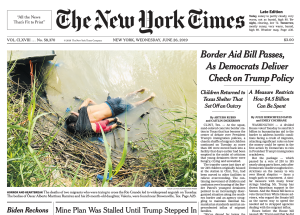
Then, on Tuesday, the awful consequences of Trump’s policies were driven home in even more graphic detail, as news organizations published a photo of the bodies of a father and daughter from El Salvador who had drowned while attempting to cross the Rio Grande from Mexico into the United States.
This time the public appears to be paying attention. No, not the way they did several weeks after Trump’s inauguration, when thousands of people turned out in Boston (and many more across the country) to protest the first iteration of his ban on Muslim immigrants. That was before Trump had had a chance to induce inaction through the sheer repetition of outrages. But the news media, at least, have shone a spotlight on the horrifying details coming out of Clint. Media interest is an imperfect measure of public interest, but to the extent that there is some correlation, the news appears to be breaking through. Some examples:
• From The New York Times: “Children as young as 7 and 8, many of them wearing clothes caked with snot and tears, are caring for infants they’ve just met, the lawyers said. Toddlers without diapers are relieving themselves in their pants. Teenage mothers are wearing clothes stained with breast milk.”
• From The Associated Press: “A 2-year-old boy locked in detention wants to be held all the time. A few girls, ages 10 to 15, say they’ve been doing their best to feed and soothe the clingy toddler who was handed to them by a guard days ago. Lawyers warn that kids are taking care of kids, and there’s inadequate food, water and sanitation for the 250 infants, children and teens at the Border Patrol station.”
• From The New Yorker (quoting Warren Binford, one of the lawyers who visited Clint): “Many of the children reported sleeping on the concrete floor. They are being given army blankets, those wool-type blankets that are really harsh. Most of the children said they’re being given two blankets, one to put beneath them on the floor. Some of the children are describing just being given one blanket and having to decide whether to put it under them or over them, because there is air-conditioning at this facility. And so they’re having to make a choice about, Do I try to protect myself from the cement, or do I try to keep warm?”
Naturally, these reports haven’t stopped Trump from lying about what is happening. Over the weekend, in an interview with Chuck Todd on “Meet the Press,” Trump blamed his predecessor, President Obama, for the policy of separating migrant children from their families. Not only did the hapless Todd fail to challenge him but, as Aaron Rupar of Vox noted, whoever was running the “Meet the Press” Twitter feed repeated Trump’s assertion. In case you had any doubts, it was entirely false, according to Miriam Valverde’s analysis at PolitiFact.
Trump being Trump, news organizations are not being allowed to witness what is taking place in Clint, or at other detention facilities. We have to rely on the reports of public interest lawyers because the press has been banned from witnessing what’s taking place.
As Paul Farhi reports in The Washington Post: “The blackout on press access has left Americans largely in the dark about conditions in government facilities designed to handle migrants who have crossed the border. Photographs and TV images are both rare and often dated. Rarer still are interviews with federal agency managers and employees and with the children themselves.”
Even so, the news that has trickled out has apparently been enough to prompt action. Some of the children were transferred to other, presumably less crowded, facilities. On Tuesday came word that John Sanders, acting commissioner of Customs and Border Protection, would resign — a significant move given that, until now, Trump’s immigration officials have generally been pushed out for insufficient rather than excessive cruelty.
Horrors such as this can lead us to feel enraged — and then, because there seems to be so little we can do, apathetic and resigned. So I want to close with two pieces of information that should spark hope rather than despair.
The first is an editorial in The New York Times that closes with a list of steps we can all take — from contacting elected officials, to donating money to humanitarian organizations, to holding political candidates accountable.
The second is from Warren Binford’s interview with The New Yorker. When the interviewer, Isaac Chotiner, asked her about the “attitude of the guards” toward the lawyers, Binford replied: “They are on our side. Multiple guards told us while we were there that they are on our side and they want us to be successful, because the children don’t belong there, and the children need to be picked up and put in appropriate places for children. They want us to be successful.”
Binford is no Pollyanna, and she acknowledged that there is some cruelty among the guards. But, she said, “I do believe in the inherent goodness of people.”
Binford has seen much worse than we on the outside have. I’m struck by her optimism that most people are good, and that there are steps we can take to counteract the evil in our midst. It may seem in these dark times that there is little that decent people can do. We can’t give in to that type of thinking. The stakes are too high.
It looks like this front-page New York Times story that has drawn so much attention is almost a complete botch. Headlined “Mexico Agreed to Take Border Actions Months Before Trump Announced Tariff Deal,” the premise is that President Trump got nothing out of his tariff standoff and subsequent agreement with Mexico to increase border security. Michael D. Shear and Maggie Haberman write:
The deal to avert tariffs that President Trump announced with great fanfare on Friday night consists largely of actions that Mexico had already promised to take in prior discussions with the United States over the past several months, according to officials from both countries who are familiar with the negotiations.
The story goes into considerable detail in an attempt to show that there’s nothing new about the U.S.-Mexico agreement, and that Trump is boasting about it solely as face-saving gesture.
But wait! Inside the paper, under the headline “Mexico Sets Domestic Priorities Aside to Meet Terms of U.S. Trade Deal,” Azam Ahmed reports that Mexico is going to considerable lengths to meet the terms of Trump’s demands in an effort to head off those tariffs. Ahmed writes:
Under an agreement hammered out in marathon negotiations with American officials over the last few days, Mexico agreed to send up to 6,000 National Guard troops to its southern border with Guatemala. It also agreed to allow more asylum applicants to wait in Mexico while their cases are pending in the United States.
Further down in the story, there’s this:
But as Mr. Trump’s hectoring of Mexico on migration has increased, so, too, has the willingness of the López Obrador administration to take measures to calm its northern neighbor.
After initially saying the Remain in Mexico program was a pilot, Mexican officials quickly expanded it to new cities. Now, as part of the deal on Friday, they have agreed to expand it across the entire border.
Hat tip to Daniel Radosh of “The Daily Show,” who tweeted this out on Saturday:
These two articles were posted to @nytimes within an hour of each other. Seems like one of them has to be incorrect, right? pic.twitter.com/pGKk2XJuWy
And yes, indeed, one of them has to be incorrect. Given the level of detail in the second story, I’d say it’s the front-page splash that needs correcting.
If nothing else, this ought to quiet those on the left who’ve been accusing Haberman of being in the tank for Trump.
Yelling louder about President Trump’s multitudinous lies isn’t going to change anything. Yet that’s what Washington Post media columnist Margaret Sullivan suggested last week when she wrote in frustration about the lack of public outrage over the 10,000 “false or misleading statements” Trump has made since his inauguration.
Sullivan argued that “to do their jobs, the news media can’t engage in business as usual,” and that they “have to bring some new tools and techniques — and maybe a new attitude — to the project.” Her suggestions were commonsensical: be more willing to label falsehoods as lies and stop using euphemisms, as The New York Times did on Twitter recently when it blandly described Trump’s ugly libel that doctors who are performing abortions are “executing babies” as “an inaccurate refrain.”
But the idea that a more aggressive attitude on the part of the press will persuade Trump supporters to embrace facts that they don’t already know is not just absurd — it misunderstands the role of the media and the limits of journalism.
Consider that, by a wide margin, the public already regards the president as dishonest. According to a Quinnipiac University poll conducted two months ago, 65 percent of those surveyed said that Trump was dishonest while just 30 percent said he was honest. In other words, the message that Trump lies is already being heard loud and clear.
Consider, too, the swamp of misinformation and disinformation that many of Trump’s supporters are mucking around in. A new NBC/Wall Street Journal poll, for instance, found that “fewer than 30 percent of Americans who get their news via broadcast TV, CNN or MSNBC believe Trump has been honest about the Russia probe, compared with 61 percent of Fox News viewers.”
The reality is that the media we choose is based in large measure on our tribal identity, and that identity is far more powerful than mere facts.
Currently I’m reading a collection of essays by the late media theorist James W. Carey. Carey’s writing tends to be difficult and obscure, but some of his ideas are as relevant today as they were when he wrote them in the 1980s and ’90s. Especially useful to this discussion is his argument that media serve two functions: “transmission” and “ritual.”
The transmission function of media is to inform. In Carey’s view, it’s much more complicated than that — it’s tied up in notions of power and the ever-accelerating speed of media (from the town crier to the printing press, from the telegraph to the internet), which enables them to encompass ever more people and territory. But its essence is clear enough, and it’s what we generally mean when we think about the media.
By contrast, the media’s ritual function serves to reinforce a sense of community and identity. “If the archetypal case of communication under a transmission view is the extension of messages across geography for the purpose of control, the archetypal case under a ritual view is the sacred ceremony that draws persons together in fellowship and commonality,” Carey writes. Later, he adds, “ We recognize, as with religious rituals, that news changes little and yet is intrinsically satisfying; it performs few functions yet is habitually consumed. Newspapers do not operate as a source of effects or functions but as dramatically satisfying, which is not to say pleasing, presentations of what the world at root is.”
The problem, which Carey does not address because his work was published before the rise of partisan media, is that we are no longer reinforcing our shared sense of community with a mainstream newspaper and a daily visit with Walter Cronkite. Rather, we are hanging out with fellow tribe members in our own separate mediaspheres.
Seen in this light, calling more attention to presidential lying not only is ineffective but has the effect of confirming for Trump supporters that the mainstream press is not to be trusted and is fundamentally opposed to their interests and beliefs. At the same time, those mainstream outlets are themselves benefiting from tribal loyalties, as the anti-Trump majority rallies around newspapers like The Washington Post and The New York Times. Yes, those outlets have reported factually, for the most part, on Trump’s many flaws, lies, and misdeeds. But they have done so in much greater quantity than would have been strictly necessary to transmit that information to the public.
Margaret Sullivan closed her call for more innovative approaches to reporting on Trump’s lying with this: “None of this, of course, will solve the problem. It’s unlikely to reverse the avalanche or slow the ever-increasing pace. But it may help an overwhelmed and numbed public find renewed reason to care.”
No, it won’t. Most of us are well aware that he’s lying, and some love him all the more for it. The function of news is to inform, of course. But it’s also to express and reinforce our common values. Sadly, hyperpolarization means that there no longer is one set of common values, but, rather, two, three, or more.
“Everybody is entitled to their own opinions, but not their own facts,” the late Daniel Patrick Moynihan famously said.