New Hampshire may fuel media talk of Bloomberg, Biden

Michael Bloomberg in 2010 with possible future running mate. Photo via Wikimedia Commons.

Previously published at WGBHNews.org.

It’s a little after 11 p.m. With the all-important question of whether Jeb Bush will finish third or fourth in New Hampshire still unanswered, allow me to anticipate two names we’re going to be hearing in the days ahead: Michael Bloomberg. And Joe Biden.

In fact, it’s already started. And the results of the first-in-the-nation primary guarantee that it’s only going to intensify.

Bloomberg, the former mayor of New York, is the more plausible of the two names given that he’s letting it be known he’s considering an independent run. The New Hampshire results make it more likely, not less, that he’ll keep gearing up for a possible campaign.

Consider what the Democrats did to themselves. Everyone was expecting Bernie Sanders to beat Hillary Clinton. But he handed her such an unexpectedly crushing defeat that she can’t help but emerge as a damaged candidate. She’s still likely to win the nomination as the campaign moves on to states with substantial African-American populations. But she’s looking more vulnerable than ever in November, provided the Republicans manage to choose a nominee who is recognizably of the human species.

Oops. Donald Trump also won big tonight. Although he fell considerably short of a majority, he got about 35 percent of the vote, far ahead of second-place finisher John Kasich. The Iowa winner, Ted Cruz, an extremist much loathed within his own party, was running third, just ahead of Bush. Marco Rubio, who seemed to be emerging as a contender until his circuit board malfunctioned at last Saturday’s debate, faded to fifth.

So the Democrats are stuck with a diminished Hillary Clinton or, less likely, a 74-year-old left-winger who—if conventional wisdom means anything at all anymore—probably could not win a general election. And Trump, detested by a majority of the public, may be on a glide path to the Republican nomination.

Of course, the conventional wisdom also holds that an independent can’t be elected president. But if the Democrats and the Republicans both nominate candidates who are unacceptable to the broad middle of the electorate that decides elections (and yes, I realize that the broad middle is a lot smaller than it used to be), then surely there is an opening for someone like Bloomberg, a moderate with a reputation for competence. Yes, he’s dour, uncharismatic, and has a well-deserved reputation for nanny-statism. But it’s precisely those non-scary qualities that could make him a viable alternative.

And the media are stoking a Bloomberg run. The veteran media critic Jack Shafer wrote for Politico earlier today that “as Bloomberg works his way through the editorial food chain and breaks through the primary election news, I’m certain reporters will be setting themselves on fire to convince their editors to assign them to Bloomberg.”

Count me as someone who thinks Bloomberg might actually be able to defeat Sanders and Trump, if that’s what it comes to.

Which brings me to a Biden candidacy, a far less likely possibility. Unlike Bloomberg, Biden has declared pretty definitively that he wouldn’t enter the race. It’s also too late logistically for him to enter the Democratic primaries.

But Biden would make some theoretical sense if the race between Clinton and Sanders ends in a muddle, or if the email controversy in which Clinton is embroiled leads to legal trouble. In either case, so this line of thinking goes, the Democratic National Convention might turn to a respected non-candidate like Biden as the nominee.

Is this going to happen? Almost certainly not. A brokered convention is a quadrennial fantasy, but it is almost impossible under the modern primary system. Still, if you search Google News for “Biden 2016,” you’ll find that plenty of people are giving the idea some thought.

For my purposes, what matters isn’t what is going to happen. Rather, it’s what you’ll be hearing from the media as the two major parties, suffering from self-inflicted wounds, limp ahead. New Hampshire not only didn’t settle anything. It left us with a race that won’t be settled for some weeks to come.


Post-debate media mockery may doom Rubio’s campaign

Photo of Rubio in Londonderry, New Hampshire (cc) 2015 by Marc Nozell
Rubio in Londonderry, New Hampshire, last August. Photo (cc) 2015 by Marc Nozell

Previously published at WGBHNews.org.

I come today not to bury Marco Rubio, but to take pulse of the media landscape to determine whether the pundits are going to bury him. And the answer is yes. Yes they are.

The establishment choice for the Republican nomination, bolstered by a better-than-expected performance in the Iowa caucuses last Monday, ran into a wrecking ball named Chris Christie at Saturday night’s presidential debate. Judging from the media reaction, Rubio’s status as a serious candidate may effectively be over.

It started even before the debate ended, when the venerable journalist James Fallows of The Atlantic took to Twitter and called Rubio’s meltdown the “most self-destructive debate performance since Quayle ’88 and Stockdale ’92.”

https://twitter.com/JamesFallows/status/696176435854229504?ref_src=twsrc%5Etfw

It continued on CNN, where conservative commentator Matt Lewis called Chris Christie’s devastatingly effective takedown of Rubio “a murder-suicide.”

And it carried over to Talking Points Memo, with liberal analyst Josh Marshall opining that Rubio’s “flailing will be a key subject of discussion for the next two days. And that’s a terrible way to close. It’s hard to overcome an echo chamber effect in a febrile news environment over 48 hours.”

In case you missed it (and if you had something better to do on a Saturday night, I salute you), Christie went into full New Jersey bully mode and mocked Rubio’s inexperience, sneering that Rubio was unable to speak in anything other than “a memorized 25-second speech.”

Rubio got flustered, challenged Christie to little effect—and then, incredibly, came back with one of his memorized lines not once, not twice, not thrice, but four times. To wit: “This notion that Barack Obama doesn’t know what he’s doing is just not true. He knows exactly what he’s doing.”

The lead debate stories in The New York Times, The Washington Post, The Boston Globe, and, I’m sure, numerous other papers this morning referred prominently to Rubio’s self-destruction. Worse, the Florida senator became a viral sensation—and not in a good way.

A parody Twitter account, @RubioGlitch, made its debut, with each tweet ending, “He knows exactly what he’s doing.” On both sides of the Atlantic, commentators compared Rubio’s performance to a famous scene from The Stepford Wives. “Like Paula Prentiss, he got stuck in malfunction mode,” wrote my Northeastern colleague Alan Schroeder, a presidential debate historian, at The Huffington Post.Added Jonathan Freedland in The Guardian: “It looked like that sequence from the 1970s thriller The Stepford Wives, when a software glitch reveals that a human-like character is in fact a robot.”

Several commentators have pointed out that the Rubio-Christie exchange came early, and that Rubio regained his composure after that. But ABC inflicted three hours of debate-related TV on us (the actual debate was closer to two and a half hours), and I’ve got to believe that the first hour drew by far the most viewers. Besides, whatever lasting impressions people form will come from after-the-fact media coverage.

The one note of caution I could find was from Nate Silver of Five Thirty Eight, who wrote that, bad as Rubio looked, voters may not agree with the pundits:

Political reporters are in the “fog of war” phase of the campaign where our reactions aren’t necessarily good matches for those of voters at home. Some of the reason we reporters thought Rubio’s answer was so awful is because it confirmed some of our gossip about Rubio, namely that he tends to give pat, repetitive answers. But we tend to be more sensitive about that stuff, because we watch every debate from start to finish, and then we see lots of the candidates’ stump speeches and town halls on top of it. There’s a fine line between a candidate who seems stilted and repetitive and one who seems “on message” instead.

Rubio was by far the biggest story coming out of Saturday’s debate, but there were other stories as well. John Kasich turned in a fine performance, and for once post-debate commentary was swinging his way. He was ebullient during a CNN interview in the spin room. (Of course, he’s always ebullient.)

As conservative as Kasich is, the Republican Party has moved so far to the right that he is regularly dismissed as a RINO (a Republican in Name Only). But Kasich may be perfectly positioned to do well in New Hampshire, as independents who are turned off by Hillary Clinton and wary of Bernie Sanders may choose a Republican ballot instead. It’s hard to see Kasich doing well after New Hampshire, but Tuesday could be a good day for him.

I’ve made it to the 750th word of this piece without mentioning Donald Trump, the frontrunner. I thought he got away unscathed. Yes, I’m appalled at his full-throated endorsement of torture (“I would bring back waterboarding and I’d bring back a hell of a lot worse than waterboarding”), and I’m even more appalled that no one seemed to care. But the other candidates, other than Jeb Bush, didn’t challenge him all that much.

And when Bush went after Trump on eminent domain, Bush won on substance but Trump won on style, attacking the “donors and special interests” he claimed had packed the debate hall and were booing him. “The move was classic pro-wrestling—like Vince McMahon baiting the crowd,” said Jonathan Last of The Weekly Standard. “And it was so crazy that it kind of worked.”

As for Ted Cruz, he may have won Iowa, but it seems unlikely that he’ll do as well with New Hampshire voters, who have not been kind to evangelical candidates in the past. In response to the dirty tricks his campaign engaged in to sway Ben Carson’s supporters in Iowa, Cruz has settled on a characteristically cynical tactic: apologize for his campaign’s claims that Carson was dropping out of the race while claiming that they really believed it to be true. Cruz had to misrepresent CNN’s reporting in order to pull it off, but whatever.

The downfall of Marco Rubio is what we’ll be talking about this week. A candidate can survive many things, but mockery is not one of them. The next few days are going to be telling, but I really think it may be over for him. Which means that what’s left of the Republican establishment is going to have to come up with another alternative lest it get stuck with Trump or Cruz.

I recently predicted that Bush would win the nomination based on nothing other than the process of elimination. On Saturday, Rubio may have gotten himself eliminated.

A newspaper’s anti-web stance proves to be its demise

The Boston Courant, famous (or infamous) for its refusal to publish content online, is going out of business—and, weirdly enough, its anti-web stance is the reason (but not in the way you might think). Adam Gaffin explains.

We talked about the reasons for the Courant‘s apparent success last September on Beat the Press (above).

The Guardian struggles with its free digital model

Screen Shot 2016-02-03 at 11.03.43 AMMedia observer Michael Wolff writes in USA Today about the difficulties facing any news organization that seeks to make all or most of its money from digital advertising. His example is The Guardian, a left-leaning British newspaper to which he and I both used to contribute.

The Guardian is proudly, aggressively digital. Its print edition is little more than a vestigial limb (especially outside the UK), and its executives refuse to implement a paywall. The result, Wolff says, is that the trust set up to run The Guardian in perpetuity is running out of money. As I wrote last week for WGBHNews.org, relying on digital advertising is a dubious proposition because its very ubiquity is destroying its value. Wolff puts it this way:

The reality is that the Guardian’s future is almost entirely dependent on advertising revenue in a medium where the price of a view heads inexorably to an increment hardly above zero. But the hope remains that, in ways yet to be imagined, some innovation will make large profits suddenly possible.

Digital paywalls are helping to bolster the bottom line at papers like The New York TimesThe Wall Street Journal, and The Boston Globe—but they are hardly a solution to the larger problems the newspaper business faces. Print advertising still brings in most of the revenue, but it’s on the wane.

Last week I visited The Philadelphia Inquirer, a major metro similar to the Globe that was recently donated to a nonprofit foundation. It’s a promising ownership model. The Inquirer still needs to break even, which is no sure thing. But local control, no pressure to meet the expectations of shareholders, and the possibility of some grant money being raised to pay for reporting projects may bring stability to the Inquirer after years of chaos. (The nonprofit New Haven Independent was the main focus of my 2013 book, The Wired City.)

One thing they’re not talking about at the Inquirer is free digital, even though the Inquirer and its sister paper, the tabloid Daily News, compete with a vibrant (though small) free digital-only project called Billy Penn, whose modest budget is paid primarily by sponsoring events. Though I remain skeptical about paywalls for reasons I laid out in my WGBH piece, the one thing I’m certain of is that the money has to come from somewhere.

Media spin Rubio and Sanders as Iowa’s big winners

Previously published at WGBHNews.org.

For the next week you’re going to be inundated with prognostications about what the results of the Iowa caucuses mean for New Hampshire and beyond. We’ve all been wrong about so many things that I’m not sure why anyone should pay attention. So tonight let’s pause for a moment and consider what has actually happened.

As I write this, Ted Cruz has won the Republican caucuses, beating Donald Trump. Marco Rubio is running third, which was expected, but turned in such a strong performance that he may yet slip ahead of Trump, which wasn’t expected. On the Democratic side, Hillary Clinton is leading Bernie Sanders by the slimmest of margins, and it’s possible that we won’t know who actually won until sometime Tuesday.

On the surface, Trump’s bad night may suggest a victory for sanity. But consider: Cruz, Trump, and Ben Carson together received some 61 percent of the votes. And all three of them are extremists who share similar anti-immigrant, anti-Muslim views. In fact, Cruz and Carson are considerably to the right of Trump, who subscribes to no ideology beyond what’s advantageous to him at any given moment.

By winning an impressive 23 percent (as of this moment), Rubio has finally emerged as the establishment Republican alternative after months of failing to pick up the baton. Jeb Bush, John Kasich, Chris Christie, and the rest can go home now. But are the kinds of people who support Cruz, Trump, and Carson really going to turn around and vote for the establishment choice?

Maybe they will. Rubio, after all, was elected to the Senate with Tea Party support in 2010, and during this campaign he has moved far to the right on immigration. His pandering on religion excludes anyone who doesn’t subscribe to his particular brand of Christianity—never mind that he himself has been a Catholic, a Mormon, and an evangelical. If the way to defeat extremism is to offer extremism lite, then Rubio may be the Republicans’ best bet. But I suspect he’d be easy pickings for the Democrats if they weren’t so battered and bruised themselves.

I’m not sure how impressed I’m supposed to be by Sanders’s near-win over Clinton. Other than New Hampshire, Iowa was always going to be his best state. I’m inclined to think that any victory by Clinton, no matter how slim, should be seen as a victory. Sanders is still likely to take New Hampshire next week, but that’s already been baked into everyone’s expectations. Her advantages for winning the nomination remain enormous.

But now we get into the media-expectations game. And Clinton is going to get hammered over the next week because she didn’t win Iowa by a wide enough margin, even though there were plenty of reasons to believe she wouldn’t win at all.

You could see the consensus emerging tonight on cable news: There were two winners—Marco Rubio and Bernie Sanders—and one big loser—Trump. Cruz was getting very little credit for his victory. And Clinton was portrayed as barely hanging on by her fingernails. Thursday’s debate looms large.

I don’t know how much it’s going to matter. The media may still be capable of setting the narrative, but the voters themselves are less willing to go along with each election cycle. Trump is the ultimate media creation (more the entertainment media than the news media), and, after a months-long build-up, he flopped on opening night.

Anyone searching for clarity tonight had to be disappointed. I wasn’t. The Iowa caucuses are a tiny event in a small, non-representative state. They shouldn’t decide anything, and they didn’t—Martin O’Malley’s and Mike Huckabee’s exits notwithstanding.

Maybe New Hampshire will tell us more.

The newspaper business’s long, ugly decline

Brendan Lynch for WGBHNews.org
Illustration by Brendan Lynch for WGBHNews.org

Previously published at WGBHNews.org.

Twenty years ago this month, The New York Times entered the Internet age with a sense of optimism so naive that looking back might break your heart. “With its entry on the Web,” wrote Times reporter Peter H. Lewis, “The Times is hoping to become a primary information provider in the computer age and to cut costs for newsprint, delivery and labor.”

The Times wasn’t the first major daily newspaper to launch a website. The Boston Globe, then owned by the New York Times Co., had unveiled its Boston.com service—featuring free content from the Globe and other local news organizations—just a few months earlier. But the debut of NYTimes.com sent a clear signal that newspapers were ready to enlist in the digital revolution.

Fast-forward to 2016, and the newspaper business is a shell of its former self. Far from cutting newsprint and delivery costs, newspapers remain utterly reliant on their shrunken print editions for most of their revenues—as we have all been reminded by the Globe’s home-delivery fiasco.

Not only do newspapers remain tethered to 20th-century industrial processes such as massive printing presses, tons of paper, and fleets of delivery trucks, but efforts to develop new sources of digital revenue have largely come to naught.

Craigslist came up with a new model for classified ads—free—with which newspapers could not compete. And there went 40 percent of the ad revenue.

Digital display advertising has become so ubiquitous that its value keeps dropping. Print advertising still pays the bills, but for how much longer? The Internet has shifted the balance of power from publishers to advertisers, who can reach their customers far more efficiently than they could by taking a shot in the dark on expensive print ads. The result, according to the Newspaper Association of America (as reported by the Pew Research Center), is that print ad revenues have fallen from $44.9 billion in 2003 to just $16.4 billion in 2014, while digital ad revenues—$3.5 billion in 2014—have barely budged since 2006.

And it’s getting worse. Last week Richard Tofel, president of the nonprofit news organization ProPublica and a former top executive with The Wall Street Journal, wrote an essay for Medium under the harrowing headline “The sky is falling on print newspapers faster than you think.” Tofel took a look at the 25 largest U.S. newspapers and found that their print circulation is continuing to drop at a rapid rate, contrary to predictions that the decline had begun to level off.

There’s a bit of apples-and-oranges confusion in Tofel’s numbers. For instance, he suggests that the 140,000 paid weekday print circulation that the Globe claimed in September 2015 was somehow analogous to the 115,000 it reported during the recent home-delivery crisis. In fact, according to the Alliance for Audited Media, the Globe had 119,000 home-delivery and mail customers in September 2015. (Another 30,000 or so print newspapers were sold via single-copy sales.)

But there’s no disputing Tofel’s bottom line, which is that print circulation plunged between 2013 and 2015 at a far faster rate than had been expected. The Journal is down by 400,000; the Times by 200,000; The Washington Post and the Los Angeles Times by 100,000.

“Nearly everyone in publishing with whom I shared the 2015 paid figures found them surprisingly low,” Tofel wrote, adding that “if print circulation is much lower than generally believed, what basis is there for confidence the declines are ending and a plateau lies ahead?”

If advertising is falling off the cliff and print circulation is plummeting, then surely the solution must be to charge readers for digital subscriptions, right? Well, that may be part of the solution. But it’s probably not realistic to think that such a revenue stream will ever amount to much more than a small part of what’s needed to run a major metropolitan newspaper.

Not everyone agrees, of course. The journalist and entrepreneur Steven Brill, in a recent interview with Poynter.org, said newspaper executives find themselves in their current straits because they were not nearly as aggressive as they should have been about building paywalls around their content.

“I always had a basic view … that if you weren’t getting revenue from readers, you ultimately weren’t going to put a premium on your journalism,” said Brill, a founder of the paywall company Press Plus, which he later sold. “You couldn’t just rely on advertisers because they would then be your only real customers.”

Brill’s views are not extreme. For instance, he thinks it’s reasonable to give away five to 10 articles a month, as newspapers with metered paywalls such as the Globe and the Times do. But Brill does not mention what I think are by far the two biggest hurdles newspapers face in charging for digital content.

First, customers are already paying hundreds of dollars a month for broadband, cell service, and their various digital devices. It’s not crazy for them to think that the content should come included with that, as it does (for the most part) with their monthly cable bill. Those who wag their fingers that newspapers never should have given away their content overlook the reality that customers had none of those extra expenses back when their only option was to pay for the print edition.

Second, paywalls interfere with the way we now consume news—skipping around the Internet, checking in with multiple sources. To wall off content runs contrary not just to what news consumers want but to the sharing culture of the Internet. The Globe has had quite a bit of success is selling digital subscriptions—about 90,000, according to the September 2015 audit report. But what will happen when the paper ratchets the price up to $1 a day, as the newspaper analyst Ken Doctor recently reported for the website Newsonomics?

As I write this, I am on my way to Philadelphia, where I’ll be learning more about the transfer of that city’s newspapers—The Philadelphia Inquirer and the tabloid Daily News—to a nonprofit foundation. Ken Doctor, writing for the Nieman Journalism Lab, isn’t optimistic: “Sprinkling some nonprofit pixie dust won’t save the newspaper industry. Only new ideas can do that.”

For the beleaguered newspaper business, the walls are closing in and the oxygen is being pumped out of the room. Clay Shirky, who writes about digital culture, once said, “Society doesn’t need newspapers. What we need is journalism.”

Trouble is, 20 years after NYTimes.com staked out its home on the web, newspapers are still the source of most of the public interest journalism we need to govern ourselves in a democracy.

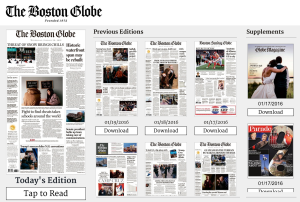
The Globe unveils a new app for tablets and smartphones

Screen Shot 2016-01-20 at 9.39.13 AM
The Globe‘s new iPad app. Click on image for larger view.

Thursday update: Significant second-day glitches. Shortly after 7 a.m., the most recent edition I could get was Wednesday’s. Then the app started telling me I needed an Internet connection, even though WiFi was working fine. Finally, a few minutes before 9, the problems seemed to be fixed.


Change isn’t always a disaster for The Boston Globe. This morning I clicked on the Globe‘s iPad app, which is based on a replica of the print edition. And the app was automatically overwritten by an entirely new version that looks much more like the ePaper available on BostonGlobe.com. It also seems to be a welcome improvement.

With the new app you can download the entire day’s paper (the only option with the previous version) or read it online. You can share articles on Twitter, Facebook, or other social networks, which represents a substantial upgrade. Tap on a story and it loads in a computer-friendly reading format. One refinement I’d like to see: when you click to make the type bigger, it should stay that way so that you don’t have to do it with each story.

The improvements aren’t dramatic, but overall the app feels more solid and complete.

The new version is also available for iPhone and, I suppose, those Android things as well. The previous version carried the miLibris brand; the new one is unbranded, though I see the company is still touting its relationship with the Globe. So maybe this is an improved miLibris product. (Or not; see update.)

The replica edition is not my favorite way of reading a newspaper. But BostonGlobe.com loads slowly on my iPad, and every so often I like to see what the paper looks like in print. Given the Globe‘s ongoing problems with home delivery, if you like print and have an iPad, you might want to give the new app a try.

Update: Former Globe digital guy Damon Kiesow reports that the new vendor is PageSuite:

https://twitter.com/dkiesow/status/689826261699555329

Debate does little to stop Bernie’s media-fueled momentum

Photo (cc) 2015 by Tiffany Von Arnim.

Previously published at WGBHNews.org.

There are few story lines the media love more than “Clinton is in trouble.” Just saying it out loud brings back warm, gauzy memories of Gennifer Flowers, Monica Lewinsky, and Whitewater, of Benghazi and private email servers.

So I suspect there was almost nothing that could have happened at Sunday night’s Democratic debate to change the narrative that Bernie Sanders is surging and Hillary Clinton is hanging on for dear life.

None responded to the moment more predictably than Glenn Thrush of Politicowho opens by writing that Clinton’s attacks on Sanders “reinforced his characterization of her as an establishment politician so desperate she’d say anything to win,” and that the Vermont senator represents “an existential threat” to her candidacy.

The Washington Post’s lead story on the debate, by Anne Gearan and Philip Rucker, offers a calmer version of the same idea, with phrases such as “she sought to puncture Sanders’s insurgent appeal and regain her footing after a difficult stretch” and a reference to “the newly potent threat Sanders poses to Clinton in her second White House run.” For good measure, the Post’s Chris Cillizza pronounces Bernie a winner and Hillary a loser.

In fact, those of us who watched—and it’s not likely there were many of us given that it took place in the middle of a holiday weekend—saw nothing all that dramatic.

Sanders, as usual, shouted and did a decent job of getting his points across. Clinton, as usual, was in command of the issues, though there’s no doubt she went after Sanders far more than in the previous three debates. Martin O’Malley, as usual, was there.

My own sense was that this was Clinton’s weakest performance, but still generally fine. I thought her worst moment was her closing remarks about sending a campaign aide to Flint, Michigan, to look into the drinking-water crisis. Why didn’t she go there herself? But I’ve seen plenty of commentary to the contrary. For instance, Paul Volpe and Quynhanh Do of The New York Times call it “her best moment of the night.”

But because the prospective voters who did not watch are going to depend on the media to tell them what happened, the takeaway is going to be that Clinton failed to stop Sanders’s momentum. That’s not wrong, just simplistic.

On the issues, I thought Clinton bested Sanders on guns, health care, and foreign policy, whereas Sanders was better on Wall Street and campaign-finance reform.

Clinton’s argument against Sanders’s newly released health-care proposal, which calls for a single-payer system that would eliminate private insurance (see Jonathan Cohn at The Huffington Post for details), isn’t really fair.

No, Sanders would not scrap the Affordable Care Act. But even liberal Democrats inclined to support single-payer are sure to recall what a horrendous slog it was to get the ACA passed. My guess is they’re disinclined to go back for another round.

“If Democrats couldn’t pass single-payer with a Senate supermajority, how would Sanders do it with a Republican House and, at best, a narrow Senate edge?” asks David A. Graham at The Atlantic. “She [Clinton] knows the limitations of health-care politics better than almost anyone.”

Though it might not have been immediately evident, Sanders may have seriously wounded himself with his answers on foreign policy. Despite offering some unconvincing caveats, he sounded like he’s all but ready to emulate Ronald Reagan and send a cake to the Iranian mullahs. Twice Sanders said the United States should work with Iran, to remove Syrian dictator Bashar al-Assad from power and to defeat ISIS. Let’s roll the tape:

But I think in terms of our priorities in the region, our first priority must be the destruction of ISIS. Our second priority must be getting rid of Assad, through some political settlement, working with Iran, working with Russia.

But the immediate task is to bring all interests together who want to destroy ISIS, including Russia, including Iran, including our Muslim allies to make that the major priority.

I have to agree with Boston Globe columnist Michael Cohen, who says of Sanders that “it’s blindingly apparent that not only does he not understand foreign policy and national security, he simply doesn’t care to know more.”

NBC News moderators Lester Holt and Andrea Mitchell did a good job of keeping things on track and covering a wide range of issues. But when Mitchell pressed Sanders on whether he would support tax increases, I would have liked to see a disclosure that she’s married to former Federal Reserve chairman Alan Greenspan.

And, finally, some counterintuitive polling wisdom from Five Thirty Eight’s Nate Silver. His analysis of multiple polls shows that Clinton has an 81 percent chance of winning the Iowa caucuses on February 1 and a 57 percent chance of winning the New Hampshire primary (where, as this Real Clear Politics compilation shows, Sanders is widely believed to be ahead) on February 9.

If Clinton takes both Iowa and New Hampshire, the race for the Democratic nomination will be over.

Sanders called a liar over a difference of opinion

Glenn Kessler. Photo via Wikimedia Commons.

Glenn Kessler, The Washington Post‘s fact-checker, gives Bernie Sanders a rating of “Three Pinocchios” for claiming that partial repeal of the Glass-Steagall law helped cause the 2008 financial collapse. It’s complicated, as you’ll see. But my conclusion is that Kessler wrote a pretty good analysis and then undermined it by calling Sanders a liar when we’re really only talking about a difference of opinion.

Several years ago I wrote a commentary for The Huffington Post on the limits of fact-checking. As I said at the time:

The problem is that there are only a finite number of statements that can be subjected to thumbs-up/thumbs-down fact-checking…. The fact-checkers are shifting from judging facts to indulging in opinion, but they’re not necessarily doing it because they want to. They’re doing it because politicians don’t flat-out lie as frequently as we might suppose.

Sanders believes the erosion of Glass-Steagall protections helped create an environment that made the 2008 financial collapse more likely. Kessler disagrees, and he’s found several experts to support his viewpoint. That doesn’t make Sanders a liar. I suspect Kessler knows better, but he’s got Pinocchios to bestow, and today Bernie’s number came up.

Your Saturday media round-up

No, not the debut of a new feature. But there’s a lot going on today. So let’s get to it.

• Jason Rezaian is coming home. Rezaian, who’s a Washington Post reporter, is being released by Iran along with three other prisoners as part of a swap. Meanwhile, Iran is moving closer to compliance with the nuclear deal, and, as we know, it returned without incident a group of American sailors who had drifted into its territorial waters even as the Republican presidential candidates were calling for war or something.

What President Obama’s critics refuse to acknowledge is that Iran is complicated, factionalized, and slowly lurching toward better (not good) behavior. Obama has invested a considerable amount of his moral authority into trying to nudge along a less dangerous Iran, and his efforts are paying off.

And kudos to Post executive editor Marty Baron, who has kept the spotlight on Rezaian’s unjust imprisonment for the past year and a half.

• The routes are at the root. Boston Globe reporter Mark Arsenault today has the most thorough examination yet of what went wrong with the Globe‘s home-delivery system when it switched vendors at the end of December. Arsenault takes a tough look at the decisions made by the paper’s business executives, who clearly did not do enough vetting of the plans put together by the new vendor, ACI Media Group. And he opens with Globe publisher John Henry amid thousands of undelivered papers at the Newton distribution center, sending a message that, yes, the owner is engaged.

As has been reported previously, but not in as much detail as Arsenault offers, ACI’s routes just didn’t make sense. And what looked like a mere glitch at the end of day one turned into a catastrophe as drivers walked off the job once they realized there was no way they could make their appointed rounds.

It’s the Globe itself that has to take primary responsibility, of course. But based on Arsenault’s report, ACI officials—who did not speak to him—clearly sold the Globe a bill of goods. If ACI has a different perspective on what happened, we’d like to hear it soon.

• Digital First workers revolt. Employees at Digital First Media are fighting for their first raise in seven to 10 years, according to an announcement by workers represented by the Newspaper Guild. These folks have been abused for years by bad ownership as hedge funds have sought to cash in.

The effort covers some 1,000 Guild members. It’s unclear whether employees at non-Guild papers—including the Lowell Sun and the New Haven Register—would be helped.