One of the few disadvantages of being a digital subscriber to the Boston Globe is that whenever there’s news regarding the print edition (except on Sundays), I’m usually the last to know.
So … today the Globe published a four-page wraparound of sponsored content from Children’s Hospital that looks like the front page, though it’s clearly labeled as advertising. I’ve seen half-page ad treatments in newspapers, which I’ve tried to emulate with the image in the middle. But I haven’t seen a full page (at left) before. The actual front page, which you get to once you pull off the wraparound, is at right.
The Children’s Hospital content is featured on BostonGlobe.com and Boston.com as well, although there’s nothing unusual about the online treatment.
The verdict: We all know this wouldn’t have flown 10 or maybe even five years ago. But there is no money in the newspaper business these days. I’m willing to be very understanding of any form of advertising as long as it’s properly labeled.
On the other hand, you don’t want to do anything that alienates your best customers—that is, your print subscribers. So, yes, I would have preferred it if the Globe had tried to talk Children’s into going for the half-page treatment instead.
The story is changing for the struggling newspaper business. After years of bad news, we seem to be moving on to (cover your eyes) even worse news. Paid circulation, advertising revenue, and newsroom employment are plunging in ways not seen since the Great Recession.
The gory details are contained within the Pew Research Center’s latest State of the News Media report. I’m not here to tell you that there’s a silver lining—there isn’t, as I argued in this space back in January. Nevertheless, there are some intriguing findings in the report that could point the way to a better future.
Essentially, there are three major pieces of information about digital media that all of us who care about journalism need to grasp:
Mobile has overtaken the desktop just as surely as digital overtook print some years earlier.
Some digitally native news organizations, such as Vox, BuzzFeed and the now-venerable Huffington Post, are doing reasonably well, although profitability remains elusive.
Third-party platforms such as Facebook, Apple News, and Google AMP (for Accelerated Mobile Pages) have become immensely important for the distribution of news, especially since they handle mobile better than do the news organizations whose journalism they are repackaging.
Perhaps the greatest challenge facing journalism is that the very services that now control so much of the distribution are also the beneficiaries of most digital advertising revenue. Consider, for instance, this tidbit from the report:
Five technology and social media companies—Google, Facebook, Yahoo, Microsoft and Twitter—continue to dominate the digital advertising market, accounting for 65% of all revenue from digital advertising in 2015, or $38.5 billion out of $59.6 billion. This is slightly higher than the share generated by the top five companies in 2014 (61%).
You may find yourself scratching your head, as I did, at learning that Yahoo and Microsoft are big players in digital advertising. Otherwise, though, this all makes sense, especially with respect to Google and Facebook. Google, as we know, does not share its ad revenues with the news organizations whose content it aggregates. The idea has always been that Google drives traffic to the originating site and that it’s up to the people who run that site to take advantage of the increased traffic by selling more ads. It hasn’t worked.
The situation is slightly better with Facebook, as publishers are cutting deals with the mega-network in order to share ad revenues. But publishers get nothing when, say, a friend of yours shares a story from the Cleveland Plain Dealer.
Nicco Mele, the incoming director of Harvard’s Shorenstein Center on Media, Politics and Public Policy, said earlier this year that the balance needs to be recalibrated: “To a large extent, Facebook and Google are sucking up revenue that publishers of content should be receiving.” How and whether Facebook and Google can be pressured to share more of their revenues with news organizations is a matter for another day.
Newspapers, which are still by far the most significant producers of journalism aimed at holding government and other powerful institutions to account, are truly suffering. How bad is it? According to Pew, paid circulation, including paid digital, was down 7 percent in 2015. Total ad revenue at newspapers owned by publicly traded companies was down 8 percent, a figure that, again, includes digital.
But to my eye, what’s unspeakably ugly is how dependent newspapers remain on their print editions. Seventy-five percent of ad revenues still come from print. Print circulation in 2015 comprised 78 percent of weekday circulation and 86 percent of Sunday circulation.
This isn’t so much a matter of newspapers failing to navigate the digital transition as it is that their most loyal customers are refusing to give up print. And since those customers will, inevitably, be departing this vale of tears over the next few decades, newspapers have to figure out a way to vastly increase their digital presence in order to attract younger readers.
Very few are doing that, though the Washington Post has been notably successful on that front. At least digitally native news organizations have the advantage of not having to serve a dwindling but still-lucrative print audience at the same time they are trying to build out their digital side. But as the Pew report says, not all is well in digital news, either:
For some digital publishers, a quest for scale has resulted in annual revenue estimates in the tens of millions of dollars, bolstered in some cases by venture capital funding. Yet there is little evidence that many of these sites are profitable.
In an influential blog post seven years ago, Clay Shirky wrote, “Society doesn’t need newspapers. What we need is journalism.” If the definition of a newspaper is something made of paper, then I’d say Shirky’s moment is upon us. I’d guess that newspapers are heading toward a mostly digital future as they move away from print, even at the expense of alienating part of their aging audience. (Caveat: Ten years ago many of us, including me, thought print would be more or less gone by now. So who knows?)
Sadly, newspaper staffs will continue to shrink, and within a few years they will be digital-only except for a weekend print edition. They won’t be able to do as much as they can today, just as they can’t do as much today as they could 10 or 15 years ago. But large regional news organizations such as the Boston Globe, the Chicago Tribune, the Philadelphia Inquirer, and the Dallas Morning News will continue to provide most of the accountability journalism that their communities need.
That’s an optimistic assessment. The reality could be much worse. Let’s hope today’s newspaper leaders get tomorrow right.
Note: Boston Globe arts editor Rebecca Ostriker has responded to this post.
The Boston Globe is cutting back on some of its arts coverage, as reported by Anulfo Baez at the Evolving Critic and, several weeks ago, by the Boston Musical Intelligencer. Based on those posts and an email I received from an affected writer, it appears that the Globe is drastically reducing its use of freelancers to cover arts-related events.
In that light, it’s perhaps noteworthy that today’s Globe includes a music review by Jon Garelick, who’s a full-time copy editor for the opinion section. Jon, a former colleague of mine at the Boston Phoenix, is widely respected as one of the most accomplished arts journalists in the country.
I suspect the contours of what’s happening with the Globe‘s arts coverage will be more clearly defined when the results of the ongoing reinvention effort are made public, perhaps later this summer.
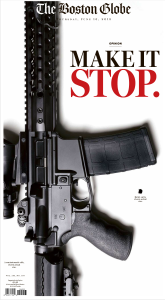
The Boston Globe has published an unusual multimedia, interactive editorial calling for a ban on assault weapons that includes data, animated graphics, and thumbnail bios of six recalcitrant senators—including information on how much money they’ve received from the gun lobby as well as tools to email or tweet at them.
Front of the print edition.
The Globe is using the hashtag #makeitstop via its main Twitter account and its @GlobeOpinion account. Among other things, it’s been tweeting out the names of the Orlando mass-shooting victims.
The print edition comes with a four-page wraparound comprising the editorial and accompanying material.
Overall, it’s a well-executed effort, and I applaud editorial-page editor Ellen Clegg and her staff. I like it more than the fake front page the Globe devoted to Donald Trump earlier this year, which some people confused with the paper’s actual page one.
Unfortunately, the problem with such campaigns is that even when they’re effective at making their case, they’re ineffective in changing anyone’s minds. Still, we have to try. So kudos.
David Arkin, a top official with GateHouse Media, is leaving the company for a position in Texas. The following is a memo to employees from GateHouse chief executive Kirk Davis.
Dear Colleagues,
It is with very mixed feelings that I write to tell you that David Arkin, our Senior Vice President for Content and Product Development will be leaving GateHouse to become Chief Content Officer for Community Impact, a group of 21 award winning, hyper-local newspapers serving communities in the Austin, Dallas-Fort Worth and Houston markets. The free newspapers have a total circulation of 1.6 million.
I have worked with David for nearly 10 years and watched him develop from a lot of raw talent, to a truly great leader of our news and digital operations. I’m sad to lose that. However, for David, this new role means getting back into community journalism and a lot less travel (and more time with his family, including his three young children). I know he’s excited about that and I’m excited for him.
David has accomplished an enormous amount over the last several years. He launched our Center for News & Design in May of 2014 which today provides editing and design services for 220 GateHouse newspapers and is also home to More Content Now, our niche content business, and Community Content, which processes briefs and events for our papers. Reflecting the quality of its work, the Center has recently begun to take on significant commercial clients.
David used our centralized content services platform to develop innovative programs focused on quality journalism. For example, Pinnacle, our national enterprise reporting mentorship program, continues to produce great work like the recent piece examining the impact of substitute teachers in America.
Finally, David has led the transition of our newsroom culture from print to digital to mobile first. He initiated large-scale programs like reporter-produced video, social media engagement and digital journalism training, and focused our newsrooms on new, organizational structures and the use of digital analytics. And, most recently,
David led the development of the new, Garcia-designed responsive sites that we are currently rolling out.
David has accomplished all this with the support of a terrific team, including Tom Clifford, recently hired as VP of the Center for News and Design. We are confident that this team will continue to do a great job supporting our GateHouse operations. We will begin the process of identifying David’s replacement immediately.
In our discussions about what was a difficult decision, David shared how proud he is of his team and the digital transformation work happening across GateHouse newsrooms today. David also spoke to how much he values the relationships he has developed over the past decade with hundreds of GateHouse journalists.
David’s last day will be July 7th. Please join me in wishing David all the best!
Washington Post executive editor Marty Baron (left) interviews Post owner Jeff Bezos at a recent event.
Donald Trump, who earlier today suggested that President Obama might somehow be linked to the Orlando shooting, has revoked the credentials of Washington Post reporters because of a headline stating that Trump had suggested Obama might somehow be linked to the Orlando shooting. Trump:
Post executive editor Marty Baron:
Donald Trump’s decision to revoke The Washington Post’s press credentials is nothing less than a repudiation of the role of a free and independent press. When coverage doesn’t correspond to what the candidate wants it to be, then a news organization is banished. The Post will continue to cover Donald Trump as it has all along — honorably, honestly, accurately, energetically, and unflinchingly. We’re proud of our coverage, and we’re going to keep at it.
It was just a few weeks ago that Trump launched a Nixonesque attack on the Post and its owner, Amazon chief executive Jeff Bezos.
A few random thoughts.
• Shouldn’t we be suspicious of any news organization that hasn’t had its credentials revoked by the Trump campaign?
• This won’t hurt the Post a bit. Access is hugely overrated.
• I’m sorry that this is the first time I’ve written about Trump’s banishment of journalists. Previously he’s gone after Politico, the Huffington Post, and the Daily Beast. Yes, the Washington Post is one of our great newspapers. But Trump’s attacks on other news organizations are no less despicable.
• I’d like to see every news organization covering Trump burn their credentials and refuse to report on his events until open access is guaranteed for all.
A year ago this month, authorities say, Dylann Roof walked into Emanuel African Methodist Episcopal Church in Charleston, South Carolina, and shot nine people to death during a prayer service. It was soon discovered that Roof—who faces the death penalty if he’s convicted—had espoused hateful views of African-Americans and had posed with the Confederate flag and white-supremacist memorabilia.
Early Sunday morning, Omar Mateen walked into a gay nightclub in Orlando andmurdered 50 people. While he was inside, he called 911 and pledged his allegiance to ISIS.
I don’t have to tell you where I’m going with this. Whenever there is a mass shooting in the United States, the first question the media ask is whether it was tied to Muslim extremists. Never mind that mass shootings are as American as apple pie; the Orlando massacre was the 133rd mass shooting this year, Vox reports.
Invariably, whenever there’s an Islamist angle to a multiple murder, the tragedy is portrayed as more frightening, with the government held somehow more culpable for not doing something about the foreign menace within our midst. (Note: Mateen was born in New York.)
But mass shootings are mass shootings, and terror is terror. Dylann Roof was inspired by hateful ideology just as thoroughly as Omar Mateen. Robert Lewis Dear Jr., accused of killing three people and wounding nine others in November 2015 at a Planned Parenthood clinic in Colorado Springs, was said to be motivated by extreme anti-abortion views. A short time later, the San Bernardino shootings claimed 14 lives, and the ISIS link espoused by the perpetrators, Syed Rizwan Farook and Tashfeen Malik, is a principal reason why that incident is far better remembered.
Needless to say, we should never forget the day in December 2012 when Adam Lanza, suffering from severe mental illness, murdered 20 young children at Sandy Hook Elementary School in Newtown, Connecticut.
All of which is to say that we have a problem with mass shootings in this country that goes well beyond any particular explanation for those shootings, be it Islamist extremism, racial hatred, or schizophrenia. Gun advocates claim that tougher restrictions would make no difference. But countries with strict guns laws don’t have this problem on anywhere near the same scale, the occasional horrors of Paris andNorway notwithstanding. It certainly seems like we ought to be able to do something.
With that, a few media notes.
• The Orlando Sentinel’s front page today goes not with news of the shootings but with an elegiac editorial headlined “Our Community Will Heal.” It begins: “Words cannot adequately convey the depth of the horror and grief in Central Florida in the wake of what now ranks as the worst mass shooting in American history.” An accompanying story explains the reasoning behind the unusual treatment:
We decided the front page of the Orlando Sentinel needed to reflect what we were hearing throughout Sunday about the shooting at the Pulse nightclub.
Many talked of the sadness that we were now the leaders on an infamous list of mass shootings in the United States. But also we heard a growing chorus throughout the day that this horror would not be how we are remembered.
The decision makes sense given that a print newspaper is now the last place people turn to learn about breaking news. The shootings were the biggest story in the country Sunday. Not only were Orlando residents keeping up to date via theSentinel’s website and the local TV stations, but the events got heavy attention from national media, with the cable networks broadcasting live from the scene.
Given that, the role of print is to provide some perspective and to do it in a way that holds up for more than a few hours.
• Were the shootings aimed at the LGBT community? As late as 8:17 a.m. today, theWashington Postwas still emphasizing that we can’t know for certain if Mateen was motivated by hatred for lesbians and gay men. “FBI Special Agent Ron Hopper said the bureau was still working to determine whether sexual orientation was a motive in the Orlando attack,” the Post reported.
It certainly seems more than likely that Mateen deliberately chose the Pulse, a gay nightclub. His father said so, though anything he has to say seems unreliable given his own bizarre activities and statements. It’s LGBT Pride month. ISIS’s homicidal homophobia has been well-documented. Politicians like Hillary Clinton are saying so, and the refusal of many Republicans to acknowledge the sexual orientation of the victims is conspicuous.
Still, it was only a week ago that the media were subjected to a vigorous finger-wagging for pointing out that Hillary Clinton had clinched the Democratic nomination for president. The LBGT community—and all of us—have suffered a terrible loss in Orlando. But it strikes me as reasonable to acknowledge that loss while at the same time admitting that we can’t be entirely certain what motivated the shooter.
• Donald Trump is still a terrible person. The presumptive Republican presidential nominee’s first instinct after the Orlando shootings was to pat himself on the back so vigorously that he risked dislocating his shoulders—and to do everything he could to whip up hatred against Muslim Americans.
Jonathan Martin of the New York Timeswrote that “if the Orlando massacre was a test of how willing candidates and their supporters are to pursue partisan attacks in the aftermath of horrific violence, Mr. Trump left little doubt about his willingness to push the boundaries of the country’s public discourse.”
As befits someone who has conducted much of his campaign on Twitter, Trump’s most nauseating act Sunday was to send out a self-congratulatory tweet: “Appreciate the congrats for being right on radical Islamic terrorism, I don’t want congrats, I want toughness & vigilance. We must be smart!”
Appreciate the congrats for being right on radical Islamic terrorism, I don't want congrats, I want toughness & vigilance. We must be smart!
Trump also called on President Obama to resign for failing to use the words “radical Islam” in his address Sunday. As New Yorker editor David Remnick wrote in a brief commentary whose every word is worth pondering:
It feels indecent on such a day to engage these comments of Trump’s at all. But their velocity, vapidity, and sheer ugliness reflect his character, his emptiness, and, most of all, the shape of the election campaign to come. Since Trump has ascended, it’s been clear that his demagogic instincts could be tested precisely by the sort of tragedy suffered in Orlando. And, when faced with the path of modesty and the path of dark opportunism, he has chosen the latter. That’s what he is about. It’s who he is.
• How much attention should the media give to the shooter? This is always a dilemma for the media following a mass shooting. We are talking about a major news story, and it’s important to find out as much as we can about Omar Mateen. From his ex-wife we’ve learned that he was a disturbed individual and an abusive husband, but that he had never showed much interest in religion. That matters.
But as Zeynep Tufekci wrote in the New York Times in 2015 after two television journalists were murdered by a killer who recorded the act on video, there really is a copycat effect. She urged news organizations to think about the way they cover such events. “This doesn’t mean censoring the news or not reporting important events of obvious news value,” she wrote. “It means not providing the killers with the infamy they seek. It means somber, instead of lurid and graphic, coverage, and a focus on victims.”
We already know that Mateen mentioned the Boston Massacre bombings in his 911 call. It seems more than likely that he had studied the terrorist acts carried out by Tamerlan and Dzhokhar Tsarnaev very closely.
I’m not sure how to handle these questions. When something like the Orlando shootings takes place, I want to know everything I can—including the life story and motivations of the shooter.
Maybe the best solution is to let the story play out for a few days. After that, if there’s nothing new to say, let Mateen’s name be forgotten.
I’m excited to let you see what I worked on during the spring semester at the Shorenstein Center for Media, Politics and Public Policy: a paper on the reinvention of the Washington Post under Jeff Bezos titled “The Bezos Effect.” It’s long, but I also wrote a summary version for my friends at the Nieman Journalism Lab.
My time as a Joan Shorenstein Fellow at Harvard’s Kennedy School was incredibly rewarding. An expanded version of my paper will appear in my book-in-progress, which has a working title of The Return of the Moguls and which will be published by ForeEdge, the trade imprint of University Press of New England, in 2017.
Hillary Clinton had seemed like the inevitable Democratic nominee for so long—not just in the current campaign, but eight years ago as well—that she tends not to get the credit she’s due for what is by any measure a remarkable accomplishment.
And it’s not just that she’s the first woman to become the presumptive nominee of a major party, though that is legitimately a big deal. She also staged a comeback unlike any in recent political history. Since her enemies like to compare her to Richard Nixon, she ought to get the benefit of that comparison as well—as she does in a piece by Peter Beinart at the Atlantic, who writes:
In purely political terms, Clinton’s victory—after losing the Democratic nomination in 2008—constitutes the greatest comeback by a presidential candidate since Richard Nixon won the Republican nomination in 1968, after losing the presidential election of 1960.
Clinton’s fall from grace eight years ago was more devastating than we might remember, Beinart argues, noting that major party figures such as Harry Reid, Ted Kennedy, and Chuck Schumer were so appalled at the prospect of a Clinton campaign that they urged Barack Obama (some openly, some privately) to run against her. Civil-rights leader John Lewis even unendorsed her and switched to Obama.
“Over the past 30 years, no American political figure has absorbed as many blows as Clinton,” Beinart writes. “And none has responded with more tenacity and grit.”
That theme is also reflected in Amy Chozick’s “how she won” story in the New York Times: “She may not be the orator President Obama is, or the retail politician her husband was. But Mrs. Clinton’s steely fortitude in this campaign has plainly inspired older women, black voters and many others who see in her perseverance a kind of mirror to their own struggles.”
Meanwhile, in the Washington Post, Karen Tumulty reminds us of Clinton’s shortcomings as a politician: “Not one for mega-rallies, she prefers small, scripted settings where she can discuss the policy intricacies of heroin addiction, mental health treatment, college debt or gun control—all the while keeping her campaign press corps at arm’s length. There have also been times when her tone-deafness could be spectacular.”
Thanks to the Associated Press’s questionable decision to proclaim Clinton the presumptive nominee on Monday evening (see this Facebook post by Bill Mitchell of Poynter), today’s headlines are anticlimactic. The print edition of the Times leads with “Clinton Claims the Democratic Nomination,” which feels like an update of Tuesday’s awkward banner: “Clinton Reaches Historic Mark, A.P. Says.” Today’s Post offers “Clinton celebrates victory,” and it’s less than a full page across. On Monday the Post went six columns with “Clinton reaches magic number for historic nomination.”
As of Wednesday morning, Bernie Sanders is vowing to stay in the race even though Clinton has now won a majority of pledged delegates as well as superdelegates, and has received nearly 3.7 million more votes. Media and political voices are strongly suggesting Sanders’s refusal to concede might change over the next few days as reality sinks in for him and his supporters.
But after reading this piece in Politico by Edward-Isaac Dovere and Gabriel Debenedetti, I’m not so sure. According to their reporting, Sanders is the chief hothead in his own campaign, continually overruling his advisers in favor of more aggression. “More than any of them,” they write, “Sanders is himself filled with resentment, on edge, feeling like he gets no respect—all while holding on in his head to the enticing but remote chance that Clinton may be indicted before the convention.”
So much for party unity. Then again, the self-styled democratic socialist has only been a Democrat for a few months.
Finally, Tuesday may have been Hillary Clinton’s day, but the presumptive Republican nominee, Donald Trump, came close to dominating it, as he does in practically every news cycle.
This time it wasn’t a matter of the cable networks giving him more attention than he deserved. Instead, there was actual news, as Republicans staged a collective freakout over Trump’s racist statements about Judge Gonzalo Curiel, as Matt Viser reports in the Boston Globe; House Speaker Paul Ryan denounced Trump’s comments as “racist” while sticking by his endorsement (“Everywhere Paul Ryan turns, there’s the smell of Trump” is the headline on Dana Milbank’s Washington Post column); and Trump himself issued a nonapology in the afternoon while delivering a rare prepared speech at night in which he viciously attacked Clinton but avoided his usual excesses.
At this point, conservatives are hopelessly divided over how they should respond to the demagogue at the top of the GOP ticket. A Wall Street Journal editorial criticizes conservatives for pressuring Ryan and Senate Majority Leader Mitch McConnell to abandon Trump, while Jonah Goldberg of National Review, a leading anti-Trump conservative journal, blasts Ryan for not being tough enough: “Because Trump did nothing to earn Ryan’s endorsement, the presumptive nominee may conclude that he needn’t negotiate with the GOP establishment; he can just count on its eventual submission.”
Meanwhile, at the Weekly Standard—whose editor, Bill Kristol, has been unsuccessfully trying to convince a conservative to mount an independent campaign—Jay Cost pens an open letter to Mitt Romney begging the former Massachusetts governor to run. Cost begins:
I write to you not as a fellow conservative, not as a fellow partisan, but as a citizen of our republic. You have served your nation admirably for many years and by any ordinary standard are entitled to a happy retirement. But these are extraordinary times, and your nation still has need of your service. I respectfully implore you to run for president as an independent candidate in 2016.
It’s not likely to happen. Even if a significant number of voters could be persuaded to support an independent, it may be too late for such a candidate to get on the ballot in enough states for it to matter. (I should note that the Libertarian ticket of former New Mexico governor Gary Johnson and former Massachusetts governor Bill Weld is in fact on the ballot in all 50 states.)
Still, Cost’s desperate plea is a sign of the straits in which the Republicans find themselves with Trump at the top of the ticket.
Someone pointed out the other day that the Iowa caucuses were just four months ago, whereas we still have five months to go before the November election. If you’re sick of this campaign, you’re far from alone. Unfortunately, we’ve just gotten started.
Malcolm X photographs Muhammad Ali after his first defeat of Sonny Liston. Photo via Wikipedia.
There was a time when those of us in our 50s and 60s cared about boxing. The one and only reason for that was Muhammad Ali, who died Friday at the age of 74. Ali was a great boxer, but it was his persona that made him so appealing: smart, funny, antiwar, an outspoken voice against racism.
I was not a huge boxing fan. Besides, in those days boxing was a big business, and you couldn’t see major bouts without paying money to watch it on closed-circuit TV in a movie theater. I never did that. But I remember organizing a betting pool among my fellow ninth-graders in Middleborough for the first fight between Ali and Joe Frazier in 1971.
My most vivid Ali memory also did not involve seeing him actually fight. His epic battle with George Foreman in what is now Congo took place on the night that I attended my first Bruce Springsteen concert—October 30, 1974. Everyone was convinced that Foreman would crush the aging, smaller Ali. After three and a half thrilling, exhausting hours of the 25-year-old Bruce, the promoter came out at 12:30 a.m. to announce that Ali had won. Pandemonium ensued.
No one cares about boxing anymore, and I think Ali had a lot to do with that, too. When he was young, it seemed as though he never even got hit. In the latter stages of his career, unfortunately, his strategy—as in the Foreman fight—was to absorb a terrible beating, and then to come out swinging once his opponent was exhausted. It almost certainly led to his Parkinson’s, and it’s a big reason why boxing has moved off center stage and into the shadows.