Now more than ever: Walter Lippmann and the need for reliable journalism

Walter Lippmann. Photo via the Library of Congress.

Previously published at The Arts Fuse.

The crisis we are living through is, as Walter Lippmann would have said, a crisis of journalism.*  Never before have we had such ready access to high-quality sources of news and information (at least at the national level; local journalism, sadly, is in freefall). At the same time, those sources have been under constant attack since Spiro Agnew’s “nattering nabobs of negativism” speech of 1969, culminating in President Trump’s denigration of journalists as “Enemies of the People” and their work product as “fake news.”

The frequently stated truism that the public has lost trust in the news media is misunderstood. In fact, we trust the media we use, but the explosion of opinionated sources of news has led to an ideological sorting-out that has harmed democracy and civic discourse. As the Pew Research Center found a few years ago, a majority of liberals trust NPR, PBS, and the New York Times, whereas conservatives put their faith in Fox News, Sean Hannity, and Rush Limbaugh. It hardly needs to be said that the so-called liberal sources of news are practicing actual journalism, however imperfectly, whereas the conservative sources serve up a toxic brew of falsehoods, propaganda, and conspiracy theories.

This polarized, choose-your-own-facts media environment is very different from the one proposed by Lippmann. A towering figure in 20th-century American journalism who was, among other things, a co-founder of The New Republic, Lippmann nearly a century ago reimagined newsgathering as a profession encompassing educational and ethical standards. Lippmann also conceived of the notion of objectivity, which, properly understood, refers to a “disinterested” pursuit of the truth. What matters, according to Lippmann, is a reporter’s independence: “Emphatically he ought not to be serving a cause, no matter how good.” Unfortunately, objectivity later came to be seen as balance without regard for the facts. As Bill Kovach and Tom Rosenstiel wrote in The Elements of Journalism, first published in 2001, “the concept of objectivity became so mangled it began to be used to describe the very problem it was conceived to correct.”

Lippmann laid out his vision in Liberty and the News (1920), a collection of essays in which he vividly described the rancid state of journalism in the early part of the 20th century as well as his prescription for making it better. No one is likely to improve on his description of journalism’s importance in a democratic society:

The news of the day as it reaches the newspaper office is an incredible medley of fact, propaganda, rumor, suspicion, clues, hopes, and fears, and the task of selecting and ordering that news is one of the truly sacred and priestly offices in a democracy. For the newspaper, is in all literalness the bible of democracy, the book out of which a people determine its conduct. It is the only serious book most people read. It is the only book they read every day. Now the power to determine each day what shall seem important and what shall be neglected is a power unlike any that has been exercised since the Pope lost his hold on the secular mind.

He added: “There can be no liberty for a community which lacks the information by which to detect lies.”

Lippmann’s main concern was public opinion and how it is produced, for it is what we think of events, rather than the events themselves, that forms the basis of politics and policy. He takes us through philosophers from John Milton to John Stuart Mill, who espoused various forms of toleration for opinions, and he acidly observes that their indulgence of toleration tended to be in direct proportion to the inoffensiveness of those opinions. In that view, ideas are fine as long as they pose no threat to the established order. Which is to say that ideas that truly matter are not fine at all.

A better basis for public opinion, Lippmann argued, is fact — and that’s where an improved, more substantive journalism comes in. Journalists trained to use authoritative sources of information, to make sense of the torrent of news and non-news being spewed in every direction, and to report truthfully and with the proper context are vital to self-government, he wrote.

Interestingly, Lippmann predicted that if the news media could not reform themselves, they faced the specter of government regulation. “There is everywhere,” he wrote, “an increasingly angry disillusionment about the press, a growing sense of being baffled and misled; and wise publishers will not pooh-pooh these omens.” Some things never change. Yet, at the time Lippmann was writing, the Supreme Court was about to embark on a series of rulings that had the effect of greatly expanding freedom of speech and of the press by erecting high barriers for prior restraint, allowing virtually all criticism of the government, and making it nearly impossible for public officials and public figures to win frivolous libel suits.

***

Around the time that Lippmann was writing, the news business began adopting professional standards, partly in response to his ideas, partly as a natural outgrowth of the increasing complexity and specialization of the industrial age. Codes of ethics were promulgated, the organization that became the Society of Professional Journalists was founded, and schools of journalism were established at many universities. This was elite journalism designed to lead public opinion — a prospect that met with Lippmann’s approval. He disparaged the typical newsroom as comprising men for whom “reporting is not a dignified profession” but was, rather, an “underpaid, insecure, anonymous form of drudgery, conducted on catch-as-catch-can principles.” He added:

How far can we go in turning newspaper enterprise from a haphazard trade into a disciplined profession? Quite far, I imagine, for it is altogether unthinkable that a society like ours should remain forever dependent upon untrained accidental witnesses.

In Liberty and the News, Lippmann balanced his fundamental elitism with his concern for the informational needs of the public. In his later writings, though, the balance tipped in favor of elitism at the expense of the public. As described by Jay Rosen in What Are Journalists For? (1999), Lippmann, starting with his best-known book, Public Opinion (1922), argued that the purpose of journalism was to mold opinion — to “manufacture consent” — for a public that lacked the time and the inclination to seek out the truth for itself. Public opinion, Lippmann wrote, was “an irrational force,” adding: “With the substance of the problem it can do nothing but meddle ignorantly or tyrannically.”

Speaking up in opposition to this pessimistic view, Rosen wrote, was the philosopher John Dewey, who answered Lippmann in his book The Public and Its Problems (1927). In Dewey’s view, the role of journalism was not to shut out public participation but, rather, to find ways for the public to participate, especially at the community level. “Democracy for Dewey,” according to Rosen, “meant not a system of government but a society organized around certain principles: that every individual has something to contribute, that people are capable of making their own decisions, that given the chance they can understand their predicament well enough to puzzle through it, that the world is knowable if we teach ourselves how study and discuss it.”

Today we can see the harmful effects of Lippmann-style elitism run amok. For one thing, “elite” has long since entered the vocabulary as a dirty word. Expertise itself is denigrated, and the so-called wisdom of the common people is held up as a virtuous alternative to decadent journalists and intellectuals who are allegedly out of touch with the concerns of everyday life. If we had followed Dewey instead of Lippmann, that alienation might not exist.

Here’s how the media scholar James W. Carey, in his essay “Reconceiving ‘Mass’ and ‘Media’” (reprinted in his Communication as Culture: Essays on Media and Society, 1989), summarized Dewey’s disagreement with Lippmann: “Public opinion is not formed when individuals possess correct representations of the environment [as Lippmann would have it], even if correct representations were possible. It is formed only in discussion, when it is made active in community life.” Imagine if journalism were a participatory process rather than a monologue driven from the top — the promise, still unfulfilled, of internet-based news. If we were in better touch with the public we ostensibly serve, it might be more apparent that the Washington Post is not the liberal equivalent of Fox News but, rather, is engaged in an entirely different sort of enterprise.

***

Lippmann lived a long and influential life. As David Halberstam wrote in The Powers That Be (1979), Lippmann urged Katharine Graham to consider hiring Ben Bradlee as executive editor of the Washington Post, a move that transformed the paper into a serious rival of the New York Times and helped bring down Richard Nixon’s presidency. As a syndicated columnist, Lippmann supported the Vietnam War and later turned against it once it became clear that the experts of whom he was so enamored had promoted a ruinous policy.

Despite Lippmann’s embrace of elitism, he remained convinced that the public needed reliable news. In 1971, when the New York Times and the Washington Post were under fire for publishing the Pentagon Papers, the government’s own secret history of the Vietnam War, Times columnist James Reston quoted at length from a speech his old friend had given eleven years earlier about the role of the press.

“If the country is to be governed with the consent of the governed,” Lippmann said, “then the governed must arrive at opinions about what their governors want them to consent to. … Here we correspondents perform an essential service. In some field of interest, we make it our business to find out what is going on under the surface and beyond the horizon. …

“In this we do what every sovereign citizen is supposed to do, but has not the time or the interest to do for himself. This is our job. It is no mean calling. We have a right to be proud of it, and to be glad that it is our work.”

Yet Lippmann could be withering about journalism that fell short of his standards. In 1920 he and Charles Merz published an in-depth analysis of how the New York Times had covered the Russian Revolution and its aftermath. They found that the Times had consistently skewed coverage in favor of what its editors wished would happen — that the Bolsheviks would continue Russia’s involvement in the war against Germany, and then, after the war, that the various White Army factions would defeat the Bolsheviks.

“In the large,” they wrote, “the news about Russia is a case of seeing not what was, but what men wished to see.” They added: “From the point of view of professional journalism the reporting of the Russian Revolution is nothing short of a disaster. On the essential questions the net effect was almost always misleading, and misleading news is worse than none at all.”

Lippmann would be dispirited to see that these flaws are still with us, and that they have played out to disastrous effect over and over again. That was especially true during the run-up to the war in Iraq, when most news organizations accepted at face value the George W. Bush administration’s claims that Saddam Hussein’s regime possessed weapons of mass destruction. You could also see it in coverage of the 2016 presidential campaign, when Hillary Clinton’s reliance on a private email server was held up as an example of wrongdoing equal to Donald Trump’s racism, his boasts of sexual assault, and his corrupt dealings with his family’s charitable foundation.

Ninety-nine years after the publication of Liberty and the News, journalists are better educated, have higher professional standards, and are more likely to adhere to basic ethical rules. Lippmann surely played an important role in those developments. Yet deference to power and false notions of objectivity continue to plague the press, leading to coverage that falls short of serving even that portion of the public that seeks journalism rather than propaganda. Lippmann’s hopes remain unfulfilled.

*About a week and a half after this essay was published, I was paging through Thomas E. Patterson’s Informing the News when I came across this quote from Liberty and the News: “In an exact sense the present crisis in Western democracy is a crisis in journalism.” I have revised my lead sentence to credit Lippmann. Obviously I had seen the sentence and it had stuck in my head, but not so completely that I had remembered where I got it. Not surprisingly, Lippmann put it far better than I could have.

Talk about this essay on Facebook.

How should the media cover (and not cover) mass shootings and white nationalist terror?

Previously published at WGBHNews.org.

Amid the carnage in El Paso and Dayton, a smaller story played out this week. It’s worth recounting because it has much to tell us about where we are at as a nation — and about the challenges facing journalism as we try to figure out how to cover this awful moment in our history.

The story is about Cesar Sayoc, a Florida man who was sentenced to 20 years in prison for sending pipe bombs to a number of well-known Democrats and media organizations. Fortunately, the bombs did not detonate. In a pre-sentencing letter to the judge, his lawyers wrote that Sayoc was motivated in part by his devotion to President Trump.

“He truly believed wild conspiracy theories he read on the internet, many of which vilified Democrats and spread rumors that Trump supporters were in danger because of them,” according to the letter. “He heard it from the President of the United States. A man with whom he felt he had a deep personal connection.”

Sayoc, needless to say, is responsible for his own actions. But the particular direction in which his demons took him is worth pondering. For many years now, long before he began running for president, Donald Trump has been inflaming the passions of racial hatred, from the Central Park Five to the four congresswomen known as “the Squad.”

Sayoc’s case is important because it bears directly on the massacre in El Paso, where a shooter killed 22 people in the name of a warped, racist ideology that sounded very much like what we hear from Trump on a daily basis — anti-immigrant and anti-“invasion,” with allusions to the so-called replacement theory popular on the far right that elites want to supplant white people with people of color. (No motive has been established in the Dayton shootings, which claimed nine lives.)

In the midst of all this, our leading news organizations remain perplexed at what to do. The New York Times, which on Monday published a valuable, eye-opening front-page story by Peter Baker and Michael D. Shear documenting the parallels between the shooter’s language and Trump’s, lapsed into normalizing this most abnormal of presidents just a few hours later.

Here’s how the lead headline for the next day’s print edition summarized Trump’s remarks, in which he denounced the very white supremacist forces he has fueled: “Trump Urges Unity Vs. Racism.” It was tone-deaf and offensive, and it was soon changed to “Assailing Hate but Not Guns.” But considerable damage had already been done, as the first headline set off a firestorm in media circles and on Twitter.

Jon Allsop, who writes the Columbia Journalism Review’s daily newsletter, called the original headline “particularly egregious” and quoted a tweet from the freelance journalist Yashar Ali: “I have never received more texts from furious NYT reporters/writers than I have tonight. They feel like their hard work is being sullied by a horrible headline. And they’re all blaming [executive editor] Dean Baquet.” As I’ve written previously, even though the Times’ reporting is unmatched, its tone in covering Trump is sometimes weirdly timid and deferential, as if it were covering a speech by Dwight Eisenhower in 1957.

The shootings also pose a dilemma because they weave together several different threads, each of which arguably ought to be covered in different ways. There is the publicity-seeking-gunman angle, which suggests that the media should minimize coverage to the extent possible so as not to inspire copycats. There is the white nationalist angle, which suggests just the opposite — that we need to know as much as we can about home-grown terrorism inspired by racism and hate. And, of course, there is the ever-present gun-control angle.

The story of how white nationalism has emerged as our leading terrorist threat appears to be breaking through. This Axios round-up shows how extensive the coverage has been in recent days. Never mind that white supremacists have always been more of a danger in the United States than Muslim extremists. What matters is that the media and public officials are finally talking about it, and the message appears to be resonating.

Gun control is another matter. We’ve been covering the story of government’s refusal to do anything significant about gun violence for many years now. If the public doesn’t understand that the main obstacles are the National Rifle Association and the Republican Party, then it just hasn’t been paying attention. Still, we can always do better.

Washington Post media columnist Margaret Sullivan wonders if the time has come for journalists to take on more of an advocacy role. “Can the news media really go on a righteous crusade about gun laws — or about identifying white supremacy — while maintaining their roles as truth-tellers?” she asks. Her answer: “Maybe we in the news media don’t really expect to help achieve different results. But if journalism is to be true to its public-service role, we must.”

Sullivan’s view is ultimately an optimistic one, so perhaps I should end this right there. But we all know that the hopeful approach isn’t always the right approach. And so I’ll leave you with this essay in The Atlantic by John Temple, who was editor of the now-defunct Rocky Mountain News in Denver at the time of Columbine shootings in 1999 — the incident that, along with the Oklahoma City bombing in 1995, set off the modern era of mass killings.

Temple tell us that “despite our dedication to the work, despite the countless investigations, projects, and special reports, it feels like nothing has changed. Columbine, if anything, opened a door that we can’t close. Copycats saw what happened and learned their own lessons.” He concludes: “Journalists feel the need to bear witness. But to the same horror, again and again? I can’t say anymore that I believe we learn from terrible things. I can say that I’ve seen the limits of journalism — and of hope. And I’m struggling with what to do about it.”

So here’s my short list of what we ought to do: Stop normalizing Trump and his hateful rhetoric. Tell the story of white nationalist terrorism. Push for gun-control laws, guided by experts who understand what works and what doesn’t.

And be humble enough to realize, as Temple does, that journalism can only accomplish so much.

Talk about this post at Facebook.

Newspaper Guild charges Boston Globe management with unfair labor practices

The increasingly ugly contract negotiations between the Boston Newspaper Guild and Boston Globe management have taken a turn for the worse. According to Don Seiffert of the Boston Business Journal, union employees were scheduled to stage a lunchtime walkout today.

Meanwhile, the Guild’s executive committee announced this morning that it would file an unfair labor practices complaint against management with the National Labor Relations Board. The executive committee’s statement is as follows:

Contract negotiations between the Boston Newspaper Guild and Boston Globe Media Partners show the company has no intention of backing down from its draconian proposals.

After eight months of bargaining, the company still expects us to give up overtime, seniority, pay scales, job descriptions, severance, protections from having our jobs outsourced, and more.

The union would also lose the right to defend its members against management abuses.

The company has also stated that any wage increases would not be retroactive. Their negotiators even turned down a simple union request to extend the time vacations could be rolled over even though it would cost the company nothing.

All this is being done under the guise of creating a more “flexible and nimble” company. What it will do is create a more rigid working atmosphere with fewer rights for workers.

Given the slow pace of contract negotiations and the insulting strong-arm tactics used by the company’s lawyers, the Guild has decided file an unfair labor practice charge against the Globe.

We will accept nothing but a fair contract.

Signed,
The Boston Newspaper Guild Executive Committee

The Guild represents about 300 employees. (Note: I’ve deleted a copy of the Guild’s complaint. It included several email addresses and phone numbers, and the content added nothing to the statement above.)

Earlier: Newspaper Guild and John Henry trade charges over Globe contract talks (Feb. 27)

Talk about this post on Facebook.

GateHouse Media brass touts Gannett deal in confidential message to employees

Al Neuharth in 1999. Photo (cc) by John Mathew Smith and www.celebrity-photos.com.

Following the completion of a long-anticipated deal to merge GateHouse Media with Gannett, GateHouse’s top two executives, Mike Reed and Kirk Davis, sent a confidential message to the troops, a copy of which was forwarded to me by a trusted source.

GateHouse and Gannett are the two largest newspaper publishers in the United States. By coming together, they have created a media colossus, albeit one whose decline continues apace. Reed and Davis’ message says in part:

We are incredibly proud of this team’s commitment to high-quality journalism and community leadership; this mission will remain at our core. The Gannett acquisition positions us as the leader in community journalism in the United States. In addition, we believe that together, we are well-positioned to address the profound changes our industry has faced in media consumption habits and advertising spend.

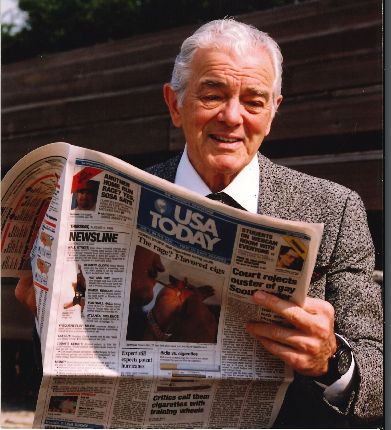
As you can see for yourself, the memo is mainly corporate boilerplate (and I don’t just mean the literal boilerplate on the second and third pages). For me, the main takeaway is that they say nice things about Gannett’s flagship, USA Today, which suggests that GateHouse — clearly the lead player despite being smaller than Gannett — isn’t going to mess around with Al Neuharth’s baby, at least not right away.

By the way, you’ll see a reference in the memo to BridgeTower Media, a name I was not familiar with. It turns out that’s the name for a GateHouse division that publishes B2B titles such as Massachusetts Lawyers Weekly.

The newspaper analyst Ken Doctor broke the news of the impending merger over the weekend. Keep an eye on the debt the combined company is taking on. Doctor estimates that it could be as high as $2 billion, which would seem to suggest further cuts ahead regardless of what kinds of cost efficiencies GateHouse-Gannett is able to achieve. As I wrote for WGBHNews.org two months ago, when it first became clear that the two companies would merge:

When a chain takes on debt to keep buying more properties and extracts revenues from its individual papers in order to satisfy shareholders, there is simply less money available for journalism than there would be with independent ownership.

I don’t think this was necessarily a terrible day for local journalism. MNG Enterprises, the hedge fund-owned chain formerly known as Digital First, was kept at bay, and that’s not nothing. But neither was it a good day. Committed local ownership is the key, and this merger moves us that much farther away from it.

Talk about this post on Facebook.

Zap! Pow! The debates need to move beyond conflict, time limits and fringe candidates

The good old days: Abraham Lincoln debates Stephen Douglas in 1858.

Previously published at WGBHNews.org.

Here we go again.

Four years ago the media gave an enormous boost to Donald Trump by making him the star of their multi-candidate Republican presidential debates. Despite his racist demagoguery and his utter lack of qualifications, Trump was moved to center stage and allowed to talk longer than anyone else because of his poll numbers and his salutary effect on TV ratings.

This time, at least, the Democratic candidates getting the center-stage treatment are reasonably plausible future presidents. But during CNN’s two-night extravaganza this week, and at the NBC debates last month, the same flaws were on display: an emphasis on combat over substance, a ridiculous adherence to time limits (at least NBC let Kamala Harris and Joe Biden go at it), and the elevation of fringe candidates who really have no business being there.

As the historian Kevin Kruse put it:

Although the moderators could have done a better job (I’ll get to that in a bit), the format itself is the real problem. CNN deserves credit for holding one-hour, one-candidate town halls with many of the contenders earlier this year. But how many viewers can make that sort of time commitment? The debates are what truly matter, and they are broken.

One alternative would be to schedule six hours of prime time over three nights for 15-minute interviews. You could actually accommodate all 24 candidates, and it would be a vast improvement over 15-second responses. Another idea comes from my former Northeastern colleague Alan Schroeder, an expert on presidential debates: bring in groups of two or three candidates for 15-minute rounds and have an open discussion. “The point is,” he said on Twitter, “there are much better ways to distribute the precious airtime.”

Even within the ridiculous constraints of the multi-candidate format, though, the moderators could have done better. In the first round, Chuck Todd took a lot of well-deserved heat with his demand for one-word answers to complicated policy questions (grunt once for “yes,” twice for “no”). This time, critics have targeted Jake Tapper for tossing undiluted Republican talking points at the Democrats and for all but encouraging the candidates to verbally assault each other. Tom Jones, who writes the newly renamed Poynter Report (and who, oddly enough, is a fan of Todd’s moderating style), described it this way:

“Tapper’s moderating strategy appeared to be nothing more than antagonizing the candidates into disagreeing with one another. Many of his questions were a version of, ‘Why is (such-and-such candidate) wrong?’

“That’s different than the approaches of fellow moderators Dana Bash and Don Lemon. Bash was the star of the night, asking candidates to state and defend their policy ideas — which is the point of a debate when voters are still trying to figure out who everyone is and who they might support. Lemon, meanwhile, started many of his questions with a very solid, ‘Tell us why you’re the best candidate to …’

“It’s not Tapper’s job to make the candidates look good or bad, but the leaders of the Democratic party could not have been happy that the tone of the debate was so nasty and that nastiness was often a direct result of Tapper’s questions.”

Or as the pollster Matt McDermott put it (via The Washington Post): “Imagine CNN asking in a Republican debate: ‘Democrats want to ensure health care for all Americans. You want to kill people. Care to respond?’”

So who won? I have no novel observations. Like just about everyone, I thought Elizabeth Warren was the week’s clear winner on both substance and style. They say you shouldn’t punch down, but her evisceration of some guy named John Delaney was one for the ages. Biden was OK, and much better than he was in June, even though he screwed a few things up and is already getting roasted for being disingenuous about his past and for not knowing the difference between a website and a text message. He was energetic, fought back, and launched a few attacks of his own. If Biden is going to drop in the polls, I’d say it won’t be quite yet.

Harris, who strikes many people (including me) as uniquely positioned to unite the progressive and moderate wings of the party, took a big step back from her breakthrough moment during the first round of debates. She blew it in several ways, including substance: she seemed utterly incapable of explaining her new health-care proposal coherently. That was a lost opportunity given the reservations people have over a pure single-payer Medicare for All plan on the one hand and the reluctance to simply nibble at the edges of Obamacare on the other.

Pete Buttigieg, Julián Castro, and especially Cory Booker all did well and probably deserve one more shot. But honestly, at this point it’s hard to imagine that the nominee will be anyone other than one of the frontrunners — Biden, Warren, Harris, and Bernie Sanders. We deserve to hear from the four of them directly. The others can be relegated to undercards and other events.

What do the media owe us in televised debates? Substance, focus, and seriousness of purpose. It’s a cliché, of course, to say that this is the most important election of our lifetime. But the stakes may be nothing less than a recommitment to democracy versus a continued slide into authoritarianism.

Grunt once if you agree, twice if you disagree.

Talk about this post on Facebook.

The Lowell Sun sports editor’s farewell column was taken down. Here’s every word of it.

Note: The hedge fund-owned newspaper chain MediaNews Group recently laid off several people at its Massachusetts papers, including sports editor Dennis Whitton of The Sun in Lowell. Whitton posted a farewell column on The Sun’s website and linked to it on Twitter, but when I tried to read it, it was gone — taken down (by management), he said in a tweet. (The column did appear in print.) An anonymous person with access to the CMS forwarded it to me, and I was able to verify that it was authentic. Here is Whitton’s farewell:

40 years of memories

By Dennis Whitton

“And then one day you find, ten years have got behind you. No one told you when to run, you missed the starting gun…”

— Pink Floyd, “Time”

LOWELL — It’s more like 40 years have got behind me. Where have they gone? What do I have to show for them? Can I get some of them back?

After 35 years as The Sun’s sports boss and another 5-6 behind that as a reporter, co-op, cub and otherwise, your intrepid correspondent will be leaving the building this afternoon for the final time.

Corporate cost-cutting is the culprit. Apparently I was making too much money to suit the suits, even with years of frozen wages. I didn’t realize I was making so much. I would have spent more.

Our assistant sports boss, Barry Scanlon, is in the same liferaft. That’s a real head-scratcher because Barry was the staff workhorse and he loved what he did for the most part and did it extremely well. Like me, he took maybe two sick days in 22 years. But he, too, was unknowingly making too much money.

My super-supportive wife Jan says I should use the term “let go” when talking about this stuff because it sounds better than “laid off.”

It probably also sounds better than fired, downsized, axed, canned, dumped, released and forced out, too. But any way you cut it, we’re down to the final countdown in a job I’ve held since before that ball went through Bill Buckner’s legs.

If I sound bitter you’re reading me wrong. With all the technology now in play it’s a young person’s game. I’ve probably overstayed my “sell by” date and now I’m looking forward to the next chapter. Of the book I’m reading. Sitting on the beach.

At least the ax wasn’t performance-related. I know that because the suits in question have no idea what Barry and I did or how we did it. In the end we were numbers on a spreadsheet. There is one major downside to the affair: According to the exit agreement, my discounted employee newspaper subscription will be rolled over to the regular customer rate at the end of the month. Damn.

Everybody knows newspapers are yesterday’s news, useful mainly to parents making scrapbooks for their high school heroes. In the Internet age there isn’t much we can tell you in the rag that you couldn’t have found out 12 hours ago. Advertisers know this, which is why newspapers are circling the drain. Which is why we’ve been let go, and a number of other good people before and after us.

Those were the days.

In looking back for this “farewell column” that the aforementioned Jan has pressured me to write, I realize nearly all of my most interesting times in the game came in the previous century. After that I became a cynical curmudgeon.

So in a nutshell, and with apologies for the overuse of the dreaded pronoun “I,” here are some of my memories:

One of my first assignments as a Northeastern (Class of ’80) co-op student in the Sun sports department was the 1978 Beanpot. Of course the Blizzard of ’78 hit and I was stuck wandering Boston for five days. At least I didn’t bail. A true newspaperman.

In October of that same year I was in the overflow “press box” on the left field roof at Fenway Park when Bucky Dent’s home run cleared the fence so close to me I could almost read Bowie Kuhn’s signature on the baseball.

I covered a lot of Red Sox, Bruins and Celtics games in that time period (much of it while still in college) and even went on several Sox road trips when Charlie (not yet Chaz) Scoggins was on vacation. Milwaukee, Baltimore, Cleveland, the Bronx, Arlington, Texas — all the garden spots. I rode the team buses (Luis Tiant was a hoot. Nobody talked to Yaz. The nicest guy was Jack Brohamer) and stayed at the team hotels.

Jack Costello, the editor whose family owned the paper, wasn’t averse to spending money, at least where travel was concerned (lunch was another matter). Now we don’t even go to the Garden because it costs too much to park.

In September of 1979 I was off to Syracuse for a feature story on Ayer’s Joe Morris, who was setting records for the Orange. From there I detoured down to Madison Square Garden where I covered Larry Bird’s first exhibition game with the Celtics. Still have the press pass to prove it.

In 1982, the paper sent me to Kitchener, Ontario, for three days to do a profile of junior hockey superstar Brian Bellows because the Bruins had the first overall pick in the draft. The stories came out OK, but the B’s went and drafted Gord Kluzak instead.

Jack sent me to Augusta National to cover five Masters Tournaments, ending with Tiger’s historic win in 1997. Got to play the course in 1990 and made birdie on the par-3 sixth with a rented Cannon 5-iron to six feet. Been living off that story ever since. Also got to take the ferry over to Long Island for two U.S. Opens at Shinnecock Hills.

Speaking of golf, in 1999 we were double-teaming the Ryder Cup in Brookline until I told Dave Pevear on Saturday night to go ahead and cover the Patriots’ game on Sunday rather than come to the U.S. funeral at TCC. A case of over-managing.

In 1980, I remember covering the horrendous clubhouse fire at Rockingham Park. It was the morning after I hit the last race, with Skip Row paying $10.20 (I kept the program).

Closer to home there was a story on Dave Boutin, a ULowell catcher from Pawtucketville who was dying of cancer. That one has always stuck with me. Dave and his mother Fleurette were a source of inspiration, even for a cynic. Absolute profiles in courage.

In 1987, they sent me to Pasadena, Calif., for Super Bowl XXI to do stories on Ayer’s Joe Morris (again), by now the Giants’ star running back. From there Mr. Costello had me drive down to San Diego to do a piece on Dennis Conner, who had brought the America’s Cup back to the States in historic fashion.

Dennis was not even in the country, but there was some good yachting talk with various officials at the leather-and-mahogany San Diego Yacht Club. Nothing like some good yachting talk on the company’s dime. At least I got to see the actual Cup.

Westford golfer Pat Bradley always made time for me whenever I needed a story. I attended her Hall of Fame induction dinner in Boston in 1991 (still have the commemorative wine glass) — and shockingly ran into her atop Mt. Washington last year after she had hiked up through thick fog at age 67.

The Golden Gloves were my beat through the ’80s and into the ’90s. I covered Micky Ward’s amateur career (and later Ward-Gatti II), saw Mike Tyson destroy a poor local kid named Jimmy Bisson in 42 seconds in 1983, got to know the tireless Arthur Ramalho and his saint of a wife, Rita, and went on five or six National Golden Gloves trips.

The most memorable of those was in Albuquerque, N.M., when Gloves director Norm Lombardi, “chaperone” Jack Baldwin and I hopped on a small plane to Las Vegas one night. I had to call Ramalho’s hotel room to find out what happened to the heavyweight we had fighting in the tournament and cranked out the story from some cheap hotel off the strip where you had to duck under the TV set when you entered the room.

Norm was obsessed with that casino game where you plug in nickels and they fall into the bin and push other nickels over a cliff for a possible 20-cent payout. Obsessed.

From 1983-85 I left to work with another mentor, Frank Dyer, at the Boston Herald. We had a blast, but there was zero chance to write so I went looking and Lowell happened to be in need of a sports editor. At age 28 I took the job.

Which brings me to the old Sun All-Star sports banquets, usually held at the Windsor (now Lenzi’s) in Dracut. By actual count I did three banquets a year for 23 years until they were discontinued in 2008 — corporate cost-cutting was the culprit.

Introducing shy high school kids and reading about their accomplishments to beaming parents for two-plus hours a night was the drill. I dreaded it at the time but looking back it was a true highlight of my career.

We were able to talk with a ton of area coaches and AD’s and athletes and parents, and it no doubt helped our high school coverage, which was always The Sun’s bread and butter.

There were usually guest speakers, too. Tom Glavine was extremely nervous and kept repeating himself. Now he’s as polished as they come. His girlfriend at the time may have been overserved. Reggie Lewis showed up with a severe burn on his right hand.

A popcorn accident in the kitchen, he told us. Wink wink. Nod nod. Jim Calhoun spoke when he was still at NU and not yet the legend he became at UConn. And there were plenty more.

I covered a Marvin Hagler fight one winter night at the Worcester Centrum and got caught again in a raging blizzard. Unwilling to wait in a long line for gas, I negotiated my beloved but totally unreliable MGB roadster back to Lowell on absolute fumes, barely able to see out the windshield. It finally gave up as I pulled into the old Rex parking lot astride the Sun office. Loved that car.

The Rex was where a Lowell cop moonlighting as a snowplow driver hit my car one night and left a note on the windshield. Thus began a long friendship with Jack Dolan.

So in the interest of wrapping this thing up, let me throw out some other names of people who have helped me along the way, made the journey more enjoyable, and in some cases even became friends:

Jack Costello, Frank Dyer, Mickey Sullivan, Jim Moriarty, Gene Manley, Ken Hughes, Kendall Wallace, Meg Buckley, Shawn Smith, Peter Flynn, Paul Daley, Chris Scott, Jim Campanini, Bill Biswanger, the entire group of sports personnel, past and present, who turned the deadlines we faced every single day into child’s play.

Then there is my aunt Joyce Dalton in Wilmington, who faithfully clipped all of my articles from day one, regardless of topic, passed judgment and sent them down the family line through Auntie Moo.

I know there are others whose names will pop into my head as I drive home after writing this. If that’s you, I apologize.

But as the great Blues Traveler song goes: “It won’t mean a thing in a hundred years.”

— 30 —

Talk about this post on Facebook.

Private equity ownership is devastating retail — just as it has destroyed newspapers

The Washington Post reports some startling figures about the role of private equity firms in the retail business. According to the Post’s Abha Bhattarai:

More than 1.3 million Americans have lost their jobs in the past decade as a result of private equity ownership in retail, according to a report released Wednesday. That includes 600,000 retail workers, as well as 728,000 employees in related industries. Overall, the sector added more than 1 million jobs during that period. [my emphasis]

This is exactly what has happened to the newspaper business over the past several decades. Yes, the internet has devastated the economic model, with advertisers fleeing to Craigslist, Google and Facebook. But that’s only part of the story. The other part is that corporate chains have hollowed out newsrooms in order to maximize profits at a time when what was really needed was investment and patience.

The most notorious of the corporate raiders is MediaNews Group, formerly Digital First Media, which is owned by Alden Global Capital. MNG has all but destroyed once-great papers like The Denver Post and The Mercury News of San Jose, as U.S. Sen. Elizabeth Warren notes in her proposal to re-regulate Wall Street. Cuts continue at MNG’s Massachusetts holdings, the Boston Herald, The Sun of Lowell and the Sentinel & Enterprise of Fitchburg. Meanwhile, The Berkshire Eagle is rebuilding after a group of local business people bought the paper back from MNG.

Consider, too, that independent regional papers such as The Boston Globe and the Star Tribune of Minneapolis are doing reasonably well, and others are taking innovative steps such as giving iPads to their readers to ease the transition to all-digital (the Arkansas Democrat-Gazette), operating under hybrid for-profit/nonprofit ownership (The Philadelphia Inquirer) or are pursuing pure nonprofit ownership (The Salt Lake Tribune).

For years we’ve been hearing that Amazon is destroying retail — yet, as the Post observes, that part of the sector not being strangled by private equity has continued to grow. Newspapers’ business problems are very real. But surely they would be shrinking a lot more slowly, and perhaps groping their way toward sustainability, if they weren’t being destroyed by our financial overlords.

Talk about this post on Facebook.

Millennials and the news: A new study shows that they’re tuned in after all

Previously published at WGBHNews.org.

Is there a more maligned demographic group in the United States than millennials? Blamed for everything from narcissism to avocado toast, adults between the ages of 18 and 34 are regularly disparaged as less ambitiousless tolerant, and less well-informed than members of older generations.

We believe these stereotypes even though they are supported by precious little in the way of evidence. In at least one of those categories, we now have some countervailing data. According to a new study by the Knight Foundation, millennials are regular news consumers who rely on journalism for information, entertainment, and guidance on how to vote.

The survey of 1,660 young adults “shows that 88 percent of people ages 18-34 access news at least weekly, including 53 percent who do so every day,” according to the Knight report. Interestingly, Hispanics and African Americans were somewhat less likely to engage with the news than whites, but were “more likely to share news with friends on social media.” Twitter habits differed by ethnic group as well: “Forty percent of young African American adults get news on Twitter at least once a week, compared to 27 percent of Hispanics and 26 percent of whites.”

I’ve been teaching young adults for the past 15 years, and the Knight findings confirm what I’ve seen. Young people care deeply about the news. But the way they define and consume it is quite different compared to my generation.

Remember Marshall McLuhan’s famous maxim that “the medium is the message.” When those of us who grew up with newspapers read journalism on our phones, we might retain some of our pre-digital ways of thinking — oh yeah, if this were the paper, what I’m reading now would be the editorial page. But for young adults who never read a print newspaper, the digital experience is everything. They don’t draw those kinds of analogies, and they accept the mobile environment for what it is: a source of infinite news and information that they have to sort through.

Granted, I teach mainly journalism students, whose interest in the news is more intense than that of other young adults. Still, I have a few observations that I think are applicable to digital natives of all backgrounds:

• Young people are dubious about “the news” as a curated package. Rather than seeing news as a compilation of international, national, and local information that they need to keep up with on a daily basis, younger news consumers tend to dive deeply into a few areas that interest them. They don’t see the digital environment as disaggregated because for them it was never aggregated. They do their own aggregation, making themselves well informed on a few topics.

• Quality is as important to millennials as it is to older generations. Studies show that older people are more likely to believe and share fake news than younger people. If we’re going to offer classes in media literacy, they are needed at the senior center every bit as much as they are in middle school — maybe more so. Perhaps that’s because older news consumers have a reverence for anything that appears in print (or even in digital text), whereas millennials grew up knowing that they have to be their own fact-checkers. In my experience, young adults are intensely concerned about quality, and they know how to separate the good stuff from the garbage.

• Millennials are unlikely to develop brand loyalty in their media habits. National newspapers like The New York Times, The Washington Post, and The Wall Street Journal are experiencing some success in charging for digital subscriptions, as are a few regional papers like the Los Angeles Times and The Boston Globe. Long-term, though, those papers may be leaving millennials behind, since they’re not going to want to restrict themselves to a few titles they pay for. We need new ideas, such as subscriptions that include a wide range of news sources, or the ability to pay for that day’s digital paper. Single-copy sales were a staple of the newspaper business for generations; they need to make the leap to the way we consume news today.

The Knight Foundation study, conducted by the NORC research institute at the University of Chicago, also found that young people regard the media as being highly biased — even sources they use regularly. They also worry that the media are harming democracy and national unity. African Americans and Hispanics said that news sources did not portray them accurately. No particular media outlets are mentioned in the report. But it does show that millennials are well aware that the country is in crisis, and that the media are too often part of the problem rather than part of the solution.

All of which shows that we older people ought to welcome our millennial overlords. We can only hope that they’ll show up on Election Day. Sadly, that is one area in which they thoroughly deserve their dismal reputation. Perhaps that will change in 2020.

Talk about this post on Facebook.

Why Justice Stevens’ fraught relationship with the First Amendment still reverberates

Justice Stevens

Previously published at WGBHNews.org.

The late Supreme Court Justice John Paul Stevens today is being hailed as a liberal beacon who took strong stands against the death penalty and in favor of gun control and limits on political spending.

But despite his well-deserved reputation as a judge who was motivated by decency and principle, his legacy with regard to the First Amendment is mixed.

For one thing, as Linda Greenhouse observed in The New York Times, Stevens in 1989 broke with his colleagues when they overturned a Texas law that banned flag-burning. “His patriotism was of the old-fashioned, unabashed variety,” wrote Greenhouse by way of explanation.

For another, on two important cases that pitted the right to privacy against freedom of the press, Stevens sided against the media. In one instance he was on the losing end. In the other, though, he wrote the majority opinion, limiting public access to government information in a decision that reverberates three decades later.

First, Stevens’ dissent. Starting with New York Times v. Sullivan in 1964, the Supreme Court began issuing a series of decisions that made it more difficult for plaintiffs to win libel suits. In the Times case, the court ruled that public officials suing for libel would have to show not only that false, defamatory material had been published about them, but that the publisher had acted with “actual malice” — that is, with the knowledge that it was false or with reckless disregard for the truth. That standard was later extended to public figures as well. Then, in Gertz v. Robert Welch Inc. (1974), the court ruled that even private figures would at least have to prove negligence in addition to falsehood and defamation.

These decisions greatly strengthened freedom of the press. Still to be settled, though, was the matter of proof. Traditionally, after a plaintiff sued for libel, it was up to the publisher to prove that the material in question was true. That changed with Philadelphia Newspapers Inc. v. Hepps (1986), in which the court ruled by a five-to-four margin that it should be up to the plaintiff to prove falsity.

Stevens was outraged. In his dissent, he wrote that “in order to comprehend the full ramifications of today’s decision, we should assume that the publisher knew that it would be impossible for a court to verify or discredit the story, and that it was published for no other purpose than to destroy the reputation of the plaintiff.” He added: “I simply do not understand … why a character assassin should be given an absolute license to defame by means of statements that can be neither verified nor disproved.”

Three years later, though, Stevens was on the winning side in ruling that public records may become private in some circumstances, and that the privacy rights of an individual can sometimes outweigh the public’s right to know.

The case, Department of Justice v. Reporters Committee for Freedom of the Press, was decided unanimously in 1989, but it had been many years in the making. Starting in 1978, Robert Schakne, a reporter for CBS News, had been seeking FBI rap sheets about the four Medico brothers, who were alleged organized crime figures with ties to a corrupt congressman named Daniel Flood. Schakne’s case, fought on his behalf by the Reporters Committee, was thrown out in 1985 at the district court level. But a federal appeals court ruled in his favor in 1987. By the time the matter reached the Supreme Court, only one of the Medico brothers was still living. That set the stage for Justice Stevens.

The rap sheets Schakne sought consisted entirely of public records that could be searched for at courthouses and other venues. Yet Stevens wrote that they had ceased to be public because they had been compiled and computerized by the FBI. Thus, the records were covered by the privacy exemption to the federal Freedom of Information Act, or FOIA.

As Stevens put it, there is a “distinction … between scattered disclosure of the bits of information contained in a rap-sheet and revelation of the rap-sheet as a whole. The very fact that federal funds have been spent to prepare, index, and maintain these criminal history files demonstrates that the individual items of information in the summaries would not otherwise be ‘freely available’ either to the officials who have access to the underlying files or to the general public. Indeed, if the summaries were ‘freely available,’ there would be no reason to invoke the FOIA to obtain access to the information they contain.”

But that was only part of the test. Under FOIA, records deemed private may still be released if there is a compelling public interest in doing so. The Reporters Committee argued that disclosure of the rap sheets was warranted because the Medico brothers had dealings with Flood. Again, Stevens ruled against the committee, writing that the documents would have provided information about the Medicos rather than the government.

Stevens wrote that “although there is undoubtedly some public interest in anyone’s criminal history, especially if the history is in some way related to the subject’s dealing with a public official or agency, the FOIA’s central purpose is to ensure that the Government’s activities be opened to the sharp eye of public scrutiny, not that information about private citizens that happens to be in the warehouse of the Government be so disclosed.”

The decision was a blow against freedom of the press. Even though rap sheets by their nature are filled with falsehoods and rumors, it seemed (and still seems) absurd that government documents that could have provided information about the Medicos’ dealings with a congressman who had pled guilty to corruption charges were not made public. As Jane Kirtley, then the director of the Reporters Committee, put it at the time, the decision had “very serious implications for public access to government information. It says that today something may be a public document but tomorrow it’s not because it’s on a computer tape.”

And yet there was something admirable about Stevens’ insistence that the privacy rights of individuals should take precedence over the interests of the news media. As a journalist and as a First Amendment advocate, I wish Stevens and his fellow justices had ruled otherwise. But today we are at the mercy of a government that has been spying on us for years and of technology giants who store all kinds of personal data about us for purposes benign and otherwise. I think it says something positive about Stevens’ character that he stood up for privacy in the early days of computerized databases.

It says something, too, for the court we had and lost. Justice Stevens was a giant, and he will be missed.

Talk about this post on Facebook.

Better campaign coverage: More substance, less horse race — and holding Trump to account

Previously published at WGBHNews.org.

Nineteen days ago, the journalist and advice columnist E. Jean Carroll leveled a credible accusation of rape against President Trump. Carroll’s claim that Trump violently assaulted her during an encounter in the 1990s created a brief stir of outrage — then all but disappeared. Meanwhile, Trump’s lies and falsehoods mount, the abuse of children at the southern border continues, and his contempt for lawful subpoenas and even Supreme Court decisions grows. The press covers all of this, of course, but with an increasingly perfunctory, what-else-is-new tone of resignation.

Compare that with the second Democratic presidential debate, at which Sen. Kamala Harris reinvigorated her campaign by challenging former Vice President Joe Biden on race and by taking a stand in favor of Medicare for all. Here we are nearly two weeks later, and we’re still discussing whether Harris was being disingenuous given her own nuanced position on the use of busing to desegregate public schools and her shifting views on private insurance. Is Harris slippery? Is she electable? Was she too tough on poor old Joe? (And — gasp! — several of the candidates attempted a little Spanish, proving, of course, that they are hopeless panderers.)

Media coverage of the 2020 presidential campaign is shaping up to be the same depressing spectacle that it always is. With few exceptions, the press focuses on polls, fundraising, who’s up, who’s down, and who made a gaffe. Two and a half years after Hillary Clinton was denied the White House despite winning nearly 3 million more votes than Trump, there’s also a lot of dangerously silly talk about whether Americans are willing to elect a woman.

On Twitter, Washington Post political reporter Dave Weigel took a shot at acknowledging legitimate questions about Harris’ shifting views while placing them within a larger Trumpian context. “The question about Harris’s debate win is if she can shake off the problem that sapped her momentum before: Twisting into a pretzel when pressed on a policy question. So far…,” Weigel tweeted. “And yes, this is another area where Trump gets to play by different rules.”

The overarching problem is the same one that defined the 2016 campaign. As Weigel noted, the media hold Trump to a different standard than the Democratic candidates. The Democrats are treated as serious political players who should be held accountable for their policy positions and for what they say. Trump is presumed to be a lying imbecile, and is therefore not covered as though his words matter.

There was at least some justification for that in the last campaign, when media organizations assumed they could exploit the Trump phenomenon for ratings and profits, safe in the knowledge that, you know, he would not actually be elected. Now there are no excuses. But the press, like the rest of us, appears to be suffering from Trump fatigue, covering the president’s latest outbursts but then dropping them almost immediately in order to chase the next shiny object.

What would better coverage look like?

First, even though Trump will be all but uncontested for the Republican nomination (sorry, Bill Weld), reporters need to understand how crucial it is that he be held accountable in exactly the same way the Democratic candidates are. That seems unlikely to happen. But at a minimum we should avoid a repeat performance of 2016, when the media feasted on emails that had been stolen from the Clinton campaign, making themselves unwitting (and witting) accomplices of Russian efforts on Trump’s behalf.

Second, the media need to stop covering politics as a sporting event and focus on what really matters. Sen. Elizabeth Warren has emerged as a leading candidate on the strength of her in-depth policy proposals on issues such as income inequality, student debt relief, and health care. But a candidate’s background, experience, character, and leadership skills are at least as important as policy. Those tend to be the subject of lengthy chin-strokers early in the campaign, supplanted by the horse race once things heat up. It shouldn’t be that way — such stories are essential, and they should be at the center of any serious news organization’s coverage right up until Election Day. On a related note: Chuck Todd of NBC News should be banned from future debates for demanding one-word answers to complex, important questions.

Third, the press should stop trying to “define the narrative.” The narrative, such as it is, is what emerges, and shouldn’t be used as a mnemonic device to make it easier for journalists to do their jobs. Yes, there are serious questions about Sen. Amy Klobuchar’s temperament. But she had long been considered a real contender, and media overkill pretty much derailed her candidacy before it could begin. Warren was described as having missed her best chance by not challenging Clinton in 2016, but here she is. Harris opened strongly! stumbled! and now is back in it! These are normal ups and downs; the press errs by taking them too seriously.

There have been some positive signs. CNN’s one-hour town halls with the Democratic candidates have encouraged thoughtfulness and depth. Unfortunately, they demand too much from all but the most committed viewers. The 10-candidate “debates” on NBC were far too superficial. How about a series of 15-minute interviews, eight a night for three nights? That should be enough time to get into some substance.

As I wrap this up, Yahoo News is reporting that the Seth Rich conspiracy madness — the false tale that the Clintonistas ordered the 2016 murder of a young Democratic operative in order to cover up their own corrupt acts — originated with Russian intelligence. This bit of toxic fakery was not taken seriously by the mainstream media, but it was promoted by Sean Hannity on Fox News and, later, by the Trump White House itself. In other words, it got wide distribution and polluted our discourse even though actual news organizations handled it responsibly.

Which brings me to my final observation. Even if political reporters can improve on their efforts to hold Trump to account, to focus more on substance and less on the horse race, and to let the larger narrative emerge rather than trying to define it for us, there are few signs that they are prepared to deal with the new media world of foreign actors, Facebook fakery, and disinformation in which we are now immersed.

That world, as much as anything, got Trump elected in 2016. If the media aren’t prepared to identify and expose such efforts in 2020, it could happen again.

Talk about this post on Facebook.