Now that a temporary restraining order stopping President Donald Trump’s niece from publishing her tell-all book has been overturned, I want to briefly touch on why we all ought to be worried that the order was issued in the first place.
According to The Daily Beast, Hal Greenwald, a New York State judge, “ordered Mary Trump and Simon & Schuster to appear before him on July 10 — and barred them from disseminating her book,” titled “Too Much and Never Enough: How My Family Created the World’s Most Dangerous Man.”
But under longstanding precedent first set forth in the Supreme Court case of Near v. Minnesota (1931), prior restraint can be invoked only if publication would result in a serious breach of national security (a hurdle the government was not able to meet even in the Pentagon Papers case), or if the material in question meets the legal definition of obscenity or would incite violence.
This is not to say that the First Amendment offers Mary Trump blanket protection. It’s very possible that she could be found to have violated a binding non-disclosure agreement, as the president argues. But in order not to run afoul of the First Amendment, legal remedies would have to come after publication.
By acting as he did, Judge Greenwald elevated a family dispute to the level of revealing the movement of troops during wartime (one of the scenarios envisioned in the Near decision) or publishing instructions on how to build a nuclear bomb (the subject of another famous court battle over prior restraint).
Two stories about racism in the news today show the heartbreaking reality of racism in the Boston area.
The first involves a 21-year-old Black woman in Groveland named Julia Santos, who was chased and harassed by a middle-aged white man in a BMW convertible as she was picking up food for her dog. Steve Annear and Maria Lovato report in The Boston Globe that the man only stopped berating her after a neighbor intervened.
It’s a sickening story, and it easily could have have escalated into something much worse. Fortunately, Santos reacted calmly and recorded the encounter on her phone.
By the way, the Globe didn’t identify the the man who stalked Santos because the reporters were unable to verify it. But she named him on Facebook, and it sounds like local police are all over the story. Let’s hope he gets what’s coming to him.
The second, by Globe reporter (and distinguished Northeastern journalism alum) Meghan Irons, concerns a Suffolk Law School study showing that Black renters are subjected to horrendous discrimination. Among other things, the undercover operation revealed that would-be renters who identified themselves by names such as Lakisha, Tyrone or Kareem were, more often than not, immediately shot down, whereas those who seemed to be white had no problems.
“In subtle and overt ways, Black renters experienced discrimination by real estate brokers and landlords in 71 percent of the cases tested,” Irons writes.
One of the first in-depth investigative reports I remember reading was in The Boston Phoenix or The Real Paper sometime in the early 1970s. The topic: landlords who discriminate against Black people looking for apartments. And here we are nearly 50 years later.
At a moment of national crisis over racism and police brutality, it is depressingly apt that our lead New England Muzzle Award this year concerns an African American teacher in Milton, Massachusetts, who was briefly placed on leave and investigated for telling her sixth-grade poetry students that some police officers are racist.
School officials in Milton quickly backtracked, and the teacher, Zakia Jarrett, received a considerable amount of public support. Nevertheless, it’s sad and telling that the school administration’s first impulse was to punish the messenger rather than focus on the uncomfortable truth of her message.
Other Muzzle Award winners this year include a judge who refused a prosecutor’s request that he drop minor charges against nonviolent protesters (for good measure, he also briefly jailed a defense lawyer for reading the law to him); the police department in Portland, Maine, whose officers made an intimidating visit to a critic’s home under the guise of what appear to be trumped-up vandalism charges; and a town official in Exeter, Rhode Island, who shepherded through an ordinance requiring that people attending public meetings act with “decorum.”
Needless to say, the 2020 Muzzle Awards come at a time of unprecedented crisis, as the country struggles with the COVID-19 pandemic, economic collapse and a long-overdue coming to terms with the legacy of racism.
New England was spared the worst of those excesses. Still, especially in the early days of the demonstrations, heavy-handed police tactics in Boston and elsewhere sometimes overshadowed the message that the protesters were trying to convey. Suffolk County District Attorney Rachael Rollins told The Boston Globe last week that she is investigating police conduct at those protests.
The New England Muzzles are published around the Fourth of July every year to call attention to outrages against freedom of speech and of the press. They were launched in 1998 at the late, great Boston Phoenix, which ceased publication in 2013. This is the eighth year they have been hosted by WGBH News. They take their name from the Jefferson Muzzles, begun in 1992 by the Thomas Jefferson Center for the Protection of Free Expression.
The envelopes, please.
Milton (Mass.) Public Schools
A Black teacher is targeted for speaking the uncomfortable truth.
Perhaps a Muzzle Award should go to the anonymous parent or student who recorded Zakia Jarrett last month as she was leading a remote sixth-grade poetry lesson and said that Black people were “being killed by racist white people … which many of the cops are, as well.” Whoever passed along that clip to Milton school officials sent an ominous warning in this new era of education by Zoom and Google: Be careful what you say, because you’re being watched.
Instead, though, the Muzzle goes to the Milton Public Schools. Their sole response should have been to remind everyone that recording teachers and making the clips public was a violation of school policy. Instead, according to The Boston Globe, Jarrett’s principal at the Pierce Middle School, William Fish, placed Jarrett on paid administrative leave while school officials investigated, sending a chilling message to the entire town.
The action affecting Jarrett was reversed later that day. But a considerable amount of damage had already been done. About 400 parents reportedly signed a letter in support of Jarrett, who is Black, and called on the school system to do a better job of teaching students about race and racism.
School officials quickly backtracked from their initial tough stance.
“At no point was the teacher suspended nor was any disciplinary action taken. The leave was rescinded after a few hours,” according to a statement posted on the school system’s website. The statement added that Schools Superintendent Mary Gormley “met with and apologized to the teacher and followed up with a written apology.”
But the Milton Educators Association, as the local teachers’ union is known, had a decidedly different perspective. In a statement published in the Milton Times, the union said that “nearly an entire week went by before the district responded to this situation in a way that conveyed how its actions let down all of the students and educators. The district’s message still fell short of what the MEA believed would have been an acceptable apology that acknowledged the full impact of this incident.”
What’s sad is that school officials fell back upon an unthinking bureaucratic response at the first sign of trouble. They should have been able to see how this would play out as soon as they received that 13-second clip. Not only could they have avoided a lot of trouble, but they missed a chance to do the right thing.
On June 19, Juneteenth, Milton educators and activists held a rally and march for racial justice. It was a chance for everyone to reflect and to take steps to ensure that nothing like it would happen again.
Despite that support, Jarrett told the Globe she hadn’t decided whether to stay in Milton.
“The word ‘racism’ triggers a lot of negative feelings,” she was quoted as saying. “The idea that people may hold racist beliefs makes them feel bad about themselves. But all people have biases and prejudices. And until we talk about them, we can’t root them out.”
Mass. Gov. Charlie Baker
He seeks to end nearly 380 years of access to vital records.
Since 1641, Massachusetts has made death certificates, marriage notices and birth records freely available to anyone who requests them. That could change, though, under an obscure proposal included as an outside section of the budget earlier this year, according to The Boston Globe. The proposal would hide such records from public view for what would amount to a lifetime.
If approved, the measure would be a step backwards in a state already notorious for limited access to public records. The Muzzle goes to Gov. Charlie Baker, who may be under the impression that he’s enhancing privacy protections, but who in reality would be cutting off a vital source of information for journalists and researchers.
Access to such records advances the public interest. For example, WGBH News reporter Jenifer McKim tweeted, “As MA governor works to make birth, death records secret, thinking of the stories I’ve written and produced with the help of these key, currently public, documents,” including suicides at colleges and universities.
As MA governor works to make birth, death records secret, thinking of the stories I've written and produced with the help of these key, currently public, documents: Stories looking at suicide deaths at local colleges and universities: https://t.co/GOzUJ7tNkC.
The genealogical community was angered as well. In an interview with the Chelsea Record, Ryan Woods, executive vice president of the New England and Genealogical Society, said, “Unequivocally it was a surprise to us. There had not been any public discussion about this until it appeared in the budget.”
The Massachusetts Genealogical Council said the measure would make health researchers’ jobs harder and could make it more difficult for women who need to document breast cancer within their families so that they may qualify for genetic testing. The council added: “This is a time when genealogists from throughout the world should step up and be heard.”
By including the proposal in his budget rather than filing it as a separate piece of legislation, Baker has made it more difficult to defeat, as legislators won’t be able to vote against it without also opposing spending measures that they might support.
The governor and the legislative leadership should delete this ill-considered proposal before it is ever put to a vote.
Judge Richard Sinnott
The son of Boston’s last official city censor keeps the tradition alive.
For courtroom heavy-handedness above and beyond the norm, it’s hard to beat Muzzle winner Richard Sinnott, a judge in the Boston Municipal Court.
Last September, The Boston Globe reported that Suffolk County District Attorney Rachael Rollins was seeking to drop charges against a group of nonviolent counter-protesters who’d been arrested on minor charges at a so-called Straight Pride demonstration. Sinnott refused.
Next, he ordered one of the defense lawyers, Susan Church, removed and locked up because she had the temerity to read from case law in order to argue that Sinnott had no right to reject Rollins’ recommendation. She was released about two hours later. “All I was trying to do is to read the law to the court, and I was summarily arrested, handcuffed, brought down to the holding cell, held there for hours,” Church told WGBH News.
The lenient treatment that Rollins sought was not indiscriminate, as she asked for more-serious charges to move forward against another group of protesters accused of violence.
“Make no mistake: some people were appropriately arraigned and will be held accountable for actions that put the safety of the public and law enforcement at risk,” Rollins said in a statement reported by Universal Hub. “For those people now tangled in the criminal justice system for exercising their right to free speech — many of whom had no prior criminal record — I will use the legal process to remedy the judge’s overstepping of his role.”
The standoff was resolved quickly. Several days later, Supreme Judicial Court Justice Frank Gaziano ruled that Judge Sinnott had no authority to stop Rollins from dropping the charges, according to MassLive.
Sinnott comes by his Muzzle-worthy ways naturally. His father, also named Richard Sinnott, was at one time the city censor, in charge of banning risqué entertainment such as strip shows and overly salacious Broadway plays. The New York Times called him “the last municipal official empowered to ban wickedness in Boston.”
Good thing that the younger Sinnott’s bid to keep the “Banned in Boston” flame burning ended in failure.
U.S. Customs and Border Protection
From their perch in northern Maine, they spy on Canadian mail.
What could be more sacrosanct than your mail? With the exception of prison inmates and targets of criminal investigations, people have a right to receive packages and read correspondence free from the prying eyes of the government.
Unless, that is, you live on Campobello Island, New Brunswick. Except for the summer months, when a ferry is in service, mail is delivered to the Canadian outpost over a bridge from Lubec, Maine — giving our Muzzle winner, U.S. Customs and Border Protection, entrée to tear it open and inspect it. Residents know their mail has been pawed over when it arrives resealed with green tape.
To be clear, we’re talking about internal Canadian mail, originating in Canada and sent to a Canadian village. The only reason it’s delivered through the United States is because of an accident of geography.
This outrageous situation drew press coverage late last year and early this year from the Canadian Broadcasting Corp., the BBC, The Washington Post, The Boston Globe and other media outlets. As Dale Calder, a retired Canadian government employee, told the Globe, “It’s an invasion of our privacy. There’s personal correspondence in there, people’s health records, and financial records. What are they doing with it once they open it?”
In a statement to CBC Radio, U.S. Customs officials said they “possess broad search authority to ensure the safety and admissibility of all goods entering the United States.”
Although U.S. officials wouldn’t confirm it, residents believe the reason for this snooping is that old demon weed. Marijuana is legal in Canada and Maine, but it remains illegal to transport it over the U.S. border.
“I don’t like American bullying. This kind of stuff bothers me,” an island resident named Steve Hatch, who holds both Canadian and American citizenship, told the CBC. “You should have an expectation of privacy with the mail, and we don’t here on the island.”
Chris Sevier
An out-of-state anti-LGBTQ activist bamboozles Rhode Island legislators.
To be fair, the bill that five Rhode Island state legislators introduced in March was aimed at addressing an unethical journalistic practice: reporting that a public official is under investigation but then failing to follow up. Sometimes accusations are set aside and the target is cleared of wrongdoing. The media should report that, as well.
Mandating a follow-up by law, however, is a clear abridgement of the First Amendment. That is why we are presenting a Muzzle Award to Chris Sevier, an anti-LGBTQ activist from Tennessee who achieved minor celebrity status some years ago for attempting to marry his laptop computer, according to the nonprofit news organization Mississippi Today.
Sevier is the leader of a nebulous organization called Stop Guilt by Accusation, which has pushed legislation in a number of states that would require news organizations to report the outcome of investigations into public officials accused of illegal or unethical conduct. “The freedom of the press is not absolute,” Sevier told Mississippi Today.
The Rhode Island legislators withdrew the bill and conceded it went too far, according to WPRI. James Bessette, president of the Rhode Island Press Association and an editor at Providence Business News, told the station, “The fact that this bill — which would be damaging beyond any comprehension — was even introduced is both laughable and frightening.”
A coda: Last January, a similar bill was introduced in the New Hampshire legislature. According to the New England First Amendment Coalition, the legislation would have imposed liability on any news outlet that reported on criminal charges and then later failed to report that the person had been acquitted or that the charges had been dismissed.
The bill quickly died in committee.
Sevier’s group identifies New Hampshire as one of the states where it is pushing his legislation. But state Rep. Jack Flanagan, R-Brookline, the sponsor of the New Hampshire bill, said in an interview with WGBH News that he had never heard of Sevier, and that the idea was his alone.
“I received a number of concerns from people who had been arrested, became public and were found not guilty, dismissed or dropped,” Flanagan said by email, adding: “My issue was that we weren’t telling what to write, but to write the whole story.”
Flanagan wins a Dishonorable Mention for his attempt to transform a reasonable observation about media ethics into an unconstitutional law.
Andrea Harrington
The Berkshire district attorney’s public records refusal prompts a resignation.
Public records violations are so common that they often don’t get the attention they deserve. Yet the principle that government should be transparent is an important one. If we don’t know what our representatives are up to, then the idea that we live in a self-governing democracy is meaningless. Unfortunately, the Massachusetts public records law is so weak that officials violate it with impunity — even though the law was strengthened slightly several years ago.
Some incidents, though, are so egregious that they warrant special mention — which is how Berkshire County District Attorney Andrea Harrington earned herself a Muzzle.
Last December, The Berkshire Eagle filed a public records request about a student at Bard College at Simon’s Rock who said she’d been racially attacked. Following an investigation, her claim was found to have been a hoax. Harrington’s office declined to provide the records.
What happened next was truly startling. Harrington’s public records officer, Jeanne Kempthorne, resigned and blew the whistle on the DA, telling the Eagle, “It was the straw that broke the camel’s back. My concern is that what she [Harrington] did was not in the public’s interest; it was in her interest. This isn’t a private company, and it’s not her campaign. There are bigger considerations — are we actually going to fulfill our public duties?” For good measure, Kempthrone gave the Eagle redacted copies of the records it had sought.
Harrington’s office denied that anything untoward had taken place. But the law requires law enforcement agencies to release records once an investigation has concluded, as was the case with the Bard incident.
“When officials abuse the investigatory exemption of the public records law, they prevent us from learning if justice is being served in our communities,” said Justin Silverman, executive director of the New England First Amendment Coalition, in an interview with the Eagle.
Finally, we are awarding a Dishonorable Mention to the Massachusetts State Police, also a 2019 Muzzle winner, which was sued by The Boston Globe in February of this year over the agency’s failure to produce documents related to the paper’s reporting on an investigation into overtime fraud and related matters.
Jeffrey Shedd
A high school principal in Maine shuts down discussion about sexual assault.
Aela Mansmann wanted to call attention to sexual harassment and assault at Cape Elizabeth High School in Maine, where she was a sophomore. So last September, she posted a note in the bathroom that read, “There’s a rapist in our school and you know who it is.” Several other girls began posting similar notes.
But when a male student complained that he was feeling targeted (an interesting reaction, given that no one was named in the notes), the school decided to act — not against sexual assault, but against whoever had posted the notes. An investigation of several weeks ensued. And the principal, Jeffrey Shedd, has earned a Muzzle Award for suspending Mansmann and two other girls for three days, writing to parents that the students had made a “bad choice” that “hurt” others, according to News Center Maine.
“I honestly feel very ashamed that my school took this action,” Mansmann said in an interview with BuzzFeed News, adding: “It was really addressing the general culture of our school, and keeping in mind several specific cases. But there are so many it’s hard to pinpoint just one and advocate for just one of them.”
After Mansmann’s parents and the ACLU of Maine filed a lawsuit in U.S. District Court to overturn her suspension, Judge Lance Walker issued a temporary restraining order, ruling that they were likely to prevail on the merits. “If school administrators,” Walker wrote acidly, “receive carte blanche to tamp down and vet non-frivolous outcries on topics of social justice, expressed in areas generally associated with free student communication, where would that leave us?”
School officials should have taken the opportunity to stand down. Instead, they filed an appeal, with Cape Elizabeth School Board Chairwoman Susana Measelle Hubbs saying that administrators needed to be able to respond to statements “that are likely to spread fear and alarm, or to harm others,” according to a report by WGME and The Associated Press.
Mansmann’s suspension was put on hold pending final resolution of the case, the Portland Press Herald reported. The other two girls have not spoken publicly. It’s time for school officials to end this fiasco and apologize for trampling on the students’ free-speech rights.
Calvin Ellis
A local official in Rhode Island tells the public: Be nice — or else.
Anyone who has spent much time covering local government meetings knows that the internet isn’t the only place where you can find trolls. Cranks of various persuasions often show up so that they can yell, raise irrelevant issues and generally make pests of themselves. Sometimes they even have legitimate concerns.
Such gadflies have been dealt with since time immemorial by asking them to be quiet or, if that doesn’t work, asking them to leave. If they resist, there’s usually a police officer on hand to help them find the door. (These days, of course, they can just be muted on Zoom.)
Which is why Calvin Ellis,president of the town council in Exeter, Rhode Island, has earned a Muzzle. Last September, the council approved his unnecessary, speech-squelching ordinance requiring “decorum” by people who attend public meetings.
“We don’t anticipate enforcement,” said Ellis, according to a report by WJAR. “Only we want proper decorum, proper conduct to prevail.” Well, if you don’t “anticipate enforcement,” why do it in the first place?
Exeter has had its issues. Reportedly, some members of the public have walked out in the face of yelling, and on one occasion the Rhode Island State Police had to be called. But it’s hard to see how a rule mandating decorum would change that.
Here’s the most problematic part of the Exeter ordinance, as reported by the Johnston Sun Rise: “Any person making personal, impertinent, or slanderous remarks or who shall become boisterous while addressing the Town Assembly, Council, Board, or Commission, or any member thereof, shall be forthwith, by the presiding officer, barred from further audience before the Town Assembly, Council, Board, or Commission at that meeting, unless permission to continue is granted by a majority vote of the Town Assembly, Council, Board, or Commission.”
As Steven Brown, executive director of the ACLU of Rhode Island, put it in a statement: “When does a pointed criticism of a Council member for their stand on an issue become ‘personal’? … When will impassioned comments of a speaker — whether out of enthusiasm or anger — become improperly ‘boisterous’ and subject him or her to removal from the meeting?”
A short time after the measure was approved, the Narragansett Town Council rejected a similar measure. Exeter needs to reconsider. It should be possible to exercise some control over a public meeting without an ordinance that tramples on the First Amendment.
Timothy McCarthy
His pre-pandemic proposal to ban face masks at protests went nowhere.
If we had a category for Most Ironic Muzzle Award, it would surely go to Boston City Councilor Timothy McCarthy. Last September, according to WGBH News, McCarthy persuaded his colleagues to draft an ordinance banning face masks and other identity-shielding coverings at public demonstrations.
What prompted him were the face shields used by some counter-protesters at the anti-LGBTQ “Straight Pride” rally — the same counter-protesters who drew Judge Richard Sinnott’s attention (above). To be fair, McCarthy was targeting those engaging in violence, not peaceful protesters.
“When did people wake up in the morning and say, ‘Hey, let’s go to a peaceful protest, but don’t forget your razors, and your keys for handcuffs, and your face masks in case you get urine and bleach that you’re throwing at the cops, you don’t want to get that in your eyes,’” McCarthy said.
The irony, of course, is that because of the COVID-19 pandemic, we are now all required to wear face masks outdoors if we’re unable to practice social-distancing. Compliance with orders to wear face masks has been less than universal during the Black Lives Matter protests that have broken out over police brutality and racism, raising the specter of another coronavirus surge. Needless to say, if McCarthy’s misguided proposal had been approved, the Council would now be racing to repeal it.
Last September, McCarthy drew some guarded support from fellow councilors for his proposed face-mask ban, who noted that similar bans have been used to good effect against the Ku Klux Klan. Mayor Marty Walsh, in an interview with Jon Keller of WBZ-TV, said such a ban might make sense as long as there was an exemption for religious reasons.
At a subsequent Council meeting, though, mask-wearing opponents spoke out against the “absurdity” of the measure, according to a Boston Globe account. “Do you feel threatened right now?” asked Belmont resident Alex Marthews, who wore a mask to the hearing.
Anonymous speech is protected under the First Amendment. And it’s hard to see how an anti-mask ordinance could be enforced against those engaging in violence while leaving peaceful protesters alone.
Then again, wearing face masks in public is going to be with us for a long time. McCarthy’s idea, wrong-headed though it may have been, now seems like it’s from a distant, better world.
Portland (Maine) Police
Officers intimidate an outspoken critic by showing up at his house.
Journalist Christian MilNeil is the editor of the transportation website StreetsblogMASS, a former data reporter for the Portland Press Herald and a board member of the Portland Housing Authority. In other words, he’s not the sort of guy you would expect to spray two police substations with graffiti, as Portland Police officers claim and as he staunchly denies.
MilNeil believes the real reason that two officers showed up at his house one day last month was because of something rather different: his tweets that criticized the police. Based on the evidence, it appears that MilNeil is correct — and thus we are awarding a Muzzle to the Portland Police Department.
On June 9, as the officers approached, MilNeil took their photo through a window and tweeted: “IDK if this is related to my recent tweets but #portlandme police are at my home now and threatening arrest, they won’t say why.”
IDK if this is related to my recent tweets but #portlandme police are at my home now and threatening arrest, they won’t say why pic.twitter.com/Me2YXm5ohh
— Christian Neal MilNeil (@c_milneil) June 9, 2020
A short time later he added, “They’re making it pretty clear they’re upset with my recent tweets. One cop told my wife ‘I know about your preconceived notions of police — I know them for a fact.’” (MilNeil later said the officers did not specifically mention the tweets, but he inferred they had seen them from what they told his wife.)
It would appear that the officers were on a mission to intimidate an outspoken critic amid protests against police brutality. Among other things, MilNeil had tweeted about a police officer who’d killed people in 2017 and 2008 — the earlier incident because, according to MilNeil, the officer had “escalated a traffic stop.” He’s also tweeted in favor of defunding the police.
According to the Portland Press Herald, city spokeswoman Jessica Grondin said the graffiti had been written on two community policing substations, one of which was housed in a Portland Housing authority building. “It’s not because of the tweets,” she said in a text.
At deadline, it appeared that attempts were underway to get to the bottom of the incident. The Press Herald reported that City Councilor Kimberly Cook was seeking body-camera video of the encounter as part of the city’s investigation into how the police had responded to Black Lives Matter protests. The Press Herald filed a Freedom of Information Act request for the video, too, but was turned down, with the police citing investigatory exemptions.
Let’s hope some answers are forthcoming. It’s hard to imagine anything more chilling to free speech than having two police officers showing up on a critic’s doorstep and threatening prosecution on the basis of dubious charges.
Vinay Mehra, president of Boston Globe Media Partners, is leaving after three years at the helm, according to an announcement to employees by managing director Linda Henry late this afternoon.
No idea of what prompted this, but I wonder if Mehra’s departure might help break the logjam between the Boston Newspaper Guild and management, which are bogged down in protracted contract negotiations.
Then, too, the union has raised the prospect that John and Linda Henry are interested in selling the Globe, according to a recent story by Sarah Betancourt of CommonWealth Magazine. It seems unlikely, but who knows?
What follows is Linda Henry’s message, a copy of which was provided to me by a trusted source a little while ago.
After three years with us, today is Vinay Mehra’s last day with Boston Globe Media Partners.
We are grateful for his work in helping to stabilize and grow our remarkable organization and are especially thankful to him for building an incredibly strong and effective Senior Leadership Team. This team is well-positioned to lead our organization and to continue the important work of ensuring that our institution continues to serve our community and our mission for years to come.
We wish Vinay the best of luck in his next venture.
Bob Woodward. Photo (cc) 2010 by Miguel Ariel Contreras Drake-McLaughlin.
There is a lot to chew over in Ben Smith’s deep dive into The Washington Post, which — like news (and non-news) organizations everywhere — is struggling with issues of diversity. But let me keep the focus narrow here, because Smith leads with a blockbuster anecdote about something that unfolded during Brett Kavanaugh’s Supreme Court confirmation hearings in 2018. Smith writes in The New York Times:
Bob Woodward, the Post legend who protected the identity of his Watergate source, Deep Throat, for 30 years, was going to unmask one of his own confidential sources. He was, in particular, going to disclose that Judge Kavanaugh had been an anonymous source in his 1999 book “Shadow: Five Presidents and the Legacy of Watergate.”
Mr. Woodward was planning to expose Mr. Kavanaugh because the judge had publicly denied — in a huffy letter in 1999 to The Post — an account about Kenneth Starr’s investigation of President Bill Clinton that he had himself, confidentially, provided to Mr. Woodward for his book. (Mr. Kavanaugh served as a lawyer on Mr. Starr’s team.)
What Kavanaugh allegedly did pretty much defines one of the circumstances under which a reporter might consider exposing an anonymous source: he told the truth (apparently) to Woodward and then lied about it in public. And the stakes were high, as Woodward’s story, if published, could have presented yet another obstacle to Kavanaugh’s confirmation.
But executive editor Marty Baron intervened, according to Smith: “Mr. Baron and other editors persuaded Mr. Woodward that it would be bad for The Post and ‘bad for Bob’ to disclose a source, one of the journalists told me. The piece never ran.”
Among those siding with Baron is Matt Storin, his predecessor as editor of The Boston Globe, where Baron served for nearly more than a decade before moving to the Post. “I’m not in a position to render judgment on a lot of this piece, but @PostBaron absolutely did the right thing on the Woodward issue, supporting any reporter in the future who needs an anonymous source,” Storin tweeted.
I'm not in a position to render judgment on a lot of this piece, but @PostBaron absolutely did the right thing on the Woodward issue, supporting any reporter in the future who needs an anonymous source. https://t.co/2vTHziEbS9
I agree with Storin — and, thus, with Baron. Unless Woodward promised Kavanaugh he’d keep his identity confidential only if he subsequently told the truth in public about their exchange, then Woodward had no business breaking their agreement. It’s a tough call, and the fact that someone of Woodward’s stature wanted to go the other way shows that good people can differ on this. But Woodward, pressured by Baron, ultimately did the right thing.
It’s not like Kavanaugh is the first source to tell a reporter one thing in confidence and then say something else publicly. It’s happened to me, and I’m sure most reporters would tell you the same thing. But that’s one of the risks you take when grant anonymity to someone.
A Whole Foods store in West Hartford, Connecticut. Photo (cc) 2014 by Mike Mozart.
The Boston Globe reports that Whole Foods is sending employees home if they show up to work wearing face masks emblazoned with “Black Lives Matter.” Katie Johnston writes:
After seeing reports of Whole Foods workers in other states being sent home for refusing to take off Black Lives Matter face masks, Savannah Kinzer decided to bring the movement to Cambridge. And, sure enough, when she and her colleagues put on masks emblazoned with the phrase Wednesday afternoon, the manager told them they either had to remove the masks or go home. So seven of them walked out.
As is often the case with such public-relations disasters, at root is a failure of the imagination. How can management not understand that this will end with them apologizing and backing down?
According to a number of recent national polls, Joe Biden has moved out to a sizable lead over President Trump — so sizable that, if the election were held now, Biden would probably win the presidency by a substantial margin, since his lead is large enough to overcome Trump’s structural advantage in the Electoral College.
What I want to address here is the assumption some observers are making that Biden wouldn’t be ahead by nearly as much (or even at all) if it weren’t for COVID-19, the resultant economic catastrophe and the Black Lives Matter protests.
Yes, those would be huge challenges for any president. But with COVID, in particular, a compassionate, reasonably competent response wouldn’t have necessarily hurt Trump and might have even helped him. Look at Massachusetts Gov. Charlie Baker, who continues to receive high marks for his response to the pandemic, according to a new Suffolk University poll.
Likewise, the reason that the Black Lives Matter protests represent such an existential threat to Trump is that he’s a stone-cold racist who’s responded by advocating violence and embracing Confederate symbols — and no one outside his base wants to hear that anymore.
The reality is that any president’s re-election campaign is a referendum on the incumbent. And Trump has been historically unpopular from his first days in office. Biden’s lead merely tracks Trump’s approval/disapproval rating. It’s currently at 41% approve/55% disapprove, according to the FiveThirtyEight averages, and that’s right in line with most of his presidency.
Biden may be uninspiring to many, but he’s a consensus figure who’s bound to attract nearly all of the voters who disapprove of Trump. It’s not like anyone is going to hold their nose and vote for Trump because Biden scares them. If you look at the FiveThirtyEight graph, you’ll see that Biden would have been far ahead of Trump at almost any point in the past three and a half years.
The triple threat of COVID, the economy and protests against racism have made Trump’s re-election that much harder. But the dynamic is the same as it ever was.
The COVID-19 pandemic has given a boost to trusted sources of news such as television and online mainstream outlets, but has battered print newspapers for the simple reason that people find it harder to get their hands on them while on lockdown. And though paid digital subscriptions are on the rise, that may be driving a demand for coverage that’s more in line with readers’ political views.
Those are some of the findings of the 2020 Digital News Report, an annual study of news-consumption habits compiled by the Reuters Institute for the Study of Journalism and the University of Oxford. The new report is based on a YouGov survey of some 80,000 people in 40 markets, most of them Western democracies but also including countries such as Kenya and the Philippines.
“The seriousness of this crisis has reinforced the need for reliable, accurate journalism that can inform and educate populations, but it has also reminded us how open we have become to conspiracies and misinformation,” writes Nic Newman, senior research associate at the Reuters Institute.
The study was mainly conducted pre-pandemic, with some follow-up in late March and early April in order to determine how COVID had affected news habits. The report is massive, but there are a few findings that I think are worth highlighting.
• Trust in the media rose somewhat at the height of the pandemic, but overall it continues to fall. For me, the most striking finding is that news consumers said their levels of trust are low even in the media that they use.
Globally, trust in the media that people actually use was 46%, down three points from the previous survey. In the United States, 45% of respondents said they trust the news they use. In addition, 29% of U.S. respondents said they trust the news media in general, 22% said they trust news from search and only 14% said they trust news from social media.
If Americans no longer trust even the media they rely on, that represents a new and unsettling challenge for journalism — and a dramatic change from just a few years ago. For instance, take a look at this 2014 survey by the Pew Research Center. More than 60% of self-identified liberals said they trusted NPR, PBS, the BBC and The New York Times. Similarly, 88% of conservatives said they trusted Fox News.
What could explain the slide? No doubt it has a lot to do with the hyperpolarization of the Trump era. I can’t explain what’s going on among conservatives; Fox News is more popular than it’s ever been, and I assume that supporters of President Donald Trump watch it because they like it.
But among liberals, and especially among politically engaged Twitter users, we’ve all seen an exponential rise in anger when supposedly liberal outlets like the Times or NPR report the news in a way that plays down Trump’s lies and wanton acts of cruelty.
There is, in fact, some substance to these complaints, and the current media business climate makes news consumers feel empowered. Which brings me to my next observation.
• As advertising revenues plummet, paid digital subscriptions continue to rise. About 20% of Americans now report paying for a digital subscription, up four points in just a year. According to the report, the digital-subscription increase has come in two waves — the first in 2017, when anti-Trump readers stepped forward to support mainstream outlets, and the second this year, as news outlets cut back on free sampling while enticing new subscribers with steep discounts. (Such discounts, for example, help account for a surge at The Boston Globe to more than 200,000 digital subscribers.)
Traditionally, advertising paid for newspaper journalism while the nominal amount that consumers paid covered the cost of printing and distribution. As advertising continues to decline in importance, though, subscribers may be demanding a bigger say in how the news is covered.
At a webinar on the Reuters report on Tuesday, Rasmus Nielsen, director of the Reuters Institute, said one of the reasons Americans, in particular, cite when asked why they subscribe to digital news is “because they believe in the mission of journalism and they want to support it.”
Given the overwhelmingly liberal orientation of subscribers to The New York Times and The Washington Post, the two leading national general-interest newspapers, it would hardly be a surprise if they see harshly negative coverage of the Trump administration as part of that mission.
And yet that runs counter to the third finding that I think is worth noting.
• Most survey respondents say they prefer neutral, objective news. This contradicts fears that an explosion of internet outlets and cable channels would lead many of us to seek out news that conforms to our ideological predilections. In the U.S., for instance, 60% “still express a preference for news without a particular point of view,” whereas 30% prefer news that reflects their beliefs.
In many other countries, though, the preference for nonpartisan news is higher than it is in the U.S. — and the percentage of American consumers who want ideologically compatible news is up seven points since 2013.
No doubt the difference between the U.S. and other countries is grounded in the sort of polarization that dismisses COVID as “fake news” and that has transformed wearing a face mask into a partisan political statement.
In addition, the report noted that countries where the preference for neutral news is highest — Germany, Japan, the United Kingdom and Denmark — all have “strong and independent public broadcasters.” That is decidedly not the case in the U.S., where the federal government spends more on the Pentagon’s public-relations office than on PBS.
Bottom line: Although it’s somewhat heartening that a solid majority of Americans prefer objective news to partisan spin, we’re not doing as well as other countries — and the trend is heading in the wrong direction.
Where do I fit the Beatles into my Top 25? I really struggled with this one. I loved the Beatles when I was a teenager, but as an adult I haven’t gone out of my way to listen to them. For me, at least, they haven’t held up as well as most of the other musicians on this list.
Overexposed? No doubt. I think their heyday came along too early, too. I’d rather listen to George Harrison’s “All Things Must Pass” (1970) than anything they recorded as a group, mainly because George’s masterpiece came along a little later and doesn’t seem as dated. Then again, my favorite music from the ’60s sounds as fresh to me today as it did when I first heard it. But, you know, these are the Beatles we’re talking about, and I’ve got to get them in here somewhere.
“Revolver” (1966) is most people’s consensus pick as their best album, but to me it’s half an album. I love John Lennon’s contributions, especially “She Said She Said” and “Tomorrow Never Knows.” Ringo Starr’s drumming on both those tracks kills me every time. I like George’s “Taxman,” especially Paul McCartney’s guitar solo. But Paul’s tracks leave me cold. He had not yet matured into the songwriter who wrote the band’s last great string of singles, “Lady Madonna,” “Hey Jude” and “Let It Be” among them.
So … “Sgt. Pepper”? There’s a lot to like, and it was hailed as their masterpiece when it was released in 1967. But I don’t think it’s aged all that well. The two best songs recorded for the album, “Strawberry Fields Forever” and “Penny Lane,” got left off because the record company had demanded they be released as singles months earlier. And sorry, but “A Day in the Life” is a lot less profound than we all used to think. But Paul’s bass-playing throughout is revelatory, and the whole album hangs together nicely thanks to George Martin’s brilliant production.
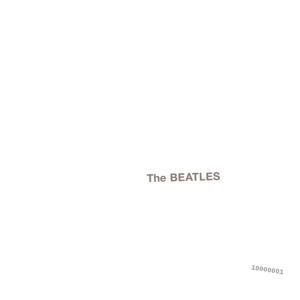
Which brings me to “The Beatles” (1968), better known as the White Album. As countless other critics have complained, the White Album isn’t so much a coherent album as it is a bunch of solo tracks by the four. Some of it is wretched, like Ringo’s “Don’t Pass Me By.” Some of it is self-indulgent crap, like John’s “Revolution #9.” But the songwriting, overall, is superb, and the whole thing is modest and focused on the music rather than any sort of grand “Pepper”-like concept.
It’s also one of those rare albums when Paul and John were both on top of their game at the same time. John’s “Revolution #1” (which I prefer to the amped-up single version), “Happiness Is a Warm Gun,” “I’m So Tired” and “Julia” are standouts, as are Paul’s “Back in the U.S.S.R.,” “Helter Skelter” and “Martha My Dear.”
Then there’s George’s “While My Guitar Gently Weeps,” which features some of the most hilariously ridiculous lyrics on the album. (OK, he gets points for rhyming “inverted” and “perverted.”) But it sounds great thanks to Eric Clapton’s lead guitar, and it’s still a song I’ll turn up loud when it comes on the radio.
And let’s play “Birthday” one more time for Paul, who celebrated his 78th last week, and for Ringo, who turns 80 (!) on July 7.
The Wall Street Journal’s excellent newsroom is calling out its often-nutty opinion section. The Journal’s Rebecca Ballhaus reports that an op-ed by Vice President Mike Pence earlier this week in which he praised the Trump administration’s response to COVID-19 had some, uh, problems:
Mr. Pence wrote that as of June 12, Project Airbridge had delivered more than 143 million N95 masks, 598 million surgical and procedural masks, 20 million eye and face shields, 265 million gowns and coveralls and 14 billion gloves.
According to FEMA data, through June 18 the program had delivered 1.5 million N95 masks, 113.4 million surgical masks, 2.5 million face shields, 50.9 million gowns, 1.4 million coveralls and 937 million gloves. The total number of those supplies is about 7% — or one-thirteenth — of the numbers cited in Mr. Pence’s article.
We talked about the Journal’s decision to publish Pence’s dubious propaganda Friday on “Beat the Press” (above). At the time, I thought the problem was more a matter of absurdly optimistic spin in the face of rising infection rates in many states rather than factual inaccuracies. I may be been giving Pence too much credit.
I still think Sen. Tom Cotton’s recently op-ed in The New York Times was worse, since he falsely claimed antifa involvement in Black Lives Matter protests in order to justify military attacks on Americans.
 Now that a temporary restraining order stopping President Donald Trump’s niece from publishing her tell-all book has been overturned, I want to briefly touch on why we all ought to be worried that the order was issued in the first place.