
Talk about this post on Facebook.
By Dan Kennedy • The press, politics, technology, culture and other passions

Previously published at GBH News.
Four years ago I was watching CNN as John King poked and prodded an interactive map of Florida while Wolf Blitzer looked on. King was explaining why the state was likely to go for Hillary Clinton. And then it happened — the map flipped red. Donald Trump was on his way to victory in Florida and to a narrow Electoral College win nationwide.
So it was with a deep sense of foreboding Tuesday night as I watched King and Blitzer pore over the same map. The early lead Joe Biden had built up over President Trump in that state was beginning to fade. And sure enough, Trump moved ahead in Florida while the two were talking, just as he had in 2016.
But this is not 2016. As I write this, in the early-morning hours on Wednesday following a sleepless night, the race has not yet been decided. The headline on The New York Times home page reads “Election Turns Into Nail-Biter That May Extend for Days.” Moments after I crawled out of bed and turned on the TV, a lead that Trump had maintained in Wisconsin all night suddenly went Biden’s way. The election could go in either direction, and Biden is still very much in the running.
Among those of us who are appalled by Trump, the sickening feeling we experienced last night was based entirely on Biden’s inability to break through in solidly red states that had seemed to be within his grasp. Texas was never ridin’ with Biden. Nor was Florida — not quite an all-red state, but one that has been trending increasingly Republican in recent years, a trend that has been boosted by voter suppression. Nor was Georgia (or so I thought; at the moment it’s actually trending toward Biden).
In fact, if you strip away the fantasies of a Biden landslide, the map looks very much like what we had expected, with the race coming down to the industrial states of Pennsylvania, Michigan and Wisconsin.
Last night it struck me that the only real surprise was there hadn’t been any surprises. So I was reassured to see Boston College History Professor Heather Cox Richardson confirm that judgment. In her daily newsletter, “Letters from an American,” she wrote, “Tonight, we wait, as returns from this year’s election are about what we expected. … This is the scenario we all foresaw.”
As Cox and others have pointed out, the reason that the mail-in votes are taking so long to tally in Pennsylvania, Michigan and Wisconsin is that Republicans fought tooth and nail to prevent them from being counted before the polls closed. As the liberal economist Dean Baker put it, Republican complaints about the slow pace “is pretty thick hypocrisy even for Republicans.”
CNN is talking about Trump's tweet complaining about "they" trying to steal the election. Might be worth mentioning, that the Rs were the ones who deliberately delayed the counting in MI, WI, and PA. This is pretty thick hypocrisy even for Republicans
— Dean Baker (@DeanBaker13) November 4, 2020
This is also the moment when Trump, cornered and desperate, will be at his most dangerous. Trump is attempting to capitalize, railing against the media in a middle-of-the-night speech and — as we all knew he would — falsely claiming that he’s won and threatening to take the election to the Supreme Court on some unspecified grounds.
“This is an extremely flammable situation, and the president just threw a match into it,” Fox News Anchor Chris Wallace told viewers.
In the hours and days ahead, the media must exercise all the discipline it can muster and keep reminding viewers, listeners and readers that the election isn’t over until all the ballots have been counted. We all know what happened this year — about 100 million ballots were cast early, many by mail, because of the COVID pandemic, and that has created delays and confusion. Republican leaders need to speak up for a fair election as well, but I’ve pretty much given up any hope that they’ll do the right thing.
A couple of other points.
First, Democrats must be shocked to see Hispanic voters shifting toward the Republicans. As The Texas Tribune reported, “Even as Biden performed well in large suburban counties that used to be reliably Republican, he failed to notch wide margins of victory in some critical Democratic strongholds, massively underperforming Hillary Clinton in the mostly Hispanic Rio Grande Valley. For example, Trump was leading in unofficial results in Zapata County — where Clinton won with 66% of the vote in 2016.”
Noting there were also signs that Black voters were not as monolithically with Biden as had been expected, the conservative pundit Byron York said on Fox News: “This is something the Republican Party has been trying to do for a long time.”
And yet Trump has shown in word and deed that he’s a racist, going all the way back to his earliest days as a real-estate developer. As the Black Lives Matter activist DeRay Mckesson tweeted, “No matter what happens tonight, we will have to reckon with the millions of people who chose Trump after seeing his racism, bigotry, and xenophobia over the past 4 years.” Democrats have some serious soul-searching to do as to why that’s the case.
No matter what happens tonight, we will have to reckon with the millions of people who chose Trump after seeing his racism, bigotry, and xenophobia over the past 4 years. If Trump is this wild for the first term, he will be an even more intense terror for a second term.
— deray (@deray) November 4, 2020
Second, although it’s too early to pass judgment given that millions of mail-in ballots have not yet been counted, it may be that the long-predicted polling apocalypse is upon us. A lot of observers said that four years ago, too, but the polls then really weren’t that bad. Clinton’s victory in the popular vote was within the margin of error, and Trump barely squeaked by in the Electoral College.
This time, though, it feels different — although, if you look at the final RealClearPolitics polls of battleground states, it may turn out that the numbers aren’t that far off. Even so, it wasn’t supposed to be this hard, and hopes that the Democrats would take back the Senate appear to be hanging by a thread. The wildly optimistic forecasts published by polling analysts like Nate Silver of FiveThirtyEight (see this and this) are a separate problem, and too complex to be dealt with at the moment.
For those of us who believe that Trump is a would-be authoritarian who poses a threat to American democracy, the results so far have been shocking. But we need to get out of our bubble. It looks like Biden may have just barely accomplished what he needed to do to win, which was all we could have realistically expected. He’ll win the popular vote by a lot. The Electoral College, on the other hand, is increasingly becoming a bulwark of Republican minority rule. A huge Biden win was probably never in the cards.
In the hours and days ahead, it’s important that all of us — not just Biden supporters, but Trump supporters as well — stay calm and wait for the final result to become clear.
I’ve got to get up early and try to write something for GBH News. We’re not going to learn any more tonight, so that’s it for me. But one quick thought: The only surprise is that there haven’t been any surprises. Hopes that the Biden camp had of breaking through in Trump country have been dashed. Biden was never going to win Georgia or Texas, and probably not Florida or Ohio, either.
So it comes down to Pennsylvania, Michigan and Wisconsin. And we may not know until later this week, if then, who the winner is.
 Our Northeastern journalism students are doing a really cool project today — they’re interviewing people about whether or not they voted, taking their photos and posting them on Instagram. If you get a chance, call up the Instagram app on your phone and search for the hashtag #nujournalismelectionday.
 Right on the heels of Gannett’s selling The Inquirer and Mirror of Nantucket and The Pine Bluff Commercial of Arkansas, the giant chain has now announced that it’s offloading its business-to-business subsidiary, BridgeTower Media, to a private-equity firm.
BridgeTower’s local holdings include Massachusetts Lawyers Weekly, Rhode Island Lawyers Weekly and Color Magazine, which “highlights topics of interest revolving around professionals of color.” The new owner, Transom Capital Group, is based in Los Angeles. Its self-description is so hilariously awful that it’s worth quoting:
Transom Capital Group is an operations-focused private equity firm in the lower-middle market. Our functional pattern recognition, access to capital, and proven ARMOR℠ Value Creation Process combine with management’s industry expertise to realize improved operational efficiency, significant top-line growth, cultural transformation and overall distinctive outcomes.
It’s too early to hope that the debt-addled Gannett chain, which has a stranglehold on most of the community newspapers in Greater Boston, Rhode Island and southern New Hampshire, is in the midst of a selloff. But if you’re thinking of making an offer on your local Gannett-owned newspaper, it looks like this might be a good time.

Twenty-eight years ago today, also a Sunday, I got up in the pre-dawn hours in order to drive a neighbor to the airport. Before returning home, I stopped at my favorite diner, ordered breakfast and spread out that day’s New York Times. The coverage pointed to a victory by Bill Clinton over President George H.W. Bush and Texas businessman Ross Perot. Which, of course, is exactly what happened.
The news in today’s Times foretells a similar outcome. The latest Times/Sienna College poll of likely voters shows Joe Biden with a lead over President Trump in four key battleground states — Arizona, Florida, Pennsylvania and Wisconsin. Only Florida seems close enough that it could slip away. With the FiveThirtyEight model giving Biden a 90% chance of winning and The Economist up to 95%, there is plenty of reason to be hopeful that we can finally put Trump in the rear-view mirror.
And yes, we all know what happened four years ago. Shocking as it was, though, Biden has held a larger, more durable lead over Trump than Hillary Clinton ever did. James Comey wasn’t around to deliver a late, devastating hit only to say “never mind.” The media have been smarter and more responsible about Trumpist disinformation, such as Tara Reade’s unsupportable allegations and the laptop that may or may not have belonged to Hunter Biden. Last week, NBC News even reported that documents circulating in the fever swamps of the right were not only fake, but had been produced by a fake company headed by a fake person whose fake face had been created using artificial intelligence.
In these final hours before the polls close on Tuesday, we are hearing lots of anxiety-inducing stories about voters being turned away, ballots getting lost and thugs in Texas threatening a Biden campaign bus, resulting in the cancellation of several Biden rallies. As disturbing as this is, I think we’d all be better off if we relaxed as best we can until it’s over. Have you voted? Will you vote? Good. For most of us, that’s all we can do.
Fortunately, Biden seems likely to win by a large enough margin to withstand whatever assault on the vote’s legitimacy Trump tries to mount. It’s not over till it’s over, of course. Right now, though, it looks like we can soon look forward to a victory by Biden and Kamala Harris — and to our country returning to some semblance of normal.
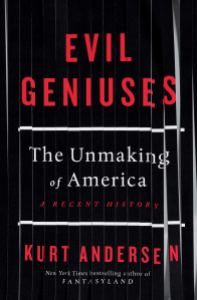 Kurt Andersen’s newest book, “Evil Geniuses: The Unmaking of America: A Recent History,” tells the story of our political culture’s long march to the right, from Barry Goldwater’s 1964 presidential campaign to Donald Trump.
I finished the audio version of it earlier this week — read by Andersen, a welcome touch. You can’t properly review an audio book, of course. You’re not bookmarking pages or making notes. So my observations here are impressionistic, and I’m sure I’m leaving stuff out that struck me as important at the time but that I’ve since forgotten.
First, Andersen deals a blow to my Richard Nixon Unified Theory of Everything. Andersen rightly points out that Nixon governed as a liberal on domestic policy, even embracing the left-wing notion of wage-and-price controls. Nixon wasn’t as liberal as the Northern Democrats of his era, but as someone who didn’t really care about anything except Richard Nixon, he was willing to go with the flow as long as it helped him maintain power.
I’m not sure that Andersen assigns Nixon enough blame, though, for his vicious prosecution of the war in Vietnam and Cambodia, a prelude of what was to come, or of beginning the transformation of the Republican Party into an amoral force for destruction, as it clearly is today. Ideologically, however, he is right that you can trace a direct line from Goldwater to Ronald Reagan to George W. Bush to Trump. Nixon was an outlier; George H.W. Bush was only a partial outlier given the role of Bush’s chief of staff, John Sununu, in fostering climate denialism, something I didn’t know about until I heard Andersen describe it.
Second, this move to the right has had important intellectual underpinnings, starting in 1970 with an essay by the economist Milton Friedman in The New York Times Magazine arguing — as Andersen puts it — that it was actually Mr. Potter, not George Bailey, who was the hero of “It’s a Wonderful Life.” Another important contribution to the movement was made by Lewis Powell in his pre-Supreme Court days. All of this has been extremely well funded by the Koch brothers and their ilk, thus moving fringe right-wing ideas into the mainstream.
Third, and to my mind most controversially, this long move back to the past has been accompanied by a cultural embrace of nostalgia, starting in the 1970s with the ’50s revival and continuing to the present. The idea is that we’ve turned to the political and economic norms of pre-New Deal America as a wistful yearning for old values, just as we have with music and fashion, and are only now beginning to realize just how toxic those times really were. There’s something to this, but I think Andersen pushes it too hard.
I can’t say that Andersen offers much in the way of solutions except that we need to re-energize ourselves and start electing left-leaning politicians. (He tells us repeatedly that Bernie Sanders nearly defeated Hillary Clinton for the Democratic presidential nomination in 2016, but saying it over and over doesn’t make it so.) He also favors a universal basic income as a counterbalance to the decline of decent full-time work fueled by artificial intelligence.
“Evil Geniuses” provides an exhaustive — and, at times, exhausting — overview of what’s gone wrong in these United States over the past 50 years. If Andersen’s ideas on how to get out of this mess are inadequate, it may be because the challenges are so daunting.
As I write this, Joe Biden seems likely to be elected president and the Senate to flip to the Democrats. That may staunch the Trump-induced bleeding of the past four years. But it’s going to take a lot more than that to solve political polarization, economic inequality, climate change, racial injustice and all the rest.
We can’t begin that work until we understand how we got here, though. Andersen has provided a useful guide.

I had thought from the beginning that “Anonymous,” the Trump administration official who torched President Trump in a New York Times op-ed piece in 2018, was someone close to John Kelly. And so it is: Miles Taylor, the 33-year-old former chief of staff of the Department of Home Security, Kelly’s first stop before becoming Trump’s chief of staff.
Why a Kelly aide? “Anonymous” came across as enthusiastic about Trump’s vicious right-wing policies, calling to mind Josh Marshall’s description of Kelly as an example of “Total Quality Trumpism.” In other words, Kelly and his allies were mainly appalled by Trump’s behavior and indiscipline, not by his record. As “Anonymous” wrote at the time:
To be clear, ours is not the popular “resistance” of the left. We want the administration to succeed and think that many of its policies have already made America safer and more prosperous….
Don’t get me wrong. There are bright spots that the near-ceaseless negative coverage of the administration fails to capture: effective deregulation, historic tax reform, a more robust military and more.
As for whether Taylor qualifies as a “senior official in the Trump administration,” as the Times described him when it published his op-ed, well, I’d say more no than yes. Chief of staff of a Cabinet department is not nothing, but I don’t think it’s what people imagine when they hear the phrase “senior official.”
I’d chalk it up as yet another in a pile of misjudgments by former editorial-page editor James Bennet.
Also: Chris Cuomo doesn’t seem to like Taylor too much. Click here or in the caption above to watch.
Correction. Kelly’s first name now fixed.

Previously published at GBH News.
One week from today, it will be over. Maybe we’ll know who won. Maybe they’ll still be counting. Maybe angry demonstrators will be marching in the streets. No longer, though, will we be checking FiveThirtyEight 15 times a day, tracking every up, down and sideways movement.
For most of the past four years I’ve felt pessimistic about the short term but optimistic about the long term. Now I feel just the opposite — optimistic about what the next few years may bring but pessimistic about the fate of our country. Let me explain.
As an opinion journalist, I have the privilege of being able to say what I think. I don’t have to take a neutral stance on issues I’m writing about. And I most certainly don’t have to take a neutral stance on President Donald Trump, a racist demagogue who, if given another term, will continue to move us down the road toward authoritarianism. I was pessimistic during most of Trump’s presidency because of the damage he was doing to our democratic norms. I was optimistic because I believed that, together, we would get past this dark moment.
But now I’m optimistic in the short run because, according to all indications, former Vice President Joe Biden is going to beat Trump by a substantial if not an overwhelming margin. It also seems likely that the Democrats will take over the Senate, meaning that, at least for the next two years, the president and Congress will be able to get a few things done. Biden was not my first choice — something I’m sure you’ve heard a lot of people say. But he is a caring and decent person, and his running mate, Sen. Kamala Harris, puts the Democrats in a strong position for 2024 and beyond.
So why am I pessimistic about the long run? Because of the horrible mess Biden will be inheriting — assuming he wins. A deadly pandemic that the Trump administration has simply given up on, according to White House chief of staff Mark Meadows. A broken economy. A refusal by too many of us to confront racism. And, above all, a fractured culture, with about 40% of the country believing all kinds of outlandish and dangerous things, right up to and including the ugly notion that Democrats are involved in some sort of secret pedophile ring.
Then there is our dysfunctional political system. We’ve learned a lot during the past few years about flaws that we may not have thought about before. The founders didn’t like the idea of political parties, and they designed the Constitution so that the three branches would hold one another accountable if any of them got out of line. But that presumed nonpartisan government. What we’ve got instead is a Congress that will not hold the president accountable because the Senate and the White House are both controlled by the same party. Never was that more obvious than when the Senate took up the House’s strong impeachment case against Trump and dismissed it without even calling any witnesses, and with every Republican except Sen. Mitt Romney voting to acquit the president.
I’ve often complained about the Electoral College and the Senate, both of which are constructed in such a way as to favor the low-population states and thus give the Republicans an artificial advantage. Over the weekend, Steven Levitsky and Daniel Ziblatt, the authors of “How Democracies Die” (one of the most important books of the past several years), proposed abolishing the Electoral College and tilting the Senate a bit toward majority rule by granting statehood to D.C. and Puerto Rico.
“In America today, … the majority does not govern. This disjuncture cries out for reform. We must double down on democracy,” they wrote in The New York Times, adding: “Not only would ending minority rule be inherently democratic, but, importantly, it would also encourage the Republican Party to abandon its destructive course of radicalization.”
That last truth is not spoken out loud nearly enough. The Democrats, for all their flaws, remain a normal political party. The Republicans, by contrast, have gone off the rails. According to The Guardian, a new study finds that the party of Lincoln “has become dramatically more illiberal in the past two decades and now more closely resembles ruling parties in autocratic societies” such as Hungary, Poland, Turkey and India. We need a responsible center-right party, but we no longer have one.
Those trends will continue post-Trump. By refusing to approve a COVID relief package that even Trump kind of sort of seems to want, Senate Majority Leader Mitch McConnell is sowing the seeds for gridlock. Having run up the deficit to unprecedented levels by passing a massive tax cut for the rich, the Republicans are going to yammer about the deficit incessantly if Biden wins and do everything they can to destroy his presidency. We can only hope that our ever-malleable press doesn’t go along with this cynical game.
The Republicans are also getting ready to question Biden’s legitimacy, arguing that Trump easily would have won re-election were it not for the pandemic and the concomitant economic collapse. Don’t believe it. As the RealClearPolitics average of national polls shows, Biden has led Trump by a significant margin since October 2019. According to FiveThirtyEight, Trump’s approval ratings have been under water almost from Inauguration Day in 2017. Trump’s grotesque response to COVID may have hurt him at the margins, but he always faced a steep uphill fight to win re-election.
In the second and final debate last week, Biden promised to be president of the entire country, not just of his supporters. “I represent all of you whether you voted for me or against me,” he said. It was the sort of statement that would have seemed clichéd and devoid of content in any other campaign. But given that his opponent is Trump, his message of unity would amount to a complete reversal.
Can a President Biden really bring us together? Can he overcome the weaponized propaganda of Fox News, the bizarro world that is QAnon and — let’s face it — the broken promises of previous Democratic administrations that contributed so much to the anger that enabled Trump’s victory in the first place?
In other words, can Biden capitalize on the short-term optimism that will greet his victory over Trump and translate that into a reason to be hopeful? It is an exceedingly tall order, and I’m not sure that anyone would be up to the task.
But the alternative is unthinkable.
 At some point toward the end of my senior year of high school, I acquired a bootleg of the Beatles’ 1965 concert at Shea Stadium. I was not happy with my purchase — it was unlistenable, with screaming fans all but drowning out the music.
Fortunately my friend Jim was a Beatles collector, and he suggested a trade. He’d give me his new copy of Miles Davis’ “Big Fun” in return for the Shea Stadium album. Figuring I had nothing to lose, I agreed. I had heard of Miles, but I didn’t know anything about him except that he played trumpet. “Big Fun,” released in 1974, proved to be life-changing.
Before I get to the music, let me try to describe how cool the packaging was. The front cover featured a nude woman in front of a horn. The inside gateway was given over to a massive photo of Miles, looking down slightly, wearing a serious expression, wraparound sunglasses, a sparkly top of some sort and a polka-dot kerchief. He was holding his trumpet, to which was attached a pickup and a cord. All of this made a huge impression on 17-year-old me.
And the music lived up to the packaging. “Big Fun,” as I now know, was a hodgepodge, pieced together from several sessions over the previous few years. But what a hodgepodge. The original album comprised four tracks, one on each side (the Spotify version features extra tracks). Two are absolutely brilliant.
“Great Expectations” is a riff on “Thus Spoke Zarathustra.” It is repetitive and trance-like, with a huge band anchored by Harvey Brooks on bass guitar and Billy Cobham on drums. There’s not a lot of improvising as Miles tries out different sonic approaches to the same theme. That segues to an entirely different passage as things slow down, Ron Carter takes over on bass (in fact, the track is a spliced-together pastiche) and Miles plays a melody that’s been altered so that it almost sounds like two trumpets, one slightly behind the other. The percussion in the background sounds like someone crying. Although the liner notes don’t say so, this is actually a different piece, Joe Zawinul’s “Orange Lady,” also recorded by Zawinul’s band Weather Report. Trust me: Miles’ version is much better, deeper and more keenly felt.
The other highlight is “Go Ahead John,” featuring guitarist John McLaughlin. In some ways this is a real period piece: Jack DeJohnette’s drums and McLaughlin’s broken-speaker solo are both processed through what you might call extreme stereo, with the audio switching back and forth between speakers. But the piece is so great that it transcends such touches. What’s more, the entire middle part consists of Miles playing a gorgeous two-track solo. This is astonishing music.
OK, I know what you’re thinking: “Big Fun” isn’t Miles’ best album — although I do think it’s better than “Bitches Brew,” his 1970 album that gave birth to the jazz-rock genre. I still love “Big Fun” and listen to it after all these years. And even though I later came to appreciate just about everything Miles ever recorded, “Big Fun” remains an underrated classic from a career that extended from the 1940s to his death in 1991.
Although it’s hard to choose, I think my other favorite Miles album is “’Round About Midnight,” released in 1957 with his classic quintet of John Coltrane on tenor sax, Red Garland on piano, Paul Chambers on bass and Philly Joe Jones on drums. Two years later a slightly different lineup of musicians would release “Kind of Blue,” still the best-selling jazz album of all time. But “Midnight” has more variety to it — and the title track, by Thelonious Monk, is simply the best version of that song ever recorded.
I had the privilege of seeing Miles twice — at Paul’s Mall in 1974 with the aforementioned Jim (we got to shake his hand!) and then at Kix Disco with my wife, the first show of a 1983 comeback tour. Miles didn’t play much at Paul’s Mall, even leaving the stage when he wasn’t soloing. But he was Mr. Entertainment at Kix.
He was a great artist, one of the towering geniuses of 20th-century music. You can listen to Miles endlessly and never get to the bottom, always surprised and delighted by new discoveries. Lately I’ve found myself thinking there’s a decent chance that the trumpet solo on “It Never Entered My Mind” is actually the voice of God. I’ll let you know if I find out.
_(8269691015).jpg)