Axios perpetuates #bothsides journalism in the midst of insanity

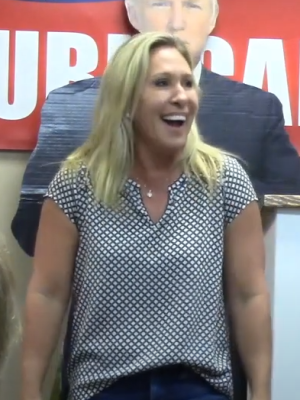
Marjorie Taylor Greene. Photo (cc) 2020 by FYNTV FetchYourNews.

Many mainstream news organizations are genuinely struggling to come to terms with the current dynamic in Washington: an often feckless Democratic Party opposed by crazy and dangerous Republicans. It’s not an entirely new scenario, and has in fact been building since Newt Gingrich’s speakership in the mid-1990s. But it’s become acute since the Trump-inspired insurrection of Jan. 6 and the embrace of QAnon and sedition by large swaths of the GOP.

But while responsible journalists are trying to figure out how to navigate this reality, there’s another group that continues to embrace #bothsides-ism at its most mindless. At the center of this is Axios, which combines the politics-as-sports sensibility of Politico, whence it sprang, with bullet points and lots of boldface.

Take, for instance, “The Mischief Makers.” According to Axios reporters Alayna Treene and Kadia Goba, leaders in each of the two major parties are being tormented by “troublemakers” and “political thorns” within their ranks. And who are these feisty backbenchers?

Well, on the Republican side is House member Marjorie Taylor Greene, who has called for the execution of  Speaker Nancy Pelosi and other top Democrats and who believes that wildfires are caused by a Jewish-controlled laser in outer space. Also getting a nod are Matt Gaetz, Louie Gohmert and Mo Brooks, all of whom supported the insurrection.

What Democrats could possibly be as dastardly as that? Why, the Squad, of course! Because they’re liberal and/or progressive. So Alexandria Ocasio-Cortez, Ilhan Omar and Ayanna Pressley all get a shoutout, as well as like-minded newcomers such as Jamaal Bowman and Cori Bush.

In the Senate, Republicans Ted Cruz, Rand Paul and Josh Hawley, all of whom supported Trump’s coup attempt, are equated with Democrats Kyrsten Sinema and Joe Manchin, who are more conservative than most of their party peers, and independent Bernie Sanders, who’s to the left of most of his colleagues but who’s been notably supportive of President Joe Biden.

But wait! There’s to-be-sure paragraph buried amid all this:

Not all are created equal. Democrats often contend with an outspoken, very progressive wing of their caucus and try to keep centrists from crossing party lines. Republicans have senators who led efforts to invalidate the 2020 election results and flirted with the same conspiracy theories that fueled groups involved in the Capitol siege.

No kidding.

So, does anything Axios publishes cause genuine harm? It’s hard to say. But Axios is aimed primarily at insiders — congressional staff members, lobbyists and other journalists. And many of them would love nothing more than validation that they can return to business as usual.

Cynical takes such as this can serve to normalize what’s going on in Washington, providing the narcotic drip we need to help us forget that many powerful Republicans attempted to overthrow the results of the election less than a month ago. Five people died, and we haven’t even begun to get to the bottom of what happened.

The Telegram & Gazette hardens its paywall

The Telegram & Gazette of Worcester is hardening its paywall. Currently you can access seven stories a month before you are asked to pay. Now the T&G, as well as other Gannett papers, is going to remove “investigative stories, political commentary, sports analysis and other content found only on telegram.com.” More routine stories and public-safety coverage will remain within the seven-story allotment.

Look, I get it. But what I don’t like about this is that there are those of us who might need to download two or three stories a year from various papers around the country. Last year, I actually took out a subscription to an out-of-state paper for a month — and then had to call several times so I could cancel it after the reporting project I was working on was done.

I’ve long thought papers ought to be flexible enough to charge for $1 an article or to sell day passes to people for whom a monthly digital subscription doesn’t make sense. But I’ve been told it’s not cost-effective, as it would be difficult to set up and could take away from subscription sales.

I also hope that whatever extra money the company pulls in will be used for journalism and not to service Gannett’s massive debt.

A chain of 14 weeklies in New Jersey will convert to nonprofit ownership

Bernardsville, N.J. Photo (cc) 2012 by Doug Kerr.

I love this. A small chain of 14 weekly papers in north central New Jersey is converting to nonprofit ownership. The New Jersey Hills Media Group will work with the Corporation for New Jersey Local Media in order to make the transition — and will immediately embark on a fundraising drive with a goal of $500,000. Co-publisher and business manager Steve Parker explains the move this way:

Our family has served as stewards of these newspapers for 66 years, and we are pleased that a nonprofit group based in our communities has come forward to ensure that they will continue their mission of community journalism far into the future.

The papers — some of which are more than 100 years old — serve 52 communities in Morris, Somerset, Essex and Hunterdon counties.

According to the announcement, the chain might become the largest nonprofit group of weeklies in the country. Among large daily papers, The Salt Lake Tribune has converted to nonprofit status, while there are a handful of for-profit papers owned by nonprofit organizations — a list that includes The Philadelphia Inquirer, the Tampa Bay Times, the New Hampshire Union Leader and The Day of New London, Connecticut. And, of course, public radio stations are nonprofit news organizations.

You sometimes hear that nonprofit ownership doesn’t solve all the problems faced by shrinking newspapers, since they still have to balance the books. That’s true. But it solves a lot of the problems. Tax-exempt status and ownership by people invested in the community rather than by corporate chains and hedge funds go along way toward ensuring the future of local news.

‘Trumpcast’ draws to a close

Perhaps the only thing I’ll miss about the Trump era is “Trumpcast,” a podcast produced by Slate and hosted by the longtime journalist Virginia Heffernan. Wise, witty and profane, Heffernan has guided us through the insanity for the past five years. I started listening about two years ago, and I didn’t catch every episode. But I appreciated the way she and her guests guided us through a terrible time in our history. So it was with a sense of instant nostalgia that I listened to her final episode while I was out on a walk Saturday.

The guest on the grand finale was New York University journalism professor and PressThink blogger Jay Rosen. Rosen summarized his most recent piece, in which he argued that the media finally found their voice and stood up for democracy once it became clear in the aftermath of the election that Donald Trump really did intend to steal a second term. Before that, he said, the press too often wallowed in bothsides-ism and normalized Trump’s corrupt, authoritarian behavior.

As I wrote recently, I don’t think the media’s performance was quite that bad. Sure, there was some normalization that took place, which was inevitable in covering the president day to day. But after turning in a horrendous performance during the 2016 campaign, I think much of the media dug in and covered Trump with the harshness and investigative zeal that he deserved. The problem is larger than journalism alone can solve. Our culture has become profoundly tribal, and any negative coverage of Trump was seen by his supporters as just further evidence that the media were out to get their hero. The 52% disapprove/42% approve dynamic never budged.

After Rosen left, Heffernan and her producer, Melissa Kaplan, kicked around the show’s greatest hits. They sounded like they’re going to miss “Trumpcast” too, though not the reason for its existence. It was a fun retrospective, and I think both of them accurately identified what made “Trumpcast” special — its giving a voice to alternative perspectives and not just those from the “normcore.”

As for what’s next, they’re both going to continue to be involved in podcasting. Heffernan will be hosting a show about the aftermath of Trumpism for Lawfare, which I’m looking forward to hearing.

In Somerville, as elsewhere, tough times for local news

The Boston Institute for Nonprofit Journalism has an interview with Julia Taliesin, the only reporter at Gannett’s Somerville Journal, on what it’s like to work at an under-resourced corporate-owned newspaper. Key quote:

I am acutely aware that it is absolutely impossible for me to do justice to what the city deserves in terms of news. What Somerville deserves is a handful of reporters who watch every city council meeting, or at least 90% of them, because this city council is busy. When I think of what effective news looks like, it’s just that. It’s just enough people to cover the issues. Not the press conferences and the press releases, but the actual work and the legislating that goes on.

I should note that Somerville has more than 80,000 residents. Next door, the Gannett-owned Medford Transcript hasn’t had a full-time staff reporter to cover the city’s 57,000 residents since the fall of 2019.

Ron Johnson’s home-state paper publishes his lies — with footnotes

Sen. Ron Johnson. Photo (cc) 2011 by Gage Skidmore.

Following the deadly attack on Congress on Jan. 6, the Milwaukee Journal Sentinel published an editorial calling on Sen. Ron Johnson, R-Wis., to resign or be kicked out “for his role in spreading disinformation about the presidential election.” Johnson submitted a response — and the Journal Sentinel published it along with 19 footnotes “to provide additional context.” For instance, here’s part of Johnson’s letter:

It is also important to acknowledge — instead of scornfully dismissing — the legitimate concerns of tens of millions of Americans and to recognize that it is not sustainable that so many have lost faith in our institutions and the fairness of our electoral process.

And here is the footnote:

Why have some Trump supporters lost faith in the fairness of the electoral process? It is precisely because irresponsible politicians like Trump and Johnson, aided by reckless allies at right-wing propaganda outlets, continually called those election results into question.

It’s an ingenious way of letting Johnson have his say while sticking to the journalistic imperative of providing our audience with the best available version of the truth. Of course, I’m sure Johnson doesn’t see it that way.

Yes, Curt Schilling should be in the Hall of Fame

Curt Schilling in better days. Photo (cc) 2007 by Andrew Malone.

We have a good discussion under way on Facebook about whether Curt Schilling should be in the Baseball Hall of Fame. I say yes, even though he’s devolved into a terrible human being who’s mocked trans people and joked about journalists being murdered in the years since his playing days ended.

The argument against Schilling, one of the great post-season clutch pitchers, is that the Hall of Fame has a character clause, and there’s no doubt that the Schilling of today is someone of exceedingly poor character. But the clause should pertain to how he conducted himself as a player. Schilling always respected the game, unlike cheaters such as Roger Clemens, Barry Bonds and Pete Rose. With Clemens, it wasn’t just steroids; it was also his adolescent meltdown in the 1990 playoffs. Clemens was thrown out, and the Red Sox lost the game and the series. Of course, that probably would have happened anyway given Clemens’ miserable record in big games.

Sean McAdam of the Boston Sports Journal wrote a terrific piece the other day about the man Schilling used to be before becoming a deranged right-wing extremist. I was particularly struck by McAdam’s account of Schilling’s leadership in awarding full shares of the team’s 2004 World Series money to low-paid clubhouse attendants and the like. Here’s how McAdam put it:

After the fact, I was told that Schilling was behind the gesture. (For those suspicious that Schilling was the source of this information, he was not). He argued that for the players, the difference between a full share of, say, $300,000 and $250,000 was minuscule, relatively speaking. But by including more non-players in the distribution of full shares, they could impact the lives of so many who didn’t make seven- and eight-figure annual salaries.

Indeed, some bought houses, paid off mortgages or paid tuition bills with that money. And indirectly, they have Schilling to thank.

None of us knows what happened to Schilling. Obviously something went haywire along the way. In some respects his Hall of Fame credentials are borderline, and we can only imagine the unhinged speech he’d give at Cooperstown if he were actually inducted. But that shouldn’t enter into it. He deserves a plaque.

There’s nothing new about online white-supremacist terrorism

Commodore 64. Photo (cc) 2010 by Luca Boldrini.

The New York Times has an interesting long look at the history of online activism among violent white supremacists. Laura Smith traces it back to a former Ku Klux Klan “Grand Dragon” named Louis Beam, who launched a bulletin-board system for haters on his Commodore 64 back in the early 1980s. In one of his early screeds, Beam wrote:

Imagine, if you will, all the great minds of the patriotic Christian movement linked together and joined into one computer. Imagine any patriot in the country being able to call up and access these minds.

The people Beam was trying to reach could imagine it only too well. Among those who may have been influenced by such early online networking on the extreme right was the Oklahoma City bomber, Timothy McVeigh, who owned two Commodore 64s when he was in high school and may well have stumbled across Beam’s network.

And as Smith writes, the goals espoused by today’s extremely online domestic terrorists “can sound chillingly similar to those envisioned by Mr. Beam and his cohort.”

Member Newsletter #5

I just sent out the weekly Media Nation Newsletter. If you’re a member and you don’t see it, make sure to look in your spam folder. The formatting might not look quite right, but there’s a link at the very top of the page that lets you view it in your browser. And if you’d like to become a member for $5 a month, just click here. You’ll support my work and receive the members-only newsletter every Friday with exclusive content, a wrap-up of the week’s news, photography and a song of the week.

The FT offers a close-up look at how Alden is destroying the Hartford Courant

The state capitol in Hartford, Connecticut. Photo (cc) 2009 by Dan Kennedy.

Not too many years ago, New England was home to a number of medium-size and smaller daily newspapers that did an excellent job of covering their communities. There are a dozen or so that come to mind. But among the largest and the best were The Providence Journal and the Hartford Courant.

The Journal, as we all know, has been decimated by its corporate-chain owner, Gannett, the successor to GateHouse Media. The Hartford Courant, which bills itself as the oldest continuously published paper in the country, has been battered for years under the ownership of a chain now known as Tribune Publishing. The Courant’s printing has been outsourced, and the newsroom was shuttered recently as well. There is no indication that reporters and editors will have a place to work other than their homes even after the COVID pandemic is behind us.

As I’ve written several times recently, the hedge fund Alden Global Capital, whose MediaNews Group is widely regarded as the worst newspaper owner in operation, controls 32% of Tribune — and is seeking a majority share.

The Financial Times recently published a lengthy article on the plight of local news focused on the Courant. There is nothing new in the story — we hear about the widespread closure of community newspapers, the rise of hedge-fund ownership and other familiar themes. Nevertheless, it’s a strong overview for anyone who’s unfamiliar with the tale of what happened to a key part of democratic life.

There are also a few points that deserve to be emphasized. At a time when profits in local news are elusive at best, Alden is living high:

The cost cutting is certainly working. MediaNews Group achieved about 20-25 per cent operating margins in 2019, according to people familiar with the matter, more than double that of peers such as Gannett or even The New York Times. In 2020, although the pandemic shattered advertising and MNG’s revenues fell by 20 per cent, the company was still on track to make a profit.

The Courant itself is doing well from a bottom-line perspective as well, earning a profit of $2 million a year, according to the FT’s reporting.

What this shows is that there is still an inflow of cash into even the most moribund newspapers. Readers buy them despite their ever-decreasing value. Businesses advertise in them. If you’re willing to gut the newspapers you own to keep expenses well below income, and to keep cutting as income continues to fall, well, yes, you can earn a profit. At some point, needless to say, you’ll reach the point at which you can no longer cut. And that’s when you shut your doors. (Oops. Bad analogy. They already have.)

Heath Freeman and other officials at Alden rarely speak for the record. When Freeman cooperated with a Washington Post reporter last year, it, uh, did not go well. So I was interested to see that the FT did manage to get a comment out of a company spokesperson named Chrissy Carvalho. It was a classic:

It’s a lot easier to make snippy anonymous comments than actually undertake the difficult task of making sure news organisations across America are able to serve their communities during a prolonged period of declining revenues.

As the FT notes, there are efforts to try to get Tribune to sell the Courant to local interests. But that’s going to be hard to do given the paper’s continued profitability. The tragedy is that the crisis afflicting local news is only partly related to external factors such as technology, the decline of advertising and the rise of Google and Facebook. Corporate greed is at least as responsible.

Previous coverage: