Several weeks ago we had a reunion of Northeastern University journalism alumni who were involved in student media in the 1970s and early ’80s. Among those attending was David McKay Wilson, one of the very few in our crowd who is still working as a full-time reporter. And he was excited about a story he was digging into about a Republican politician who seemed to have infiltrated a Democratic group in the suburbs north of New York City using a fake name.
Today The Journal News published that story, and it is weird and wonderful. Erin Crowley, a county legislator who also works for Republican congressman Mike Lawler, appears to have gotten herself inserted into an anti-Lawler chat group on Signal using the name “Jack Thomas.” Once in, Thomas — again, almost certainly Crowley — tried to generate an uproar against Lawler at a town meeting he was holding in May. Thomas/Crowley apparently believed that such behavior would create sympathy for her boss.
Although there is no definite proof, Thomas’ phone number is identical to one that Crowley has used. Wilson writes:
After two Lawler critics were carried out of the hall by New York State troopers, Thomas posted that chat group members should leave the auditorium to protest Lawler’s crackdown on dissent and his evasive answers to questions from the audience.
“Should we walk out en masse?” posted Thomas. “Make a point we won’t tolerate his bullsh** anymore.”
Wilson also quotes an anti-Lawler activist named Ann Starer, who says, “Walking out of the hall would have been to their benefit. That would have been great for them. I said on the chat that I didn’t think it was a good idea.”
The story is locked behind a paywall. Because The Journal News is a Gannett paper, I was able to access it through my USA Today subscription. If that’s not an option, you can read a thorough synopsis by Josh Marshall of Talking Points Memo, who calls it “my official new favorite story ever.”
Wilson has tangled with Lawler before, as I’ve written, and last month he was kicked out of a Lawler event for photographing Crowley. David’s doggedness at holding power to account at an age when many of his peers are retired is an inspiration.
Lyndon Johnson on the campaign trail in 1954. Photo via the LBJ Library.
The IRS has ruled that religious leaders can endorse political candidates from the pulpit, thus overturning a ban that had been in place since 1954. The New York Times broke the story, but in case you can’t get around the paywall, here is The Associated Press’ version.
The news is sure to be greeted with consternation among many observers, especially on the left. But the ban was, in fact, an unintended consequence of a move by Lyndon Johnson to silence a tax-exempt political group that opposed his re-election to the Senate. Johnson’s chief aide, George Reedy, told an interviewer years later that he believed LBJ had not intended to include religious organizations in the ban.
The IRS action comes just days after the presiding bishop of our denomination, Sean Rowe, wrote a powerful commentary in which he called on the Episcopal Church to be an engine of the resistance to Donald Trump’s authoritarian rule. (You may recall that Episcopal Bishop Mariann Budd got Trump’s second term off to a rousing start by admonishing him from the pulpit on Inauguration Day.) It sounds like it just became easier for our church to speak out and not have its tax status threatened, although who knows if the regime will try to punish religious liberals? Here is part of what Bishop Rowe wrote:
Churches like ours, protected by the First Amendment and practiced in galvanizing people of goodwill, may be some of the last institutions capable of resisting this administration’s overreach and recklessness. To do so faithfully, we must see beyond the limitations of our tradition and respond not in partisan terms, but as Christians who seek to practice our faith fully in a free and fair democracy.
We did not seek this predicament, but God calls us to place the most vulnerable and marginalized at the center of our common life, and we must follow that command regardless of the dictates of any political party or earthly power. We are now being faced with a series of choices between the demands of the federal government and the teachings of Jesus, and that is no choice at all.
In 2017 I wrote a commentary for GBH News in which I expressed agreement with Trump after he called for the Johnson Amendment to be overturned. Now that has happened. I’m posting the full piece after the jump.
I’m inclined to believe that any information about a major political figure is newsworthy, especially when they are new to the spotlight. Still, I think it’s important to analyze some of the ethical issues that have been raised by last Thursday’s New York Times report (gift link) that New York mayoral candidate Zohran Mamdani identified himself as “Asian” and “Black or African American” on a Columbia University entrance application when he was 17 years old.
The story sparked outrage on social media, with many Mamdani supporters arguing that the Times made it seem like the candidate had done something wrong when, in fact, he was being entirely accurate: Mamdani was born in Uganda to Indian parents. I’m old enough to remember that Teresa Heinz Kerry, the wife of 2004 Democratic presidential nominee John Kerry, identified herself as African American. Though white, she was born and raised in Mozambique. Heinz Kerry was mocked in some circles, but, like Mamdani, she was not wrong. (It’s fair to note that both Heinz Kerry and Mamdani ignored the generally accepted meaning of “African American.”)
Liam Scott’s detailed overview in the Columbia Journalism Review of both the Mamdani story and the fallout provide most of what you need to know, but I want to expand on a few of the issues that have been raised.
John Hancock, better known for his signature than for his accomplishments, is the subject of a new biography, reviewed by Ted Widmer in The New York Times.
“John Hancock: First to Sign, First to Invest in America’s Independence,” by Willard Sterne Randall, is, according to Widmer’s encapsulation, the story of “an 18th-century American who seemed preordained to follow the path of his father and grandfather into the ministry, but then swerved in another direction when his father died and a wealthy uncle offered to adopt him.”
Sounds interesting, but I wish Widmer had mentioned an earlier Hancock biography — “The Baron of Beacon Hill,” published in 1980 by my friend Bill Fowler. I read it as soon as it came out, so I can’t say I remember much about it 45 years later except that it was dauntingly well researched and a great read.
William M. Fowler Jr. was one of my favorite professors at Northeastern in the 1970s and was the inspiration for my deciding to get a master’s degree in American history at Boston University. My master’s thesis, “The Boston Massacre and the Press,” came straight out of my love for Colonial New England that Bill had sparked.
There was (and is) a group of journalism students from the mid- to late ’70s who were all members of the Bill Fowler Admiration Society. We took as many classes as we could with him, and we got him to write a column called “Bygone Boston” for the Northeastern News, as the student newspaper was then known (it’s now the independent Huntington News); he wrote a similar column for MetroNorth Magazine, a short-lived venture that I published in 1989 and ’90.
Bill is still doing well. The last time I saw him was about a year ago at the opening of the revamped Archival Center at Northeastern’s Snell Library. Unfortunately, he couldn’t attend a recent alumni reunion we held a few weeks ago because he was on a long-planned vacation.
I could not find any direct evidence that Randall cites “The Baron of Beacon Hill,” although I did find some indirect hints. I wasn’t going to spend $15 on the Kindle version to find out, but at some point I’ll be sure to look. In the meantime, I recommend Fowler’s earlier biography. According to Amazon, the hardcover can be yours for just $286.80.
One day you’re telling yourself that at least the billionaire owner of your local newspaper hasn’t thrown in with Donald Trump. The next day a group of players from the baseball team he owns are lined up in the Oval Office, shaking hands with the president on the very day that Congress passed the worst piece of legislation in our lifetime.
Apparently we’ve already moved on from the news that a group of Red Sox players were greeted by Trump on Thursday during what has been described as a family visit. News accounts have been sketchy on the details, and it seems that no one is inclined to follow up. They should. I mean, this is Boston, and it’s the Red Sox, not the Trump-supporting Patriots. Has our favorite fourth-place, below-.500 team gone MAGA?
Here’s what we know, according to Chris Cotillo of MassLive. Thursday was an off-day before the Red Sox’ Fourth of July game against the Washington Nationals. A number of players decided to visit the White House as part of their annual family outing. Margo Martin, part of Trump’s communications team, posted a 17-second video on Twitter (you can watch it above) of 10 players shaking hands with the president. Those players were Trevor Story, Justin Wilson, Abraham Toro, Romy Gonzalez, Connor Wong, Greg Weissert, Wilyer Abreu, Garrett Whitlock, Brennan Bernardino and Rob Refsnyder. If there were any others, they haven’t been identified.
Not everyone on the team attended. Garrett Crochet posted a photo of a panda that he took while visiting the zoo, which may or may not have been intended as a zing at his teammates. Also missing were manager Alex Cora, coaches and team officials. This appears to have been an unofficial visit — an extremely embarrassing unofficial visit.
“It was scheduled as an apolitical, behind-the-scenes tour with no expectations of publicity or meeting President Trump, a source familiar with the visit said,” the Globe’s Tim Healey reported. Whether that source is being straight with Healey or not, at least the Sox realize this is not something they want to associate themselves with. As they say, hypocrisy is the tribute that vice pays to virtue.
The Globe’s owner, John Henry, is a billionaire financier, and he’s also the principal owner of the Red Sox. That’s what makes this so dicey. Unlike Jeff Bezos’ Washington Post and Patrick Soon-Shiong’s Los Angeles Times, the Globe has remained a liberal paper, and its editorial pages enthusiastically endorsed Kamala Harris for president last year. Henry and his wife, Globe Media CEO Linda Pizzuti Henry, are regarded as politically liberal. Any signs of slippage would be alarming, which is why I hope that Thursday’s White House visit was just something that 10 players did on their own.
A protest in Chicago against the illegal detention of Kilmar Ábrego García in a Salvadoran prison. Photo (cc) 2025 by Paul Goyette.
This is likely to be my last post of the week, and it’s a depressingly fitting one this Fourth of July. Although we may have much to celebrate in our own lives, we all recognize that our country is in great danger. Donald Trump is trampling on the Constitution, and the Republican-led Congress and Supreme Court are doing nothing to slow him down.
So today I want to make sure you’ve seen this story about Kilmar Ábrego García, one of the better known victims of Trump’s persecution of undocumented immigrants. Earlier this year, Ábrego García, of Maryland, charged with no crime other than living in the U.S. without the proper papers, was illegally shipped off to a prison in El Salvador. He’s back, at least for now, and his lawyers filed chilling documents on Wednesday alleging that he was tortured while in Salvadoran custody. Maanvi Singh reports for The Guardian:
While being held at the so-called Terrorism Confinement Center (Cecot) in El Salvador, Ábrego García and 20 other men “were forced to kneel from approximately 9:00 PM to 6:00 AM”, according to the court papers filed by his lawyers in the federal district court in Maryland.
Guards struck anyone who fell from exhaustion while kneeling, and during that time, “Ábrego García was denied bathroom access and soiled himself”, according to the filing.
Detainees were held in an overcrowded cell with no windows, and bright lights on 24 hours a day. They were confined to metal bunk beds with no mattresses.
Ábrego García is back in the U.S., and now federal prosecutors are charging him with human smuggling and being a member of the MS-13 gang. We’ll see if there’s any actual evidence; the case has all the hallmarks of a story that the Trump regime concocted after the fact.
But why should we take seriously Trump’s alleged desire to crack down on MS-13? On Monday, a team of six New York Times reporters revealed (gift link) that Trump had returned a notorious MS-13 killer and other gang members to El Salvador who are allies of that country’s thuggish president, Nayib Bukele. The transfer appears to be a quid pro quo for Bukele’s willingness to accept U.S. deportees.
I hope there will come a time when Trump and everyone associated with his brutal reign is held to account, perhaps by the International Court of Justice. In the meantime, we have to live through this and do what we can to call out their shocking behavior and engage in acts of resistance. For what it’s worth, I write.
May you, your families and friends have a wonderful Independence Day. There will be better times ahead.
Shari Redstone speaking at a Committee to Protect Journalists event. Photo (cc) 2022 by CPJ photos.
Given how long negotiations were dragged out, there was some reason to hope that Paramount Global wouldn’t give in and settle Donald Trump’s bogus lawsuit claiming that “60 Minutes” had deceptively edited an interview with Kamala Harris last October.
In the end, Trump got what he wanted. Paramount, CBS’s parent company, will settle the suit for $16 million. If you’re looking for one tiny reason to be hopeful, the settlement did not come with an apology. In agreeing to pay off Trump, Paramount’s major owner, Shari Redstone, will now presumably find smooth sailing through the regulatory waters in selling her company to Skydance Media. Skydance, in turn, is headed by David Ellison, the son of Oracle co-founder Larry Ellison, a friend of Trump’s.
NPR media reporter David Folkenflik has all the details. What’s clear is that this may well be the end of CBS News as a serious news organization. Just the possibility of a settlement has brought about the resignations of top executives as well as criticism from “60 Minutes” correspondent Scott Pelley. As recently as Monday, media reporter Oliver Darcy revealed that all seven “60 Minutes” correspondents had sent a message to their corporate overlords demanding that it stand firm. Murrow weeps, etc.
What I want to note, briefly, is that there are still two complications that Paramount and Skyline must contend with before wedded bliss can ensue.
The first is a threat by U.S. Sens. Elizabeth Warren, D-Mass., Ron Wyden, D-Ore., and Bernie Sanders, I-Vt., to launch an investigation into whether the payoff amounts to an illegal bribe. Given that every legal and journalistic expert who’s looked at the case believes the editing of the Harris interview was ordinary and unremarkable (among other things, “60 Minutes” edited out a clip of Harris complaining about her hay fever), that investigation might yield some headlines at least.
“Paramount appears to be attempting to appease the Administration in order to secure merger approval,” the three said in a May press release issued by Warren’s office. They added: “If Paramount officials make these concessions in a quid pro quo arrangement to influence President Trump or other Administration officials, they may be breaking the law.”
The second is a threatened shareholder lawsuit by the Freedom of the Press Foundation. In a May statement, the organization’s director of advocacy, Seth Stern, cited the three senators’ possible investigation and said this:
Corporations that own news outlets should not be in the business of settling baseless lawsuits that clearly violate the First Amendment and put other media outlets at risk. A settlement of Trump’s meritless lawsuit may well be a thinly veiled effort to launder bribes through the court system.
In this morning’s newsletter from CNN media reporter Brian Stelter, the foundation is reported to be moving ahead with its plans: “The group’s lawyers are huddling today, I’m told. A spokesperson said ‘Paramount’s spineless decision to settle Trump’s patently unconstitutional lawsuit is an insult to the First Amendment and to the journalists and viewers of “60 Minutes.” It’s a dark day for Paramount and for press freedom.’”
The Paramount settlement follows Disney’s disastrous and unnecessary $15 million settlement of a suit brought by Trump over a minor wording error by ABC News anchor George Stephanopoulos in describing the verdict against Trump in the E. Jean Carroll civil case. Stephanopoulos said Trump had been found to have “raped” Carroll, whereas the technical legal term was “sexual abuse.”
Trump’s claim failed on two grounds: What Stephanopoulos said was substantially true, and there was no evidence that the anchor had deliberately or recklessly mischaracterized the outcome of the case. But no matter. Disney settled anyway.
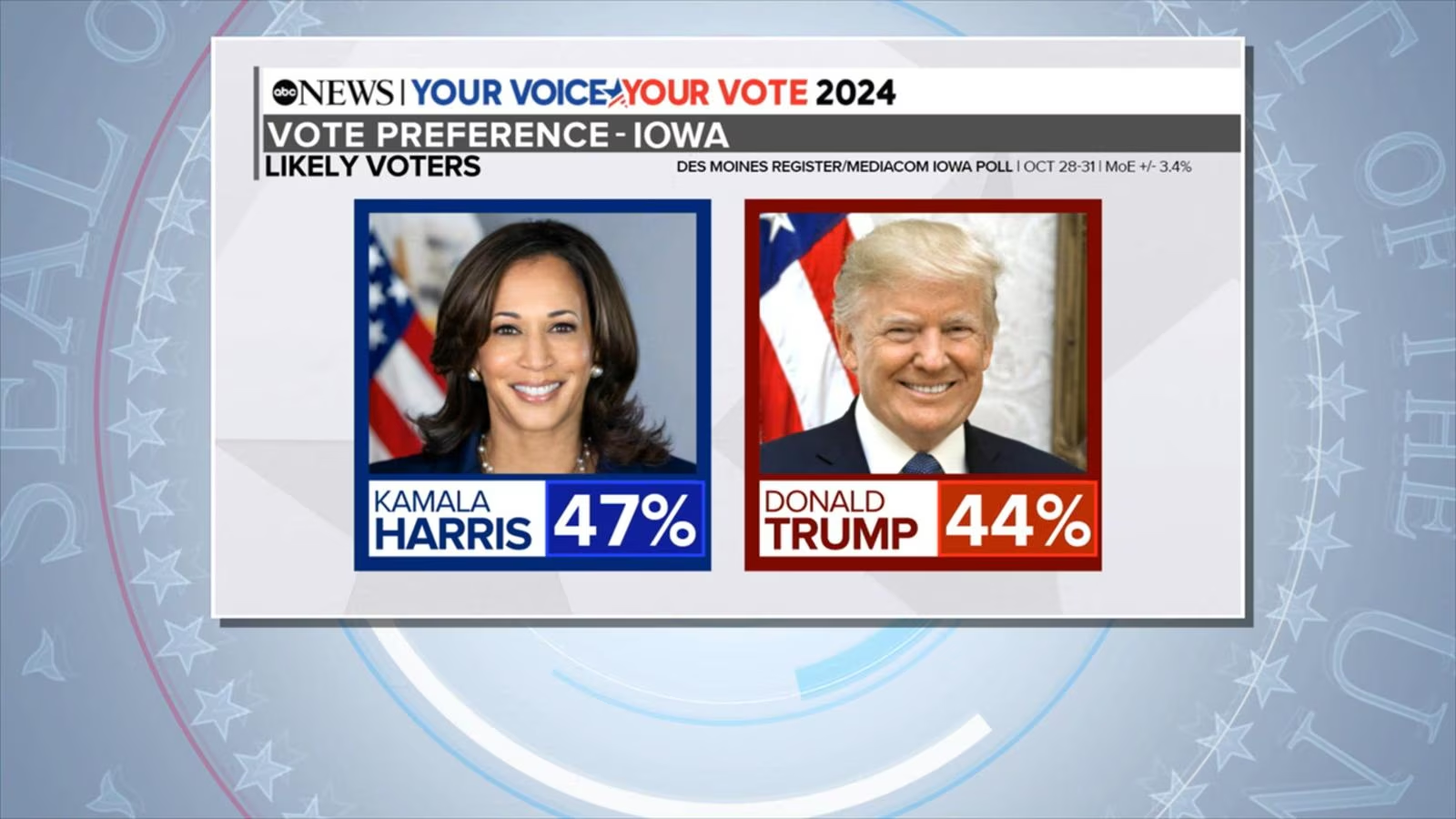
So far, at least, Gannett is holding firm in Trump’s suit against The Des Moines Register and pollster Ann Selzer over a survey that showed Trump trailing Harris in the Buckeye Hawkeye State (which he ended up winning easily) several days before the 2024 election.
Correction: Like the great Boston Brahmin writer Cleveland Amory, I regarded “the West” as anything west of Dedham. So, yes, Iowa is the Hawkeye State. I’m fixing that here and in Tuesday’s item as well.
For a brief moment Monday, it looked like Donald Trump had given up on his ridiculous lawsuit against The Des Moines Register and pollster Ann Selzer.
You may recall that Trump claimed they had committed consumer fraud because of a poll taken just before Election Day showing Kamala Harris with a 3-point lead in the Hawkeye State. Notwithstanding Selzer’s sterling reputation, Harris ended up losing Iowa by 13 points, which is about what you’d expect. She was wrong, and the error may have hastened her retirement, but the notion that she put out a false poll to help Harris is transparently ludicrous.
Well, Monday’s good news didn’t last. It turns out that Trump withdrew his suit from the federal courts and refiled it in state court one day before an Iowa anti-SLAPP law was scheduled to take effect, William Morris reports for the Register. SLAPP stands for “strategic lawsuits against political participation,” and it’s designed to give judges a reason to throw out garbage suits such as Trump’s. No such luck since Trump beat the deadline.
This isn’t the first time Trump has sought to have his Iowa case heard in state court. Apparently his lawyers believe the federal courts are unlikely to tolerate his foolishness. To its credit, the Register’s corporate owner, Gannett, has hung tough. A spokesperson for the paper, Lark-Marie Anton, said in a statement:
After losing his first attempt to send his case back to Iowa state court, and apparently recognizing that his appeal will be unsuccessful, President Trump is attempting to unilaterally dismiss his lawsuit from federal court and refile it in Iowa state court. Although such a procedural maneuver is improper, and may not be permitted by the court, it is clearly intended to avoid the inevitable outcome of the Des Moines Register’s motion to dismiss President Trump’s amended complaint currently pending in federal court.
The Foundation for Individual Rights and Expression, which is representing Selzer, said on social media that Trump’s attempt to move the case to state court was “a transparent attempt to avoid federal court review of the president’s transparently frivolous claims,” according to The Washington Post.
Meanwhile, there have been some developments in one of Trump’s other legal attempts to intimidate the press. According to media reporter Oliver Darcy, all seven correspondents at CBS News’ “60 Minutes” have sent a message to their corporate owner, Paramount, demanding that it stand firm in fighting Trump’s lawsuit over the way the program edited an interview with Harris last October. Darcy writes:
They pointedly expressed concern that Paramount is failing to put up a fierce and unrelenting fight in the face of Trump’s lawsuit over the program’s Kamala Harris interview, which has been widely denounced by the legal community as baseless, according to the people familiar with the matter. They said Trump’s allegations against the storied program are false and ripped his lawsuit as baseless. And they warned in no uncertain terms that if Paramount were to settle with Trump, it will stain the reputation of the company and undermine the First Amendment.
Trump is claiming consumer fraud in a Texas federal court under the state’s Deceptive Trade Practices Act, alleging that “60 Minutes” edited its interview with Harris to make her appear more coherent, thus helping her campaign. “60 Minutes” has defended the editing as normal and routine. The interview has been nominated for an Emmy in the editing category, no doubt to send a message to the White House.
Unfortunately, Darcy reports that Paramount continues to lurch toward a settlement with Trump in order to pave the way for federal approval of a merger with Skydance Media.
Back during the heady early years of the Jeff Bezos era at The Washington Post, the paper competed head to head with The New York Times for web traffic. Generally CNN would come in first, with the Times and the Post battling it out for second place. For instance, in April 2017 the Times recorded nearly 89.8 million unique visitors and the Post 78.7 million. Among news sites, they were outranked only by CNN.com, with 101.2 million.
But though the Times has thrived in the years following Trump’s first term, the Post has struggled, and has been in free fall since Bezos suddenly transformed himself from a model newspaper owner into the mogul from hell, starting with his decision last fall to kill an endorsement of Kamala Harris just before the election.
The latest numbers from Similarweb, reported by Press Gazette, tell an ugly tale. The Times recorded 444.9 million unique visitors in May 2025, finishing first among U.S. news websites. CNN was second, with 311.7 million. And the Post was all the way back at 17th, with 72.2 million.
Most of the sites recorded a drop compared to 2024, but the Post’s decline was especially steep — down 24% versus just 8% at the Times. (CNN was down a whopping 28%.) The Post was only a little ahead of The Wall Street Journal and The Guardian and behind The Associated Press and Newsweek, which it once owned.
Last week I dismissed as irrelevant a steep decline in print circulation at the Post. The erosion of web traffic, though, is a much bigger deal. The goal is to sign up paid digital subscribers, and web traffic is how you get those subscribers. In business terms, those monthly visitors are at the top of the conversion funnel and paid customers are at the bottom. If there are fewer visitors to pull through the funnel, then there are fewer opportunities to sell them subscriptions.
As for the Times, we all know that its success in selling digital subscriptions has a lot to do with its non-news offerings such as games, food and consumer advice. That has nothing to do with raw web traffic, though. The reality is that dramatically more people are enticed to click on New York Times links to check out its journalism. Both the Times and the Post offer 10 gift links per month, yet five times as many people are accessing the Times compared to the Post.
Bezos has single-handedly transformed the Post from one of the newspaper business’ great success stories into a disaster. And he’s too rich to care.
Should we be worried about deepfake videos? Well, sure. But I’ve tended to think that some skepticism is warranted.
My leading example is a 6-year-old video of then-House Speaker Nancy Pelosi in which we are told that she appears to be drunk. I say “we are told” because the video was simply slowed down to 75%, and the right-wing audience for whom it was intended thought this crude alteration was proof that she was loaded. Who needs deepfakes when gullible viewers will be fooled by such crap? People believe what they want to believe.
But the deepfakes are getting better. This morning I want to call your attention to a crucially important story in The New York Times (gift link) showing that deepfakes powered by artificial intelligence are causing toxic damage to the political and cultural environment around the world.
“The technology has amplified social and partisan divisions and bolstered antigovernment sentiment, especially on the far right, which has surged in recent elections in Germany, Poland and Portugal,” write reporters Steven Lee Myers and Stuart A. Thompson. A few examples:
Romania had to redo last year’s presidential election after a court ruled that AI manipulation of one of the candidates may have changed the result.
An AI-generated TikTok video falsely showed Donald Trump endorsing a far-right candidate in Poland.
Another fake video from last year’s U.S. election tied to Russia falsely showed Kamala Harris saying that Trump refused to “die with dignity.”
As with the Pelosi video, fakes have been polluting the media environment for a long time. So I was struck by something that Isabelle Frances-Wright of the Institute for Strategic Dialogue told the Times: Before AI, “you had to pick between scale or quality — quality coming from human troll farms, essentially, and scale coming from bots that could give you that but were low quality. Now, you can have both, and that’s really scary territory to be in.”
In other words, disinformation is expanding exponentially both in terms of quality and quantity. Given that, it’s unlikely we’ll see any more Russian-generated memes of a satanic Hillary Clinton boxing with Jesus, a particularly inept example of Russian propaganda from 2016. Next time, you’ll see a realistic video of a politician pledging their eternal soul to the Dark Lord.
And since I still have a few gift links to give out before the end of month, here’s a Times quiz with 10 videos, some of which are AI fakes and some real. Can you tell the difference? I didn’t do very well.
So what can we do to protect our political discourse? I’m sure we can all agree that it’s already in shockingly bad shape, dominated by lies from Trump and his allies that are amplified on Fox News and social media. As I said, people are going to believe what they want to believe. But AI-generated deepfake videos are only going to make things that much worse.


 William M. Fowler Jr. was one of my favorite professors at Northeastern in the 1970s and was the inspiration for my deciding to get a master’s degree in American history at Boston University. My master’s thesis, “The Boston Massacre and the Press,” came straight out of my love for Colonial New England that Bill had sparked.