Staying optimistic about local news amid the damage wrought by corporate chains

Providence, R.I. Photo (cc) 2017 by Kenneth C. Zirkel.

My research work on the local news crisis often feels like a race against time. On the one hand, I try to highlight independent community journalism projects that are keeping their heads above water or, in a few cases, are actually thriving. On the other hand, chain owners like Alden Global Capital and Gannett keep hollowing out the hundreds of newspapers they own across the country, not because they’re not making money but because they want to make more.

Last week came the odd news that Gannett is seeking to sell The Providence Journal’s printing plant for $8 million, as well as several other plants that it owns across the country. The story was broken by Alexa Gagosz of The Boston Globe, a former student of mine. What struck me as odd is that the Journal isn’t outsourcing its printing; rather, it intends to lease the plant back for a period of five or 10 years.

No doubt Gannett executives are thinking ahead to the day when the Journal goes all-digital. But the sell-and-leaseback provision seems hard to explain, especially for a paltry amount like $8 million. That doesn’t put a dent in the massive debt that Gannett is struggling with.

Also last week, The Atlantic published an essay about The Hawk Eye, of Burlington, Iowa, the oldest paper in the state, which was acquired several years by GateHouse Media — the predecessor to Gannett — and is now being dismantled. Written by Elaine Godfrey and photographed by KC McGinnis, it is a lovely piece, haunting and elegiac, conjuring a lost way of life as much as a newspaper that’s been hollowed out. But Godfrey has a keen sense of Gannett’s business model as well. This gets right to the heart of it:

Readers noticed the paper’s sloppiness first — how there seemed to be twice as many typos as before, and how sometimes the articles would end mid-sentence instead of continuing after the jump. The newspaper’s remaining reporters are overworked; there are local stories they’d like to tell but don’t have the bandwidth to cover. The Hawk Eye’s current staff is facing the impossible task of keeping a historic newspaper alive while its owner is attempting to squeeze it dry.

None of this was inevitable: At the time of the sale to GateHouse, The Hawk Eye wasn’t struggling financially. Far from it. In the years leading up to the sale, the paper was seeing profit margins ranging from the mid-teens to the high 20s. Gannett has dedicated much of its revenue to servicing and paying off loans associated with the merger, rather than reinvesting in local journalism. Which is to say that southeastern Iowans are losing their community paper not because it was a failing business, but because a massive media-holding company has investors to please and debts to pay.

So what’s lost? Consider the experience of Tom Courtney, a former state senator, who lost his re-election bid after he discovered that his constituents, lacking any reliable local news, were judging him on the basis of national stories instead:

In the absence of local coverage, all news becomes national news: Instead of reading about local policy decisions, people read about the blacklisting of Dr. Seuss books. Instead of learning about their own local candidates, they consume angry takes about Marjorie Taylor Greene. Tom Courtney, a Democrat and four-term former state senator from Burlington, made more than 10,000 phone calls to voters during his 2020 run for office. In those calls, he heard something he never had before: “People that live in small-town rural Iowa [said] they wouldn’t vote for me or any Democrat because I’m in the same party as AOC,” Courtney told me. “Where did they get that? Not local news!”

Also last week, the trade magazine Editor & Publisher ran a story about Gannett papers that have actually been bought back by local owners. Written by Gretchen A. Peck, the story looks in on four people who’ve acquired former Gannett papers and are now reinvesting in news and in their communities.

Still, it hardly looks like a trend. Peck spoke with newspaper broker Sara April, who said Gannett is selling just a few papers here and there. “All the markets are typically smaller. Look at the size of the towns. That has been the charge: To find quality local companies, with high regard for journalism, to take ownership of these newspapers so they can continue to serve their communities,” April was quoted as saying. No doubt the papers don’t fit with Gannett’s current strategy, which seems to be filling up its papers and websites with regional news so it doesn’t have to put too much into local coverage.

The good news — and there’s always good news — is that local independent journalism is thriving in many parts of the country. The bad news is that the corporate chains and the hedge funds continue to strangle news organizations that would otherwise be doing much better.

An earlier version of this post was part of last week’s Media Nation Member Newsletter. To become a member for just $5 a week, please click here.

A new study highlights the difficulties of working for small newspapers

Photo (cc) 2013 by zamo86

You’ll have to forgive me for not plowing through a massive new report from Columbia’s Tow Center for Digital Journalism on a survey of more than 300 newsroom employees at small (under 50,000 circulation) newspapers. The survey follows up a similar study conducted in 2016. I did look at the executive summary and the conclusion, which contain some interesting findings. Among them:

  • More than a third of those responding, or 37%, said they work between 50 and 60 hours a week, and 50% said they work 40 to 50 hours a week.

Recently the NewsGuild announced it was investigating unpaid overtime work at Gannett. But that would involve union papers, which tend to be larger. It’s no secret that small dailies and weeklies have been exploiting their employees pretty much forever. As the economics of the business become increasingly difficult, the situation may be getting worse.

  • COVID is taking a toll, with 43% saying they felt less secure in their employment than they did at the beginning of the pandemic.
  • “Participants were often highly critical of hedge-fund ownership and frequently cited nonprofit models as the way forward for the sector.”
  • Efforts to create more diverse newsrooms at small newspapers are inadequate at best.
  • Some 57% say they are more involved in digital work than they were three years ago; 49% said they are producing more stories per week than they were three years ago; and 62% said social media had become a more important tool in their work.

“Despite a challenging financial landscape, coupled with wider issues such as trust in journalism, our 2020 cohort — like their predecessors in 2016 — retained a sense of optimism about the future of their industry,” write the authors, Damian Radcliffe and Ryan Wallace. “In particular, they highlighted the importance of hyperlocal news, embracing digital and filing information gaps by covering stories not offered elsewhere.”

One fact that stands out from the survey is that the staffs at smaller newspapers are old and white, and that if there’s any hope of reaching younger, more diverse audiences, then new approaches are needed. I hope anyone working for these newspapers who’s under the age of 50 is making plans right now to start a new venture in their community.

There’s also an important unanswered question here. What would the findings look like if employees of independently owned newspapers could be separated out from those whose papers have been acquired by a corporate chain or hedge fund? Working conditions can be pretty tough at independents as well, but the journalists might have more of a sense of community service.

Finally: Laura Hazard Owen has written a good overview of the study at Nieman Lab.

Legendary North Shore newspaper publisher Bill Wasserman dies at 94

Bill Wasserman. Photo by Jim Walsh. Used by permission.

Legendary North Shore publisher Bill Wasserman has died at the age of 94. The founder of the Ipswich Chronicle, which he built into a group of about a dozen papers comprising North Shore Weeklies, Wasserman sold in 1986 and later became an outspoken critic of corporate chain ownership.

Several years ago, GateHouse Media — now Gannett — folded the Chronicle and merged it into a paper called the Chronicle & Transcript, which covers six North Shore Communities. Wasserman did something about it, becoming a consultant and ad salesman at a nonprofit startup, Ipswich Local News, which appears to be going strong.

Starting in the early 1990s, Wasserman’s former papers became part of larger groups — first Community Newspaper Co., owned by Fidelity and later then-Boston Herald publisher Pat Purcell, and then GateHouse. Wasserman lamented the cuts that were implemented at his old papers. In 2008 I wrote about GateHouse for CommonWealth Magazine; Wasserman was among those I interviewed. An excerpt:

After 20 years of consolidation, it’s fair to ask if corporate ownership of community newspapers makes sense — not just journalistically, but financially. Take Bill Wasserman, who built North Shore Weeklies and sold the group in 1986 to investors who, in turn, sold to Fidelity several years later. Wasserman says the main problem with corporate ownership is a failure to understand that, even in the best of times, community journalism is little more than a break-even proposition.

“I was paid a salary, which was modest,” says Wasserman. “The reward was not in the profit. The reward was having a lot of fun putting out a community paper.”

Earlier this year Wasserman was honored by the Ipswich Rotary Club. Even in his 90s, he was looking to the future, saying:

The Ipswich Local News, which is surviving despite all the reports of failing local newspapers, is doing well because of its small but dedicated staff led so ably by John Muldoon — a Rotarian — and the broad support of both the local business community and the residents. It is a joy to be part of this effort to keep local news and its watchdog component alive.”

Wasserman retired from the paper a little more than a year ago, saying, “I will be 93 in two weeks, and I would like to pay more attention to my family and sleep without a deadline. There’s enough news and concerns in our town to keep busy 24 hours 7 days a week.”

I last saw Wasserman several years ago. He looked well and was as sharp as ever. His passion for community journalism was undimished. It’s fitting that toward the end of his life he came full circle — helping to found a newspaper in Ipswich to take the place of a once-thriving paper shut down by a corporation for whom the bottom line is always the bottom line.

Probe of Gannett’s overtime practices needs to include smaller papers as well

The Burlington Free Press of Burlington, Vt. Photo (cc) 2019 by Dan Kennedy.

The NewsGuild is investigating Gannett for allegations of unpaid overtime work, according to Kerry Flynn of CNN. Flynn writes:

NewsGuild President Jon Schleuss sent a letter to Gannett CEO Mike Reed last Friday about the union’s plan to launch an investigation and requested the company do the same. The union also called on Gannett, which owns USA Today and more than 260 local publications including The Arizona Republic, the Detroit Free Press and The Indianapolis Star, to agree to other labor protections proposed in the ongoing union bargaining taking place in some of its newsrooms.

This is long overdue, and I hope the Guild doesn’t limit itself to Gannett’s unionized papers, which tend to be the larger dailies. Small dailies and its 1,000 or so community weeklies, many of which are in Eastern Massachusetts, need to be investigated as well.

Gannett journalists are grossly underpaid even at 40 hours a week. The only way Gannett has been able to keep its debt-addled ship afloat is by  demanding sacrifice after sacrifice from its employees. It’s great that the Guild is taking action. Now let’s see federal authorities get involved as well.

Become a member of Media Nation for just $5 a month!

How events help local news organizations connect with their audience

Bedford Citizen managing editor Julie McCay Turner, right, takes a photo of students and staff from Shawsheen Tech along with Bedford Police Chief Robert Bongiorno.

Community events give local news organizations an opportunity to connect with their audience — and to expand their audience as well. With that in mind, I drove to Bedford, Massachusetts, on Saturday morning for Bedford Town Day in order to check in with The Bedford Citizen, a nonprofit website that combines paid and volunteer staff.

The Citizen, like about 100 other organizations, had set up a booth. Four or five volunteers rotated in and out while managing editor Julie McCay Turner and staff reporter Mike Rosenberg made their way through the crowd, which I’d estimate in the hundreds but could have been larger.

“We hope to get a few sign-ups,” said executive director Teri Morrow. She added that another goal was to get story ideas from community members. One person she had talked to, she said, had suggested profiles of interesting but relatively unknown people and organizations.

On the table were business cards and a larger sign with a QR code taking you to the Citizen’s website as well as free copies of the Citizen’s 2020 and 2021 Bedford Guide, a glossy publication that’s fill with ads and that serves as a fundraiser for the organization.

Turner was making her way through the fairgrounds, taking pictures and greeting people. She connected with Brian O’Donnell, a Bedford representative on the Shawsheen Valley Technical High School in nearby Billerica. O’Donnell introduced her to Allison Cammarata, the school’s brand-new director of community services and workforce development, who serves as the school’s public relations person.

Table sign with QR code

“We are relentlessly local,” Turner told Cammarata, explaining that she wants to run stories about Shawsheen in the Citizen but only if they feature Bedford students. Turner then called out “Bob! Bob!” Police Chief Robert Bongiorno, was walking by, and he stopped and chatted.

The Citizen competes with a Gannett weekly, the Bedford Minuteman, a once independent paper that now provides minimal coverage of the town. The Minuteman did not have a booth at Town Day, although it did send a photographer.

O’Donnell praised the Minuteman’s coverage of Shawsheen, saying that the school, which serves five towns, fits with the paper’s mission of reporting on regional news. “But in terms of what’s happening in Bedford — events, issues, discussions, exchanges — that’s happening in the Citizen now,” he said.

As I made the rounds and talked with people about where they get their local news, I found a high level of awareness about the Citizen, which was founded in 2012.

“The thing I like about the Citizen is that if there’s anything with the school committee or the select board or any issues that come up, they report on both sides of the issue,” said Alice Churella. “It seems to me to be totally unbiased.”

Others, though, said they got their news mainly through word of mouth, Facebook groups, the official town website and emails from the school department.

“I don’t read it regularly,” said Anna Smiechowski of the Citizen. “If I know something’s happening in town or I want to look something up, I’ll search it.”

Become a member of Media Nation for just $5 a month.

Several Gannett papers, including the Worcester T&G, won’t print on Labor Day

The Telegram & Gazette of Worcester is taking a day off. According to an announcement in the print edition, the paper won’t publish tomorrow, which is Labor Day.

The 016, which has the story, observes that “the last date the Telegram & Gazette was not printed is not immediately known,” and that the T&G will be joined by some other Gannett papers, including the Milwaukee Journal Sentinel and the Tallahassee Democrat.

A highly unusual move to say the least.

More: Add the Cape Cod Times to the list. It’s starting to look like this applies to many if not most of Gannett’s dailies.

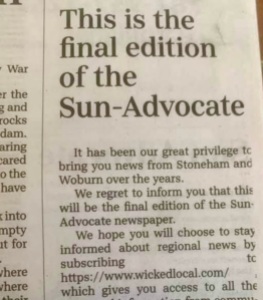
Gannett’s closing spree comes to Woburn and Stoneham

On and on it goes. I was a reporter at The Daily Times Chronicle of Woburn in the 1980s when the Woburn Advocate was launched by a local developer. It eventually fell into GateHouse Media’s and then Gannett’s hands. The Times Chronicle, still owned by the Haggerty family, continues to do good work. The Advocate, meanwhile, was merged with another GateHouse/Gannett paper, the Stoneham Sun, and now is no more.

To the extent that Gannett has any strategy with its most recent closings, the emphasis seems to be on getting out of places where there is competition. The Haggertys, in addition to running the Times Chronicle, also operate The Stoneham Independent.

I’ve heard there may be a couple of other Gannett weeklies in Eastern Massachusetts that have been shut down as well. Keep those tips coming. I’d also love to see any internal memos that lay out all of the closings. Send them along to dan dot kennedy at northeastern dot edu. As always, discretion is assured.

Earlier:

Gannett purge hits Upper Cape

Gannett has gone on a spree of closing print weeklies. The latest: The Sandwich Broadsider and The Bourne Courier, both of which were founded to serve the Upper Cape in the 1970s. Katie M. Goers of the independent Sandwich Enterprise has the story.

In addition to Sandwich, the Enterprise papers serve Bourne, Falmouth and Mashpee, so I’m guessing that the impact of Gannett’s action on local coverage will be minimal.

I’m hearing that Gannett is walking away from other weeklies in Eastern Massachusetts as well. If you’ve got a tip or (be still my heart) an internal memo, please pass it along to me at dan dot kennedy at northeastern dot edu. Discretion assured.

Update, Aug. 8: The Courier, Bulletin which covered Mashpee and Falmouth, was also shut down by Gannett, I’m told.

Earlier:

There they go again: Gannett shutters the 119-year-old Melrose Free Press

Postcard via Wikimedia Commons

Gannett has pulled the plug on the Melrose Free Press. The weekly published its final edition on Thursday, July 29, and employees were told it was all over on Thursday morning of this week, according to sources.

As best as I can tell, the Free Press had no dedicated staff members, and I haven’t heard of any layoffs. This was a move aimed at saving printing costs. Gannett’s Wicked Local website for Melrose will live on, though, as you’ll see, most of it consists of news from other communities, as is Gannett’s practice. For those who really want a print edition, the guessing is that they will receive the Observer Advocate, which currently serves the neighboring communities of Reading, Wakefield and Malden.

Melrose is served by a Patch site and by the Melrose Weekly News, a family-owned chain whose papers also cover Wakefield, North Reading and Lynnfield. Mike Carraggi, Patch’s regional editor for Massachusetts, New Hampshire, Rhode Island and Maine, tweeted that he’ll “continue making sure Melrose has as much independent reporting as possible via Patch.”

https://twitter.com/PatchCarraggi/status/1422723662445154307

The Free Press’ paid circulation was 639 as of March, according to the Alliance for Audited Media — a paltry figure given that U.S. Census data show Melrose is a city of about 28,000, with 11,329 households. Carraggi also tweeted that the paper hadn’t had a full-time reporter in several years.

The Melrose Free Press was founded in 1901, according to the Melrose Historical Commission. Unlike its two competitors at the time, Melrose did not charge — hence its name. (At the time of its demise, the Free Press was a paid product.) The paper was sold to Fidelity’s Community Newspaper Co. in 1991, which put it in the hands of a corporate chain. Cutting continued through various iterations of the chain, culminating in ownership by GateHouse Media, which merged with Gannett in 2020.

“In recent years,” the historical commission said, “the paper has weathered the decimation of advertising revenue that accompanied the rise of the Internet, and an ever-shrinking staff.”

Gannett always seems to be in retrenchment mode, but it’s been especially severe recently, with the chain shutting down its weeklies in Marlborough and Hudson and cutting back on print distribution in Newton.

Despite spinning off a few papers, there are no signs that chains are walking away

Nantucket, where The Inquirer & Mirror is once again locally owned. Photo (cc) 2007 by Michael Galvin.

From time to time I’ve taken note of rare instances when Gannett has sold some of its 1,000 or so papers to local ownership. In Massachusetts, for example, The Inquirer & Mirror of Nantucket was acquired last fall by a group headed by the editor and a local businessman.

Kristen Hare of Poynter asked Gannett for some numbers, it turns out that the chain has sold 24 papers to community interests. (Be sure not to miss the correction. As you’ll see, Gannett can’t even keep track of how many papers it owns.)

Not that there’s any benevolent motive at work here. Gannett is going to do what’s best for its bottom line, and a few isolated weeklies don’t fit with its strategy of regional groups, dailies and stories shared across papers regardless of whether they have any local interest.

Just recently, Gannett shut down two weeklies west of Boston — the Marlborough Enterprise and the Hudson Sun. Maybe there weren’t any local buyers available. But those towns are also covered by Gannett’s MetroWest Daily News, so there was an incentive not to empower any possible competitors.

Writing for the Local News Initiative at Northwestern University, Mark Jacob speculates that the hedge fund Alden Global Initiative might sell off some of the nine major-market dailies it acquired when it gobbled up Tribune Publishing earlier this year. I suppose anything is possible, but that seemed to fly out the window when Baltimore hotel magnate Stewart Bainum’s efforts to buy Tribune fell short. Bainum planned to break up the chain, starting with The Baltimore Sun, which he wanted to donate to a nonprofit. In the end, though, Alden’s offer prevailed, even though it was loaded with undisclosed debt.

Jacob also profiles The Berkshire Eagle of Pittsfield, a rare instance of a newspaper that Alden was willing to sell to local interests, and The New Bedford Light, launched despite Gannett’s refusal to sell The Standard-Times.

And then there is this odd observation by Jacob:

In some ways, large chains can be beneficial for local news consumers. They often bring website expertise, technical support and consistent business practices. And they may have a greater ability to recruit talent.

No. Some chains are better than others, but all of them are dedicated to the proposition that newspapers exist mainly so that the owners can squeeze out profits that could otherwise be invested in news and technology. Even in terms of digital publishing, I have rarely encountered an independent news website that is as clunky and intrusive as a typical chain site.

As the old saying goes: Local doesn’t scale.

Become a member of Media Nation for just $5 a month!