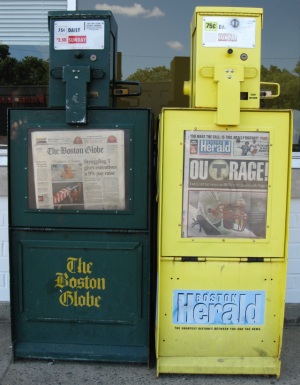
MediaNews Group, the newspaper chain owned by Alden Global Capital, has named a new senior editor at The Sun of Lowell and the Sentinel & Enterprise of Fitchburg: Bruce Castleberry, who will remain as regional sports editor for Massachusetts.
Castleberry replaces Tom Shattuck, who left late last month.
The group of billionaire investors headed by Baltimore hotel magnate Stewart Bainum has pulled out ahead of the hedge fund Alden Global Capital in the bidding for Tribune Publishing’s nine daily newspapers. The Bainum group would split the chain apart and run at least some of the papers as nonprofits. Cara Lombardo and Lukas I. Alpert report in The Wall Street Journal:
If Alden loses the deal, it would mark a stunning, 11th-hour turnaround for the New York hedge fund, and a major victory for critics who say its model of aggressive cost-cutting has hurt the local news industry. Alden had spent nearly a year-and-a-half positioning itself to take over Tribune, publisher of nine large-market daily newspapers including the Chicago Tribune, New York Daily News and the Baltimore Sun.
I don’t think any of us believe that Trumpism is going away. To the extent that we take any comfort from the current chaotic state of the Republican Party, it’s that it seems mainly to be defined by the QAnon craziness of Marjorie Taylor Greene, the alleged perversion of Matt Gaetz and the cartoonish cynicism of Josh Hawley. Yes, we need to keep an eye on them. But they’re so out there on the fringes that the amount of damage they could do would appear to be limited.
Which is why an essay published recently by Glenn Ellmers of the Claremont Institute should chill you to the bone. Running at more than 3,200 words, Ellmers’ screed is nothing less than an assertion of authoritarianism and white supremacy, dressed up in intellectual garb. I don’t mean to suggest that he advances a coherent argument — he keeps telling the reader that he’s going to explain what he means, and he never actually gets around to it. But Ellmers can write, and he’s got a worldview that he wants to impose on all of us. “Pure, undiluted fascism,” tweeted my GBH News colleague Adam Reilly.
"[A] majority of people living in the United States today can no longer be considered fellow citizens."
Ellmers begins by asserting that more than half of his fellow countrymen are “not Americans in any meaningful sense of the term.” And what does he mean by that? Well, he wants you to know that his definition of not-Americans goes well beyond those he bluntly labels as “illegal immigrants” and “aliens.” He writes:
I’m really referring to the many native-born people—some of whose families have been here since the Mayflower—who may technically be citizens of the United States but are no longer (if they ever were) Americans. They do not believe in, live by, or even like the principles, traditions, and ideals that until recently defined America as a nation and as a people. It is not obvious what we should call these citizen-aliens, these non-American Americans; but they are something else.
So who are the real Americans? Why, Trump voters, of course. That is, “the 75 million people who voted in the last election against the senile figurehead of a party that stands for mob violence, ruthless censorship, and racial grievances, not to mention bureaucratic despotism.”
There’s the hate, right out in the open. I really don’t need to quote any more except to say that Ellmers goes on at great length, in pseudo-intellectual language, to tell us that action must be taken. What kind of action he doesn’t say. But I would assume that his only regret about the insurrection of Jan. 6 is that it failed.
What’s especially chilling about this is that there’s none of the unseriousness that often defines hardcore Trumpism — no pedophilia rings masterminded by Hillary Clinton and George Soros, no claims that the election was stolen. Just a pure will to power, which is a defining characteristic of fascism.
If you don’t want to read the whole thing, I recommend this analysis by Zack Beauchamp of Vox. Under the headline “The conservative movement is rejecting America,” Beauchamp writes:
Ellmers’s essay should be taken seriously because it makes the anti-democratic subtext of this kind of conservative discourse into clearly legible text. And it is a clear articulation of what the movement has been telling us through its actions, like Georgia’s new voting law: It sees democracy not as a principle to respect, but as a barrier to be overcome in pursuit of permanent power.
The Claremont Institute, based in California, is what might be called a right-wing think tank that at some point in recent years abandoned ultraconservatism for something much more dangerous. In 2016 it published a pseudonymous essay called “The Flight 93 Election,” arguing that — just like the passengers who brought down a planeload of terrorists on Sept. 11, 2001 — voters had to vote for Donald Trump lest they allow Hillary Clinton to destroy the country. As Conor Friedersdorf explained it in The Atlantic at the time:
The most radical, least conservative people in American politics right now are the so-called conservatives who are imprudently counseling the abandon of core values and norms to avoid a point-of-no-return that is a figment of their imagination, often with rhetorical excesses that threaten the peaceful transition of power at the core of America’s success insofar as the excesses are taken seriously.
I couldn’t find a whole lot about Ellmers other than his bio at the Claremont Institute, which describes him as a visiting research scholar at Hillsdale College, another bastion of the far right, as well as a minor politico of sorts. Of local note: According to the bio, he holds a bachelor’s degree in international relations from Boston University.
More than anything I’ve seen since Jan. 6, though, Ellmers’ essay defines and explains the ongoing threat we face from Trumpism.
President Joe Biden speaks often about his desire to unite the country, and poll numbers suggest that he’s having some success. Until and unless the fever breaks, though, it’s clear that a large minority of Americans — 25%, 30%, 40% — are going to regard themselves as the only true patriots and the rest of us as the Other.
It’s a horrifying dilemma, and there’s no clear path forward.
The Orlando Sentinel — one of nine Tribune Publishing newspapers that are either on the verge of being bought and destroyed by Alden Global Capital or rescued by a group of would-be billionaire saviors — has published a remarkable editorial about its fate.
“Alden’s history with newspaper ownership is akin to a biblical plague of locusts — it devours newsroom resources to maximize profits, leaving ruin in its wake,” the editorial says. Indeed, Alden, the hedge fund behind MediaNews Group, has destroyed papers from coast (the Orange County Register) to coast (the Boston Herald) and at various points in between (The Denver Post).
The Sentinel’s local and regional coverage would be valuable to its community in any case. But as the editorial notes, it’s the paper’s reporting on indicted former elected official Joel Greenberg that led the national press to U.S. Rep. Matt Goetz, a Florida Republican whose meltdown encompasses so much alleged wrongdoing that it can’t be easily summarized here.
As I wrote earlier this week, a group led by the hotel magnate Stewart Bainum, who hopes to take Tribune’s Baltimore Sun nonprofit, has offered Tribune’s board slightly more money than Alden ($650 million to $630 million). But the board has been leaning Alden’s way because the Bainum group hasn’t pulled its financing together yet. The Sentinel editorial puts it this way:
This is the kind of principled ownership the Sentinel and other Tribune papers like the Chicago Tribune and South Florida Sun Sentinel need to survive and thrive, investors who see not just an opportunity to make money (because many papers, ours included, still make money) but also a way to strengthen their communities.
With chains of varying levels of greed such as Gannett, Advance and McClatchy controlling almost everything else, the fight of Tribune really feels like it’s the last battle in a long war for the soul of American newspaper journalism.
If the Bainum group loses, the only thing left will be the hard work of building an alternative local news ecosystem.
The U.S. Supreme Court on Thursday unanimously upheld a 2017 ruling by the FCC to loosen media ownership regulations, including an end to the so-called cross-ownership ban. That ban prohibits one entity from owning a newspaper and a TV or radio station in the same market.
The FCC’s long, tortured history on cross-ownership shaped the Boston media scene from the 1950s through the ’80s. Although the ban wasn’t formalized until 1975, the FCC had much to say about the issue well before that. No one told the story better than John Aloysius Farrell in his 2001 book “Tip O’Neill and the Democratic Century,” which I wrote about for The Boston Phoenix.
It’s a pretty amazing tale, and it’s crucial if you want to understand how the dynamic between The Boston Globe and the Boston Herald played out over the course of those decades. The very short version: the Boston Herald Traveler, with the support of the Kennedys, obtained the license to Channel 5 in the 1950s through corrupt means. The Globe, with the help of O’Neill, then a young congressman, exposed that corruption. That, in turn, led to the Herald’s losing the license to Channel 5 in the early 1970s, thus cementing the Globe’s status as the city’s dominant daily newspaper.
The final act played out in the late 1980s when Rupert Murdoch, who then owned the Herald, bought Channel 25 and sought a waiver from the FCC that would have allowed him to keep both. Sen. Ted Kennedy slipped an amendment into a bill that made it virtually impossible for the FCC to grant such a waiver. Several years later Murdoch sold the Herald to Pat Purcell, a longtime lieutenant. Although the Herald enjoyed a few years of prosperity under Purcell, it eventually entered a long, slow decline, ending in bankruptcy and the sale to the hedge fund Alden Global Capital in 2018.
So now that the cross-ownership ban is gone, what’s next? A number of organizations, including the media-reform group Free Press, opposed the FCC’s move, arguing that it will make it more difficult for local groups, including those representing women and people of color, to acquire media outlets. I agree, although there’s also a case to be made that newspapers and, to some extent, broadcast media are so moribund that ownership regulations are more about the last century than this one.
It does seem likely to me that we’re going to see newsrooms that combine newspaper and broadcast operations in an attempt to save money. We’ll see less diversity and less coverage as a result. But given that virtually all media have shifted to the unregulated internet, the ultimate effect of such consolidation is yet to be determined.
Edward Wasserman. Photo (cc) 2019 by the Knight Foundation.
The controversy over New York Times columnist and “PBS NewsHour” commentator David Brooks’ conflicts of interest has all but faded away. But before everyone just, you know, moves on, I’d like to share with you a new blog post by Edward Wasserman, former dean of the Graduate School of Journalism at UC Berkeley and one of the country’s leading media ethicists. If you’ve forgotten the backstory, Wasserman has recapitulated it for you.
Wasserman begins with the valuable observation that conflicts tend to arise at the opposite ends of the economic spectrum — low-paid journalists caught in the realities of a shrinking news business have to take on outside work, meaning that “every story we read may be an audition for future work (or a thank-you for past employment), and we’re left to wonder how single-minded the writer’s commitment to us can be.” Or, for that matter, they might have an incentive to write nice things about McDonald’s. That, at least is understandable.
On the Brooksian end of the spectrum, though, the corruption is much more clear. Wasserman writes:
Star journalists cash in on notoriety from their day jobs, and the lead commentator for a prestige publication who moonlights on cable TV can make tens of thousands to speak at a trade association confab or corporate retreat. That’s a powerful incentive to pick subjects and grind axes that sharpen the journalist’s brand — which again raises the question, when we read their work, of who else they’re working for.
Another important point Wasserman makes is that the full disclosure Brooks failed to provide until he was caught by BuzzFeed News is no substitute for avoiding the conflict in the first place. Now, I’m among a younger (not that young) generation of media critics influenced by New York University Jay Rosen, which means that I tend to favor full disclosure without worrying quite as much about conflicts as earlier generations did.
But it’s hard to disagree with Wasserman when he writes: “Disclosure can never cleanse work of its bias; it can only alert readers to the possibility that bias exists and dare them to find it.” I would differ with Wasserman on his use of the word “bias.” Of course Brooks is biased. He’s an opinion journalist. But Brooks does owe us his independence, and he compromised that through his entanglements with Facebook and the Bezos family, among others.
I’m not sure whether Brooks could have survived this if he hadn’t apparently disclosed his conflicts to his previous editors (though not to readers or viewers). In any case, he’s still standing, and though he can drive me crazy sometimes, I agree with Wasserman that he is “a lucid and humane writer.” I’d miss him if he were gone. But I don’t know that I’ll ever trust him again — and there were already reasons to approach Brooks’ work with tweezers and a pair of rubber gloves.
Brooks has undermined trust in the Times, the “NewsHour” and himself. I guess the calculation is that he still has value; otherwise, he’d be gone. But he’s definitely moved himself to the discount rack, perhaps permanently.
This morning is a time when the racial injustice that continues to run rampant is hitting home particularly hard. The Derek Chauvin trial, which is proving to be every bit as heartbreaking and enraging as it was a year ago, when we watched him kill George Floyd. The ongoing struggle over Georgia’s new racist voter-suppression law.
And it turns out that it’s the late, great Gil Scott-Heron’s birthday, which Brendan was taking note of on WUMB. So here he is performing the incandescent “Johannesburg” in 1976.
As Love Live Local points out, the Cape’s legacy newspapers are now owned by Gannett, which, along with its predecessor company, GateHouse Media, has cut them repeatedly over the years. If residents really want to be informed about what’s going on in their communities, they need to seek out independent sources of news.
So what is Love Live Local? Here is what the About page says:
When Love Live Local started in 2013, how it would evolve was a bit of an unknown. The intention was to highlight positive stories, Cape Cod happenings and connect local businesses with customers and supporters. As the founders began to appreciate not only how important small business was to the region, but also how much they were struggling, the messaging evolved, and they began to advocate much more strongly on behalf of small, local businesses — the backbone of this community.
Locally owned media and other types of businesses are all part of the same ecosystem that makes for a vibrant community. It’s good to see that there’s an organization on the Cape dedicated to helping them thrive.
Luke Winkie has a terrific piece up at the Nieman Journalism Lab about the five-years-in-the-making overnight success of Stat, the health- and life-sciences site that’s part of Boston Globe Media.
The newly unionized Stat was designed as a niche site at is launch in 2015, which I wrote about for GBH News. Now the project is growing by leaps and bounds — from 1.5 million unique visitors a month in 2019 to 23 million, and, more recently, back to around 7 million. Stat has about 50 employees, which is about the same as when it started, though up slightly over its pre-pandemic head count. And it’s looking to hire another 20. Executive editor Rick Berke tells Winkie:
Stat has changed forever after last year. As a media company, we were on a good trajectory before the pandemic. But there’s no going back to the pre-pandemic reach that we had.