Last week The New York Times reported on local news outlets that report COVID vaccine misinformation. The story, by Sheera Frenkel and Tiffany Hsu, focused on the Freedom’s Phoenix of, well, Phoenix and the Atlanta Business Journal, which were pushing falsehoods from Joseph Mercola, described as “a top spreader of misleading COVID-19 information.”
The story attributes the rise of misinformation on local news sites to the financial squeeze that has left community journalists bereft of the resources they would need to fact-check outside contributions from the likes of Mercola. Frenkel and Hsu also write, “Vaccine misinformation has also been published on sites that purport to be local news, but which are pay-for-play content websites,” but they do not describe the Freedom’s Phoenix or the Atlanta Business Journal as such.
Big mistake — and the Times got nailed by Ed Miller, the editor and co-founder of The Provincetown Independent. “This atrocious piece of sloppy reporting in the country’s best newspaper makes my heart ache,” Miller writes in his most recent commentary. He explains:
Ten minutes of online research would have revealed that the Freedom’s Phoenix is not “a local news site.” It is a national propaganda machine launched in 2015 by Ernest Hancock, a longtime libertarian publisher and radio host who was associated with the paramilitary Viper Militia that conspired to blow up government buildings in Phoenix. The Times reported in 1996 that Hancock defended the militia leaders, saying, “Their crime is educating other people.”
To which I would add: Come on, people. Take a look at the site. This isn’t even a pink-slime project purporting to be a local news organization. It’s pure nut-job right-wing conspiracy-mongering.
Miller wasn’t able to find out much about the Atlanta Business Journal, but suffice it to say that it’s not the Atlanta version of the Boston Business Journal. In fact, there is such a thing, but it goes under the name of the Atlanta Business Chronicle. The Atlanta Business Journal, by contrast, doesn’t appear to be especially business-oriented, and it includes oddities such as a disingenuously straight-up story about the Arizona vote-audit fiasco and a livestream of a church service.
Great work by Miller. All I can add that it’s disheartening to see a Times story I took at face value turn out to be such a steaming pile of — well — misinformation.
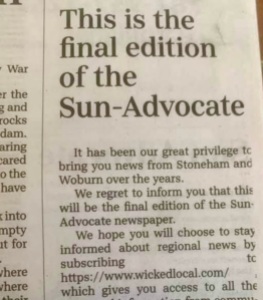
On and on it goes. I was a reporter at The Daily Times Chronicle of Woburn in the 1980s when the Woburn Advocate was launched by a local developer. It eventually fell into GateHouse Media’s and then Gannett’s hands. The Times Chronicle, still owned by the Haggerty family, continues to do good work. The Advocate, meanwhile, was merged with another GateHouse/Gannett paper, the Stoneham Sun, and now is no more.
To the extent that Gannett has any strategy with its most recent closings, the emphasis seems to be on getting out of places where there is competition. The Haggertys, in addition to running the Times Chronicle, also operate The Stoneham Independent.
I’ve heard there may be a couple of other Gannett weeklies in Eastern Massachusetts that have been shut down as well. Keep those tips coming. I’d also love to see any internal memos that lay out all of the closings. Send them along to dan dot kennedy at northeastern dot edu. As always, discretion is assured.
Gannett has gone on a spree of closing print weeklies. The latest: The Sandwich Broadsider and The Bourne Courier, both of which were founded to serve the Upper Cape in the 1970s. Katie M. Goers of the independent Sandwich Enterprise has the story.
In addition to Sandwich, the Enterprise papers serve Bourne, Falmouth and Mashpee, so I’m guessing that the impact of Gannett’s action on local coverage will be minimal.
I’m hearing that Gannett is walking away from other weeklies in Eastern Massachusetts as well. If you’ve got a tip or (be still my heart) an internal memo, please pass it along to me at dan dot kennedy at northeastern dot edu. Discretion assured.
Update, Aug. 8: The Courier, Bulletin which covered Mashpee and Falmouth, was also shut down by Gannett, I’m told.
The Connecticut Statehouse in Hartford. Photo (cc) 2009 by Dan Kennedy.
Chain ownership is almost never a good thing. But some chains are better than others — and Hearst is among the very best. No doubt its status as a privately owned company whose family is involved in management has a lot to do with that. The legendary mogul William Randolph Hearst would be proud.
Among other things, the Hearst-owned Times Union of Albany, New York, did some of the crucial early reporting about sexual assault allegations against Gov. Andrew Cuomo — accusations that have brought him to the brink of resignation or removal.
Hearst has been making some interesting moves in Connecticut for quite some time. Now, with the hedge fund Alden Global Capital tearing apart what’s left of the Hartford Courant, Hearst is positioning itself as a digital rival for statewide coverage. Rick Edmonds of Poynter reports that the company has launched a new website, CTInsider.com, that features coverage from its 160 journalists at eight dailies and 14 weeklies and websites in the state.
CTInsider.com offers a combination of free and paid content. Subscribers pay $3.99 a week after an initial discount.
The Hearst paper I’m most familiar with is the New Haven Register, a daily paper that figured heavily in my 2013 book about hyperlocal news projects, “The Wired City.” The project I was profiling, the New Haven Independent, a digital nonprofit founded in 2005, was providing deep coverage of the city, filling a gap left by the dramatic downsizing of the Register.
It was an interesting time for the Register. Under the ownership of the reviled Journal Register chain, the Register had lurched into bankruptcy. Journal Register then morphed into Digital First Media, headed by a visionary chief executive named John Paton who, about a dozen years ago, provided a jolt of optimism. Soon, though, Alden moved in, merging Digital First with its Denver-based chain, MediaNews Group, and, well, you know the rest. But then Hearst bought the New Haven Register a few years ago, and the paper has since undergone something of a revival.
The Hartford Courant had thrived for many decades as Connecticut’s sole statewide paper. But under Tribune Publishing’s chaotic ownership, it had been shrinking for many years. During the years that I was reporting “The Wired City,” a pair of vibrant websites devoted to covering state politics and policy had popped up — the for-profit CTNewsJunkie.com and the nonprofit Connecticut Mirror, both of which are still going strong.
Things went from bad to worse at the Courant earlier this year when Alden added Tribune to its holdings despite efforts by the staff to find a local buyer.
It’s great to see Hearst now upping its game in Connecticut as well.
Facebook cuts reseachers’ access to data, claiming privacy violations. It seems more likely, though, that the Zuckerborg was tired of being embarrassed by the stories that were developed from that data. Mathew Ingram of the Columbia Journalism Review explains.
Gannett has pulled the plug on the Melrose Free Press. The weekly published its final edition on Thursday, July 29, and employees were told it was all over on Thursday morning of this week, according to sources.
As best as I can tell, the Free Press had no dedicated staff members, and I haven’t heard of any layoffs. This was a move aimed at saving printing costs. Gannett’s Wicked Local website for Melrose will live on, though, as you’ll see, most of it consists of news from other communities, as is Gannett’s practice. For those who really want a print edition, the guessing is that they will receive the Observer Advocate, which currently serves the neighboring communities of Reading, Wakefield and Malden.
Melrose is served by a Patch site and by the Melrose Weekly News, a family-owned chain whose papers also cover Wakefield, North Reading and Lynnfield. Mike Carraggi, Patch’s regional editor for Massachusetts, New Hampshire, Rhode Island and Maine, tweeted that he’ll “continue making sure Melrose has as much independent reporting as possible via Patch.”
The Free Press’ paid circulation was 639 as of March, according to the Alliance for Audited Media — a paltry figure given that U.S. Census data show Melrose is a city of about 28,000, with 11,329 households. Carraggi also tweeted that the paper hadn’t had a full-time reporter in several years.
The Melrose Free Press was founded in 1901, according to the Melrose Historical Commission. Unlike its two competitors at the time, Melrose did not charge — hence its name. (At the time of its demise, the Free Press was a paid product.) The paper was sold to Fidelity’s Community Newspaper Co. in 1991, which put it in the hands of a corporate chain. Cutting continued through various iterations of the chain, culminating in ownership by GateHouse Media, which merged with Gannett in 2020.
“In recent years,” the historical commission said, “the paper has weathered the decimation of advertising revenue that accompanied the rise of the Internet, and an ever-shrinking staff.”
Like most of us, I’m confused and concerned about the latest news regarding COVID-19 and the Delta variant.
Everyone in my immediate circle, including me, is fully vaccinated, healthy and, if no longer young, then not elderly yet, either. So I’m confident that if any of us got sick, we’d experience nothing more than mild symptoms.
But what about others? We all encounter people on a daily basis who can’t be vaccinated because they’re too young or have compromised immune systems. If we don’t mask up once again, are we all going to turn into carriers who fuel yet another surge of a disease that has killed 613,000 of our fellow Americans?
In addition, there’s the resentment we can’t help but feel toward those who resisted masking and are now resisting vaccines. Josh Marshall, writing at Talking Points Memo, put it this way: “Masking is coming back largely because of the actions of the unvaccinated and also largely for the benefit of the unvaccinated [Marshall’s emphasis]. The burden of non-vaccination is being placed on those who are vaccinated. That basic disconnect is our problem.
“That disconnect places no effective pressure on the voluntarily unvaccinated while sowing demoralization and frustration and contempt with public authorities among those who’ve gotten the vaccine,” he continued. “No good comes of that combination.”
So where does that leave us? More than anything, I think the media need to do a better job of communicating risk. Even with Delta, which is far more contagious than the original iteration of COVID-19, the vaccines are highly effective. No one died in the now-infamous Provincetown outbreak, and life there is already returning to normal. As President Joe Biden said recently, what we’re dealing with now is a “pandemic of the unvaccinated.”
There are all kinds of data that show Delta isn’t a problem for people who are vaccinated. For instance, Zeynep Tufekci of the University of North Carolina tweeted on Sunday that just 6,587 have been hospitalized among the 163 million people who’ve been vaccinated. That’s an almost unmeasurable 0.004%.
There’s good news on the vaccination front, too, as the number of people getting the shots has been rising since mid-July. Presumably there are several reasons for that, such as fear of Delta as well as a sudden burst of semi-responsible behavior by leading Republican officials and right-wing media figures. More good news: Walmart and Disney announced over the weekend that they’re going to require their employees to be vaccinated.
The Centers for Disease Control and Prevention hasn’t covered itself with glory, arguably sending the country into a panic over the Provincetown outbreak before all the data were in. But as scientists who are responsible for public health, they’re going to try to provide guidance in real time, and sometimes they’re going to get it wrong. Which means that the media need to do better by not obsessing over infinitesimal numbers.
“Scary, sensational headlines about P-town have sparked confusion this week, but the problem is much bigger than a single outbreak in a single town,” said Brian Stelter, the host of CNN’s “Reliable Sources,” in his Sunday commentary. “The problem starts with the CDC and its absolute failure to communicate clearly and effectively. Sloppy news coverage then makes a bad situation worse.”
As Stelter noted, COVID hospitalizations are up nationally because of the Delta variant. But they’re up far more in states with low vaccination rates like Louisiana than in states with high rates like Vermont. If you and your family have been fully vaccinated, the pandemic is largely over.
My attitude about COVID since the beginning of the pandemic has been to take it seriously and follow the guidelines and mandates, but not to exceed them. I taught two of my classes in person and took public transportation throughout — masked, of course. I was thrilled when the mask mandate was dropped, and I’m not eager to go back to it.
But I will if those are the rules. I’ve gone grocery shopping a couple of times during the past week, and I’ve pulled out my mask and put it on. I didn’t think it was necessary, but most of the other shoppers were wearing them, so I didn’t want to seem cavalier.
This week we’re going on vacation, and on our way home we’re going to visit my 92-year-old father-in-law in upstate New York. He’s fully vaxxed, but that presents a dilemma, doesn’t it? The vaccines simply don’t work as well among the elderly. Maybe we’ll mask up. Maybe it will be nice enough that we can sit outside.
The past 17 months have been a nightmare for the country and the world. Just a few weeks ago, it seemed like it might be over. It wasn’t.
But that doesn’t change the fundamental facts. We are in a far better place than we were during the height of the pandemic. Vaccines work. With some adjustments, life can return to normal. And the media need to report this ongoing story with context and nuance rather than sending everyone into a panic with each twist and turn.
Then-Boston Mayor Marty Walsh. Photo (cc) 2014 by Joe Spurr.
Good to know that Secretary of Labor Marty Walsh regrets having dumped the Dennis White mess into Acting Mayor Kim Janey’s lap. But he still hasn’t explained why he refused to release former police officer and accused child molester Patrick Rose’s personnel records despite having been ordered to do so by the secretary of state’s office.
I made it very clear I wanted to resolve that situation before I left. And unfortunately, wasn’t able to. But, you know, Kim took action. I watched what she did. And now there’s a search for a commissioner. And that’s the right way to go.
Walsh left behind a disaster within the Boston Police Department. White was the police commissioner for a few days before claims of domestic abuse were surfaced, leading Walsh to suspend him. Janey ended up firing him. Rose, a former president of the Boston Police Patrolmen’s Association, has been charged with multiple counts of child sexual abuse, a spree that was enabled by an apparent failure to act on an internal investigation in the mid-’90s that found one of his alleged victims was most likely telling the truth.
Both White and Rose have denied any wrongdoing.
Walsh’s stonewalling in the Rose matter earned him a New England Muzzle Award from GBH News last month.
Happy August! We’re going on vacation this week, and blogging will be light. I’ll be semi-working the week of Aug. 9, and then it’s back to the salt mine the following week. Behave yourselves.
I love this profile of Keith Kelly, who recently retired as the New York Post’s media columnist. The Post is a toxic-waste pit, but Kelly enjoyed a well-earned reputation for accuracy. And pugnacity. The Kelly anecdotes in Shawn McCreesh’s New York Times profile are gold, but McCreesh’s own writing pulls you in as well. For instance:
Mr. Kelly came up in an age when a handful of glamorous editors in glittering towers told the country how to eat, think and dress. Today’s media landscape is an artless and unsexy place by comparison, a lowveld of SPACs and substacks. Newsletters badly in need of editing lard inboxes, while journalists spend their days flinging mud on Twitter.


.jpg)
