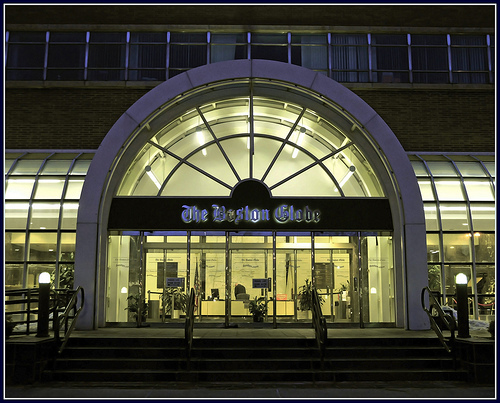
Guild treasurer addresses Totten charges

The following e-mail has been sent to the members of the Boston Newspaper Guild, the largest union at the Boston Globe. A copy was obtained by Media Nation earlier today.

September 25, 2009

Dear Colleague,

I understand that many questions have arisen from yesterday’s e-mail from the Executive Committee regarding alleged financial impropriety by BNG President Daniel Totten.

As treasurer, I have a fiduciary responsibility, which I take very seriously. I intend to fulfill that responsibility to the fullest extent.  I assure you that the Executive Committee is asserting due diligence on this matter. Once made aware of the situation, the appropriate steps were taken to ensure the safety of your union funds.

The second order of business was to notify you. It would have been preferable to notify you, and file the charges simultaneously. But time constraints did not allow that to happen. We took the position that notification was our next priority.

We are guided in this process by the constitution of the CWA [the Communications Workers of America], our parent union. The by-laws require that charges be filed within 60 days from the time an offense becomes known.  I intend to draft the charges and file them early next week with our Recording Secretary Kathy McCabe, as required by the by-laws. We are well within the 60 day time frame. After they are filed, members will be notified of the details of the charges.

I know that there may be more questions as this process moves forward. We are working with the guidance of legal counsel from both the CWA and the BNG. We will keep you updated as more information becomes available.

In closing, I ask for your patience.

In Unity,

Patrice Sneyd,
Treasurer BNG

What we still don’t know about Dan Totten

The Globe and the Herald today report that Boston Newspaper Guild president Dan Totten is suspected of signing someone else’s name as a countersignature on his paycheck. So here are a few follow-up questions:

  • Is this something he did regularly?
  • Did other union officials know it?
  • Have other union officials done the same?
  • Was this money to which he wasn’t entitled? (Surely he was entitled to his paycheck.)

To be sure, Totten, whose union is the Globe’s largest, shouldn’t have signed someone else’s name on a check, and it kind of sounds like he’s admitted that, according to the reports. But we still don’t know whether we’re talking about ill intent or just a seat-of-the-pants management style.

Harvey Silverglate goes after the feds

Harvey Silverglate at the Harvard Book Store. (Click on photo for a larger image.)

Friend of Media Nation Harvey Silverglate packed the house at the Harvard Book Store in Cambridge last night at an event for his new book, “Three Felonies a Day: How the Feds Target the Innocent.”

The book is about what Silverglate describes as an increasing tendency by prosecutors to abuse their discretion by charging people with crimes they didn’t even know they’d committed. A noted civil-liberties lawyer, Silverglate described most of his clients as people “who committed the act but committed no crime.”

Since the mid-1980s, Silverglate said, the criminal-justice system has abandoned the ancient principle that there can’t be a crime without criminal intent. Referring to cases in which law enforcement has withheld important information, he said, “There’s something wrong with a system that knows there’s evidence of innocence and hides it.”

And he described prosecutors as “kidnappers and extortionists” for threatening targets with lengthy prison sentences and then demanding that they testify against others as the price of having those sentences reduced. Such testimony is notoriously unreliable, he said, quoting Harvard Law School professor Alan Dershowitz (who wrote the preface) as saying that such witnesses are taught not just to “sing,” but also to “compose.”

Harvey and I go back many years at the Boston Phoenix, where I had the privilege of editing his column, and where we later collaborated on several articles. Harvey also was the inspiration behind the Phoenix’s annual Muzzle Awards, which I’ve been cranking out, with his help, for 12 years.

Last night the Phoenix newspapers’ executive editor, Peter Kadzis, and the Boston Phoenix’s editor, Lance Gould, were both on hand, as was Harvey’s wife, the photographer Elsa Dorfman, whose work has appeared in the Phoenix. “Three Felonies” was edited by Catherine Tumber, a former Phoenix editor who’s now working on a book about the significance of small cities.

Kadzis interviews Silverglate about “Three Felonies” in this week’s Phoenix. Kadzis writes:

At this curious moment in history, Silverglate’s book might not shock either the left or the right. For some time now, the two opposing wings of the American centrist polity have been alarmed by the predatory nature of our national government. For those in the middle of the political spectrum, however, Silverglate’s book should be a bracing wake-up call. Liberty and freedom are being compromised, one prosecution at a time.

Indeed, it’s Silverglate’s advocacy for such notorious bad guys as the financier Michael Milken and the accounting firm Arthur Andersen that takes “Three Felonies” out of the realm of political polemics and transforms it into an important book.

Meltdown at the Boston Newspaper Guild? (II)

More on the charges against Boston Newspaper Guild president Dan Totten, whose union is the Boston Globe’s largest, from the Boston Herald and the Globe.

I would be very cautious about drawing any conclusions based on the sketchy information that’s come out so far. This could be serious. Or it could be factional warfare.

Much more to come, I’m sure.

Meltdown at the Boston Newspaper Guild?

I will confess that I have been following contretemps within the Boston Newspaper Guild from afar, at best. But from the looks of an e-mail sent to Guild members this afternoon and obtained by the Phoenix’s Adam Reilly, it appears that a total meltdown is under way.

Dan Totten, the controversial president who led the union in talks with the Boston Globe’s corporate owner, the New York Times Co., during the spring and summer, has had his financial authority suspended, and an audit is being conducted, according to the e-mail from the Guild’s executive board.

This comes on top of a recall effort led by some Globe staffers who have accused Totten of inadequate communication — which another way of saying that the $10 million in concessions approved during the summer cut health benefits by considerably more than union members say they’d been led to believe.

Journalism ethics in real time

Melissa Bailey
Melissa Bailey

Melissa Bailey, the managing editor of the New Haven Independent, has written a fascinating story for Slate’s Double X on the steps she took to protect the identities of the fiancée and the ex-girlfriend of Raymond Clark, who’s been charged with the murder of Yale University student Annie Le. Bailey writes:

We learned the girlfriend’s identity, as well as the names of Clark and his current fiancee, before their identities were public. This was in the days after Le had disappeared but before her body was found, when slews of national reporters had descended on our city to find clues to the killing. As we chased the story, I wanted to break news — that’s my job. But I also wanted to shield the women caught up in the case from an onslaught of judgment and national attention that would make things harder for them.

Bailey writes about the decision to use material from the women’s Facebook and MySpace pages even while withholding their names. The Independent also withheld Clark’s name until he had been formally charged, even after New Haven police put it in a press release and repeated it at a news conference.

Her essay is an interesting, close-up look at applied journalism ethics. I’m not sure whether I’d have made the same calls as the Independent. But I’m impressed at how much thought went into Bailey’s and editor Paul Bass’ decision-making.

A missed opportunity

I don’t want to make it look like I’m in the tank for fellow Northeastern professor Michael Dukakis. So I’ll leave it at this: Paul Kirk will probably do a fine job as interim senator. But Gov. Deval Patrick could have made a better pick by choosing former governor Dukakis.

Joan Vennochi and Margery Eagan have more to say. And the Herald’s Jessica Van Sack and Hillary Chabot note some conflicts Kirk will need to avoid.

Dropping the paper in order to save it

Maybe I’m part of the solution after all.

Media Nation has learned that the Sunday-versus-weekday revenue split at the Boston Globe may be more dramatic than I had previously heard. In 2008, the Monday-through-Friday editions brought in $113 million. The Saturday and Sunday papers’ take was $259 million — just a shade under 70 percent of the total.

I don’t have separate numbers for the Sunday paper alone. But, traditionally, Saturday papers are the smallest and least lucrative of the week, which means that the Sunday Globe accounts for the overwhelming majority of those weekend revenues. Several days ago, I wrote that the Sunday Globe was thought to account for 60 percent of revenues; it now appears that figure might have been low.

Given that, it makes sense for the Globe to push electronic distribution for its weekday papers as long as it’s done with an eye toward preserving the Sunday print edition. If the Globe could save on printing and distribution costs and entice weekday advertisers into the Sunday edition, its revenues might drop, but its profit margin could rise. (Or, since this is a newspaper we’re talking about, rematerialize.)

Also this morning, a couple of tidbits on the New York Times Co.’s efforts to sell the Globe:

• A bid by former Globe executive Stephen Taylor, a member of the family who sold the paper to the Times Co. in 1993, may be facing some obstacles. Word is that the group is still trying to line up investors. Not that those investors won’t be found, but it doesn’t sound like Taylor is ready to write a check just yet.

I also hear that the San Diego-based Platinum Equity group may be losing its ardor for the deal — which puts Taylor in a strong position if he can come up with the money. People are buzzing about the addition of former Globe publisher Ben Taylor (a cousin of Stephen’s) and longtime Boston journalist Mary McGrath to the Taylor group. But they’ve got to find the dough.

Given that the Taylors sold the Globe for $1.1 billion, and that they are now trying to buy it back (along with the Worcester Telegram & Gazette) for a mere fraction of that, you’d think money wouldn’t be a problem.

But the $1.1 billion was split among many, many members of the Taylor family. And investors these days aren’t exactly clamoring to get into the newspaper business.

• On the other hand, Poynter Institute media-business analyst Rick Edmonds writes that recent statements from the Times Co. suggesting it might hold onto the Globe are, in all likelihood, so much malarkey (via Ralph Ranalli at BeatthePress.org).

The reason: the Times Co. needs to take a loss by the end of 2009 in order to offset capital gains it’s realized by selling off other properties. In addition, Edmonds says:

I don’t think taxes alone would impel a sale. The Times Co. may also fear getting stuck with another round of operating losses (or find itself forced to lay off more employees, with renewed labor upheaval). Also, the company may have worn out its welcome both inside the paper and with Bostonians, who would welcome a Taylor family restoration.

As Ranalli notes, Edmonds is the guy who cracked the code earlier this year in explaining the Times Co.’s claim that the Globe was on track to lose $85 million. According to Edmonds’ analysis, though that number was real, the paper’s actual cash operating loss for 2009 would probably be around $20 million. All of a sudden, the Times Co.’s demand for $20 million in union concessions made sense.

When Times Co. chairman Arthur Sulzberger Jr. told Globe employees in August that the paper’s finances had improved and the company was in no hurry to sell, it struck me mainly as a ploy to drive up the price. Edmonds’ latest fits right in with that.

Photo (cc) by Tony the Misfit and republished here under a Creative Commons license. Some rights reserved.

Thinking about the post-newspaper era

Paul Starr
Paul Starr

Princeton University scholar Paul Starr, author of “The Creation of the Media” (2004) as well as a provocative essay in The New Republic earlier this year titled “Goodbye to the Age of Newspapers (Hello to a New Era of Corruption),” will speak at Suffolk Law School next Thursday, Oct. 1.

Delivering responses to Starr’s remarks will be Boston Globe editor Marty Baron and me.

Sponsored by the Rappaport Center for Law and Public Service and the Ford Hall Forum, the event will take place from 6:30 to 8 p.m. in Suffolk University’s Moot Court Room, at 120 Tremont St.

Admission is free, but you do need to sign up in advance. You can simply e-mail an RSVP to Senka Huskic at shuskic {at} suffolk {dot} edu. (Change {at} and {dot} to create a normal-looking e-mail address.)

Hope to see you there.